


Eric R. Larson
@ericrlarson.bsky.social
Associate professor in freshwater ecology, University of Illinois at Urbana-Champaign. Crayfish, invasive species, environmental DNA, and more. https://publish.illinois.edu/erlarson/
This is another of our studies that I really value for getting us out to the same streams throughout the year, with a snapshot here of a few of our fall and winter sampling events.

January 12, 2026 at 4:54 PM
This is another of our studies that I really value for getting us out to the same streams throughout the year, with a snapshot here of a few of our fall and winter sampling events.
Do precipitation events have opposing effects on aquatic versus terrestrial environmental DNA (eDNA) recovered from streams and rivers? New from the lab at Ecological Applications: doi.org/10.1002/eap....

January 12, 2026 at 4:48 PM
Do precipitation events have opposing effects on aquatic versus terrestrial environmental DNA (eDNA) recovered from streams and rivers? New from the lab at Ecological Applications: doi.org/10.1002/eap....
Semi-related: this signal crayfish from G.C. Miller's 1960s thesis (The Taxonomy and Certain Biological Aspects of the Crayfish of Oregon and Washington), covered in barnacles out of the Columbia River estuary at Astoria.

December 21, 2025 at 8:27 PM
Semi-related: this signal crayfish from G.C. Miller's 1960s thesis (The Taxonomy and Certain Biological Aspects of the Crayfish of Oregon and Washington), covered in barnacles out of the Columbia River estuary at Astoria.
The Sangamon River of Illinois through the seasons. We visited this site every few weeks in 2025 to track changing stream communities with environmental DNA.


December 6, 2025 at 2:51 PM
The Sangamon River of Illinois through the seasons. We visited this site every few weeks in 2025 to track changing stream communities with environmental DNA.
New OA study led by Dr. Caitlin Bloomer of U. Illinois: can you predict good habitat for burrowing crayfish even if your model is trained on data from different burrowing crayfish species (doi.org/10.1111/fwb....)? Highly relevant to these hard-to-detect and identify animals.


December 4, 2025 at 5:02 PM
New OA study led by Dr. Caitlin Bloomer of U. Illinois: can you predict good habitat for burrowing crayfish even if your model is trained on data from different burrowing crayfish species (doi.org/10.1111/fwb....)? Highly relevant to these hard-to-detect and identify animals.
I know this result is a bit obvious, but I think it merits evidencing: if you remove all vegetation from miles of natural streams, there are costs to wildlife and to people who enjoy and benefit from that wildlife. If you hunt or fish or bird watch or hike, we live in a diminshed landscape.

December 3, 2025 at 4:56 PM
I know this result is a bit obvious, but I think it merits evidencing: if you remove all vegetation from miles of natural streams, there are costs to wildlife and to people who enjoy and benefit from that wildlife. If you hunt or fish or bird watch or hike, we live in a diminshed landscape.
Riparian buffers help more than just streams and rivers in agricultural landscapes. Lab Masters student Olivia Reves used environmental DNA (eDNA) to quantify the benefit of riparian buffers to terrestrial wildlife in downstate Illinois; open access at doi.org/10.1111/1365...

December 3, 2025 at 3:06 PM
Riparian buffers help more than just streams and rivers in agricultural landscapes. Lab Masters student Olivia Reves used environmental DNA (eDNA) to quantify the benefit of riparian buffers to terrestrial wildlife in downstate Illinois; open access at doi.org/10.1111/1365...
New invasion note from southern Idaho, where we've rediscovered the non-native red swamp crayfish after a half century without detection (doi.org/10.3391/bir....). Intensive burrowing by red swamp crayfish could be a risk to canals and other irrigation infrastructure.

November 10, 2025 at 5:04 PM
New invasion note from southern Idaho, where we've rediscovered the non-native red swamp crayfish after a half century without detection (doi.org/10.3391/bir....). Intensive burrowing by red swamp crayfish could be a risk to canals and other irrigation infrastructure.
New faculty position in the University of Illinois Department of Natural Resources and Environmental Sciences for an assistant or associate professor of agroecology: illinois.csod.com/ux/ats/caree.... Position closes October 31st. Happy to answer questions about the dept / university / town.

September 24, 2025 at 9:29 PM
New faculty position in the University of Illinois Department of Natural Resources and Environmental Sciences for an assistant or associate professor of agroecology: illinois.csod.com/ux/ats/caree.... Position closes October 31st. Happy to answer questions about the dept / university / town.
Completed my annual trip to northern Wisconsin, continuing population monitoring of invasive rusty crayfish (Faxonius rusticus) that extends back to the 1970s. Populations remain down, at only ~25% of past peak abundances, with surprising catches of large native snails in our traps.


September 6, 2025 at 3:00 PM
Completed my annual trip to northern Wisconsin, continuing population monitoring of invasive rusty crayfish (Faxonius rusticus) that extends back to the 1970s. Populations remain down, at only ~25% of past peak abundances, with surprising catches of large native snails in our traps.
This pool was packed with non-native virile crayfish; we recovered >120 in only four traps. It will likely dry out by the end of summer, but virile crayfish have dispersed through this intermittent reach. We found them abundant in the permanent stream higher up the watershed (photos 2 & 3).


August 20, 2025 at 9:24 PM
This pool was packed with non-native virile crayfish; we recovered >120 in only four traps. It will likely dry out by the end of summer, but virile crayfish have dispersed through this intermittent reach. We found them abundant in the permanent stream higher up the watershed (photos 2 & 3).
So ... any crayfish in this small and declining habitat?

August 19, 2025 at 3:48 PM
So ... any crayfish in this small and declining habitat?
Our search for invasive crayfish barriers includes more than just dams or irrigation diversions. Because the virile crayfish is intolerant of stream drying (doi.org/10.1086/725318), intermittent reaches could present barriers to upstream spread to permanent streams in the mountains.

August 19, 2025 at 3:46 PM
Our search for invasive crayfish barriers includes more than just dams or irrigation diversions. Because the virile crayfish is intolerant of stream drying (doi.org/10.1086/725318), intermittent reaches could present barriers to upstream spread to permanent streams in the mountains.


Here an abundance of crayfish claws and carapaces have been cleaned out of center pivot irrigation filters that had clogged. In our study region, many farmers and ranchers identify this as a problem, but I don't think anyone has quantified these type of impacts of invasive crayfish to agriculture.

August 8, 2025 at 9:38 PM
Here an abundance of crayfish claws and carapaces have been cleaned out of center pivot irrigation filters that had clogged. In our study region, many farmers and ranchers identify this as a problem, but I don't think anyone has quantified these type of impacts of invasive crayfish to agriculture.
The non-native virile crayfish (Faxonius virilis) in particular has boomed in regions of the western US without any native crayfishes like the Colorado River (nas.er.usgs.gov/queries/Fact...). Given its abundance in irrigated lands, I wonder if we're missing damages and costs as an ag pest?

August 8, 2025 at 5:32 PM
The non-native virile crayfish (Faxonius virilis) in particular has boomed in regions of the western US without any native crayfishes like the Colorado River (nas.er.usgs.gov/queries/Fact...). Given its abundance in irrigated lands, I wonder if we're missing damages and costs as an ag pest?
I routinely get calls from water management districts in southern Idaho concerned about damage to canals from burrowing by this same non-native crayfish. In estimates of economic costs of invasive crayfish (doi.org/10.1016/j.sc...), I think we're missing effects on agriculture in the western US.

August 8, 2025 at 5:23 PM
I routinely get calls from water management districts in southern Idaho concerned about damage to canals from burrowing by this same non-native crayfish. In estimates of economic costs of invasive crayfish (doi.org/10.1016/j.sc...), I think we're missing effects on agriculture in the western US.
This was another barrier where non-native crayfish passage was obvious before we started sampling. Here a small gate in one of the water control structures was clogged with carcasses from the upstream pool. I think this barrier is open to flow at times of the year when crayfish are moving around.


August 7, 2025 at 6:11 PM
This was another barrier where non-native crayfish passage was obvious before we started sampling. Here a small gate in one of the water control structures was clogged with carcasses from the upstream pool. I think this barrier is open to flow at times of the year when crayfish are moving around.
This irrigation diversion looked promising as an invasive crayfish barrier. The diversion gates didn't appear to be climbable. Water is diverted into a buried pipe with screens to prevent fish entrainment. Concrete retaining walls extend into the riparian zone. Can crayfish get over or around this?

August 6, 2025 at 2:08 PM
This irrigation diversion looked promising as an invasive crayfish barrier. The diversion gates didn't appear to be climbable. Water is diverted into a buried pipe with screens to prevent fish entrainment. Concrete retaining walls extend into the riparian zone. Can crayfish get over or around this?
A relief to add a new pilose crayfish site this week. This native species disappeared from the mainstem, low elevation Bear River in Wyoming between 1987 & 2007, replaced by the non-native virile crayfish (peerj.com/articles/5668/). Remnant populations are confined to higher elevation tributaries.

August 1, 2025 at 8:55 PM
A relief to add a new pilose crayfish site this week. This native species disappeared from the mainstem, low elevation Bear River in Wyoming between 1987 & 2007, replaced by the non-native virile crayfish (peerj.com/articles/5668/). Remnant populations are confined to higher elevation tributaries.
Freshwater invaders pose unique challenges to species distribution (or ecological niche) models used in risk analysis. New in Freshwater Science (doi.org/10.1086/737200), I identify strategies to improve predictions of suitable habitat for emerging, data-poor freshwater invaders using these tools.

July 31, 2025 at 7:44 PM
Freshwater invaders pose unique challenges to species distribution (or ecological niche) models used in risk analysis. New in Freshwater Science (doi.org/10.1086/737200), I identify strategies to improve predictions of suitable habitat for emerging, data-poor freshwater invaders using these tools.
One challenge in our work is that although considerable effort has been directed at fish passage and barriers in the study watershed, crayfish and fish differ in what barriers they can and can't pass (e.g., doi.org/10.1016/j.bi...).

July 31, 2025 at 4:36 PM
One challenge in our work is that although considerable effort has been directed at fish passage and barriers in the study watershed, crayfish and fish differ in what barriers they can and can't pass (e.g., doi.org/10.1016/j.bi...).
It didn't take much investigation here to conclude this wasn't a barrier to crayfish. We start from a variety of databases in our study watershed (e.g., doi.org/10.1002/rra....) to identify prospective barriers, but need to get in the stream to check out the structure and look for crayfish above it.

July 31, 2025 at 4:13 PM
It didn't take much investigation here to conclude this wasn't a barrier to crayfish. We start from a variety of databases in our study watershed (e.g., doi.org/10.1002/rra....) to identify prospective barriers, but need to get in the stream to check out the structure and look for crayfish above it.
Here's another potential invasive crayfish barrier: a concrete structure extending across a river channel associated with a municipal water supply diversion. Can crayfish get over/around this, or not?

July 30, 2025 at 3:00 PM
Here's another potential invasive crayfish barrier: a concrete structure extending across a river channel associated with a municipal water supply diversion. Can crayfish get over/around this, or not?
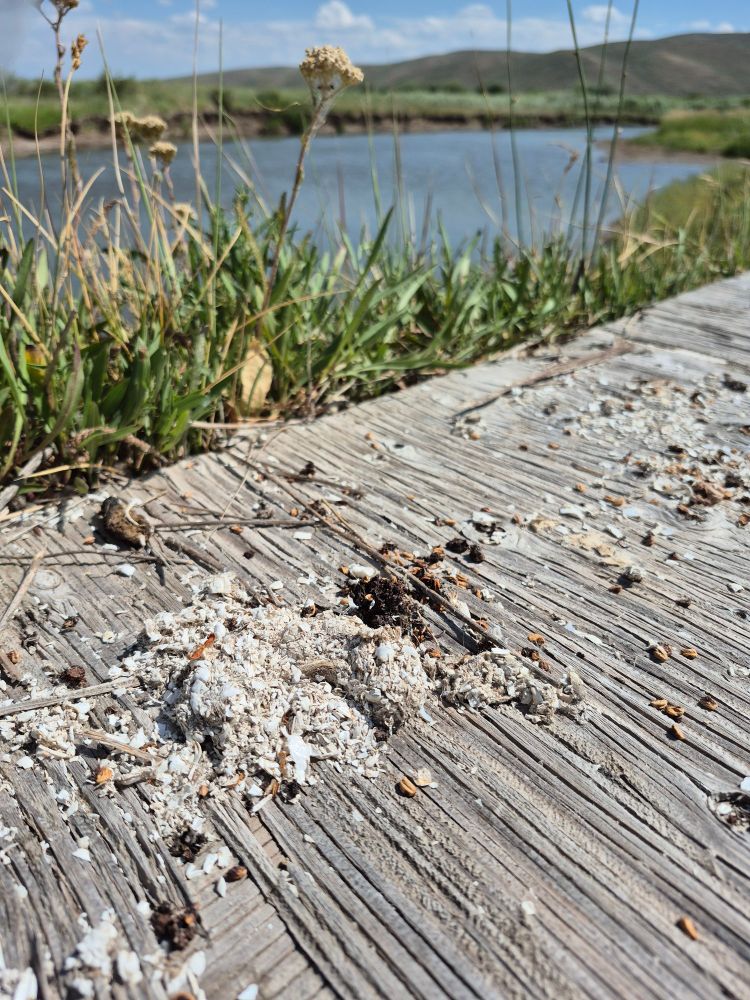
More hints that one of our study sites is a good place to catch crayfish
July 29, 2025 at 7:33 PM
More hints that one of our study sites is a good place to catch crayfish