


Esen K. Tütüncü
@esenktutuncu.bsky.social
XR & Neuroscience Researcher | Transdisciplinary Artist | PhD Candidate in UB | Previously at Google
Aspiring Schachtürke
www.esenka.co
Aspiring Schachtürke
www.esenka.co
She was the first true coder in our family, I'm just following her steps 🫀
December 8, 2024 at 10:14 AM
She was the first true coder in our family, I'm just following her steps 🫀
It’s wild to think how common this practice was in Turkey. My grandma, from Isparta (famous for its roses), wove a rug in shades of pink inspired by the rose fields. It still hangs in our home in Istanbul—a piece of her story, told through knots and threads.
December 8, 2024 at 10:14 AM
It’s wild to think how common this practice was in Turkey. My grandma, from Isparta (famous for its roses), wove a rug in shades of pink inspired by the rose fields. It still hangs in our home in Istanbul—a piece of her story, told through knots and threads.
Think of the loom itself as the hardware. The vertical threads (warp) and horizontal threads (weft) are like binary code—structured, layered, and precise.

December 8, 2024 at 10:14 AM
Think of the loom itself as the hardware. The vertical threads (warp) and horizontal threads (weft) are like binary code—structured, layered, and precise.
And, just like with programming, there's room for creativity. Some weavers would improvise, introducing "bugs" (unexpected deviations) or "easter eggs".
December 8, 2024 at 10:14 AM
And, just like with programming, there's room for creativity. Some weavers would improvise, introducing "bugs" (unexpected deviations) or "easter eggs".
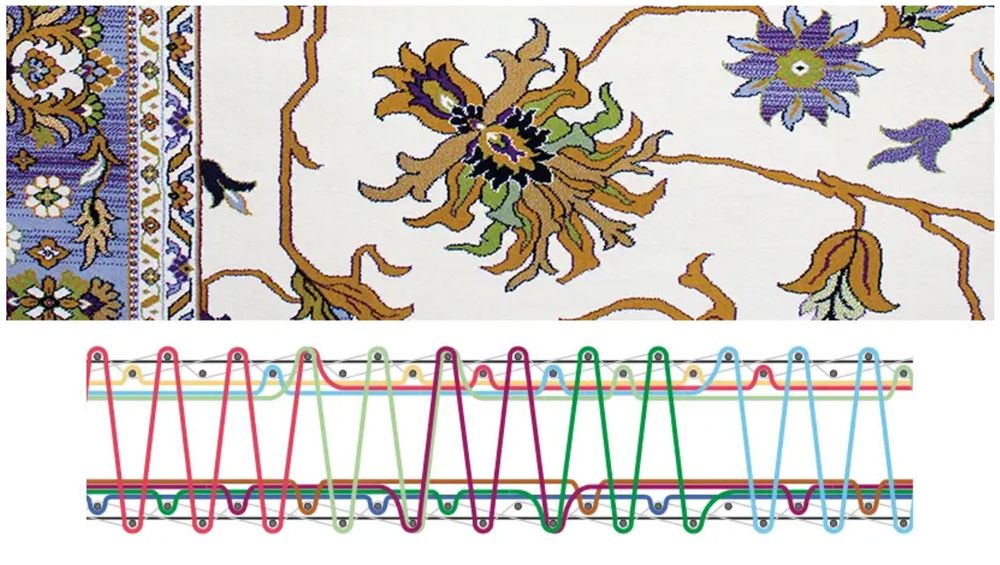
Like early computers, carpets have "input" (the weaver’s knowledge and tools), "process" (the act of weaving according to the pattern), and "output" (a completed design with embedded meaning).
December 8, 2024 at 10:14 AM
Like early computers, carpets have "input" (the weaver’s knowledge and tools), "process" (the act of weaving according to the pattern), and "output" (a completed design with embedded meaning).
For example, this carpet became the biggest meme in Turkey this year, a 20th-century rug written, “God bless this deer.”

December 8, 2024 at 10:14 AM
For example, this carpet became the biggest meme in Turkey this year, a 20th-century rug written, “God bless this deer.”
These patterns aren’t just decorative—they're a set of rules, almost like an algorithm. Each knot, color choice, and motif represents something. A story, a piece of local history, or even a protective charm. It’s information encoded in wool, silk, and dye.
December 8, 2024 at 10:14 AM
These patterns aren’t just decorative—they're a set of rules, almost like an algorithm. Each knot, color choice, and motif represents something. A story, a piece of local history, or even a protective charm. It’s information encoded in wool, silk, and dye.
Tried to find the book which first gave me this idea (if anyone knows please enlighten me) but we know that raditional carpets, especially from regions like Persia, Central Asia, and the Caucasus, often follow strict patterns.

December 8, 2024 at 10:14 AM
Tried to find the book which first gave me this idea (if anyone knows please enlighten me) but we know that raditional carpets, especially from regions like Persia, Central Asia, and the Caucasus, often follow strict patterns.