



Federico D’Agostino
@fededagos.bsky.social
PhD student @ Uni Tübingen | @bethgelab.bsky.social | Computational Neuroscience & ML
📈 The Result: SceneWalk-X (also re-implemented in #JAX ⚡)
These 3 mechanisms double SceneWalk’s explained variance on the MIT1003 dataset (from 35 % → 70 %)! We closed over 56 % of the gap to deep networks, setting a new State-of-the-Art for mechanistic scanpath prediction.
These 3 mechanisms double SceneWalk’s explained variance on the MIT1003 dataset (from 35 % → 70 %)! We closed over 56 % of the gap to deep networks, setting a new State-of-the-Art for mechanistic scanpath prediction.

November 30, 2025 at 9:24 PM
📈 The Result: SceneWalk-X (also re-implemented in #JAX ⚡)
These 3 mechanisms double SceneWalk’s explained variance on the MIT1003 dataset (from 35 % → 70 %)! We closed over 56 % of the gap to deep networks, setting a new State-of-the-Art for mechanistic scanpath prediction.
These 3 mechanisms double SceneWalk’s explained variance on the MIT1003 dataset (from 35 % → 70 %)! We closed over 56 % of the gap to deep networks, setting a new State-of-the-Art for mechanistic scanpath prediction.
↔️ 3. Cardinal + Leftward Bias
People tend to move their eyes more horizontally, and display a subtle initial bias for leftward movements. Adding this adaptive attentional prior further stabilized the model.
People tend to move their eyes more horizontally, and display a subtle initial bias for leftward movements. Adding this adaptive attentional prior further stabilized the model.

November 30, 2025 at 9:24 PM
↔️ 3. Cardinal + Leftward Bias
People tend to move their eyes more horizontally, and display a subtle initial bias for leftward movements. Adding this adaptive attentional prior further stabilized the model.
People tend to move their eyes more horizontally, and display a subtle initial bias for leftward movements. Adding this adaptive attentional prior further stabilized the model.
➡️ 2. Saccadic Momentum
The eyes often tend to continue moving in the same direction, especially after long saccades. We captured this bias by adding a dynamic directional map that adapts based on the previous eye movement.
The eyes often tend to continue moving in the same direction, especially after long saccades. We captured this bias by adding a dynamic directional map that adapts based on the previous eye movement.

November 30, 2025 at 9:24 PM
➡️ 2. Saccadic Momentum
The eyes often tend to continue moving in the same direction, especially after long saccades. We captured this bias by adding a dynamic directional map that adapts based on the previous eye movement.
The eyes often tend to continue moving in the same direction, especially after long saccades. We captured this bias by adding a dynamic directional map that adapts based on the previous eye movement.
🔥 1. Time-Dependent Temperature Scaling
Early fixations are more focused (exploitative), later ones become more exploratory. We modeled this with a decaying “temperature” that controls the determinism of fixation choices over time.
Early fixations are more focused (exploitative), later ones become more exploratory. We modeled this with a decaying “temperature” that controls the determinism of fixation choices over time.

November 30, 2025 at 9:24 PM
🔥 1. Time-Dependent Temperature Scaling
Early fixations are more focused (exploitative), later ones become more exploratory. We modeled this with a decaying “temperature” that controls the determinism of fixation choices over time.
Early fixations are more focused (exploitative), later ones become more exploratory. We modeled this with a decaying “temperature” that controls the determinism of fixation choices over time.
💡 Our idea: Use the deep model not just to chase performance, but as a tool for scientific discovery.
We isolate "controversial fixations" where DeepGaze's likelihood vastly exceeds SceneWalk's.
These reveal where the mechanistic model fails to capture predictable patterns.
We isolate "controversial fixations" where DeepGaze's likelihood vastly exceeds SceneWalk's.
These reveal where the mechanistic model fails to capture predictable patterns.

November 30, 2025 at 9:24 PM
💡 Our idea: Use the deep model not just to chase performance, but as a tool for scientific discovery.
We isolate "controversial fixations" where DeepGaze's likelihood vastly exceeds SceneWalk's.
These reveal where the mechanistic model fails to capture predictable patterns.
We isolate "controversial fixations" where DeepGaze's likelihood vastly exceeds SceneWalk's.
These reveal where the mechanistic model fails to capture predictable patterns.
🚨 New paper at #NeurIPS2025!
A systematic fixation-level comparison of a performance-optimized DNN scanpath model and a mechanistic cognitive model reveals behaviourally relevant mechanisms that can be added to the mechanistic model to substantially improve performance.
🧵👇
A systematic fixation-level comparison of a performance-optimized DNN scanpath model and a mechanistic cognitive model reveals behaviourally relevant mechanisms that can be added to the mechanistic model to substantially improve performance.
🧵👇

November 30, 2025 at 9:24 PM
🚨 New paper at #NeurIPS2025!
A systematic fixation-level comparison of a performance-optimized DNN scanpath model and a mechanistic cognitive model reveals behaviourally relevant mechanisms that can be added to the mechanistic model to substantially improve performance.
🧵👇
A systematic fixation-level comparison of a performance-optimized DNN scanpath model and a mechanistic cognitive model reveals behaviourally relevant mechanisms that can be added to the mechanistic model to substantially improve performance.
🧵👇
The currently supported models follow a Core + Readout architecture:
🔸 Core: Extracts shared retinal features across data recording sessions
🔸 Readout: Maps shared features to individual neuron responses
🔹 Includes pre-trained models & easy dataset loading (6/9)
🔸 Core: Extracts shared retinal features across data recording sessions
🔸 Readout: Maps shared features to individual neuron responses
🔹 Includes pre-trained models & easy dataset loading (6/9)

March 14, 2025 at 9:41 AM
The currently supported models follow a Core + Readout architecture:
🔸 Core: Extracts shared retinal features across data recording sessions
🔸 Readout: Maps shared features to individual neuron responses
🔹 Includes pre-trained models & easy dataset loading (6/9)
🔸 Core: Extracts shared retinal features across data recording sessions
🔸 Readout: Maps shared features to individual neuron responses
🔹 Includes pre-trained models & easy dataset loading (6/9)
Understanding the retina is crucial for decoding how visual information is processed. However, decades of data and models remain scattered across labs and approaches. We introduce openretina to unify retinal system identification. (2/9)

March 14, 2025 at 9:41 AM
Understanding the retina is crucial for decoding how visual information is processed. However, decades of data and models remain scattered across labs and approaches. We introduce openretina to unify retinal system identification. (2/9)
🚨 New paper alert! 🚨
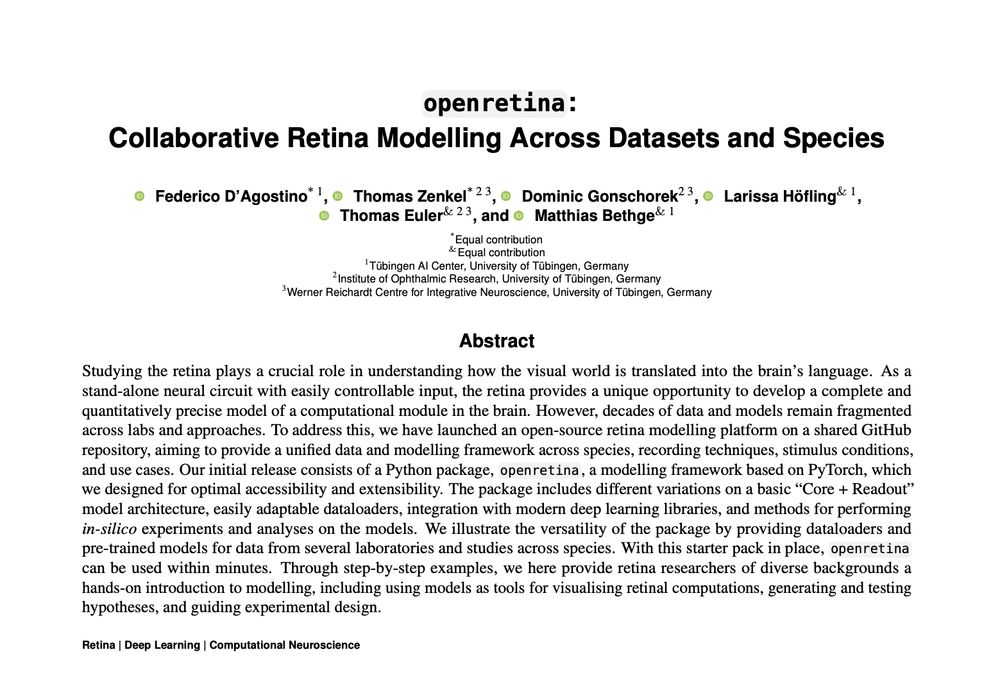
We’ve just launched openretina, an open-source framework for collaborative retina modeling across datasets and species.
A 🧵👇 (1/9)
We’ve just launched openretina, an open-source framework for collaborative retina modeling across datasets and species.
A 🧵👇 (1/9)
March 14, 2025 at 9:41 AM
🚨 New paper alert! 🚨
We’ve just launched openretina, an open-source framework for collaborative retina modeling across datasets and species.
A 🧵👇 (1/9)
We’ve just launched openretina, an open-source framework for collaborative retina modeling across datasets and species.
A 🧵👇 (1/9)