




Florian Ruepp
@fruepp.bsky.social
Doctoral Student in Chemistry | Living for the mountains, cats & sunny days ⛰️🐈☀️
Reposted by Florian Ruepp

#RobSelects preprint of the week #ChemRxiv: Three-step one-pot protocol for cycloaddition-cycloreversion metathesis of ketenes and nitroso benzene to form ketones and phenyl isocyanate. #catalysis https://doi.org/10.26434/chemrxiv-2025-b0fgk

C=C/N=O Metathesis Enables Oxidative Decarboxylation
Metathesis reactions proceeding through a (2+2) cycloaddition – (2+2) cycloreversion sequence are of great importance in synthetic chemistry. However, to date, this type of reactivity has only been demonstrated for a limited set of compatible sub-strate classes. We present herein the design and development of a novel reaction of this class, an iron (II)-catalyzed C=C/N=O metathesis, and its application to the mild oxidative decarboxylation of carboxylic acids. The reaction proceeds under air in a one-pot fashion, utilizing readily available, inexpensive reagents, and features an earth-abundant, environmentally benign iron catalyst. The reaction exhibits broad functional group tolerance, is efficiently scalable, and its late-stage applicability was showcased through the streamlined oxidative decarboxylation of 12 drug molecules. Divergent and convergent reactivity was demonstrated relying on the complementary C=C/O=N metathesis counterpart providing access to imines instead of ketones, and the method was extended to the synthesis of esters from α-aryloxy and α-alkoxy carboxylic acids. Results of preliminary mechanistic experiments, reaction profile analysis with ReactIR, and computational studies are presented to provide further insight into the transformation.
chemrxiv.org
December 14, 2025 at 8:06 AM
#RobSelects preprint of the week #ChemRxiv: Three-step one-pot protocol for cycloaddition-cycloreversion metathesis of ketenes and nitroso benzene to form ketones and phenyl isocyanate. #catalysis https://doi.org/10.26434/chemrxiv-2025-b0fgk
Reposted by Florian Ruepp
Now in its final version @jacs.acspublications.org ! pubs.acs.org/doi/10.1021/...
Congrats to @fruepp.bsky.social, Vasily Grebennikov, Mykola Avramenko, Marc-Olivier Ebert "Kinetic, Spectroscopic, and Computational Investigation of Oxidative Aminative Alkene Cleavage Reveals an N-Iodonium-Iminoiodinane Pathway" now @chemrxiv.org - chemrxiv.org/engage/chemr...

November 3, 2025 at 5:39 PM
Now in its final version @jacs.acspublications.org ! pubs.acs.org/doi/10.1021/...
Reposted by Florian Ruepp
#RobSelects preprint of the week #ChemRxiv: Comprehensive mechanistic study of the oxidative aminative cleavage of alkenes with a hypervalent iodine oxidant and ammonium carbamate. #OrgChem https://doi.org/10.26434/chemrxiv-2025-6cdgb

Kinetic, Spectroscopic, and Computational Investigation of Oxidative Aminative Alkene Cleavage Reveals an N-Iodonium-Iminoiodinane Pathway
The combination of hypervalent iodine(III) oxidants and ammonia sources has been applied in various oxidative aminative transformations of high synthetic value. Central to these reactions is the proposed in situ generation of a four-electron oxidizing intermediate, commonly referred to as iodonitrene. However, this species’ mechanism of formation, nature, and relevance to N-atom transfer remains uncertain. Furthermore, evidence for its direct implica-tion as the key reactive intermediate remains elusive. Herein, we present an extensive mechanistic study of a re-cently published oxidative aminative cleavage of alkenes, which allowed us to obtain key insights into these under-studied aspects of hypervalent iodine-mediated nitrogen atom insertion. Through in situ 19F nuclear magnetic reso-nance (NMR), initial rate kinetics, linear free energy relationships (LFER), H/D and 12C/13C kinetic isotope effect (KIE) determination, electrospray ionization mass spectrometry (ESI-MS) and density functional theory (DFT) stud-ies, we show that the formation of an N-iodonium-iminoiodinane is rate-determining in this reaction. This species is highly electrophilic and capable of concerted, asynchronous transfer of a [PhI–N]+ unit to double bonds. These find-ings point towards the N-iodonium-iminoiodinane, not an iodonitrene, being the active N-atom transfer agent gen-erated from the combination of hypervalent iodine(III) oxidants and ammonia. This ultimately deepens our under-standing of this commonly used reagent combination and will help to inform the development of methods and rea-gents for oxidative amination reactions using this reactive manifold.
chemrxiv.org
September 7, 2025 at 8:14 AM
#RobSelects preprint of the week #ChemRxiv: Comprehensive mechanistic study of the oxidative aminative cleavage of alkenes with a hypervalent iodine oxidant and ammonium carbamate. #OrgChem https://doi.org/10.26434/chemrxiv-2025-6cdgb
Reposted by Florian Ruepp
Congrats to @fruepp.bsky.social, Vasily Grebennikov, Mykola Avramenko, Marc-Olivier Ebert "Kinetic, Spectroscopic, and Computational Investigation of Oxidative Aminative Alkene Cleavage Reveals an N-Iodonium-Iminoiodinane Pathway" now @chemrxiv.org - chemrxiv.org/engage/chemr...
September 2, 2025 at 7:18 PM
Congrats to @fruepp.bsky.social, Vasily Grebennikov, Mykola Avramenko, Marc-Olivier Ebert "Kinetic, Spectroscopic, and Computational Investigation of Oxidative Aminative Alkene Cleavage Reveals an N-Iodonium-Iminoiodinane Pathway" now @chemrxiv.org - chemrxiv.org/engage/chemr...
Reposted by Florian Ruepp
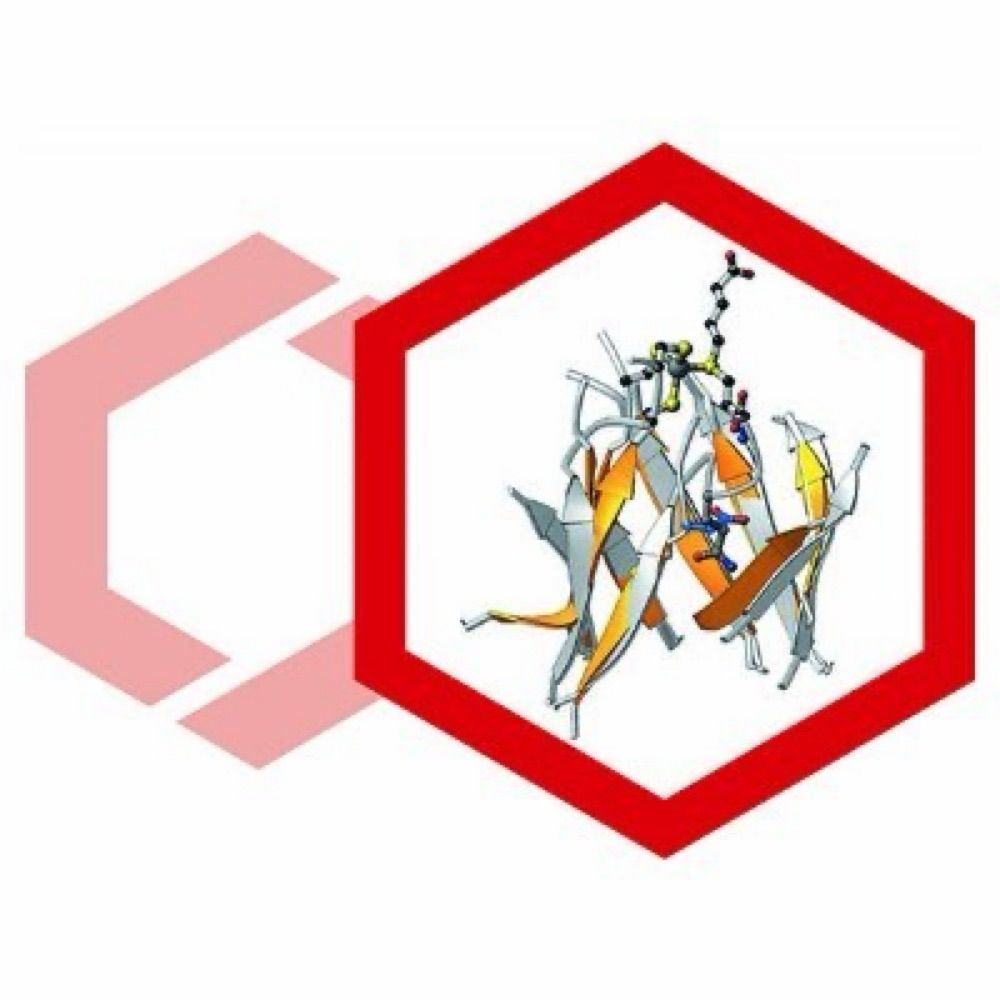
IRMPD spectroscopy, TIMS, and DFT reveal tautomerization in protonated BOX ligands, refining our understanding of non-covalent interactions relevant to catalysis. @bdebreaker.bsky.social @vmgorbachev.bsky.social
doi.org/10.1002/hlca...
doi.org/10.1002/hlca...

Understanding the Structure of Protonated Box Ligands: Insights from Spectroscopy and Computational Studies
Protonation and tautomerization significantly impact the conformational landscape and non-covalent interactions in bis(oxazoline) (BOX) ligands, which are crucial for their applications in catalysis....
doi.org
April 15, 2025 at 8:19 AM
IRMPD spectroscopy, TIMS, and DFT reveal tautomerization in protonated BOX ligands, refining our understanding of non-covalent interactions relevant to catalysis. @bdebreaker.bsky.social @vmgorbachev.bsky.social
doi.org/10.1002/hlca...
doi.org/10.1002/hlca...
Reposted by Florian Ruepp
Congrats to @mixalhsmpogdos.bsky.social, @sevenroediger.bsky.social, @fruepp.bsky.social, Patrick, Nathalie, Fabio on this epic study of the factors governing reductive elimination - using causal inference, organometallics, electrochemistry, kinetics and DFT
@chemrxiv.bsky.social go.shr.lc/4j8O5MM
@chemrxiv.bsky.social go.shr.lc/4j8O5MM
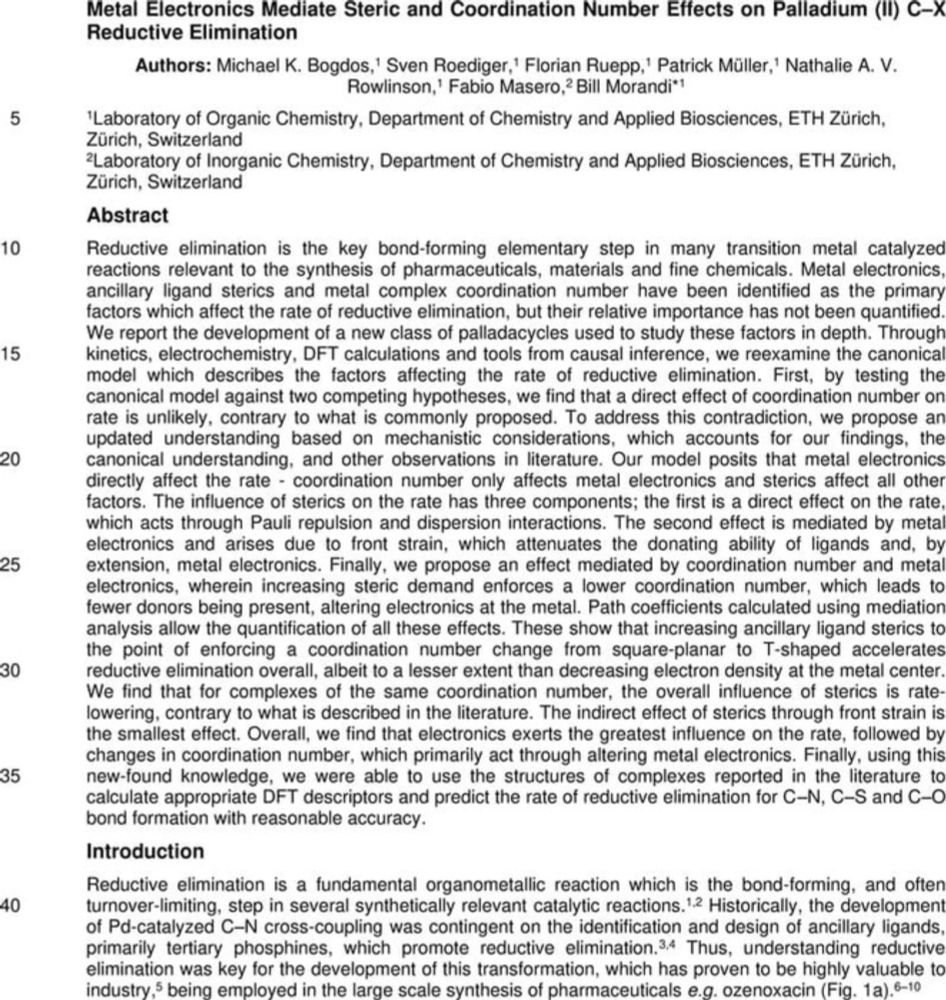
Metal Electronics Mediate Steric and Coordination Number Effects on Palladium (II) C–X Reductive Elimination
Reductive elimination is the key bond-forming elementary step in many transition metal catalyzed reactions relevant to the synthesis of pharmaceuticals, materials and fine chemicals. Metal electronics...
go.shr.lc
April 11, 2025 at 8:24 PM
Congrats to @mixalhsmpogdos.bsky.social, @sevenroediger.bsky.social, @fruepp.bsky.social, Patrick, Nathalie, Fabio on this epic study of the factors governing reductive elimination - using causal inference, organometallics, electrochemistry, kinetics and DFT
@chemrxiv.bsky.social go.shr.lc/4j8O5MM
@chemrxiv.bsky.social go.shr.lc/4j8O5MM
Reposted by Florian Ruepp
Many congrats to Emilien Le Saux for this new publication in @jacs.acspublications.org describing a catalytic approach to Transfer Iodination from Aryl Iodides to Nonactivated C(sp3)–H Bonds.
pubs.acs.org/doi/10.1021/...
pubs.acs.org/doi/10.1021/...
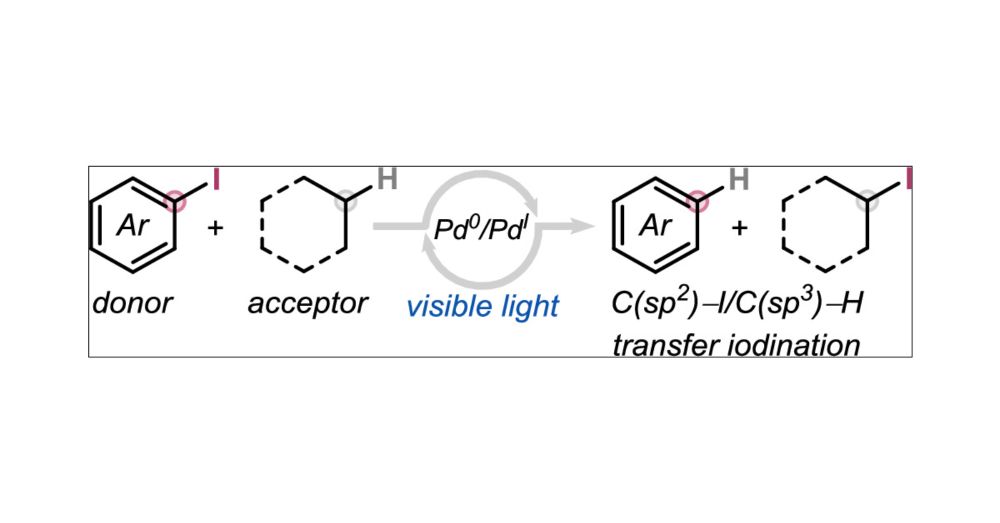
Palladium-Catalyzed Transfer Iodination from Aryl Iodides to Nonactivated C(sp3)–H Bonds
We report a new strategy for the catalytic iodination of nonactivated C(sp3)–H bonds. The method merges the concepts of shuttle and light-enabled palladium catalysis to employ aryl iodides as both hyd...
pubs.acs.org
April 8, 2025 at 1:03 PM
Many congrats to Emilien Le Saux for this new publication in @jacs.acspublications.org describing a catalytic approach to Transfer Iodination from Aryl Iodides to Nonactivated C(sp3)–H Bonds.
pubs.acs.org/doi/10.1021/...
pubs.acs.org/doi/10.1021/...