




Gabriele Bellomia
@gbellomia.bsky.social
Condensed matter physicist ⟩〰〰⟨
Also, a passionate flute player 🪈
Also, a passionate flute player 🪈
Thanks to the dream team, really proving that "more is different" when the tiny bits put together are different skills and points of view on a given problem! Edoardo Zavatti, Matteo Ferraretto, @samuelegiuli.bsky.social and, of course, our eclectic PI @massimocapone.bsky.social.
December 5, 2025 at 9:02 AM
Thanks to the dream team, really proving that "more is different" when the tiny bits put together are different skills and points of view on a given problem! Edoardo Zavatti, Matteo Ferraretto, @samuelegiuli.bsky.social and, of course, our eclectic PI @massimocapone.bsky.social.
Lowering the SU(4) symmetry with a flavor-selective Raman coupling, we show how strong correlations are immediately recovered. A full crossover is unveiled by varying both the Raman and the Hubbard couplings, featuring a tricritical point where all three phases coexist.


December 5, 2025 at 9:02 AM
Lowering the SU(4) symmetry with a flavor-selective Raman coupling, we show how strong correlations are immediately recovered. A full crossover is unveiled by varying both the Raman and the Hubbard couplings, featuring a tricritical point where all three phases coexist.
Remarkably, while a Mott gap is always opened in SU(N) systems at strong coupling, only the SU(2) insulator hosts strong correlations: Already with N=4 flavors, correlations fall one order of magnitude below the SU(2) value, essentially in the same class of large-N models.

December 5, 2025 at 9:02 AM
Remarkably, while a Mott gap is always opened in SU(N) systems at strong coupling, only the SU(2) insulator hosts strong correlations: Already with N=4 flavors, correlations fall one order of magnitude below the SU(2) value, essentially in the same class of large-N models.
In particular, we assess inter-particle correlations (nongaussianity) with the recently introduced (arxiv.org/abs/2506.18709) mutual information between natural orbitals, which in this case coincide with the local fermionic flavors.
And, before you ask: yes, it can be measured in experiments!
And, before you ask: yes, it can be measured in experiments!

Local classical correlations between physical electrons in Hubbard systems
We demonstrate that the local nonfreeness, an unbiased measure of correlation between electrons at a single lattice site, can be computed as the mutual information between local natural spin orbitals....
arxiv.org
December 5, 2025 at 9:02 AM
In particular, we assess inter-particle correlations (nongaussianity) with the recently introduced (arxiv.org/abs/2506.18709) mutual information between natural orbitals, which in this case coincide with the local fermionic flavors.
And, before you ask: yes, it can be measured in experiments!
And, before you ask: yes, it can be measured in experiments!
Inspired by exciting past experiments (tinyurl.com/Tusi22), we investigate a symmetry-tuned crossover in a N-flavor Fermi-Hubbard model, complementing traditional markers for Mott localization with information-theoretic measures of state complexity.

December 5, 2025 at 9:02 AM
Inspired by exciting past experiments (tinyurl.com/Tusi22), we investigate a symmetry-tuned crossover in a N-flavor Fermi-Hubbard model, complementing traditional markers for Mott localization with information-theoretic measures of state complexity.
This, after all, has been the guiding principle behind our latest updates, bringing interfaces to the #TRIQS and #w2dynamics libraries, as well as language-level interoperability with Python, C/C++, Julia... and, with minimal effort, any C-interfacing language you might think of 😉

October 4, 2025 at 1:00 AM
This, after all, has been the guiding principle behind our latest updates, bringing interfaces to the #TRIQS and #w2dynamics libraries, as well as language-level interoperability with Python, C/C++, Julia... and, with minimal effort, any C-interfacing language you might think of 😉
We hope that this fresh publication strategy will allow for easier and effective dissemination of our software, tightening ties with the broader impurity-model community and enhancing opportunities for cross-development of #QuantumEmbedding schemes.
October 4, 2025 at 1:00 AM
We hope that this fresh publication strategy will allow for easier and effective dissemination of our software, tightening ties with the broader impurity-model community and enhancing opportunities for cross-development of #QuantumEmbedding schemes.
The publication is a bundle of a software paper, with special attention to instructions and examples, and the source code itself, which is not relegated to a static archive, but consists of a full-fledged citable git-repository, that we will keep updating at every major release of the library.
October 4, 2025 at 1:00 AM
The publication is a bundle of a software paper, with special attention to instructions and examples, and the source code itself, which is not relegated to a static archive, but consists of a full-fledged citable git-repository, that we will keep updating at every major release of the library.
We also introduce explicit, ready-to-go interfaces with two major DMFT frameworks, #TRIQS and #w2dynamics. The EDIpack2TRIQS layer will be presented this week at the TRIQS yearly meeting.
June 3, 2025 at 10:57 PM
We also introduce explicit, ready-to-go interfaces with two major DMFT frameworks, #TRIQS and #w2dynamics. The EDIpack2TRIQS layer will be presented this week at the TRIQS yearly meeting.
Thanks to @massimocapone.bsky.social for bringing @edoardo_zavatti, me and @samuelegiuli.bsky.social into this exciting adventure!
June 3, 2025 at 6:44 PM
Thanks to @massimocapone.bsky.social for bringing @edoardo_zavatti, me and @samuelegiuli.bsky.social into this exciting adventure!
Whereas standard cuprates must find a compromise between correlations and coherence to find a maximal critical temperature at optimal doping, we propose that trilayers effectively hack the limitation by realizing both aspects all together. A sort of ying yang superconductor if you will 😄
June 3, 2025 at 6:39 PM
Whereas standard cuprates must find a compromise between correlations and coherence to find a maximal critical temperature at optimal doping, we propose that trilayers effectively hack the limitation by realizing both aspects all together. A sort of ying yang superconductor if you will 😄
Overall, these results complement the experimental data in suggesting an important proximity influence between layers, with the underdoped central plane providing strong correlations ⟩〰⟨ (hence a larger d-wave gap) and the outer ones providing coherent quasiparticles ⚾💨.
June 3, 2025 at 6:39 PM
Overall, these results complement the experimental data in suggesting an important proximity influence between layers, with the underdoped central plane providing strong correlations ⟩〰⟨ (hence a larger d-wave gap) and the outer ones providing coherent quasiparticles ⚾💨.
Furthermore, in the superconducting phase, the central layer displays a greatly enhanced d-wave gap at densities relevant for the experimental realization. At larger doping fractions even the overdoped outer layers have a slightly larger gap than a corresponding single layer.

June 3, 2025 at 6:39 PM
Furthermore, in the superconducting phase, the central layer displays a greatly enhanced d-wave gap at densities relevant for the experimental realization. At larger doping fractions even the overdoped outer layers have a slightly larger gap than a corresponding single layer.
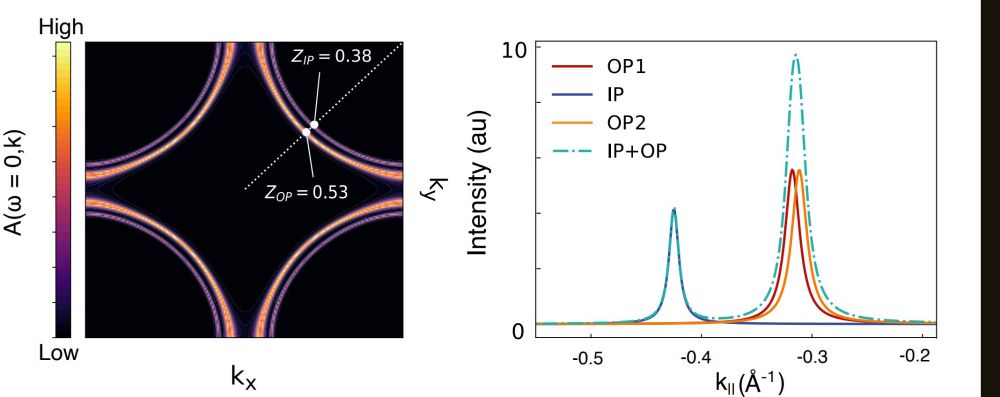
Our model captures the essence of layer dependent physics, with the central and outer layers respectively pinned to the underdoped and overdoped regimes. Yet, in the normal phase, all layers display a higher quasiparticle count with respect to a single layer at the same doping!
June 3, 2025 at 6:39 PM
Our model captures the essence of layer dependent physics, with the central and outer layers respectively pinned to the underdoped and overdoped regimes. Yet, in the normal phase, all layers display a higher quasiparticle count with respect to a single layer at the same doping!
Even just one that does not pester your day to day scrolling with random refreshes, making you lose track of what you were reading/looking at.
January 15, 2025 at 7:29 PM
Even just one that does not pester your day to day scrolling with random refreshes, making you lose track of what you were reading/looking at.