


Greg Egan
@gregegansf.bsky.social
SF writer / computer programmer
Latest novel: MORPHOTROPHIC
Latest collection: SLEEP AND THE SOUL
Web site: http://gregegan.net
Also: @[email protected]
Latest novel: MORPHOTROPHIC
Latest collection: SLEEP AND THE SOUL
Web site: http://gregegan.net
Also: @[email protected]
In special relativity, observers in relative motion will disagree about various measurements. But if Alice draws any planar figure, and fires a simultaneous pulse of light from each point on it, perpendicular to the plane, any observer will agree on the figure’s shape and size.

February 5, 2026 at 5:50 AM
In special relativity, observers in relative motion will disagree about various measurements. But if Alice draws any planar figure, and fires a simultaneous pulse of light from each point on it, perpendicular to the plane, any observer will agree on the figure’s shape and size.
These are the paths of the individual ants, from the starting point until they bump into each other.

February 2, 2026 at 1:07 PM
These are the paths of the individual ants, from the starting point until they bump into each other.
Two pairs of ants set off from the same starting point, walking side-by-side. One pair takes the red path, the other pair takes the blue path.
The red and blue paths are geodesics (the straightest possible paths, like great circles on a sphere) …
The red and blue paths are geodesics (the straightest possible paths, like great circles on a sphere) …

February 1, 2026 at 7:40 AM
Two pairs of ants set off from the same starting point, walking side-by-side. One pair takes the red path, the other pair takes the blue path.
The red and blue paths are geodesics (the straightest possible paths, like great circles on a sphere) …
The red and blue paths are geodesics (the straightest possible paths, like great circles on a sphere) …
"We're trying to compete with the big boys, and part of that is you've got to keep your content refreshed and new all of the time," Mr Hennessy said.
Refreshed, new and hallucinated: tourists book trips to nonexistent hot springs.
www.abc.net.au/news/2026-01...
Refreshed, new and hallucinated: tourists book trips to nonexistent hot springs.
www.abc.net.au/news/2026-01...

January 21, 2026 at 11:09 PM
"We're trying to compete with the big boys, and part of that is you've got to keep your content refreshed and new all of the time," Mr Hennessy said.
Refreshed, new and hallucinated: tourists book trips to nonexistent hot springs.
www.abc.net.au/news/2026-01...
Refreshed, new and hallucinated: tourists book trips to nonexistent hot springs.
www.abc.net.au/news/2026-01...
For crying out loud, ABC news, never send a line graph to do a bar chart’s job.
Link: www.abc.net.au/news/2026-01...
Link: www.abc.net.au/news/2026-01...

January 21, 2026 at 10:21 AM
For crying out loud, ABC news, never send a line graph to do a bar chart’s job.
Link: www.abc.net.au/news/2026-01...
Link: www.abc.net.au/news/2026-01...
Now, consider two particles moving around a massive body, both in circular orbits of equal size, but in slightly different planes. The red and blue circles in the image show these orbits in space, while the red and blue helices represent the world lines of the particles in spacetime.

January 11, 2026 at 11:19 AM
Now, consider two particles moving around a massive body, both in circular orbits of equal size, but in slightly different planes. The red and blue circles in the image show these orbits in space, while the red and blue helices represent the world lines of the particles in spacetime.
Gravity is the curvature of spacetime. So, how curved is the spacetime we are in right now?
Let’s start by looking at the effect of curvature in a very simple situation. Two meridians on a sphere, like the red and blue ones in the diagram, will come together and move apart …
Let’s start by looking at the effect of curvature in a very simple situation. Two meridians on a sphere, like the red and blue ones in the diagram, will come together and move apart …

January 11, 2026 at 11:19 AM
Gravity is the curvature of spacetime. So, how curved is the spacetime we are in right now?
Let’s start by looking at the effect of curvature in a very simple situation. Two meridians on a sphere, like the red and blue ones in the diagram, will come together and move apart …
Let’s start by looking at the effect of curvature in a very simple situation. Two meridians on a sphere, like the red and blue ones in the diagram, will come together and move apart …
What surface arising naturally in physics is described by a degree-6 polynomial?
There’s a whole family of them hiding in plain sight:
x^2 – k^2 (x^2 + y^2 + z^2)^3 = 0
These are the surfaces of equal electrostatic potential for a dipole pointing along the x-axis!
There’s a whole family of them hiding in plain sight:
x^2 – k^2 (x^2 + y^2 + z^2)^3 = 0
These are the surfaces of equal electrostatic potential for a dipole pointing along the x-axis!

December 16, 2025 at 11:33 AM
What surface arising naturally in physics is described by a degree-6 polynomial?
There’s a whole family of them hiding in plain sight:
x^2 – k^2 (x^2 + y^2 + z^2)^3 = 0
These are the surfaces of equal electrostatic potential for a dipole pointing along the x-axis!
There’s a whole family of them hiding in plain sight:
x^2 – k^2 (x^2 + y^2 + z^2)^3 = 0
These are the surfaces of equal electrostatic potential for a dipole pointing along the x-axis!
Those coefficients A, B, C themselves depend on the semi-axes a, b, c, and are given by the values of certain integrals.
But the upshot is that we can find a curve in the space of eccentricities for two meridians of the ellipsoid, say e_xz and e_yz, in two orthogonal planes.
But the upshot is that we can find a curve in the space of eccentricities for two meridians of the ellipsoid, say e_xz and e_yz, in two orthogonal planes.

December 11, 2025 at 12:21 PM
Those coefficients A, B, C themselves depend on the semi-axes a, b, c, and are given by the values of certain integrals.
But the upshot is that we can find a curve in the space of eccentricities for two meridians of the ellipsoid, say e_xz and e_yz, in two orthogonal planes.
But the upshot is that we can find a curve in the space of eccentricities for two meridians of the ellipsoid, say e_xz and e_yz, in two orthogonal planes.
But how can this possibly work for a tri-axial ellipsoid? We only have one parameter to tweak, the rate of spin, so how can we match two *differently shaped* meridians?
The answer is that you *can’t* pull off this trick for a generic tri-axial ellipsoid, with any old a, b and c.
The answer is that you *can’t* pull off this trick for a generic tri-axial ellipsoid, with any old a, b and c.
December 11, 2025 at 12:20 PM
But how can this possibly work for a tri-axial ellipsoid? We only have one parameter to tweak, the rate of spin, so how can we match two *differently shaped* meridians?
The answer is that you *can’t* pull off this trick for a generic tri-axial ellipsoid, with any old a, b and c.
The answer is that you *can’t* pull off this trick for a generic tri-axial ellipsoid, with any old a, b and c.
Given any oblate spheroid (a = b > c), made of rock, say, so we can fix the shape, the surfaces of constant potential will also be spheroids — but if it’s not spinning they will not match the shape of the body.
However, by adding just enough spin the shapes can be made the same.
However, by adding just enough spin the shapes can be made the same.
December 11, 2025 at 12:19 PM
Given any oblate spheroid (a = b > c), made of rock, say, so we can fix the shape, the surfaces of constant potential will also be spheroids — but if it’s not spinning they will not match the shape of the body.
However, by adding just enough spin the shapes can be made the same.
However, by adding just enough spin the shapes can be made the same.
If a mass of incompressible fluid is floating in space, subject only to its own gravity and centrifugal force, what shape will it adopt as its angular momentum is increased?
Initially, it will form an oblate spheroid, with two equal semi-axes shorter than its axis of rotation.
Initially, it will form an oblate spheroid, with two equal semi-axes shorter than its axis of rotation.
December 11, 2025 at 12:16 PM
If a mass of incompressible fluid is floating in space, subject only to its own gravity and centrifugal force, what shape will it adopt as its angular momentum is increased?
Initially, it will form an oblate spheroid, with two equal semi-axes shorter than its axis of rotation.
Initially, it will form an oblate spheroid, with two equal semi-axes shorter than its axis of rotation.
One mouse click away from butt-dialling the Big Bang.

November 24, 2025 at 7:34 AM
One mouse click away from butt-dialling the Big Bang.
Every parallelepiped that you place around an ellipsoid whose faces are tangent to the ellipsoid at their centres has the same volume for a given ellipsoid: 8 a b c, where a, b and c are the semi-axes of the ellipsoid.
November 6, 2025 at 1:45 PM
Every parallelepiped that you place around an ellipsoid whose faces are tangent to the ellipsoid at their centres has the same volume for a given ellipsoid: 8 a b c, where a, b and c are the semi-axes of the ellipsoid.
Every parallelogram that you draw around an ellipse whose sides are tangent to the ellipse at their midpoints has the same area for a given ellipse: 4 a b, where a and b are the semi-axes of the ellipse.
November 6, 2025 at 1:44 PM
Every parallelogram that you draw around an ellipse whose sides are tangent to the ellipse at their midpoints has the same area for a given ellipse: 4 a b, where a and b are the semi-axes of the ellipse.
The portions of the string where it departs from the hyperbola or the ellipse both lie on cones whose axis is a tangent to the curve at that point, and which make an angle with the tangent that is the same as the adjacent segment of the string.

November 1, 2025 at 1:56 AM
The portions of the string where it departs from the hyperbola or the ellipse both lie on cones whose axis is a tangent to the curve at that point, and which make an angle with the tangent that is the same as the adjacent segment of the string.
Here is a version where the point on the ellipse is held still while the point on the hyperbola is swept along it.
November 1, 2025 at 1:55 AM
Here is a version where the point on the ellipse is held still while the point on the hyperbola is swept along it.
Most people know how to draw an ellipse by pinning two ends of a string to a board and sweeping a pencil around inside the string, keeping it taut.
But what about the 3D equivalent?
Start with an ellipse and a hyperbola in orthogonal planes, with each curve’s vertices being the other’s foci.
But what about the 3D equivalent?
Start with an ellipse and a hyperbola in orthogonal planes, with each curve’s vertices being the other’s foci.
October 31, 2025 at 10:53 AM
Most people know how to draw an ellipse by pinning two ends of a string to a board and sweeping a pencil around inside the string, keeping it taut.
But what about the 3D equivalent?
Start with an ellipse and a hyperbola in orthogonal planes, with each curve’s vertices being the other’s foci.
But what about the 3D equivalent?
Start with an ellipse and a hyperbola in orthogonal planes, with each curve’s vertices being the other’s foci.
Oh, just a caterpillar that keeps all the husks it shed from its head when it was smaller as a kind of elaborate hat … because why wouldn’t you?
Congratulations to Georgina Steytler, who just won a wildlife photography award for this extraordinary image!
www.abc.net.au/news/2025-10...
Congratulations to Georgina Steytler, who just won a wildlife photography award for this extraordinary image!
www.abc.net.au/news/2025-10...

October 26, 2025 at 10:39 AM
Oh, just a caterpillar that keeps all the husks it shed from its head when it was smaller as a kind of elaborate hat … because why wouldn’t you?
Congratulations to Georgina Steytler, who just won a wildlife photography award for this extraordinary image!
www.abc.net.au/news/2025-10...
Congratulations to Georgina Steytler, who just won a wildlife photography award for this extraordinary image!
www.abc.net.au/news/2025-10...
Checking in on my recent ebook sales ... at least someone at Amazon has a sense of humour about what to display when there’s an outage.

October 20, 2025 at 7:26 AM
Checking in on my recent ebook sales ... at least someone at Amazon has a sense of humour about what to display when there’s an outage.

From my novel ZENDEGI (2010). I thought this kind of thing would be in widespread use much more rapidly!

October 19, 2025 at 1:23 PM
From my novel ZENDEGI (2010). I thought this kind of thing would be in widespread use much more rapidly!
Gordon had been lost in the fog of Alzheimer’s, but then a new drug halts the progress of the disease, and a kind of neural pacemaker restores his ability to access memories & skills that seemed to have slipped away forever. But no new cure is perfect.
“Spare Parts for the Mind”
“Spare Parts for the Mind”

October 15, 2025 at 6:01 PM
Gordon had been lost in the fog of Alzheimer’s, but then a new drug halts the progress of the disease, and a kind of neural pacemaker restores his ability to access memories & skills that seemed to have slipped away forever. But no new cure is perfect.
“Spare Parts for the Mind”
“Spare Parts for the Mind”
Yeah, sure Amazon, whatever you say.

October 15, 2025 at 10:32 AM
Yeah, sure Amazon, whatever you say.
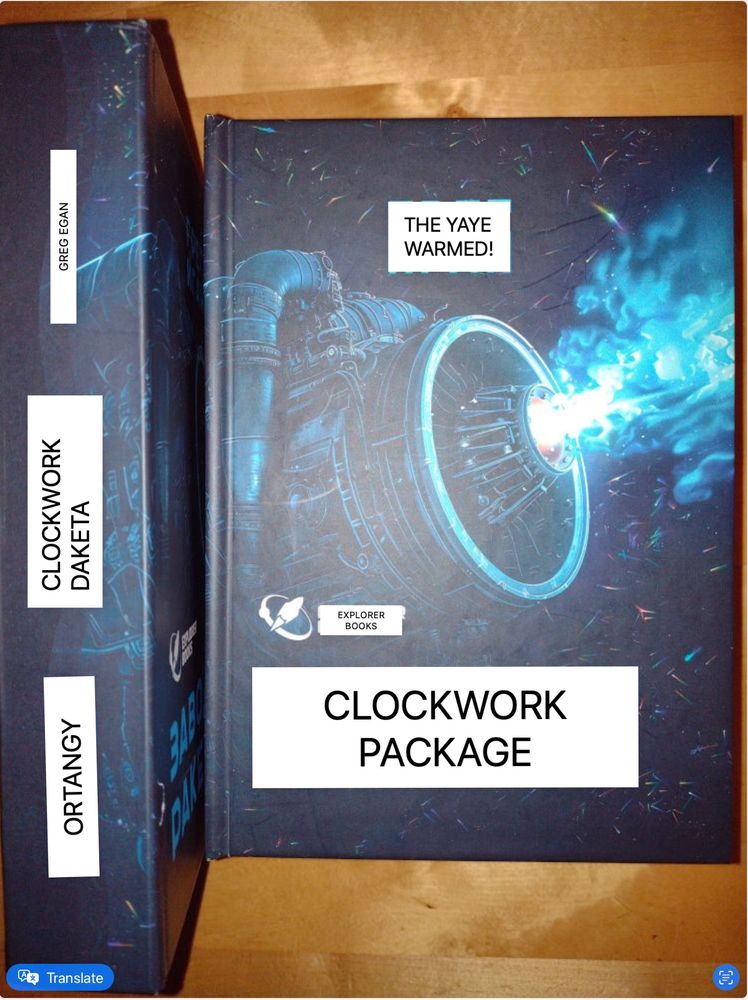
MacOS helpfully offers translations:
October 7, 2025 at 8:10 AM
MacOS helpfully offers translations: