



Gregor Semieniuk
@gregorsemieniuk.bsky.social
Associate Professor @ UMass Amherst | Political economy of the low-carbon transition, energy and resources in economic growth and development, inequality | Views are my own
Fossil fuel profits also sharply increase inflation inequality.
Incremental 2022 fossil fuel profits over 2021 compensate several percent of 2022 inflation for the richest groups (triangles and squares), dwarfing differences in inflation due to differing consumption baskets (disks). 10/
Incremental 2022 fossil fuel profits over 2021 compensate several percent of 2022 inflation for the richest groups (triangles and squares), dwarfing differences in inflation due to differing consumption baskets (disks). 10/

October 8, 2025 at 4:50 PM
Fossil fuel profits also sharply increase inflation inequality.
Incremental 2022 fossil fuel profits over 2021 compensate several percent of 2022 inflation for the richest groups (triangles and squares), dwarfing differences in inflation due to differing consumption baskets (disks). 10/
Incremental 2022 fossil fuel profits over 2021 compensate several percent of 2022 inflation for the richest groups (triangles and squares), dwarfing differences in inflation due to differing consumption baskets (disks). 10/
Record fossil fuel profits reinforce existing racial & ethnic inequalities. Whites (64% of households) benefit disproportionately with claims on 87% of all profits. Blacks (14% of hholds) have a claim on only 3% of all profits, & Hispanics (10% of hholds) a mere 1%, mainly through pensions. 9/

October 8, 2025 at 4:50 PM
Record fossil fuel profits reinforce existing racial & ethnic inequalities. Whites (64% of households) benefit disproportionately with claims on 87% of all profits. Blacks (14% of hholds) have a claim on only 3% of all profits, & Hispanics (10% of hholds) a mere 1%, mainly through pensions. 9/
This results in this central Sankey plot that shows the flow of 2022 fossil fuel profits ‘from the well’ to their ultimate U.S. beneficiaries. 7/

October 8, 2025 at 4:50 PM
This results in this central Sankey plot that shows the flow of 2022 fossil fuel profits ‘from the well’ to their ultimate U.S. beneficiaries. 7/
We propagate profits from oil and gas firm to
-direct ultimate beneficiaries (holding shares in their own names) and fund managers (holding shares on behalf of others);
-on to ultimate beneficiaries, e.g. pension funds or business owners;
-and to socioeconomic distributions, e.g., by wealth. 6/
-direct ultimate beneficiaries (holding shares in their own names) and fund managers (holding shares on behalf of others);
-on to ultimate beneficiaries, e.g. pension funds or business owners;
-and to socioeconomic distributions, e.g., by wealth. 6/

October 8, 2025 at 4:50 PM
We propagate profits from oil and gas firm to
-direct ultimate beneficiaries (holding shares in their own names) and fund managers (holding shares on behalf of others);
-on to ultimate beneficiaries, e.g. pension funds or business owners;
-and to socioeconomic distributions, e.g., by wealth. 6/
-direct ultimate beneficiaries (holding shares in their own names) and fund managers (holding shares on behalf of others);
-on to ultimate beneficiaries, e.g. pension funds or business owners;
-and to socioeconomic distributions, e.g., by wealth. 6/
We start with global profits, which we then trace to US shareholders. To do this, we used all the data we could get. They’re listed in the first column here, together with what we used them for. 5/

October 8, 2025 at 4:50 PM
We start with global profits, which we then trace to US shareholders. To do this, we used all the data we could get. They’re listed in the first column here, together with what we used them for. 5/
The stock market consequences could not have been starker: The MSCI World Energy Index (ExxonMobil, Chevron, Shell etc) doubled in 2021-2022, while the Global Alternative Energy index (Vestas, First Solar, Orsted etc) fell by half in 2021-2024. 4/

October 8, 2025 at 4:50 PM
The stock market consequences could not have been starker: The MSCI World Energy Index (ExxonMobil, Chevron, Shell etc) doubled in 2021-2022, while the Global Alternative Energy index (Vestas, First Solar, Orsted etc) fell by half in 2021-2024. 4/
Oil & gas profits were much higher than in previous years: $916 billion for listed firms worldwide.
That was a huge windfall for shareholders: U.S. beneficiaries held claims to $301bn—one third of the listed total.
For comparison, total 2022 U.S. low-carbon energy investment was $266 billion. 3/
That was a huge windfall for shareholders: U.S. beneficiaries held claims to $301bn—one third of the listed total.
For comparison, total 2022 U.S. low-carbon energy investment was $266 billion. 3/

October 8, 2025 at 4:50 PM
Oil & gas profits were much higher than in previous years: $916 billion for listed firms worldwide.
That was a huge windfall for shareholders: U.S. beneficiaries held claims to $301bn—one third of the listed total.
For comparison, total 2022 U.S. low-carbon energy investment was $266 billion. 3/
That was a huge windfall for shareholders: U.S. beneficiaries held claims to $301bn—one third of the listed total.
For comparison, total 2022 U.S. low-carbon energy investment was $266 billion. 3/
🚨NEW PAPER🚨
We all know the 2022 energy price shock fueled the cost of living crisis. It also caused a profit bonanza for the very rich. We show the US reaped the largest profits ($377bn) of any country. 50% went to the richest 1%, only 1% to the bottom 50%. A🧵 www.sciencedirect.com/science/arti...
We all know the 2022 energy price shock fueled the cost of living crisis. It also caused a profit bonanza for the very rich. We show the US reaped the largest profits ($377bn) of any country. 50% went to the richest 1%, only 1% to the bottom 50%. A🧵 www.sciencedirect.com/science/arti...

October 8, 2025 at 4:50 PM
🚨NEW PAPER🚨
We all know the 2022 energy price shock fueled the cost of living crisis. It also caused a profit bonanza for the very rich. We show the US reaped the largest profits ($377bn) of any country. 50% went to the richest 1%, only 1% to the bottom 50%. A🧵 www.sciencedirect.com/science/arti...
We all know the 2022 energy price shock fueled the cost of living crisis. It also caused a profit bonanza for the very rich. We show the US reaped the largest profits ($377bn) of any country. 50% went to the richest 1%, only 1% to the bottom 50%. A🧵 www.sciencedirect.com/science/arti...
We also discuss how demand saturation for the service, efficiency-induced economic growth, and resulting changes in the energy price could affect these results. We further provide some simple sensitivity estimates (below).

August 8, 2025 at 7:48 PM
We also discuss how demand saturation for the service, efficiency-induced economic growth, and resulting changes in the energy price could affect these results. We further provide some simple sensitivity estimates (below).
What I like most is the summary of the results in ‘rebound planes’, quantitatively precise visualizations of how energy flow, financial expenditure and consumption of energy and other services co-evolve across each analytical stage of rebound. Below is the one for energy flow.

August 8, 2025 at 7:48 PM
What I like most is the summary of the results in ‘rebound planes’, quantitatively precise visualizations of how energy flow, financial expenditure and consumption of energy and other services co-evolve across each analytical stage of rebound. Below is the one for energy flow.
The resulting treatment derives each type of rebound shown below in (excruciating) detail and comes up with simple expressions.
We provide an accompanying Excel sheet that allows anyone to input data like usage and prices for their own example - or question and play with our parameter choices.

August 8, 2025 at 7:48 PM
The resulting treatment derives each type of rebound shown below in (excruciating) detail and comes up with simple expressions.
We provide an accompanying Excel sheet that allows anyone to input data like usage and prices for their own example - or question and play with our parameter choices.
The rebound effect describes the difference between nameplate energy savings and those actually achieved in an energy efficiency upgrade. The *financial* savings end up being spent on other things - that consume additional energy.
A rebound of 20% means 20% of nameplate savings are 'taken back'.

August 8, 2025 at 7:48 PM
The rebound effect describes the difference between nameplate energy savings and those actually achieved in an energy efficiency upgrade. The *financial* savings end up being spent on other things - that consume additional energy.
A rebound of 20% means 20% of nameplate savings are 'taken back'.
Energy rebound is elusive but key for climate change mitigation.
My co-authors & I developed a framework to consistently trace all energetic and economic aspects of rebound & visualize them.
Framework: doi.org/10.1177/0195...
Visualization & car & lamp upgrade examples: doi.org/10.1177/0195... 🔌💡
My co-authors & I developed a framework to consistently trace all energetic and economic aspects of rebound & visualize them.
Framework: doi.org/10.1177/0195...
Visualization & car & lamp upgrade examples: doi.org/10.1177/0195... 🔌💡

August 8, 2025 at 7:48 PM
Energy rebound is elusive but key for climate change mitigation.
My co-authors & I developed a framework to consistently trace all energetic and economic aspects of rebound & visualize them.
Framework: doi.org/10.1177/0195...
Visualization & car & lamp upgrade examples: doi.org/10.1177/0195... 🔌💡
My co-authors & I developed a framework to consistently trace all energetic and economic aspects of rebound & visualize them.
Framework: doi.org/10.1177/0195...
Visualization & car & lamp upgrade examples: doi.org/10.1177/0195... 🔌💡
As a thought experiment, we quantify how the distribution of wealth is impacted depending on who owns the assets created by climate mitigation & adaptation investments. The result are starkly different wealth distribution trajectories 👇 4/6

March 3, 2025 at 10:34 PM
As a thought experiment, we quantify how the distribution of wealth is impacted depending on who owns the assets created by climate mitigation & adaptation investments. The result are starkly different wealth distribution trajectories 👇 4/6
Wealth is derived from the financial valuation of real assets & liabilities, and so physical impacts of climate change, changes in expectations about future profits due to impacts and policies, and current rates of return all combine to determine its amount.
We mapped the interconnections👇 2/6
We mapped the interconnections👇 2/6

March 3, 2025 at 10:34 PM
Wealth is derived from the financial valuation of real assets & liabilities, and so physical impacts of climate change, changes in expectations about future profits due to impacts and policies, and current rates of return all combine to determine its amount.
We mapped the interconnections👇 2/6
We mapped the interconnections👇 2/6
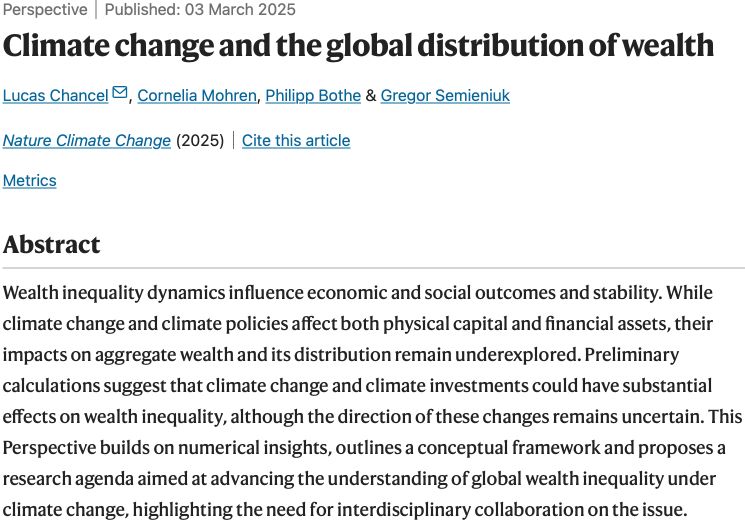
How does climate change impact the distribution of wealth? In Nature Climate Change we map out the impact channels.
There's a lot we don’t know yet & much depends on how societies decide to allocate burdens & upsides of climate change. 1/6
@lucaschancel.bsky.social
www.nature.com/articles/s41...
There's a lot we don’t know yet & much depends on how societies decide to allocate burdens & upsides of climate change. 1/6
@lucaschancel.bsky.social
www.nature.com/articles/s41...
March 3, 2025 at 10:34 PM
How does climate change impact the distribution of wealth? In Nature Climate Change we map out the impact channels.
There's a lot we don’t know yet & much depends on how societies decide to allocate burdens & upsides of climate change. 1/6
@lucaschancel.bsky.social
www.nature.com/articles/s41...
There's a lot we don’t know yet & much depends on how societies decide to allocate burdens & upsides of climate change. 1/6
@lucaschancel.bsky.social
www.nature.com/articles/s41...
More evidence that finance is following sentiment on climate mitigation elsewhere, rather than leading it.

January 10, 2025 at 2:56 AM
More evidence that finance is following sentiment on climate mitigation elsewhere, rather than leading it.
What's the EU pivot to industrial policy got in store for Eastern EU member states?
In the EU Regular Economic Report with contributions from many teams across the World Bank, we study how trade & firm data allows revealing existing strengths in clean tech.
www.worldbank.org/en/region/ec...
🔌💡
In the EU Regular Economic Report with contributions from many teams across the World Bank, we study how trade & firm data allows revealing existing strengths in clean tech.
www.worldbank.org/en/region/ec...
🔌💡

January 8, 2025 at 11:28 PM
What's the EU pivot to industrial policy got in store for Eastern EU member states?
In the EU Regular Economic Report with contributions from many teams across the World Bank, we study how trade & firm data allows revealing existing strengths in clean tech.
www.worldbank.org/en/region/ec...
🔌💡
In the EU Regular Economic Report with contributions from many teams across the World Bank, we study how trade & firm data allows revealing existing strengths in clean tech.
www.worldbank.org/en/region/ec...
🔌💡
A key problem of current macroeconomic-climate (IAM) modeling: even the worst climate impacts only shave off a cream layer from GDP: the world in 2100 is 4.4 times richer even with +3°C warming.
Nice to see the NGFS handbook acknowledge & discuss this in box 2 (source: www.ngfs.net/en/climate-m...)
Nice to see the NGFS handbook acknowledge & discuss this in box 2 (source: www.ngfs.net/en/climate-m...)

November 22, 2024 at 11:37 PM
A key problem of current macroeconomic-climate (IAM) modeling: even the worst climate impacts only shave off a cream layer from GDP: the world in 2100 is 4.4 times richer even with +3°C warming.
Nice to see the NGFS handbook acknowledge & discuss this in box 2 (source: www.ngfs.net/en/climate-m...)
Nice to see the NGFS handbook acknowledge & discuss this in box 2 (source: www.ngfs.net/en/climate-m...)
When fossil-fuel profits are high, investors who are in for the money find it irresistible to partake. Some evidence reported by the FT how hard it is for finance to lead, rather than follow, on climate:
Pimco joins JPMorgan and State street in quitting climate investor group on.ft.com/42J95Ch 🔌💡
Pimco joins JPMorgan and State street in quitting climate investor group on.ft.com/42J95Ch 🔌💡

February 16, 2024 at 8:56 PM
When fossil-fuel profits are high, investors who are in for the money find it irresistible to partake. Some evidence reported by the FT how hard it is for finance to lead, rather than follow, on climate:
Pimco joins JPMorgan and State street in quitting climate investor group on.ft.com/42J95Ch 🔌💡
Pimco joins JPMorgan and State street in quitting climate investor group on.ft.com/42J95Ch 🔌💡
Oil & gas producing countries are losing an important source of revenue & jobs in the low-carbon transition. What about those that aren’t already affluent?
Pleased to have contributed to a perspective discussing some of these countries’ options in Nature Energy: www.nature.com/articles/s41... 🔌💡
Pleased to have contributed to a perspective discussing some of these countries’ options in Nature Energy: www.nature.com/articles/s41... 🔌💡

February 11, 2024 at 8:58 AM
Oil & gas producing countries are losing an important source of revenue & jobs in the low-carbon transition. What about those that aren’t already affluent?
Pleased to have contributed to a perspective discussing some of these countries’ options in Nature Energy: www.nature.com/articles/s41... 🔌💡
Pleased to have contributed to a perspective discussing some of these countries’ options in Nature Energy: www.nature.com/articles/s41... 🔌💡
Unintended consequence of moving from RCP8.5 to 7.0 while hard-wiring RCPs with SSPs: assessments of high climate impacts using SSP3-RCP7.0 may end up analyzing projection of future climates with relatively low precipitation.
From the SSP3 modelers @ www.nature.com/articles/s41...
🔌💡 #greensky
From the SSP3 modelers @ www.nature.com/articles/s41...
🔌💡 #greensky

December 16, 2023 at 4:44 PM
Unintended consequence of moving from RCP8.5 to 7.0 while hard-wiring RCPs with SSPs: assessments of high climate impacts using SSP3-RCP7.0 may end up analyzing projection of future climates with relatively low precipitation.
From the SSP3 modelers @ www.nature.com/articles/s41...
🔌💡 #greensky
From the SSP3 modelers @ www.nature.com/articles/s41...
🔌💡 #greensky
As debates about fossil fuel phase-out at COP28 run hot, I am pleased to have contributed to '10 new insights in climate science 2023', esp. the 2nd insight with a clear message: Fast-shrinking carbon budget calls for a managed & equitable fossil fuel phase-out
doi.org/10.1017/sus....
#greensky 🔌💡
doi.org/10.1017/sus....
#greensky 🔌💡

December 7, 2023 at 11:36 PM
As debates about fossil fuel phase-out at COP28 run hot, I am pleased to have contributed to '10 new insights in climate science 2023', esp. the 2nd insight with a clear message: Fast-shrinking carbon budget calls for a managed & equitable fossil fuel phase-out
doi.org/10.1017/sus....
#greensky 🔌💡
doi.org/10.1017/sus....
#greensky 🔌💡
What would historical GDP growth look like through a classical political economy lens?
For the NSER special issue in honor of Duncan Foley and Anwar Shaikh I use their contributions to answer that question for the US: growth would be slower.
www.nsereview.org/index.php/NS...
For the NSER special issue in honor of Duncan Foley and Anwar Shaikh I use their contributions to answer that question for the US: growth would be slower.
www.nsereview.org/index.php/NS...

December 3, 2023 at 5:14 AM
What would historical GDP growth look like through a classical political economy lens?
For the NSER special issue in honor of Duncan Foley and Anwar Shaikh I use their contributions to answer that question for the US: growth would be slower.
www.nsereview.org/index.php/NS...
For the NSER special issue in honor of Duncan Foley and Anwar Shaikh I use their contributions to answer that question for the US: growth would be slower.
www.nsereview.org/index.php/NS...
What's troubling the wind industry?
Two terrific podcasts help situate the impact of high cost & interest rates, & technical problems.
Cost/rates - easy listen yet informative: www.canarymedia.com/podcasts/the...
Technical snags - nerdy (for me) yet accessible: energycentral.com/c/cp/108-win...
Two terrific podcasts help situate the impact of high cost & interest rates, & technical problems.
Cost/rates - easy listen yet informative: www.canarymedia.com/podcasts/the...
Technical snags - nerdy (for me) yet accessible: energycentral.com/c/cp/108-win...

November 7, 2023 at 12:26 AM
What's troubling the wind industry?
Two terrific podcasts help situate the impact of high cost & interest rates, & technical problems.
Cost/rates - easy listen yet informative: www.canarymedia.com/podcasts/the...
Technical snags - nerdy (for me) yet accessible: energycentral.com/c/cp/108-win...
Two terrific podcasts help situate the impact of high cost & interest rates, & technical problems.
Cost/rates - easy listen yet informative: www.canarymedia.com/podcasts/the...
Technical snags - nerdy (for me) yet accessible: energycentral.com/c/cp/108-win...