




Hallvard Evensmoen
@hallvardevensmoen.bsky.social
Researcher at St Olavs University hospital. I study the neural correlates and basic mechanisms of memory and navigation
Pinned

Our proposed model:
Between episodes: Important episodes are given more distinct temporal locations through expansion of time to neighboring episodes.
Within episodes: Important episodes are integrated through compression of time between different parts of the episode.
doi.org/10.1162/imag...
Between episodes: Important episodes are given more distinct temporal locations through expansion of time to neighboring episodes.
Within episodes: Important episodes are integrated through compression of time between different parts of the episode.
doi.org/10.1162/imag...
Our latest findings show that white matter fiber pathways that link visual cortices to the temporal lobe and the temporal lobe to other parts of the brain underpin a person's ability to form successful map-like representations.
onlinelibrary.wiley.com/doi/10.1002/...
onlinelibrary.wiley.com/doi/10.1002/...

August 7, 2025 at 9:24 AM
Our latest findings show that white matter fiber pathways that link visual cortices to the temporal lobe and the temporal lobe to other parts of the brain underpin a person's ability to form successful map-like representations.
onlinelibrary.wiley.com/doi/10.1002/...
onlinelibrary.wiley.com/doi/10.1002/...
Reposted by Hallvard Evensmoen

The most brain-like representations of visual neural networks are also the most universal ones, i.e., they are largely independent of a network’s architecture or training. Cool new work by Chen & Bonner in #ScienceAdvances! #neuroAI
www.science.org/doi/10.1126/...
www.science.org/doi/10.1126/...
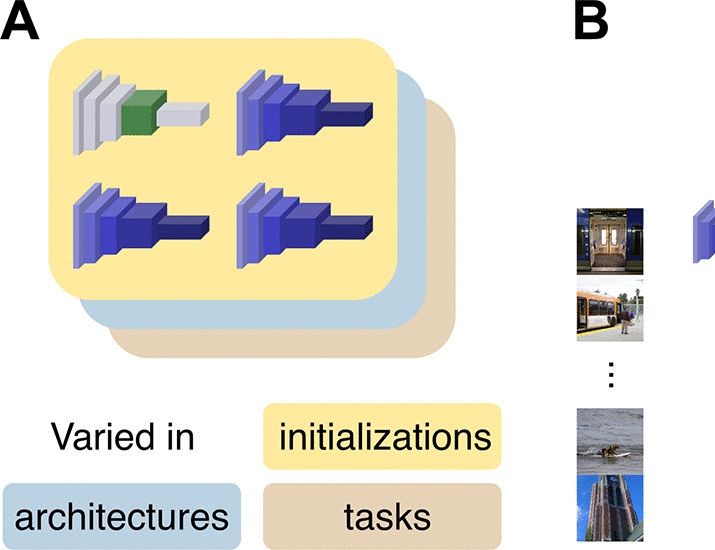
Universal dimensions of visual representation
Probing neural representations reveals universal aspects of vision in artificial and biological networks.
www.science.org
July 6, 2025 at 12:03 PM
The most brain-like representations of visual neural networks are also the most universal ones, i.e., they are largely independent of a network’s architecture or training. Cool new work by Chen & Bonner in #ScienceAdvances! #neuroAI
www.science.org/doi/10.1126/...
www.science.org/doi/10.1126/...
Reposted by Hallvard Evensmoen

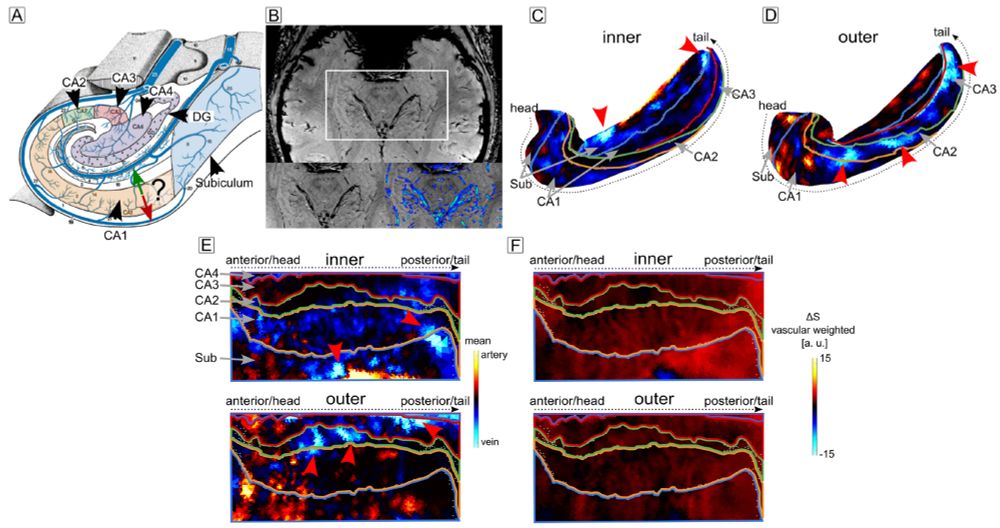
New paper in Imaging Neuroscience by Viktor Pfaffenrot, David G. Norris, et al:
Characterizing BOLD activation patterns in the human hippocampus with laminar fMRI
doi.org/10.1162/imag...
Characterizing BOLD activation patterns in the human hippocampus with laminar fMRI
doi.org/10.1162/imag...
April 14, 2025 at 6:24 AM
New paper in Imaging Neuroscience by Viktor Pfaffenrot, David G. Norris, et al:
Characterizing BOLD activation patterns in the human hippocampus with laminar fMRI
doi.org/10.1162/imag...
Characterizing BOLD activation patterns in the human hippocampus with laminar fMRI
doi.org/10.1162/imag...
Reposted by Hallvard Evensmoen

If you are interested in learning more about what DeepSeek did to improve the efficiency/performance of its latest model that is making such a splash, here is a nice explainer from @epochai.bsky.social

How has DeepSeek improved the Transformer architecture?
This Gradient Updates issue goes over the major changes that went into DeepSeek’s most recent model.
epoch.ai
January 27, 2025 at 6:19 PM
If you are interested in learning more about what DeepSeek did to improve the efficiency/performance of its latest model that is making such a splash, here is a nice explainer from @epochai.bsky.social
Reposted by Hallvard Evensmoen
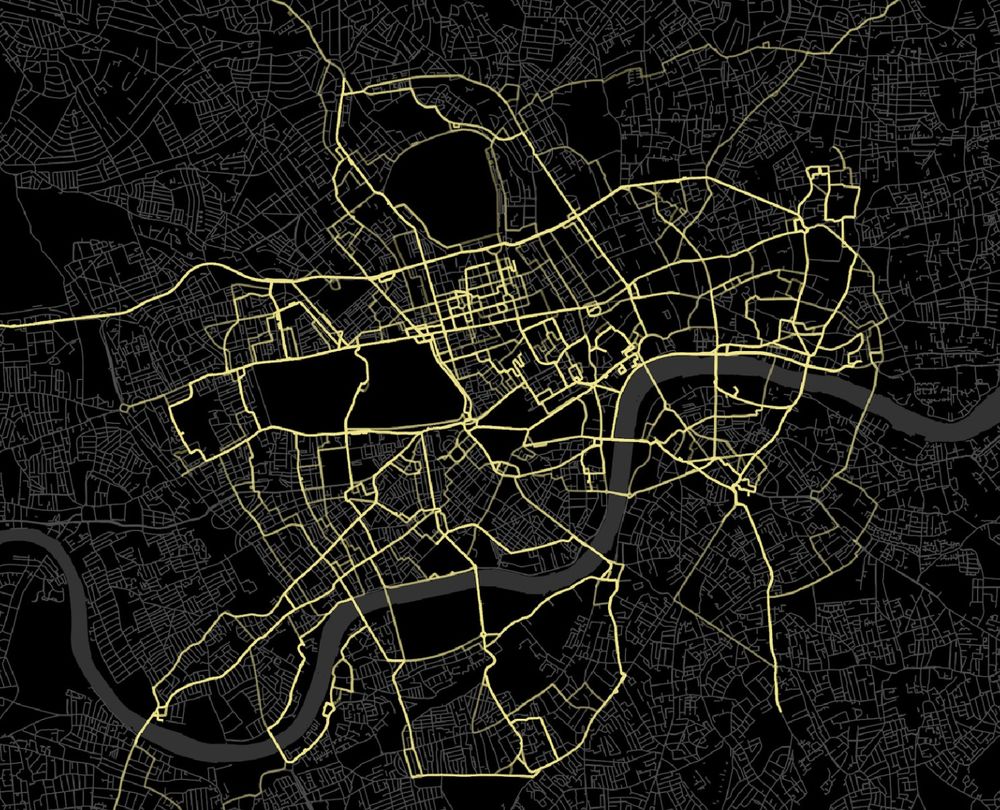
🚨 new publication from our lab in @pnas.org !
"Expert navigators deploy rational complexity–based decision precaching for large-scale real-world planning"
Entropy of streets & successor representations explain planning speed
Colab wth Daniel McNamee at Champalimaud
www.pnas.org/doi/10.1073/...
"Expert navigators deploy rational complexity–based decision precaching for large-scale real-world planning"
Entropy of streets & successor representations explain planning speed
Colab wth Daniel McNamee at Champalimaud
www.pnas.org/doi/10.1073/...
January 27, 2025 at 3:39 PM
🚨 new publication from our lab in @pnas.org !
"Expert navigators deploy rational complexity–based decision precaching for large-scale real-world planning"
Entropy of streets & successor representations explain planning speed
Colab wth Daniel McNamee at Champalimaud
www.pnas.org/doi/10.1073/...
"Expert navigators deploy rational complexity–based decision precaching for large-scale real-world planning"
Entropy of streets & successor representations explain planning speed
Colab wth Daniel McNamee at Champalimaud
www.pnas.org/doi/10.1073/...
Reposted by Hallvard Evensmoen
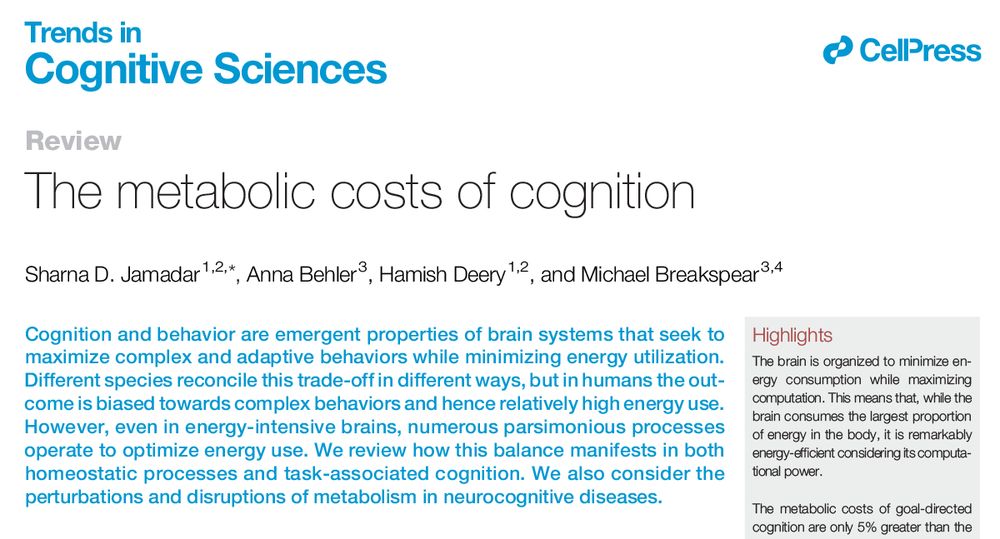
Brains minimize energy consumption while maximizing computation. In humans, this trade-off is reconciled towards complex behaviors & hence relatively high energy use
Review & synthesis with @sharnajamadar.bsky.social @annabhlr.bsky.social & Hamish Deery
tinyurl.com/47c9n65w
osf.io/preprints/os...
Review & synthesis with @sharnajamadar.bsky.social @annabhlr.bsky.social & Hamish Deery
tinyurl.com/47c9n65w
osf.io/preprints/os...
January 20, 2025 at 5:58 AM
Brains minimize energy consumption while maximizing computation. In humans, this trade-off is reconciled towards complex behaviors & hence relatively high energy use
Review & synthesis with @sharnajamadar.bsky.social @annabhlr.bsky.social & Hamish Deery
tinyurl.com/47c9n65w
osf.io/preprints/os...
Review & synthesis with @sharnajamadar.bsky.social @annabhlr.bsky.social & Hamish Deery
tinyurl.com/47c9n65w
osf.io/preprints/os...
Our proposed model:
Between episodes: Important episodes are given more distinct temporal locations through expansion of time to neighboring episodes.
Within episodes: Important episodes are integrated through compression of time between different parts of the episode.
doi.org/10.1162/imag...
Between episodes: Important episodes are given more distinct temporal locations through expansion of time to neighboring episodes.
Within episodes: Important episodes are integrated through compression of time between different parts of the episode.
doi.org/10.1162/imag...
January 17, 2025 at 8:27 PM
Our proposed model:
Between episodes: Important episodes are given more distinct temporal locations through expansion of time to neighboring episodes.
Within episodes: Important episodes are integrated through compression of time between different parts of the episode.
doi.org/10.1162/imag...
Between episodes: Important episodes are given more distinct temporal locations through expansion of time to neighboring episodes.
Within episodes: Important episodes are integrated through compression of time between different parts of the episode.
doi.org/10.1162/imag...
Reposted by Hallvard Evensmoen

How is the memorability of an image influenced by how it makes us feel?
@hartwakeland.bsky.social created an image set (VAMOS) of over 900 scene images, along with their valence, arousal, and memorability ratings. They then showed that *moderately* negative images are more memorable!
(1/2)
@hartwakeland.bsky.social created an image set (VAMOS) of over 900 scene images, along with their valence, arousal, and memorability ratings. They then showed that *moderately* negative images are more memorable!
(1/2)

January 16, 2025 at 4:01 PM
How is the memorability of an image influenced by how it makes us feel?
@hartwakeland.bsky.social created an image set (VAMOS) of over 900 scene images, along with their valence, arousal, and memorability ratings. They then showed that *moderately* negative images are more memorable!
(1/2)
@hartwakeland.bsky.social created an image set (VAMOS) of over 900 scene images, along with their valence, arousal, and memorability ratings. They then showed that *moderately* negative images are more memorable!
(1/2)
Reposted by Hallvard Evensmoen
New modelling of how episodic memory can arise from spatial mapping, just out in Nature:
www.nature.com/articles/s41...
www.nature.com/articles/s41...
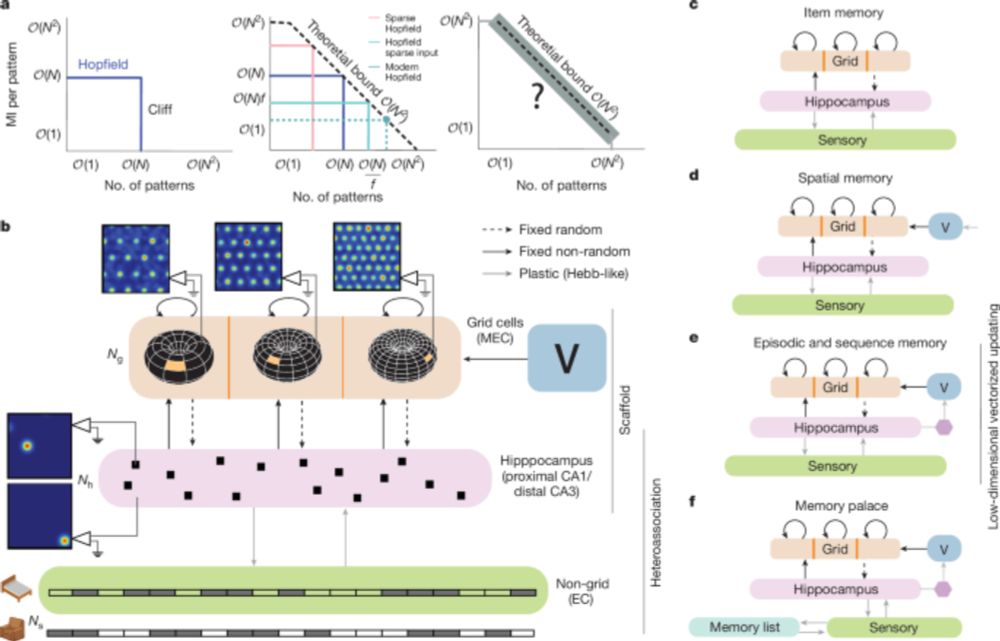
Episodic and associative memory from spatial scaffolds in the hippocampus - Nature
A neocortical–entorhinal–hippocampal network model based on grid cell states recapitulates experimental results and reconciles the spatial, associative and episodic memory roles of the hippocampus.
www.nature.com
January 16, 2025 at 10:07 PM
New modelling of how episodic memory can arise from spatial mapping, just out in Nature:
www.nature.com/articles/s41...
www.nature.com/articles/s41...
Reposted by Hallvard Evensmoen
Going beyond integrating value - dopamine responses are more sophisticated:
www.nature.com/articles/s41...
www.nature.com/articles/s41...

The curious case of dopaminergic prediction errors and learning associative information beyond value - Nature Reviews Neuroscience
Midbrain dopamine neurons are widely assumed to signal a unidimensional value-based prediction error. In this Perspective, Kahnt and Schoenbaum overview accumulating evidence that challenges this assu...
www.nature.com
January 14, 2025 at 2:05 PM
Going beyond integrating value - dopamine responses are more sophisticated:
www.nature.com/articles/s41...
www.nature.com/articles/s41...
Reposted by Hallvard Evensmoen
Ask how they did it: untangling the relationships between task-specific strategy use, everyday strategy use, and associative memory
www.tandfonline.com/doi/abs/10.1...
www.tandfonline.com/doi/abs/10.1...

Ask how they did it: untangling the relationships between task-specific strategy use, everyday strategy use, and associative memory
Past research has shown that self-reported everyday strategy use and task-specific strategy use are related to associative memory performance in aging. Understudied is the relationship between thes...
www.tandfonline.com
January 14, 2025 at 9:47 AM
Ask how they did it: untangling the relationships between task-specific strategy use, everyday strategy use, and associative memory
www.tandfonline.com/doi/abs/10.1...
www.tandfonline.com/doi/abs/10.1...
Reposted by Hallvard Evensmoen
#CogNeuro seeks unified theories of behavioral, physiological, and mental states. To this aim, our #NatureNeuro Perspective proposes a new framework centered on #TaskDemands & across-task generalization. www.nature.com/articles/s41...
w/ @aschmid.bsky.social S.Kaplan @cibaker.bsky.social D.Kravitz🧵
w/ @aschmid.bsky.social S.Kaplan @cibaker.bsky.social D.Kravitz🧵

Centering cognitive neuroscience on task demands and generalization - Nature Neuroscience
Task demands are a primary determiner of behavior and neurophysiology. Here the authors discuss how understanding their influence through multitask studies and tests of generalization is the key to ar...
www.nature.com
July 29, 2024 at 9:14 AM
#CogNeuro seeks unified theories of behavioral, physiological, and mental states. To this aim, our #NatureNeuro Perspective proposes a new framework centered on #TaskDemands & across-task generalization. www.nature.com/articles/s41...
w/ @aschmid.bsky.social S.Kaplan @cibaker.bsky.social D.Kravitz🧵
w/ @aschmid.bsky.social S.Kaplan @cibaker.bsky.social D.Kravitz🧵
Reposted by Hallvard Evensmoen
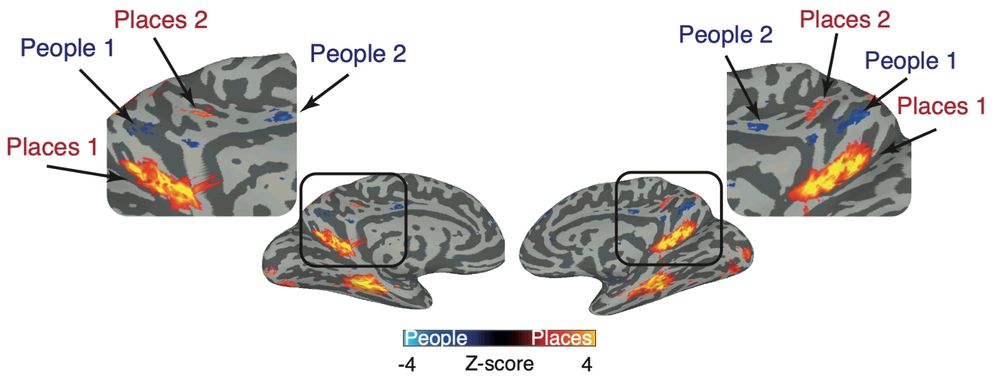
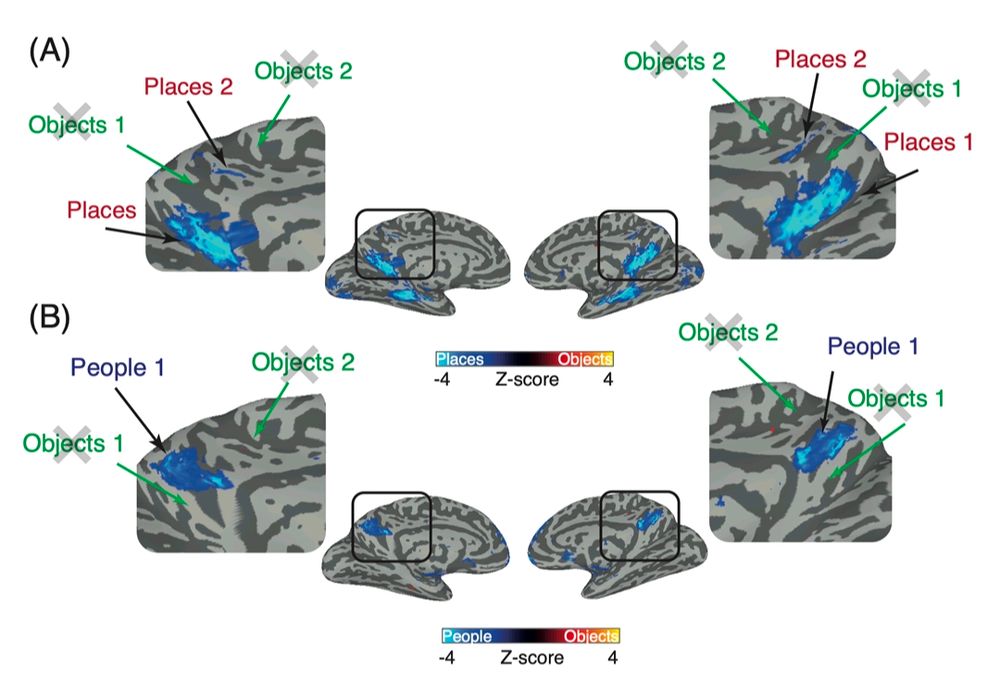
New paper with @lexkidder.bsky.social, Ed Silson, and @cibaker.bsky.social! We show that recall of people, places, and objects engages distributed cortical regions, with medial parietal & ventral temporal cortices showing distinct functional organizations. 1/2 doi.org/10.1523/ENEU...
January 14, 2025 at 8:26 AM
New paper with @lexkidder.bsky.social, Ed Silson, and @cibaker.bsky.social! We show that recall of people, places, and objects engages distributed cortical regions, with medial parietal & ventral temporal cortices showing distinct functional organizations. 1/2 doi.org/10.1523/ENEU...
Reposted by Hallvard Evensmoen
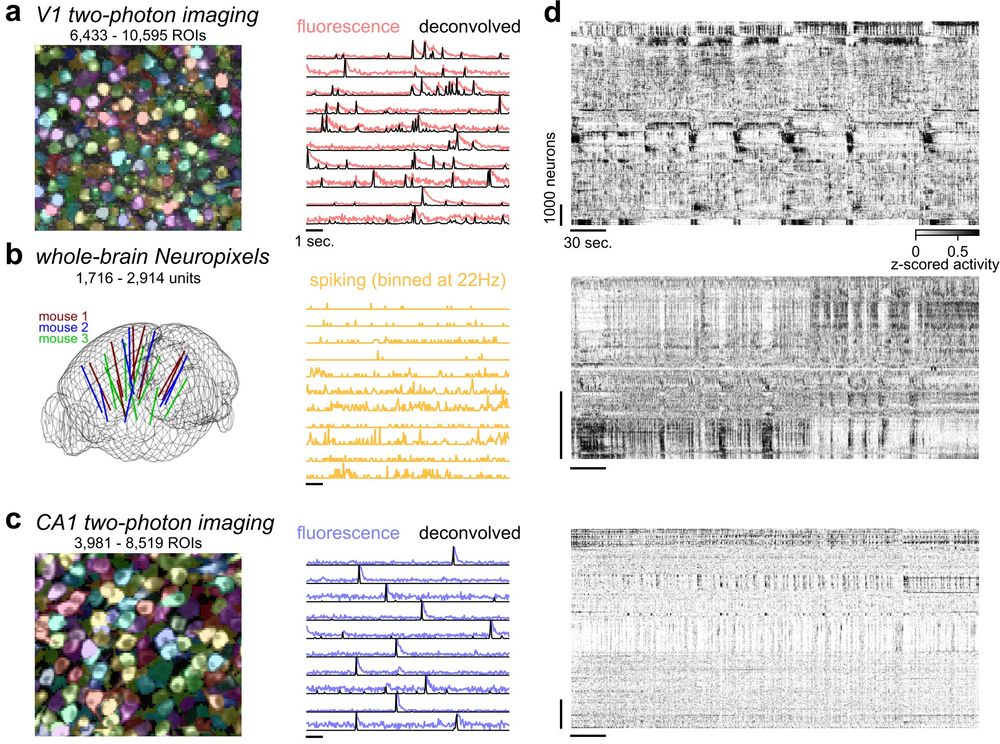
What if… spontaneous neural activity 🧠 reflects the baseline rumblings of a brainwide dynamical system initialized for learning? We find that the rumblings have macroscopic properties like those emerging from linear symmetric, critical systems 🧵 #neuroscience #neuroAI www.biorxiv.org/content/10.1...
January 12, 2025 at 7:55 PM
What if… spontaneous neural activity 🧠 reflects the baseline rumblings of a brainwide dynamical system initialized for learning? We find that the rumblings have macroscopic properties like those emerging from linear symmetric, critical systems 🧵 #neuroscience #neuroAI www.biorxiv.org/content/10.1...
Reposted by Hallvard Evensmoen
🚨 New funded PhD position at UCL 🚨
Funding is provided for a PhD student in our new centre to help work with Fiona Zisch & Sean Hanna to apply agent-based-modelling to analyse the crazy data set from 100+ people navigating a giant maze in PEARL. See details:
www.ucl.ac.uk/bartlett/arc...
Funding is provided for a PhD student in our new centre to help work with Fiona Zisch & Sean Hanna to apply agent-based-modelling to analyse the crazy data set from 100+ people navigating a giant maze in PEARL. See details:
www.ucl.ac.uk/bartlett/arc...
January 10, 2025 at 10:47 AM
🚨 New funded PhD position at UCL 🚨
Funding is provided for a PhD student in our new centre to help work with Fiona Zisch & Sean Hanna to apply agent-based-modelling to analyse the crazy data set from 100+ people navigating a giant maze in PEARL. See details:
www.ucl.ac.uk/bartlett/arc...
Funding is provided for a PhD student in our new centre to help work with Fiona Zisch & Sean Hanna to apply agent-based-modelling to analyse the crazy data set from 100+ people navigating a giant maze in PEARL. See details:
www.ucl.ac.uk/bartlett/arc...
Reposted by Hallvard Evensmoen

*How* does the hippocampus encode the world around us? Leo Waschke and Fabian Kamp bring the 🔥, showing that single-neuron spiking variability in hippocampus dynamically tracks sensory content during memory formation in humans. Our latest in Nature Communications: www.nature.com/articles/s41...
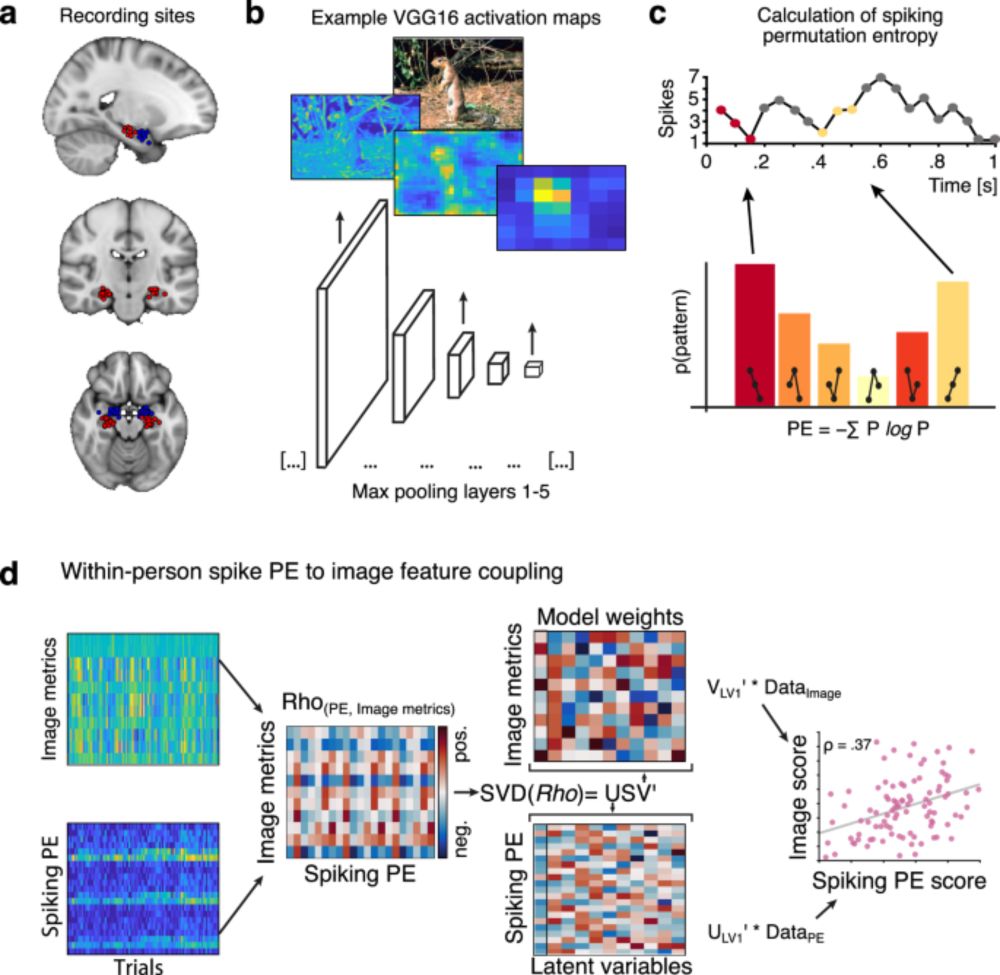
Single-neuron spiking variability in hippocampus dynamically tracks sensory content during memory formation in humans - Nature Communications
The hippocampus is thought to encode the content of stimuli, but how it does so is unknown. The authors show that when hippocampal spiking variability tracks the abstract building blocks of individual...
www.nature.com
January 13, 2025 at 7:37 PM
*How* does the hippocampus encode the world around us? Leo Waschke and Fabian Kamp bring the 🔥, showing that single-neuron spiking variability in hippocampus dynamically tracks sensory content during memory formation in humans. Our latest in Nature Communications: www.nature.com/articles/s41...
Reposted by Hallvard Evensmoen
New paper in Imaging Neuroscience by Hallvard Røe Evensmoen, Asta Håberg, et al:
Pattern integration and differentiation: Dual process model of episodic memory
direct.mit.edu/imag/article...
Pattern integration and differentiation: Dual process model of episodic memory
direct.mit.edu/imag/article...

January 10, 2025 at 1:54 PM
New paper in Imaging Neuroscience by Hallvard Røe Evensmoen, Asta Håberg, et al:
Pattern integration and differentiation: Dual process model of episodic memory
direct.mit.edu/imag/article...
Pattern integration and differentiation: Dual process model of episodic memory
direct.mit.edu/imag/article...