




Hendrik Meyer
@hendrikmeyer.bsky.social
Research Associate | PhD Candidate | Hamburg University
Political & Climate (Protest) Communication
Website: https://www.hendrik-meyer.com
Google Scholar: https://scholar.google.com/citations?user=j3fDB9oAAAAJ&hl=en
Political & Climate (Protest) Communication
Website: https://www.hendrik-meyer.com
Google Scholar: https://scholar.google.com/citations?user=j3fDB9oAAAAJ&hl=en

🛜 Bottom line: Single-platform studies risk drawing normatively loaded conclusions from a structurally partial picture. If we want to understand polarization, counterpublic- & coalition-building in fragmented media environments, multi-platform designs, despite challenges & shortcomings, are needed.
February 2, 2026 at 3:16 PM
🛜 Bottom line: Single-platform studies risk drawing normatively loaded conclusions from a structurally partial picture. If we want to understand polarization, counterpublic- & coalition-building in fragmented media environments, multi-platform designs, despite challenges & shortcomings, are needed.
• Results complicate the “closed-off communities = always bad” storyline.
• Some (semi-)closed spaces can be functional & protective for organizing & coordinating protest, while similar “counterpublic” dynamics can also describe reactionary, defensive coalitions that mobilize against activists.
• Some (semi-)closed spaces can be functional & protective for organizing & coordinating protest, while similar “counterpublic” dynamics can also describe reactionary, defensive coalitions that mobilize against activists.
February 2, 2026 at 3:16 PM
• Results complicate the “closed-off communities = always bad” storyline.
• Some (semi-)closed spaces can be functional & protective for organizing & coordinating protest, while similar “counterpublic” dynamics can also describe reactionary, defensive coalitions that mobilize against activists.
• Some (semi-)closed spaces can be functional & protective for organizing & coordinating protest, while similar “counterpublic” dynamics can also describe reactionary, defensive coalitions that mobilize against activists.
3️⃣➡️ This has normative implications for conceptualizations of #polarization, #counterpublics, and so-called “echo chambers” surrounding #climatechange and #activism debates—and shows why multi-platform research is overdue:
February 2, 2026 at 3:16 PM
3️⃣➡️ This has normative implications for conceptualizations of #polarization, #counterpublics, and so-called “echo chambers” surrounding #climatechange and #activism debates—and shows why multi-platform research is overdue:
• Twitter/X and Mastodon are more about public evaluation, visibility, and contested interpretations of events:
- police actions versus police violence;
- climate policy demands versus denial/delay of the need for climate action;
- legitimacy versus supposed radicalism of protest tactics;
- ...
- police actions versus police violence;
- climate policy demands versus denial/delay of the need for climate action;
- legitimacy versus supposed radicalism of protest tactics;
- ...
February 2, 2026 at 3:16 PM
• Twitter/X and Mastodon are more about public evaluation, visibility, and contested interpretations of events:
- police actions versus police violence;
- climate policy demands versus denial/delay of the need for climate action;
- legitimacy versus supposed radicalism of protest tactics;
- ...
- police actions versus police violence;
- climate policy demands versus denial/delay of the need for climate action;
- legitimacy versus supposed radicalism of protest tactics;
- ...
2️⃣👁️🗨️ Each platform plays a distinct role for protesters:
• Telegram matters even when the advocacy coalition is comparatively small: The platform functions as an essential semi-public infrastructure for intra-group support, organizing, and logistics.
• Telegram matters even when the advocacy coalition is comparatively small: The platform functions as an essential semi-public infrastructure for intra-group support, organizing, and logistics.

February 2, 2026 at 3:16 PM
2️⃣👁️🗨️ Each platform plays a distinct role for protesters:
• Telegram matters even when the advocacy coalition is comparatively small: The platform functions as an essential semi-public infrastructure for intra-group support, organizing, and logistics.
• Telegram matters even when the advocacy coalition is comparatively small: The platform functions as an essential semi-public infrastructure for intra-group support, organizing, and logistics.
• Twitter/X: two large polarized coalitions competing in public arena.
• Telegram: dominant “antagonist mainstream” alongside a smaller, isolated advocacy subnetwork; nevertheless central for protesters (see below)
• Mastodon: pro-activist environment; antagonists remain scattered & don't cluster
• Telegram: dominant “antagonist mainstream” alongside a smaller, isolated advocacy subnetwork; nevertheless central for protesters (see below)
• Mastodon: pro-activist environment; antagonists remain scattered & don't cluster


February 2, 2026 at 3:16 PM
• Twitter/X: two large polarized coalitions competing in public arena.
• Telegram: dominant “antagonist mainstream” alongside a smaller, isolated advocacy subnetwork; nevertheless central for protesters (see below)
• Mastodon: pro-activist environment; antagonists remain scattered & don't cluster
• Telegram: dominant “antagonist mainstream” alongside a smaller, isolated advocacy subnetwork; nevertheless central for protesters (see below)
• Mastodon: pro-activist environment; antagonists remain scattered & don't cluster
We show that “the protest debate” looks fundamentally different depending on where you look.
❗ Core insights:
1️⃣💥 Coalition structures differ sharply by platform (advocates vs. antagonists):
❗ Core insights:
1️⃣💥 Coalition structures differ sharply by platform (advocates vs. antagonists):
February 2, 2026 at 3:16 PM
We show that “the protest debate” looks fundamentally different depending on where you look.
❗ Core insights:
1️⃣💥 Coalition structures differ sharply by platform (advocates vs. antagonists):
❗ Core insights:
1️⃣💥 Coalition structures differ sharply by platform (advocates vs. antagonists):
❓ How do different social media platforms shape the formation of advocate/antagonist coalitions within #climateprotest debates?
⏩ multi-platform network & content analysis (+ qual. validation) of 259,334 posts surrounding Lützerath protests, comparing #Twitter/ #X, #Telegram, and #Mastodon
⏩ multi-platform network & content analysis (+ qual. validation) of 259,334 posts surrounding Lützerath protests, comparing #Twitter/ #X, #Telegram, and #Mastodon
February 2, 2026 at 3:16 PM
❓ How do different social media platforms shape the formation of advocate/antagonist coalitions within #climateprotest debates?
⏩ multi-platform network & content analysis (+ qual. validation) of 259,334 posts surrounding Lützerath protests, comparing #Twitter/ #X, #Telegram, and #Mastodon
⏩ multi-platform network & content analysis (+ qual. validation) of 259,334 posts surrounding Lützerath protests, comparing #Twitter/ #X, #Telegram, and #Mastodon
🔎 Our #OpenAccess Communication Theory article, which adds further perspectives and develops a more thorough framework for measuring #Polarization in media content:
doi.org/10.1093/ct/q...
doi.org/10.1093/ct/q...

When debates break apart: discursive polarization as a multi-dimensional divergence emerging in and through communication
Abstract. “Polarization” is a common diagnosis of the state of contemporary societies. Yet, few studies theorize or systematically analyze how polarization
doi.org
December 16, 2025 at 10:13 AM
🔎 Our #OpenAccess Communication Theory article, which adds further perspectives and develops a more thorough framework for measuring #Polarization in media content:
doi.org/10.1093/ct/q...
doi.org/10.1093/ct/q...

🌄 Limitations & Outlook (follow-up studies are in the making)
– Analysis focused on elites; the fringes of far-right TikTok may look quite different.
– Since EU elections, platform dynamics may have shifted, with other parties (e.g., Die Linke) catching up ahead of the 2025 federal election.
– Analysis focused on elites; the fringes of far-right TikTok may look quite different.
– Since EU elections, platform dynamics may have shifted, with other parties (e.g., Die Linke) catching up ahead of the 2025 federal election.
October 7, 2025 at 8:03 AM
🌄 Limitations & Outlook (follow-up studies are in the making)
– Analysis focused on elites; the fringes of far-right TikTok may look quite different.
– Since EU elections, platform dynamics may have shifted, with other parties (e.g., Die Linke) catching up ahead of the 2025 federal election.
– Analysis focused on elites; the fringes of far-right TikTok may look quite different.
– Since EU elections, platform dynamics may have shifted, with other parties (e.g., Die Linke) catching up ahead of the 2025 federal election.
⏩ Overall, the AfD generates engagement through divisive frames yet sustains attention — while veiling its radical and extremist positions — by blending established far-right narratives with everyday concerns.
October 7, 2025 at 8:03 AM
⏩ Overall, the AfD generates engagement through divisive frames yet sustains attention — while veiling its radical and extremist positions — by blending established far-right narratives with everyday concerns.
– Out-group and migration-related themes appeared less often but still generated strong engagement.
This may reflect ...
(a) a strategic shift toward themes that resonate with citizens, and/or
(b) entrenched exclusionary tropes of 'thick populism' that remain implicit in much of the discourse.
This may reflect ...
(a) a strategic shift toward themes that resonate with citizens, and/or
(b) entrenched exclusionary tropes of 'thick populism' that remain implicit in much of the discourse.
October 7, 2025 at 8:03 AM
– Out-group and migration-related themes appeared less often but still generated strong engagement.
This may reflect ...
(a) a strategic shift toward themes that resonate with citizens, and/or
(b) entrenched exclusionary tropes of 'thick populism' that remain implicit in much of the discourse.
This may reflect ...
(a) a strategic shift toward themes that resonate with citizens, and/or
(b) entrenched exclusionary tropes of 'thick populism' that remain implicit in much of the discourse.
❗/💡 Discussion / Interpretation
– Beyond identity-based attacks, the AfD strategically foregrounded real-world concerns that resonate with potential voters ... while still intertwining them with anti-elite cues.
– Beyond identity-based attacks, the AfD strategically foregrounded real-world concerns that resonate with potential voters ... while still intertwining them with anti-elite cues.
October 7, 2025 at 8:03 AM
❗/💡 Discussion / Interpretation
– Beyond identity-based attacks, the AfD strategically foregrounded real-world concerns that resonate with potential voters ... while still intertwining them with anti-elite cues.
– Beyond identity-based attacks, the AfD strategically foregrounded real-world concerns that resonate with potential voters ... while still intertwining them with anti-elite cues.
– Horizontal protectionism (e.g., migration critique, gender/wokeness) was least frequent (~30%).
– AfD dominance: higher overall engagement rate and far greater output (from accounts with ≥100k lifetime likes) than all other German parties combined.
– AfD dominance: higher overall engagement rate and far greater output (from accounts with ≥100k lifetime likes) than all other German parties combined.

October 7, 2025 at 8:03 AM
– Horizontal protectionism (e.g., migration critique, gender/wokeness) was least frequent (~30%).
– AfD dominance: higher overall engagement rate and far greater output (from accounts with ≥100k lifetime likes) than all other German parties combined.
– AfD dominance: higher overall engagement rate and far greater output (from accounts with ≥100k lifetime likes) than all other German parties combined.
📈 Results: What Was Posted & What Drives Engagement?
– Anti-elitism and out-group attacks generated higher per-video engagement.
– Yet most content leaned toward anti-elite messages or concern-focused themes (economy/inflation, security, rights/freedoms).
– Anti-elitism and out-group attacks generated higher per-video engagement.
– Yet most content leaned toward anti-elite messages or concern-focused themes (economy/inflation, security, rights/freedoms).
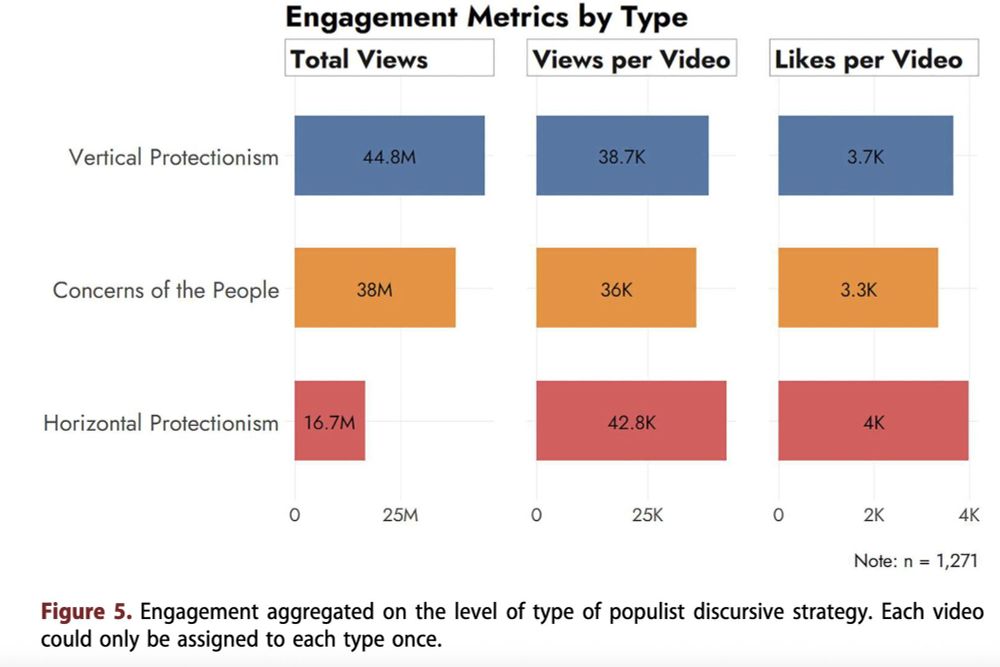
October 7, 2025 at 8:03 AM
📈 Results: What Was Posted & What Drives Engagement?
– Anti-elitism and out-group attacks generated higher per-video engagement.
– Yet most content leaned toward anti-elite messages or concern-focused themes (economy/inflation, security, rights/freedoms).
– Anti-elitism and out-group attacks generated higher per-video engagement.
– Yet most content leaned toward anti-elite messages or concern-focused themes (economy/inflation, security, rights/freedoms).
🧩 Populist Themes & Types (theory-grounded)
We identified 12 themes organized into 3 populist types:
1. Horizontal protectionism (identity/out-group: migrants, “wokeism”)
2. Vertical protectionism (anti-elitism/anti-institutionalism)
3. Concerns of the people (economy/inflation, security, freedoms)
We identified 12 themes organized into 3 populist types:
1. Horizontal protectionism (identity/out-group: migrants, “wokeism”)
2. Vertical protectionism (anti-elitism/anti-institutionalism)
3. Concerns of the people (economy/inflation, security, freedoms)

October 7, 2025 at 8:03 AM
🧩 Populist Themes & Types (theory-grounded)
We identified 12 themes organized into 3 populist types:
1. Horizontal protectionism (identity/out-group: migrants, “wokeism”)
2. Vertical protectionism (anti-elitism/anti-institutionalism)
3. Concerns of the people (economy/inflation, security, freedoms)
We identified 12 themes organized into 3 populist types:
1. Horizontal protectionism (identity/out-group: migrants, “wokeism”)
2. Vertical protectionism (anti-elitism/anti-institutionalism)
3. Concerns of the people (economy/inflation, security, freedoms)
🔍 Data & Methods
Timeframe: Mar–Jun 2024
– Content analysis: LLM-enhanced topic modeling (based on 'Concept Induction' by Lam et al., 2024) on 1,271 AfD video transcripts from 54 AfD accounts.
– Engagement comparison: Platform metrics from 109 politicians (5,590 videos in total)
Timeframe: Mar–Jun 2024
– Content analysis: LLM-enhanced topic modeling (based on 'Concept Induction' by Lam et al., 2024) on 1,271 AfD video transcripts from 54 AfD accounts.
– Engagement comparison: Platform metrics from 109 politicians (5,590 videos in total)
October 7, 2025 at 8:03 AM
🔍 Data & Methods
Timeframe: Mar–Jun 2024
– Content analysis: LLM-enhanced topic modeling (based on 'Concept Induction' by Lam et al., 2024) on 1,271 AfD video transcripts from 54 AfD accounts.
– Engagement comparison: Platform metrics from 109 politicians (5,590 videos in total)
Timeframe: Mar–Jun 2024
– Content analysis: LLM-enhanced topic modeling (based on 'Concept Induction' by Lam et al., 2024) on 1,271 AfD video transcripts from 54 AfD accounts.
– Engagement comparison: Platform metrics from 109 politicians (5,590 videos in total)
❓ Research Interests
– How did AfD politicians use TikTok to communicate populist content during the run-up to the EU elections?
– How did these communication strategies relate to user engagement?
– How did AfD politicians use TikTok to communicate populist content during the run-up to the EU elections?
– How did these communication strategies relate to user engagement?
October 7, 2025 at 8:03 AM
❓ Research Interests
– How did AfD politicians use TikTok to communicate populist content during the run-up to the EU elections?
– How did these communication strategies relate to user engagement?
– How did AfD politicians use TikTok to communicate populist content during the run-up to the EU elections?
– How did these communication strategies relate to user engagement?