



Herb Susmann
@herbps10.bsky.social
Post-doc at NYU Grossman School of Medicine (this account is solely in my personal capacity, all views are my own etc). Non-parametric statistics, causal inference, Bayesian methods. Herbsusmann.com
They also have a very neat way of deriving the efficient influence function for their infinite-dimensional parameter of interest based on Luedtke's autodiff work

October 22, 2025 at 2:47 PM
They also have a very neat way of deriving the efficient influence function for their infinite-dimensional parameter of interest based on Luedtke's autodiff work
trying to find a way to compare against previous years, unfortunately the archive.org snapshots of the job board are spotty
October 11, 2025 at 9:12 PM
trying to find a way to compare against previous years, unfortunately the archive.org snapshots of the job board are spotty
my interest in putting bounds on things now
September 25, 2025 at 5:23 PM
my interest in putting bounds on things now
some of the tricks we found useful -- the last bullet especially, I learned a lot from working closely with @alecmcclean.bsky.social on this

September 25, 2025 at 5:23 PM
some of the tricks we found useful -- the last bullet especially, I learned a lot from working closely with @alecmcclean.bsky.social on this
what's neat about our approach is that you can vary the propensity score threshold that defines the overlap and non-overlap population, and then choose the threshold that yields the smallest bounds -- with frequentist guarantees

September 25, 2025 at 5:23 PM
what's neat about our approach is that you can vary the propensity score threshold that defines the overlap and non-overlap population, and then choose the threshold that yields the smallest bounds -- with frequentist guarantees
The idea is very simple: we divide the population into a part in which overlap is satisfied, and a part in which overlap is violated. The non-overlap part is the one that poses problems, so we just apply worst-case bounds on the ATE in that subpopulation.

September 25, 2025 at 5:23 PM
The idea is very simple: we divide the population into a part in which overlap is satisfied, and a part in which overlap is violated. The non-overlap part is the one that poses problems, so we just apply worst-case bounds on the ATE in that subpopulation.
a related tip i've heard for talks is to use author + year + journal abbreviation for references on the slides (e.g. Robins 1995 JASA), makes it easier for people to find what you're talking about
September 5, 2025 at 12:39 AM
a related tip i've heard for talks is to use author + year + journal abbreviation for references on the slides (e.g. Robins 1995 JASA), makes it easier for people to find what you're talking about
The paper includes a friendly (I hope) introduction to causal inference and TMLE, and has sample R code you can use to run this type of analysis
September 3, 2025 at 3:07 PM
The paper includes a friendly (I hope) introduction to causal inference and TMLE, and has sample R code you can use to run this type of analysis
The insight is that while you can't point identify a treatment effect when the outcome is left-censored, it's possible to derive bounds on the true average treatment effect. It turns out you can estimate these bounds using standard causal inference methods like TMLE

September 3, 2025 at 3:07 PM
The insight is that while you can't point identify a treatment effect when the outcome is left-censored, it's possible to derive bounds on the true average treatment effect. It turns out you can estimate these bounds using standard causal inference methods like TMLE
the setup in this template uses slurm job arrays to spin up a bunch of workers, each of which then simulates some data, runs your estimators, saves the results in a cache directory, and then helps you collect all the results and generate tables/figures
August 26, 2025 at 10:09 PM
the setup in this template uses slurm job arrays to spin up a bunch of workers, each of which then simulates some data, runs your estimators, saves the results in a cache directory, and then helps you collect all the results and generate tables/figures
about that: www.sciencedirect.com/science/arti...

Is the “well-defined intervention assumption” politically conservative?
www.sciencedirect.com
June 20, 2025 at 1:32 PM
about that: www.sciencedirect.com/science/arti...
Reposted by Herb Susmann

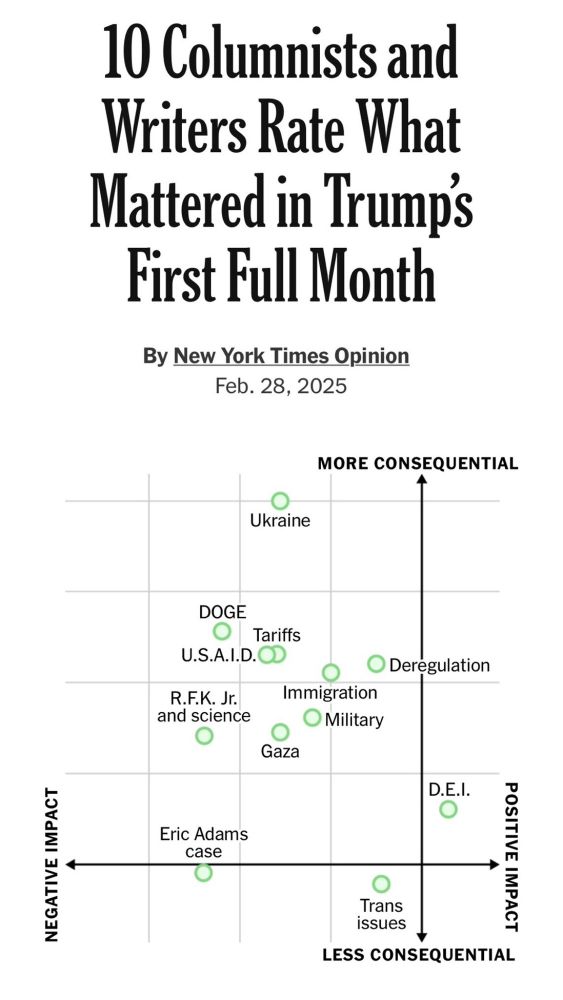
The placement of "trans issues" here is, without exaggeration, one of the most depraved things I've ever seen in the pages of this publication.

Of course the NYT sees the "DEI" stuff positively & is neutral on anti-trans discrimination
March 1, 2025 at 3:59 PM
The placement of "trans issues" here is, without exaggeration, one of the most depraved things I've ever seen in the pages of this publication.