



Ryan Heuser
@heuser.bsky.social
Assistant Professor of Digital Humanities @camdighum.bsky.social. Florida man abroad, lapsed Catholic, vulgar marxist; phd'd Stanford English, alum of Literary Lab. I make data about culture and write about forms of abstraction in (C18) literary history.
Is there a list of collaborationist unis out there? So many now it's hard to keep track
November 29, 2025 at 9:09 PM
Is there a list of collaborationist unis out there? So many now it's hard to keep track
ah! I see what you mean
November 28, 2025 at 6:40 PM
ah! I see what you mean
This is already published in Intl Journal of DH! doi is 10.1007/s42803-023-00075-w
November 28, 2025 at 6:21 PM
This is already published in Intl Journal of DH! doi is 10.1007/s42803-023-00075-w
Very useful, conceptually as well as technically: I didn't know about the "output_attentions" flag, I want to experiment with that soon.
November 28, 2025 at 12:29 PM
Very useful, conceptually as well as technically: I didn't know about the "output_attentions" flag, I want to experiment with that soon.
I like my contradictions sharpened
November 20, 2025 at 10:03 PM
I like my contradictions sharpened
How'd you know I'm hard at work on BernAI Bro
November 20, 2025 at 8:23 PM
How'd you know I'm hard at work on BernAI Bro
Most of all, I recommend you check out all the incredible articles in this special issue (culturalanalytics.org/issue/12788), with work by Tess McNulty, Laura Chapot, @jeddobson.bsky.social, Alexandre Miller et al, and @katelelkins.bsky.social.
Vol. 10, Issue 3, 2025 | Published by Journal of Cultural Analytics
In this special issue, we bring together scholars from across multiple disciplines to reconsider the intersections of computation and form at this emerging technological and critical moment.
culturalanalytics.org
October 13, 2025 at 3:50 PM
Most of all, I recommend you check out all the incredible articles in this special issue (culturalanalytics.org/issue/12788), with work by Tess McNulty, Laura Chapot, @jeddobson.bsky.social, Alexandre Miller et al, and @katelelkins.bsky.social.
Finally, I speculate whether generative AI secretly encodes an aesthetics of its own—as if internalizing Cicero's goals for art to "delight" & "instruct" to an obsessive, historically unprecedented degree. I propose "generative formalism" as a method for studying this hyper-historical aesthetics.
October 13, 2025 at 3:50 PM
Finally, I speculate whether generative AI secretly encodes an aesthetics of its own—as if internalizing Cicero's goals for art to "delight" & "instruct" to an obsessive, historically unprecedented degree. I propose "generative formalism" as a method for studying this hyper-historical aesthetics.
I investigate whether training data can explain this effect, and find some evidence that it cannot. Instead, I find that "instruction-tuning" and Reinforcement Learning Human Feedback—designed to produce "helpful" chatbots—may instill conservative, "idealizing" aesthetic tendencies in the models.


October 13, 2025 at 3:50 PM
I investigate whether training data can explain this effect, and find some evidence that it cannot. Instead, I find that "instruction-tuning" and Reinforcement Learning Human Feedback—designed to produce "helpful" chatbots—may instill conservative, "idealizing" aesthetic tendencies in the models.
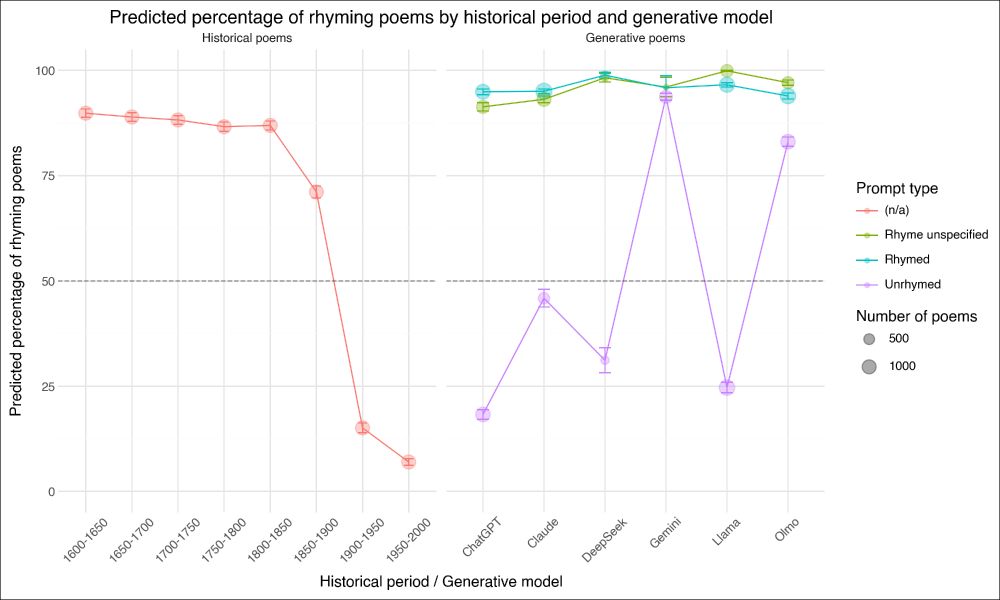
As in work by @mellymeldubs.bsky.social et al, I examine formal tendencies in the poetic output of 9 LLMs. I find that LLM verse is "formally stuck" on rhyme & regular meter, producing these forms far more than even the formally strictest periods of literary history—and even when instructed not to.

October 13, 2025 at 3:50 PM
As in work by @mellymeldubs.bsky.social et al, I examine formal tendencies in the poetic output of 9 LLMs. I find that LLM verse is "formally stuck" on rhyme & regular meter, producing these forms far more than even the formally strictest periods of literary history—and even when instructed not to.