



Paul Teas
@icedteas.bsky.social
Research scientist and Incoming post-doctoral fellow at the University of Chicago | Researching attitude moralization and political conflict
Full paper available here:
www.researchgate.net/publication/...
www.researchgate.net/publication/...

(PDF) Partisan or Principled? Explaining Political Differences in Attitudes About Violations of Democratic Norms
PDF | Although both Democrats and Republicans tend to be more tolerant of democratic norm violations that benefit their own party, this pattern is not... | Find, read and cite all the research you nee...
www.researchgate.net
October 31, 2025 at 4:19 PM
Full paper available here:
www.researchgate.net/publication/...
www.researchgate.net/publication/...
Anyway, a lot more in this paper, but a main takeaway:
Both parties bend democratic principles when it helps their side. But partisan asymmetries beyond that emerge around politicized issues like mail-in voting—not out of more stable differences in democratic values.
Both parties bend democratic principles when it helps their side. But partisan asymmetries beyond that emerge around politicized issues like mail-in voting—not out of more stable differences in democratic values.
October 31, 2025 at 4:19 PM
Anyway, a lot more in this paper, but a main takeaway:
Both parties bend democratic principles when it helps their side. But partisan asymmetries beyond that emerge around politicized issues like mail-in voting—not out of more stable differences in democratic values.
Both parties bend democratic principles when it helps their side. But partisan asymmetries beyond that emerge around politicized issues like mail-in voting—not out of more stable differences in democratic values.
I shouldn't say partisan differences disappear… it's just that partisans on *both sides* oppose democratic violations less when it benefits their side, which is not ideal but not unexpected.
October 31, 2025 at 4:19 PM
I shouldn't say partisan differences disappear… it's just that partisans on *both sides* oppose democratic violations less when it benefits their side, which is not ideal but not unexpected.
I find the latter.
When I test reactions to less politicized violations such as removing polling locations from opponent strongholds, the partisan differences disappear!
When I test reactions to less politicized violations such as removing polling locations from opponent strongholds, the partisan differences disappear!

October 31, 2025 at 4:19 PM
I find the latter.
When I test reactions to less politicized violations such as removing polling locations from opponent strongholds, the partisan differences disappear!
When I test reactions to less politicized violations such as removing polling locations from opponent strongholds, the partisan differences disappear!
But are Republicans actually just more tolerant of limitations to voter access than Democrats? Or is this more about specific, politicized practices like vote-by-mail and voter ID laws?
October 31, 2025 at 4:19 PM
But are Republicans actually just more tolerant of limitations to voter access than Democrats? Or is this more about specific, politicized practices like vote-by-mail and voter ID laws?
For instance, I find that Republicans are less opposed to politically-driven limitations to vote-by-mail than Democrats are—even when the restriction hurts their own party.
Note: this holds even when using **perceived** (rather than manipulated) inparty benefit.
Note: this holds even when using **perceived** (rather than manipulated) inparty benefit.

October 31, 2025 at 4:19 PM
For instance, I find that Republicans are less opposed to politically-driven limitations to vote-by-mail than Democrats are—even when the restriction hurts their own party.
Note: this holds even when using **perceived** (rather than manipulated) inparty benefit.
Note: this holds even when using **perceived** (rather than manipulated) inparty benefit.
Some would argue that Republicans are more tolerant of limitations to voter access, even when such limitations could hurt them electorally. That is, they just care less about voter access in principle (or Democrats care more about it in principle)
October 31, 2025 at 4:19 PM
Some would argue that Republicans are more tolerant of limitations to voter access, even when such limitations could hurt them electorally. That is, they just care less about voter access in principle (or Democrats care more about it in principle)
Across two experiments, both parties show the same basic pattern: they’re more accepting of norm violations when those violations benefit their side (shocking no one)
But there are important wrinkles in this tendency too
But there are important wrinkles in this tendency too
October 31, 2025 at 4:19 PM
Across two experiments, both parties show the same basic pattern: they’re more accepting of norm violations when those violations benefit their side (shocking no one)
But there are important wrinkles in this tendency too
But there are important wrinkles in this tendency too
Also confirmed that young participants is definitely a factor in antidemocratic endorsement in both datasets, but it doesn't nullify the effect of outparty warmth
November 24, 2024 at 7:12 PM
Also confirmed that young participants is definitely a factor in antidemocratic endorsement in both datasets, but it doesn't nullify the effect of outparty warmth
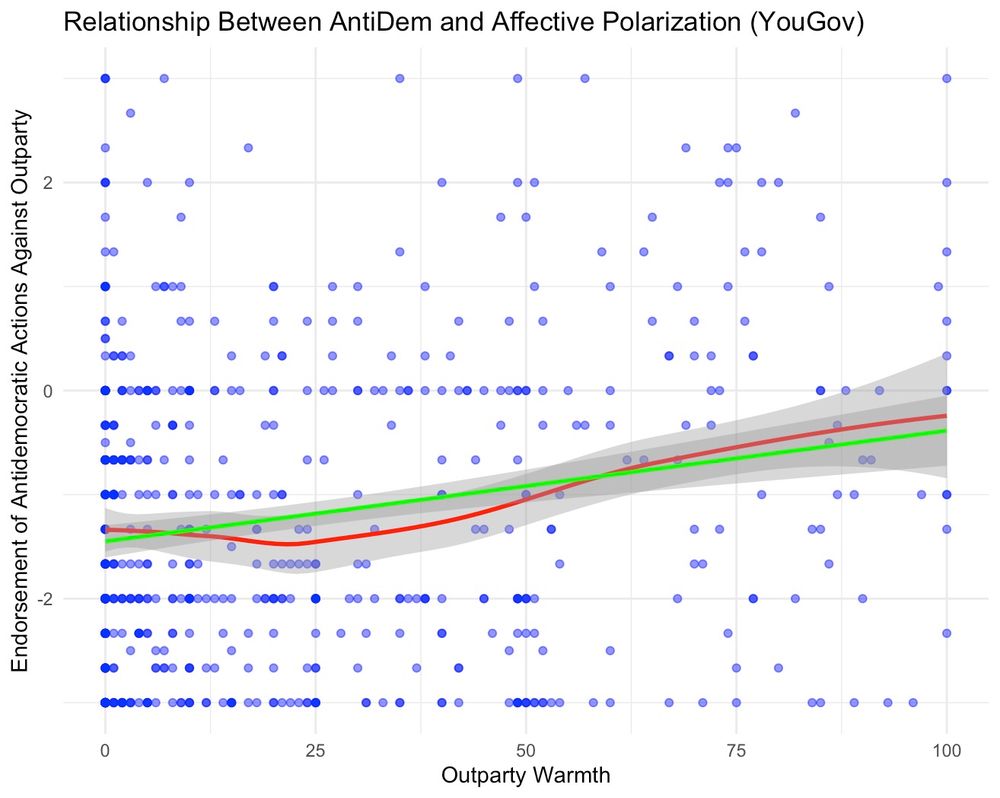
Of course, when graphing only outparty warmth, we get the weird relationship where the more you like the other party, the more willing you are to violate their democratic rights

November 24, 2024 at 7:03 PM
Of course, when graphing only outparty warmth, we get the weird relationship where the more you like the other party, the more willing you are to violate their democratic rights
We've removed inattentive respondents through several rounds, so we're pretty confident that it's not that. I've also found this in a few datasets with different methods of cleaning, etc.
November 22, 2024 at 11:02 PM
We've removed inattentive respondents through several rounds, so we're pretty confident that it's not that. I've also found this in a few datasets with different methods of cleaning, etc.
It would be one thing if they were just anti-democratic actions in general, but the items ask about specific actions *against Republicans* so I can't see how liking Republicans more is associated with greater willingness to screw them over
November 22, 2024 at 2:38 AM
It would be one thing if they were just anti-democratic actions in general, but the items ask about specific actions *against Republicans* so I can't see how liking Republicans more is associated with greater willingness to screw them over
Yes, it appears in a couple of my data sets that the negative relationship between affective polarization and support for anti-democratic actions occurs for Democrats, but not really for Republicans.
November 21, 2024 at 8:54 PM
Yes, it appears in a couple of my data sets that the negative relationship between affective polarization and support for anti-democratic actions occurs for Democrats, but not really for Republicans.
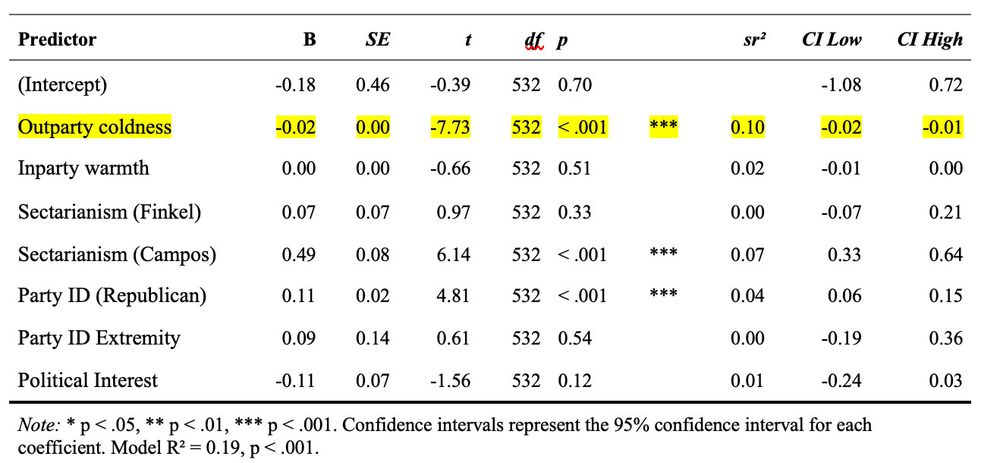
Thanks! Though I checked for that and political interest (extent to which one follows politics) didn't eliminate the effect
November 19, 2024 at 7:20 PM
Thanks! Though I checked for that and political interest (extent to which one follows politics) didn't eliminate the effect
Has anyone else found this? Is there a theoretical explanation I’m missing? Would love to hear your thoughts or related findings!
November 19, 2024 at 4:17 PM
Has anyone else found this? Is there a theoretical explanation I’m missing? Would love to hear your thoughts or related findings!
This points to the need for better measures of affective polarization like political sectarianism—the moralized, toxic view of the other side. (come to my SPSP symposium about this!)
But still... why would colder feelings lead to less support for antidemocratic actions?
But still... why would colder feelings lead to less support for antidemocratic actions?
November 19, 2024 at 4:17 PM
This points to the need for better measures of affective polarization like political sectarianism—the moralized, toxic view of the other side. (come to my SPSP symposium about this!)
But still... why would colder feelings lead to less support for antidemocratic actions?
But still... why would colder feelings lead to less support for antidemocratic actions?
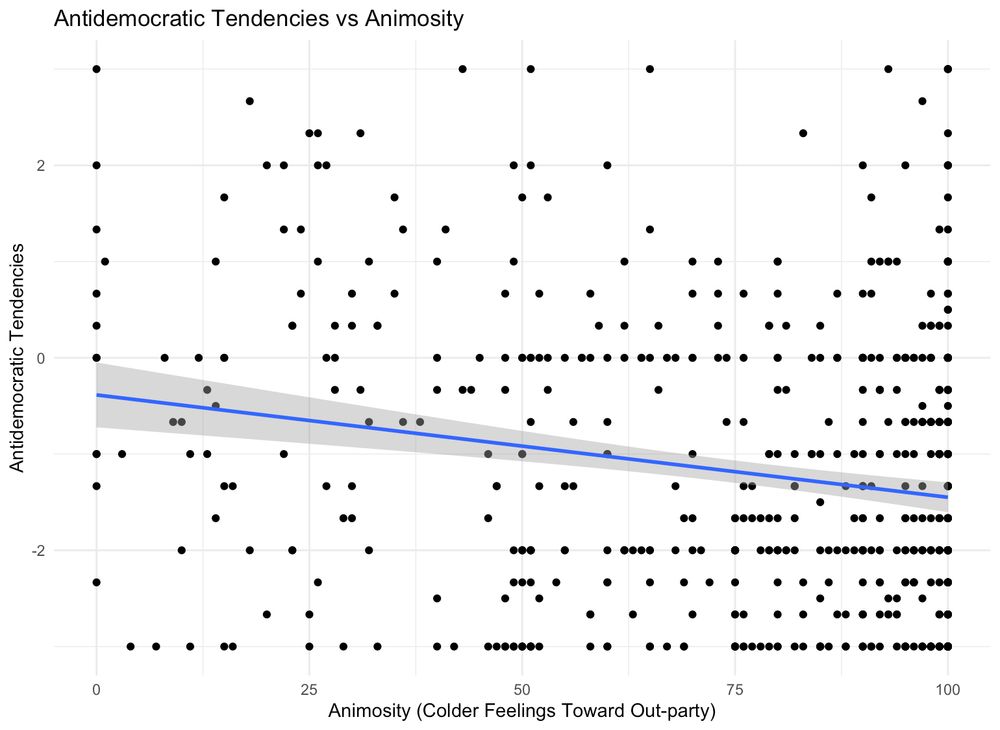
3️⃣ Could skew in the data explain it?
There’s definitely skew, but I find it hard to believe that it would fully account for the results.
There’s definitely skew, but I find it hard to believe that it would fully account for the results.
November 19, 2024 at 4:17 PM
3️⃣ Could skew in the data explain it?
There’s definitely skew, but I find it hard to believe that it would fully account for the results.
There’s definitely skew, but I find it hard to believe that it would fully account for the results.
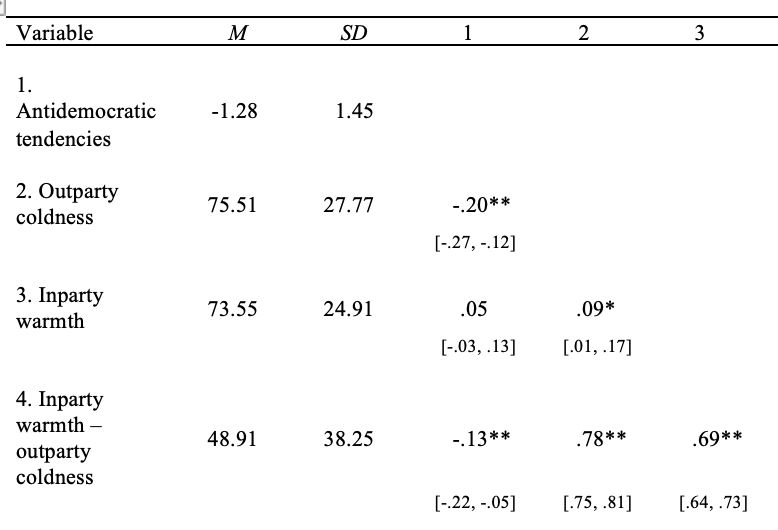
2️⃣ Maybe it's because I'm not using a combination of inparty warmth minus outparty cold…coldness(?)..coldth(??)
Tried that too and found the same negative relationship!
Tried that too and found the same negative relationship!
November 19, 2024 at 4:17 PM
2️⃣ Maybe it's because I'm not using a combination of inparty warmth minus outparty cold…coldness(?)..coldth(??)
Tried that too and found the same negative relationship!
Tried that too and found the same negative relationship!
Let’s look at some possible explanations (and rule them out):
1️⃣ Maybe people who are more polarized are also more politically conscious, which is related to more commitment to democratic norms?
Nah, I controlled for political interest and it does nothing.
1️⃣ Maybe people who are more polarized are also more politically conscious, which is related to more commitment to democratic norms?
Nah, I controlled for political interest and it does nothing.
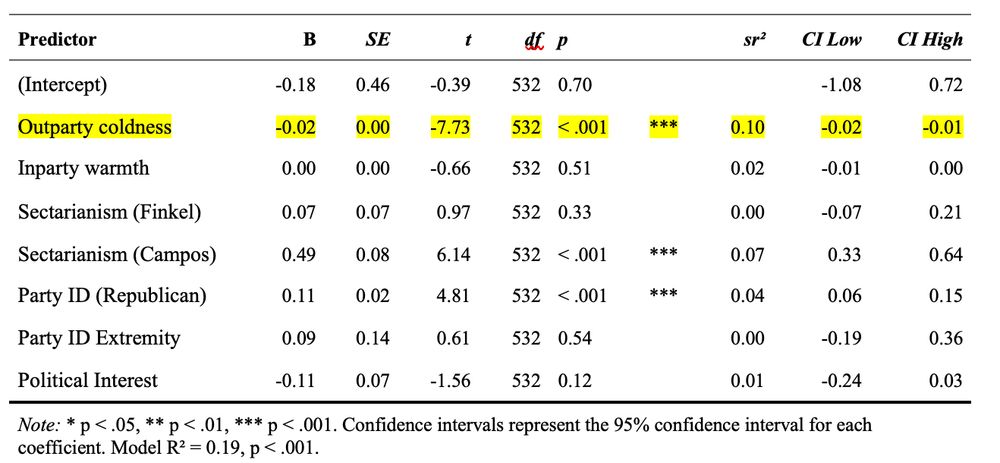
November 19, 2024 at 4:17 PM
Let’s look at some possible explanations (and rule them out):
1️⃣ Maybe people who are more polarized are also more politically conscious, which is related to more commitment to democratic norms?
Nah, I controlled for political interest and it does nothing.
1️⃣ Maybe people who are more polarized are also more politically conscious, which is related to more commitment to democratic norms?
Nah, I controlled for political interest and it does nothing.
I've seen this before in work by Campos & @cmfederico.bsky.social and @elijfinkel.bsky.social et al., especially when accounting for political sectarianism (othering + aversion + moralization). But I thought affective polarization was just unrelated, not negatively related!
November 19, 2024 at 4:17 PM
I've seen this before in work by Campos & @cmfederico.bsky.social and @elijfinkel.bsky.social et al., especially when accounting for political sectarianism (othering + aversion + moralization). But I thought affective polarization was just unrelated, not negatively related!