



Dr Jack Baldwin
@jackbwin.bsky.social
Materials Scientist at UKNNL
Reposted by Dr Jack Baldwin

Combining the effects of amides and cyclopentadienyl ligands in a dysprosium single-molecule magnet. Please see the link for our latest collaborative work with @nfchilton.bsky.social group now published in @jacs.acspublications.org, led by Dr Jack Emerson-King:
pubs.acs.org/doi/full/10....
pubs.acs.org/doi/full/10....

Magnetic Hysteresis up to 73 K in a Dysprosium Cyclopentadienyl-Amide Single-Molecule Magnet
Single-molecule magnets (SMMs) based on dysprosocenium cations, [Dy(CpR)2]+ (CpR = substituted cyclopentadienyl), have set record effective energy barriers to magnetic reversal (Ueff) and temperatures...
pubs.acs.org
September 18, 2025 at 10:46 AM
Combining the effects of amides and cyclopentadienyl ligands in a dysprosium single-molecule magnet. Please see the link for our latest collaborative work with @nfchilton.bsky.social group now published in @jacs.acspublications.org, led by Dr Jack Emerson-King:
pubs.acs.org/doi/full/10....
pubs.acs.org/doi/full/10....
Reposted by Dr Jack Baldwin
@jackbwin.bsky.social 's review on metal bis(trimethylsilyl)phosphide chemistry has just been published in @chemsocrev.rsc.org! 🥳 Hope people find this a useful resource:
pubs.rsc.org/en/content/a...
pubs.rsc.org/en/content/a...
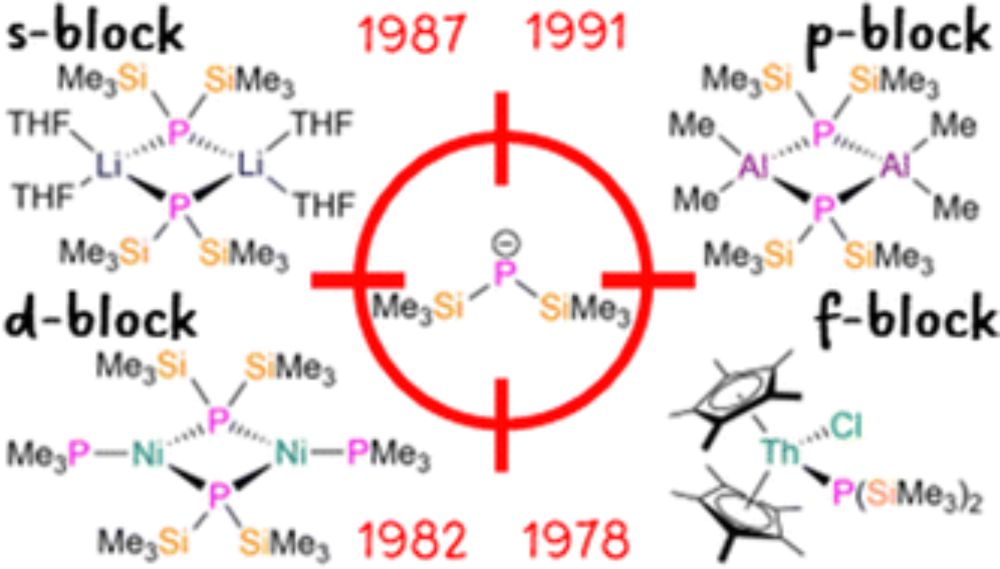
Bis(trimethylsilyl)phosphide chemistry: a half-century of advances across the periodic table
Whilst bis(trimethylsilyl)amide has been used extensively as a ligand across the periodic table, the chemistry of its heavier group 15 congeners is relatively underdeveloped. However, bis(trimethylsil...
pubs.rsc.org
March 12, 2025 at 7:03 PM
@jackbwin.bsky.social 's review on metal bis(trimethylsilyl)phosphide chemistry has just been published in @chemsocrev.rsc.org! 🥳 Hope people find this a useful resource:
pubs.rsc.org/en/content/a...
pubs.rsc.org/en/content/a...
Reposted by Dr Jack Baldwin
Check out some gorgeous paramagnetic 31P NMR spectra of lanthanide phosphide complexes 🤩 now published in JACS Au! Led by Jack Baldwin and in collaboration with the groups of Dr Daniel Lee and @nfchilton.bsky.social. pubs.acs.org/doi/10.1021/...
@gemmagransbury.bsky.social
@gemmagransbury.bsky.social

31P NMR Chemical Shift Anisotropy in Paramagnetic Lanthanide Phosphide Complexes
Lanthanide (Ln) magnetic resonance imaging and chiral shift reagents generally exploit 1H NMR shifts, as paramagnetic broadening tends to preclude the use of heavier, less sensitive nuclei. Here, we report the solution and solid-state 31P NMR shifts of an isostructural series of distorted trigonal bipyramidal Ln(III) tris-silylphosphide complexes, [Ln{P(SiMe3)2}3(THF)2] (1-Ln; Ln = La, Ce, Pr, Nd, Sm); 1-Ln was also characterized by elemental analysis; single-crystal and powder X-ray diffraction; multinuclear NMR, EPR, ATR-IR, and UV–vis-NIR spectroscopy; and SQUID magnetometry. Breaking assumptions, we observed paramagnetically broadened 31P NMR spectra for the Ln-bound P atoms for the 1-Ln family; in solution, 1-Nd showed the most downfield chemical shift (δ{31P} = 2570.14 ppm) and 1-Sm the most upfield value (δ{31P} = −259.21 ppm). We determined the span of the chemical shift anisotropies (CSAs) for solid 1-Ln using magic angle spinning NMR spectroscopy; the CSA was largest for 1-Pr (Ω{31P} ≈ 2000 ppm), consistent with a combination of paramagnetism and the relatively large differences in pyramidalization of the three P atoms in the solid-state. Density functional theory calculations for 1-La were in excellent agreement with the experimentally determined 31P NMR parameters. We find good agreement of experimental 1H NMR chemical shifts with ab initio-calculated values for paramagnetic 1-Ln, while the shifts of heavier 13C, 29Si, and 31P nuclei are not well-reproduced due to the current limitations of paramagnetic NMR calculations for nuclei with large contact shifts.
pubs.acs.org
February 21, 2025 at 10:45 PM
Check out some gorgeous paramagnetic 31P NMR spectra of lanthanide phosphide complexes 🤩 now published in JACS Au! Led by Jack Baldwin and in collaboration with the groups of Dr Daniel Lee and @nfchilton.bsky.social. pubs.acs.org/doi/10.1021/...
@gemmagransbury.bsky.social
@gemmagransbury.bsky.social
Me again! Our work in the Mills Group involving Ln(II) complexes using a bulkier triisopropylsilylphosphide ligand is now published in InorgChem! (doi.org/10.1021/acs....) Huge thanks to all involved!
https://doi.org/10.1021/acs.in…
November 13, 2024 at 10:36 PM
Me again! Our work in the Mills Group involving Ln(II) complexes using a bulkier triisopropylsilylphosphide ligand is now published in InorgChem! (doi.org/10.1021/acs....) Huge thanks to all involved!
"Fire burn, and cauldron bubble" 🧙♀️
Our work in the Mills Group on Ln(II) silylphosphide chemistry has now been published online in InorgChem (doi.org/10.1021/acs....). A big thank you to all involved!
Our work in the Mills Group on Ln(II) silylphosphide chemistry has now been published online in InorgChem (doi.org/10.1021/acs....). A big thank you to all involved!
doi.org
November 13, 2024 at 10:35 PM
"Fire burn, and cauldron bubble" 🧙♀️
Our work in the Mills Group on Ln(II) silylphosphide chemistry has now been published online in InorgChem (doi.org/10.1021/acs....). A big thank you to all involved!
Our work in the Mills Group on Ln(II) silylphosphide chemistry has now been published online in InorgChem (doi.org/10.1021/acs....). A big thank you to all involved!