



Jakub Tomek
@jakubtomek.bsky.social
Computational and experimental cardiology. Tea lover. Uilleann Piper. Sir Henry Wellcome Fellow at Oxford and UC Davis. Blog https://underlid.blogspot.com
Of course that's what they do, because it makes them look like the good guys, who do the right thing first. Then the onus of effort is on the people who come afterwards, even if they're the ones who are in fact solid. Disgusting, but unsurprising.
December 16, 2025 at 4:36 PM
Of course that's what they do, because it makes them look like the good guys, who do the right thing first. Then the onus of effort is on the people who come afterwards, even if they're the ones who are in fact solid. Disgusting, but unsurprising.
The book is available through Amazon (t.co/9qvCkYKeLJ) or on the publisher website (t.co/agmYYi66IW). Many universities got it through subscription, so you can check here onlinelibrary.wiley.com/doi/book/10.... or with your library for free access.
Thanks for sharing!
Thanks for sharing!
https://www.amazon.co.uk/Basic-Statistics-Life-Scientists-Techniques/dp/1394284969
t.co
December 9, 2025 at 1:55 PM
The book is available through Amazon (t.co/9qvCkYKeLJ) or on the publisher website (t.co/agmYYi66IW). Many universities got it through subscription, so you can check here onlinelibrary.wiley.com/doi/book/10.... or with your library for free access.
Thanks for sharing!
Thanks for sharing!
I wrote this together with Prof. David Eisner, and it was honestly one of the smoothest and nicest collaborations ever. You can find more about the background of the project and how it relates to punk rock here: t.co/seVYPxAth6
5/
5/
https://underlid.blogspot.com/2025/10/writing-book-punk-style.html
t.co
December 9, 2025 at 1:53 PM
I wrote this together with Prof. David Eisner, and it was honestly one of the smoothest and nicest collaborations ever. You can find more about the background of the project and how it relates to punk rock here: t.co/seVYPxAth6
5/
5/
It will help you figure out which statistical test to use for what question and data, and what to be careful about when using them. How to avoid common issues such as pseudoreplication and multiple testing problem. We also cover basics of data visualization and experimental design.
4/
4/
December 9, 2025 at 1:53 PM
It will help you figure out which statistical test to use for what question and data, and what to be careful about when using them. How to avoid common issues such as pseudoreplication and multiple testing problem. We also cover basics of data visualization and experimental design.
4/
4/
Existing books are typically too long, too complex, too mathsy, and at the same time often don't go into areas that essential for scientists.
We took an "maximum understanding, minimum maths" approach, fitting a lot of relevant content in under 200 pages.
3/
We took an "maximum understanding, minimum maths" approach, fitting a lot of relevant content in under 200 pages.
3/
December 9, 2025 at 1:52 PM
Existing books are typically too long, too complex, too mathsy, and at the same time often don't go into areas that essential for scientists.
We took an "maximum understanding, minimum maths" approach, fitting a lot of relevant content in under 200 pages.
3/
We took an "maximum understanding, minimum maths" approach, fitting a lot of relevant content in under 200 pages.
3/
Statistics is a key element of today's science. Unfortunately, its ubiquity is parallelled by ubiquity of problematic use, which negatively affects interpretation of results and reproducibility.
Key issue was - how to learn practical statistics for life sciences?
2/
Key issue was - how to learn practical statistics for life sciences?
2/
December 9, 2025 at 1:51 PM
Statistics is a key element of today's science. Unfortunately, its ubiquity is parallelled by ubiquity of problematic use, which negatively affects interpretation of results and reproducibility.
Key issue was - how to learn practical statistics for life sciences?
2/
Key issue was - how to learn practical statistics for life sciences?
2/
Thanks so much to everyone involved, including Xin Zhou, Hector Martinez-Navarro, Maxx Holmes, Lucas Arantes Berg, Tom Bury, Marketa Tomkova, Emily Jo, Norbert Nagy, Ambre Bertrand, Alfonso Bueno-Orovio, @physicsoftheheart.bsky.social, Don Bers, Blanca Rodriguez, and Jordi Heijman!
March 30, 2025 at 10:19 PM
Thanks so much to everyone involved, including Xin Zhou, Hector Martinez-Navarro, Maxx Holmes, Lucas Arantes Berg, Tom Bury, Marketa Tomkova, Emily Jo, Norbert Nagy, Ambre Bertrand, Alfonso Bueno-Orovio, @physicsoftheheart.bsky.social, Don Bers, Blanca Rodriguez, and Jordi Heijman!
Finally, if you want to study how a signalling pathway, a drug, or a nonstandard channel affect physiology, model generality is key for obtaining a complete picture of the effects and benefits/risks.
Happy to answer any questions/discuss suitability for your projects!
Happy to answer any questions/discuss suitability for your projects!
March 30, 2025 at 10:15 PM
Finally, if you want to study how a signalling pathway, a drug, or a nonstandard channel affect physiology, model generality is key for obtaining a complete picture of the effects and benefits/risks.
Happy to answer any questions/discuss suitability for your projects!
Happy to answer any questions/discuss suitability for your projects!
Second, real-world arrhythmia arises from interactions of arrhythmia triggers (including afterdepolarisations) and substrate (alternans, steep S1-S2 restitution). To reconstruct different origins of arrhythmia, we need a single model capable of all of those. 8/X
March 30, 2025 at 10:15 PM
Second, real-world arrhythmia arises from interactions of arrhythmia triggers (including afterdepolarisations) and substrate (alternans, steep S1-S2 restitution). To reconstruct different origins of arrhythmia, we need a single model capable of all of those. 8/X
First, it is about general credibility. Models are, like real cells, full of interconnections and feedback loops. This means if a model has a mechanistic problem in one component, this can propagate into other areas of use and cause incorrect predictions. 7/X
March 30, 2025 at 10:14 PM
First, it is about general credibility. Models are, like real cells, full of interconnections and feedback loops. This means if a model has a mechanistic problem in one component, this can propagate into other areas of use and cause incorrect predictions. 7/X
T-World will be made freely available as open-source code (Matlab, CellML, C, CUDA) and online graphical user interface to facilitate use by non-coders.
As a final note, why does generality of a model matter so much?
6/X
As a final note, why does generality of a model matter so much?
6/X
March 30, 2025 at 10:14 PM
T-World will be made freely available as open-source code (Matlab, CellML, C, CUDA) and online graphical user interface to facilitate use by non-coders.
As a final note, why does generality of a model matter so much?
6/X
As a final note, why does generality of a model matter so much?
6/X
How did we achieve this? The name of the model reflects contribution of labs from the whole world over last decades. We integrate ideas from the most influential families of cardiac models (Rudy and Bers/Grandi) and numerous new ideas and improvements. 5/X
March 30, 2025 at 10:14 PM
How did we achieve this? The name of the model reflects contribution of labs from the whole world over last decades. We integrate ideas from the most influential families of cardiac models (Rudy and Bers/Grandi) and numerous new ideas and improvements. 5/X
T-World demonstrates strong performance in predicting drug-induced arrhythmia risk and opens new opportunities for predicting and explaining drug efficacy, demonstrated by unpicking effects of mexiletine in Long QT syndrome 2. 4/X
March 30, 2025 at 10:13 PM
T-World demonstrates strong performance in predicting drug-induced arrhythmia risk and opens new opportunities for predicting and explaining drug efficacy, demonstrated by unpicking effects of mexiletine in Long QT syndrome 2. 4/X
Using T-World we revealed a likely sex-specific arrhythmia risk in females related to restitution properties, identified arrhythmia drivers in type 2 diabetes, and describe unexpectedly direct possible pro-arrhythmic role of NaV1.8 in heart failure. 3/X
March 30, 2025 at 10:13 PM
Using T-World we revealed a likely sex-specific arrhythmia risk in females related to restitution properties, identified arrhythmia drivers in type 2 diabetes, and describe unexpectedly direct possible pro-arrhythmic role of NaV1.8 in heart failure. 3/X
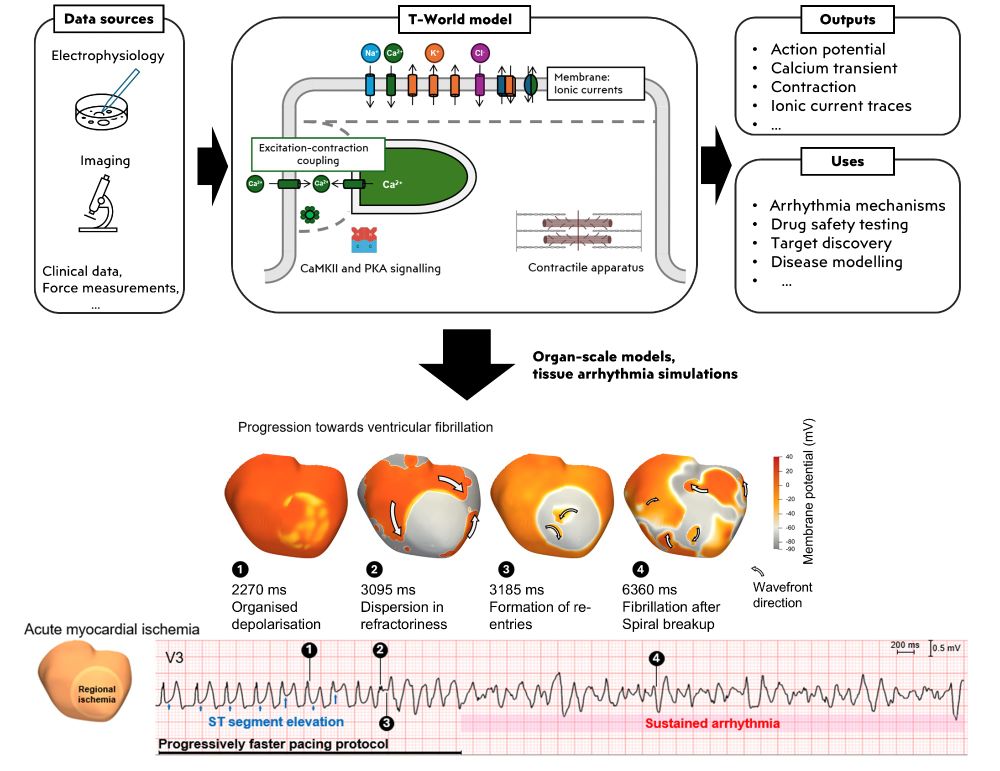
T-World recapitulates all key cellular drivers of arrhythmia: early and delayed afterdepolarisations, alternans, and steep S1-S2 restitution. We can now study their interactions in tissue, or carry out multifactorial assessment of drugs (including contractility). 2/X
March 30, 2025 at 10:13 PM
T-World recapitulates all key cellular drivers of arrhythmia: early and delayed afterdepolarisations, alternans, and steep S1-S2 restitution. We can now study their interactions in tissue, or carry out multifactorial assessment of drugs (including contractility). 2/X
Phew, this was close, just checked and this was the one before...

February 16, 2025 at 10:09 PM
Phew, this was close, just checked and this was the one before...
OK!
(using this as a last slide in talks, with "THE END" added; sadly, fewer and fewer people get the reference)
(using this as a last slide in talks, with "THE END" added; sadly, fewer and fewer people get the reference)

February 16, 2025 at 10:03 PM
OK!
(using this as a last slide in talks, with "THE END" added; sadly, fewer and fewer people get the reference)
(using this as a last slide in talks, with "THE END" added; sadly, fewer and fewer people get the reference)
You were saying?
www.asahq.org/about-asa/ne...
www.asahq.org/about-asa/ne...

Anthem Blue Cross Blue Shield Won’t Pay for the Complete Duration of Anesthesia for Patients’ Surgical Procedures
In an unprecedented move, Anthem Blue Cross Blue Shield plans representing Connecticut, New York and Missouri have unilaterally declared it will no longer pay for anesthesia care if the surgery or pro...
www.asahq.org
December 6, 2024 at 4:42 PM
You were saying?
www.asahq.org/about-asa/ne...
www.asahq.org/about-asa/ne...