



James Trujillo
@jamestrujillo.bsky.social
Assistant prof at University of Amsterdam using motion tracking and virtual agents to study multimodal language and social interaction.
Autistic and interested in autistic language and interaction.
Dad/papa, artist, runner, gamer.
Autistic and interested in autistic language and interaction.
Dad/papa, artist, runner, gamer.
I'm excited about the research we'll be doing, but also the impact that I hope it will have on creating more equitable access to healthcare for autistic adults. And to be doing something so cross-disciplinary with physical therapy / healthcare science.
Looking forward to sharing more soon..!
Looking forward to sharing more soon..!
January 27, 2026 at 4:29 PM
I'm excited about the research we'll be doing, but also the impact that I hope it will have on creating more equitable access to healthcare for autistic adults. And to be doing something so cross-disciplinary with physical therapy / healthcare science.
Looking forward to sharing more soon..!
Looking forward to sharing more soon..!
The project will run for the next two years, and we'll be using qualitative analysis, multimodal video analysis, and experiments (all developed in dialog with autistic advisors) to develop an autism education workshop and "communication toolbox" for physical therapists.
January 27, 2026 at 4:29 PM
The project will run for the next two years, and we'll be using qualitative analysis, multimodal video analysis, and experiments (all developed in dialog with autistic advisors) to develop an autism education workshop and "communication toolbox" for physical therapists.
Reposted by James Trujillo

what's the point of writing this? arguing (also to myself) that i) exploration is good, it doesn't need to lead to outputs! ii) models/research fail! and that can be insightful! but also if not insightful, that's still how research works! iii) sharing curiosity-driven efforts and excitement!
December 18, 2025 at 10:32 AM
what's the point of writing this? arguing (also to myself) that i) exploration is good, it doesn't need to lead to outputs! ii) models/research fail! and that can be insightful! but also if not insightful, that's still how research works! iii) sharing curiosity-driven efforts and excitement!
Ah cool! I'm curious what responses you get. It's certainly handy to have available, I imagine, especially for people more comfortable with R. Can't comment on how it compares to other options of course:)
November 26, 2025 at 6:24 PM
Ah cool! I'm curious what responses you get. It's certainly handy to have available, I imagine, especially for people more comfortable with R. Can't comment on how it compares to other options of course:)
I just use python for this. Pympi package for reading the .EAFs, collect and organize what I need in python, and then export to .csv and continue in R. I've been curious about the R packages as well, but I'm so comfortable with my python->R workflow I haven't gotten around to trying😅
November 26, 2025 at 10:29 AM
I just use python for this. Pympi package for reading the .EAFs, collect and organize what I need in python, and then export to .csv and continue in R. I've been curious about the R packages as well, but I'm so comfortable with my python->R workflow I haven't gotten around to trying😅
Usually 3), although using parselmouth to load them directly into python so I can compile a data frame, do any gap/overlap calculations, etc. Then over to R for stats. And then plenty of cycling back to ELAN to look again at specific data points
November 26, 2025 at 6:23 AM
Usually 3), although using parselmouth to load them directly into python so I can compile a data frame, do any gap/overlap calculations, etc. Then over to R for stats. And then plenty of cycling back to ELAN to look again at specific data points
This sounds very cool! Looking forward to reading it
November 21, 2025 at 4:44 PM
This sounds very cool! Looking forward to reading it
That would be very interesting to look at! Nothing came of it though?
November 20, 2025 at 6:28 AM
That would be very interesting to look at! Nothing came of it though?
Unfortunately, while autism in adulthood is already a much smaller field than in childhood, there's really very little research on aging in autism.
Trying to set up a project involving APD, hearing loss, and neurodivergence though, so hopefully I can say more on this some day!
Trying to set up a project involving APD, hearing loss, and neurodivergence though, so hopefully I can say more on this some day!
November 19, 2025 at 9:49 AM
Unfortunately, while autism in adulthood is already a much smaller field than in childhood, there's really very little research on aging in autism.
Trying to set up a project involving APD, hearing loss, and neurodivergence though, so hopefully I can say more on this some day!
Trying to set up a project involving APD, hearing loss, and neurodivergence though, so hopefully I can say more on this some day!
Thanks Riccardo! I would guess that hearing loss would make it worse, since it typically affects SNR. But I imagine it would depend on the type of hearing loss, as wearing Loops for example reduces everything, but thereby really helps understanding speech in noise.
November 19, 2025 at 9:48 AM
Thanks Riccardo! I would guess that hearing loss would make it worse, since it typically affects SNR. But I imagine it would depend on the type of hearing loss, as wearing Loops for example reduces everything, but thereby really helps understanding speech in noise.
I just reposted! Here's the link: doi.org/10.1177/1362...
And indeed, the overlap between APD and neurodivergence is super interesting. Seems fairly recognized in children, but then (seemingly) ignored in autistic adults. But it definitely seems to be a common, and persistent, challenge!
And indeed, the overlap between APD and neurodivergence is super interesting. Seems fairly recognized in children, but then (seemingly) ignored in autistic adults. But it definitely seems to be a common, and persistent, challenge!
Sage Journals: Discover world-class research
Subscription and open access journals from Sage, the world's leading independent academic publisher.
doi.org
November 19, 2025 at 9:37 AM
I just reposted! Here's the link: doi.org/10.1177/1362...
And indeed, the overlap between APD and neurodivergence is super interesting. Seems fairly recognized in children, but then (seemingly) ignored in autistic adults. But it definitely seems to be a common, and persistent, challenge!
And indeed, the overlap between APD and neurodivergence is super interesting. Seems fairly recognized in children, but then (seemingly) ignored in autistic adults. But it definitely seems to be a common, and persistent, challenge!
I'm posting about this because Elena is not on Bluesky, but she was the one doing most of the work, as this was her masters thesis project. I personally wanted to see a project like this for a while so im excited it finally became reality! Thanks Elena!
November 17, 2025 at 6:31 PM
I'm posting about this because Elena is not on Bluesky, but she was the one doing most of the work, as this was her masters thesis project. I personally wanted to see a project like this for a while so im excited it finally became reality! Thanks Elena!
Why are these results interesting? I hope it brings awareness to those who may not realize this is a common challenge and not something they are struggling with alone. More research can also bring better understanding of the underlying issues so we can think about how to accommodate these challenges
November 17, 2025 at 6:31 PM
Why are these results interesting? I hope it brings awareness to those who may not realize this is a common challenge and not something they are struggling with alone. More research can also bring better understanding of the underlying issues so we can think about how to accommodate these challenges
The lack of difference between self identifying and clinically diagnosed individuals is likely due to statistical power. But the equivalence tests shows the importance of digging into this further, as those who self identify are also reporting similar experiences to those with a clinical dx
November 17, 2025 at 6:31 PM
The lack of difference between self identifying and clinically diagnosed individuals is likely due to statistical power. But the equivalence tests shows the importance of digging into this further, as those who self identify are also reporting similar experiences to those with a clinical dx
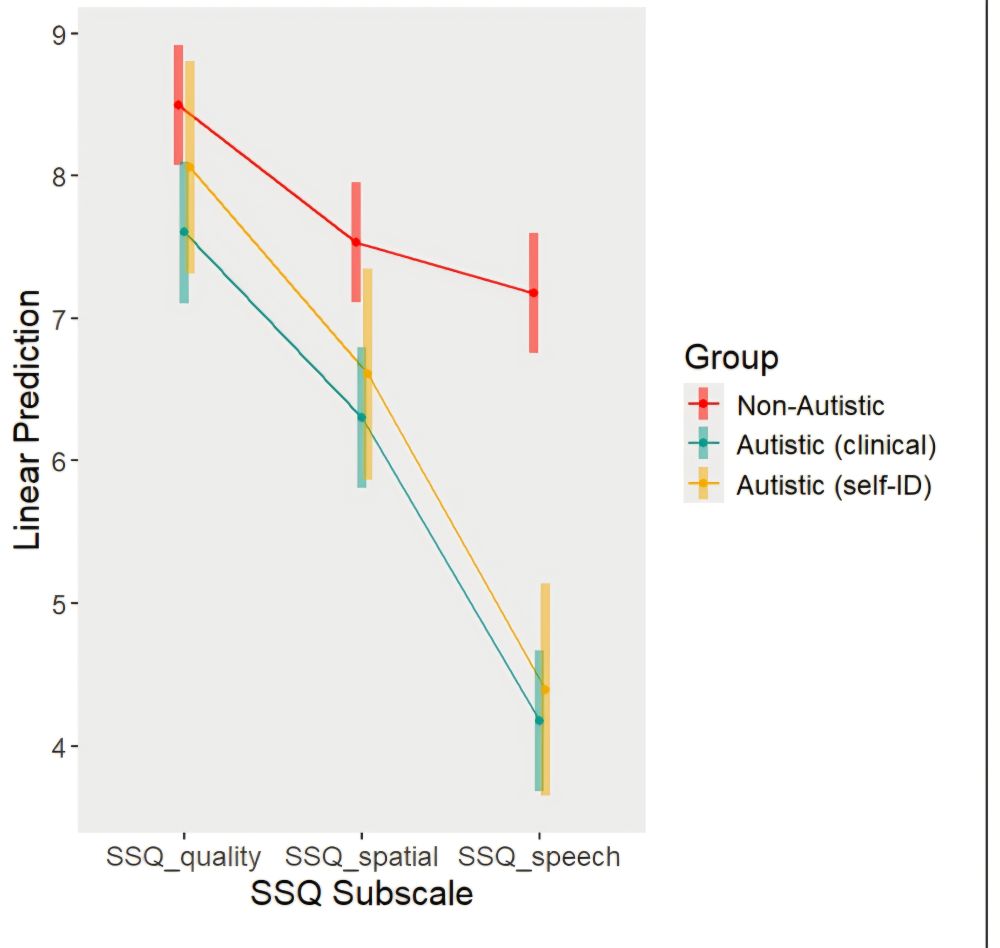
What about the self-identifying group? They also differed significantly from nonautistic adults in the Speech domain. But interestingly, equivalence tests showed that their reports were statistically equivalent to the clinically diagnosed group! Indeed, plotting the group predictions highlights this
November 17, 2025 at 6:31 PM
What about the self-identifying group? They also differed significantly from nonautistic adults in the Speech domain. But interestingly, equivalence tests showed that their reports were statistically equivalent to the clinically diagnosed group! Indeed, plotting the group predictions highlights this
We found that, across all domains of the SSQ (spatial perception, quality of sound, and speech understanding), the clinically diagnosed group reported more difficulties than the nonautistic group.

November 17, 2025 at 6:31 PM
We found that, across all domains of the SSQ (spatial perception, quality of sound, and speech understanding), the clinically diagnosed group reported more difficulties than the nonautistic group.
We used the Speech, Spatial and Qualities of Hearing Scale (SSQ) as a simple, short survey to see whether autistic adults indeed report lower auditory processing abilities than non autistic adults. We surveyed both clinically-diagnosed individuals and those who self-identify as autistic.
November 17, 2025 at 6:31 PM
We used the Speech, Spatial and Qualities of Hearing Scale (SSQ) as a simple, short survey to see whether autistic adults indeed report lower auditory processing abilities than non autistic adults. We surveyed both clinically-diagnosed individuals and those who self-identify as autistic.
Differences in sensory processing between autistic and nonautistic people are well known, I think, in general terms. But I've heard anecdotes for quite a while that autistic people find speech processing, particularly in noise, very challenging. But there didn't seem to be much evidence for it.
November 17, 2025 at 6:31 PM
Differences in sensory processing between autistic and nonautistic people are well known, I think, in general terms. But I've heard anecdotes for quite a while that autistic people find speech processing, particularly in noise, very challenging. But there didn't seem to be much evidence for it.