




Karin Kirk
@karinkirk.bsky.social
Geologist, skier, science journalist for Yale Climate Connections. Former Earth and climate science writer for NASA, but our federal govt decided these topics are threatening to them. Increasingly determined to keep working on climate change.
Absolutely we do! Best way to hold them accountable is to buy EVs built by other companies. Of course, I'd love to see them held accountable in other ways, too.
February 13, 2026 at 5:54 PM
Absolutely we do! Best way to hold them accountable is to buy EVs built by other companies. Of course, I'd love to see them held accountable in other ways, too.
yup!
But U.S. gasoline consumption peaked in 2019, and it's never coming back. That does give me some hope.
However, Big Oil will delay the switch to cleaner fuels as much as they can, which is terrible for everyone except them.
But U.S. gasoline consumption peaked in 2019, and it's never coming back. That does give me some hope.
However, Big Oil will delay the switch to cleaner fuels as much as they can, which is terrible for everyone except them.
February 13, 2026 at 5:42 PM
yup!
But U.S. gasoline consumption peaked in 2019, and it's never coming back. That does give me some hope.
However, Big Oil will delay the switch to cleaner fuels as much as they can, which is terrible for everyone except them.
But U.S. gasoline consumption peaked in 2019, and it's never coming back. That does give me some hope.
However, Big Oil will delay the switch to cleaner fuels as much as they can, which is terrible for everyone except them.
Yes, it's plenty. We do charge at home. I work at a ski area and it takes about an hour and a half of March sunshine on our roof to power a round trip to work. I think that's amazing.
February 12, 2026 at 2:29 PM
Yes, it's plenty. We do charge at home. I work at a ski area and it takes about an hour and a half of March sunshine on our roof to power a round trip to work. I think that's amazing.
No. Gas mileage is one way to measure efficiency.
The reason behind any given gas mileage figure is because of the operating efficiency of the vehicle.
If you wanted to compare EVs and ICE using distance traveled/units of energy you would get this exact same result.
The reason behind any given gas mileage figure is because of the operating efficiency of the vehicle.
If you wanted to compare EVs and ICE using distance traveled/units of energy you would get this exact same result.
February 12, 2026 at 2:27 PM
No. Gas mileage is one way to measure efficiency.
The reason behind any given gas mileage figure is because of the operating efficiency of the vehicle.
If you wanted to compare EVs and ICE using distance traveled/units of energy you would get this exact same result.
The reason behind any given gas mileage figure is because of the operating efficiency of the vehicle.
If you wanted to compare EVs and ICE using distance traveled/units of energy you would get this exact same result.
300 miles, on average
February 12, 2026 at 5:53 AM
300 miles, on average
I do, but that's thankfully not a prerequisite for understanding them.
February 12, 2026 at 4:59 AM
I do, but that's thankfully not a prerequisite for understanding them.
Sadly, you are not correct. No regular gasoline ICE cars get an efficiency anywhere near that high.
Your example is a hybrid engine. It's making electricity, not turning a crankshaft.
Your example is a hybrid engine. It's making electricity, not turning a crankshaft.
February 12, 2026 at 4:34 AM
Sadly, you are not correct. No regular gasoline ICE cars get an efficiency anywhere near that high.
Your example is a hybrid engine. It's making electricity, not turning a crankshaft.
Your example is a hybrid engine. It's making electricity, not turning a crankshaft.
Ah, got it. All the Bad Things you ascribe to heavy EVs are reserved only for EVs. An ICE car that is equally heavy (but pollutes way way more!) is just fine.
Thanks for making it so clear you're making a bad faith argument.
Thanks for making it so clear you're making a bad faith argument.
February 12, 2026 at 1:30 AM
Ah, got it. All the Bad Things you ascribe to heavy EVs are reserved only for EVs. An ICE car that is equally heavy (but pollutes way way more!) is just fine.
Thanks for making it so clear you're making a bad faith argument.
Thanks for making it so clear you're making a bad faith argument.
Whooo, nice! I live in a red state, so we don't get any extra incentives. OTOH, our solar array offsets some very dirty energy so that part is a big win for us.
Way to go in donating your old car! 🫡
Way to go in donating your old car! 🫡
February 12, 2026 at 12:16 AM
Whooo, nice! I live in a red state, so we don't get any extra incentives. OTOH, our solar array offsets some very dirty energy so that part is a big win for us.
Way to go in donating your old car! 🫡
Way to go in donating your old car! 🫡
Ah, I see. So now you're just talking about the many downsides of big cars. I agree. Big cars are terrible, and it does not matter what type of drivetrain they have. Let's make rules that encourage smaller cars, all around. 👍
February 12, 2026 at 12:07 AM
Ah, I see. So now you're just talking about the many downsides of big cars. I agree. Big cars are terrible, and it does not matter what type of drivetrain they have. Let's make rules that encourage smaller cars, all around. 👍
Niiice! That is an awesome car, and you have a beautifully clean energy supply. Win win!
We have the sister car, Kia EV6, and a roof full of solar panels. Happy times.
We have the sister car, Kia EV6, and a roof full of solar panels. Happy times.
February 12, 2026 at 12:04 AM
Niiice! That is an awesome car, and you have a beautifully clean energy supply. Win win!
We have the sister car, Kia EV6, and a roof full of solar panels. Happy times.
We have the sister car, Kia EV6, and a roof full of solar panels. Happy times.
ICE vehicles suffer the exact same problems, though. Both types of vehicles are inefficient at extreme temps. EVs are still much more efficient in every scenario.
February 12, 2026 at 12:01 AM
ICE vehicles suffer the exact same problems, though. Both types of vehicles are inefficient at extreme temps. EVs are still much more efficient in every scenario.
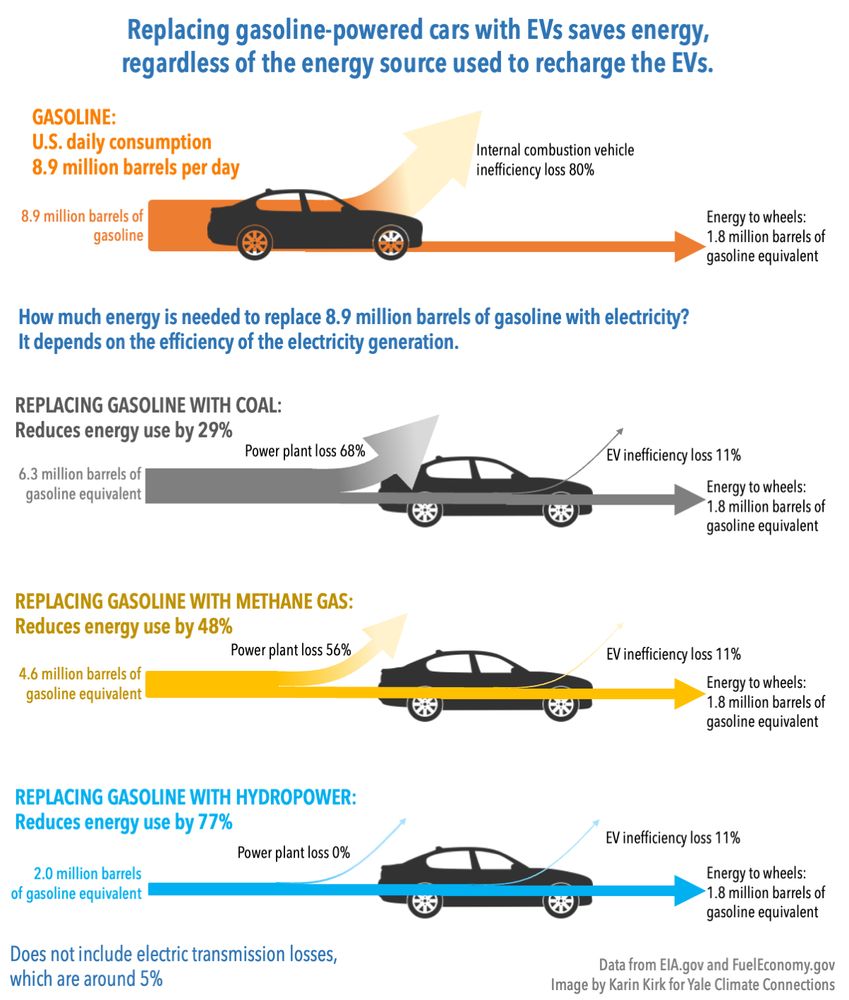
Note that the diagram specifically says gasoline, not diesel. The numbers are correct. 🙂
February 11, 2026 at 11:59 PM
Note that the diagram specifically says gasoline, not diesel. The numbers are correct. 🙂
Here you go! This diagram shows you how the efficiency changes depending on the source of electricity.
yaleclimateconnections.org/2024/01/elec...
yaleclimateconnections.org/2024/01/elec...
February 11, 2026 at 11:57 PM
Here you go! This diagram shows you how the efficiency changes depending on the source of electricity.
yaleclimateconnections.org/2024/01/elec...
yaleclimateconnections.org/2024/01/elec...
Sure, but then 80% of that gasoline is wasted.
It doesn't matter that much what the energy density of gasoline is, considering that the majority of it ends up being useless in terms of moving you down the road. It might be dense energy, but it's still wasted energy.
It doesn't matter that much what the energy density of gasoline is, considering that the majority of it ends up being useless in terms of moving you down the road. It might be dense energy, but it's still wasted energy.
February 11, 2026 at 11:53 PM
Sure, but then 80% of that gasoline is wasted.
It doesn't matter that much what the energy density of gasoline is, considering that the majority of it ends up being useless in terms of moving you down the road. It might be dense energy, but it's still wasted energy.
It doesn't matter that much what the energy density of gasoline is, considering that the majority of it ends up being useless in terms of moving you down the road. It might be dense energy, but it's still wasted energy.
Yeah, this is a common reply, but how energy dense is gasoline when you consider that 80% of it is wasted? Turns out, the density of the energy doesn't add up to all that much when you factor in how little of that energy actually propels you down the road.
February 11, 2026 at 11:49 PM
Yeah, this is a common reply, but how energy dense is gasoline when you consider that 80% of it is wasted? Turns out, the density of the energy doesn't add up to all that much when you factor in how little of that energy actually propels you down the road.
haha, it's ok! I always learn from them. Often it helps me find my next topics to work on.
February 11, 2026 at 11:46 PM
haha, it's ok! I always learn from them. Often it helps me find my next topics to work on.
Yeah, some utilities offer a great deal on that. Others don't give any discount at all. YMMV, as they say.
In my case, I took a quick approach to use statewide data, rather than delving into every utility in the U.S. Certainly it can be done, but that's a much bigger scale of research effort.
In my case, I took a quick approach to use statewide data, rather than delving into every utility in the U.S. Certainly it can be done, but that's a much bigger scale of research effort.
February 11, 2026 at 11:45 PM
Yeah, some utilities offer a great deal on that. Others don't give any discount at all. YMMV, as they say.
In my case, I took a quick approach to use statewide data, rather than delving into every utility in the U.S. Certainly it can be done, but that's a much bigger scale of research effort.
In my case, I took a quick approach to use statewide data, rather than delving into every utility in the U.S. Certainly it can be done, but that's a much bigger scale of research effort.
I write a lot of articles for a lot of different audiences. If you don't agree with the framing on this one, that's really ok w/ me.
80% of your gas money is wasted and you get absolutely nothing for it. Maybe that framing is better for you?
80% of your gas money is wasted and you get absolutely nothing for it. Maybe that framing is better for you?
February 11, 2026 at 11:20 PM
I write a lot of articles for a lot of different audiences. If you don't agree with the framing on this one, that's really ok w/ me.
80% of your gas money is wasted and you get absolutely nothing for it. Maybe that framing is better for you?
80% of your gas money is wasted and you get absolutely nothing for it. Maybe that framing is better for you?
Efficiency is exactly the same as gas mileage.
Here's the closing sentiment of this article. There are many ways to frame efficiency as a win. Cost is one of them, for sure!
(I've also written articles focused entirely on cost savings of EVs, such as yaleclimateconnections.org/2024/01/gaso...)
Here's the closing sentiment of this article. There are many ways to frame efficiency as a win. Cost is one of them, for sure!
(I've also written articles focused entirely on cost savings of EVs, such as yaleclimateconnections.org/2024/01/gaso...)

February 11, 2026 at 11:16 PM
Efficiency is exactly the same as gas mileage.
Here's the closing sentiment of this article. There are many ways to frame efficiency as a win. Cost is one of them, for sure!
(I've also written articles focused entirely on cost savings of EVs, such as yaleclimateconnections.org/2024/01/gaso...)
Here's the closing sentiment of this article. There are many ways to frame efficiency as a win. Cost is one of them, for sure!
(I've also written articles focused entirely on cost savings of EVs, such as yaleclimateconnections.org/2024/01/gaso...)
Yes! Exactly.
Here's a map (yes, I made this one too) that shows the price of home charging an EV in each state, put in terms of the price of a gallon of gasoline.
It's so much cheaper!
Source article and data: yaleclimateconnections.org/2024/01/gaso...
Here's a map (yes, I made this one too) that shows the price of home charging an EV in each state, put in terms of the price of a gallon of gasoline.
It's so much cheaper!
Source article and data: yaleclimateconnections.org/2024/01/gaso...

February 11, 2026 at 11:11 PM
Yes! Exactly.
Here's a map (yes, I made this one too) that shows the price of home charging an EV in each state, put in terms of the price of a gallon of gasoline.
It's so much cheaper!
Source article and data: yaleclimateconnections.org/2024/01/gaso...
Here's a map (yes, I made this one too) that shows the price of home charging an EV in each state, put in terms of the price of a gallon of gasoline.
It's so much cheaper!
Source article and data: yaleclimateconnections.org/2024/01/gaso...
Most people don't love things that are wasteful or inefficient, or polluting. It makes tremendous practical difference – just as you said – in terms of cost.
80% of your gas money is going up in smoke, basically.
EVs really change the equation, and in a good way. People seem to like knowing that.
80% of your gas money is going up in smoke, basically.
EVs really change the equation, and in a good way. People seem to like knowing that.
February 11, 2026 at 11:02 PM
Most people don't love things that are wasteful or inefficient, or polluting. It makes tremendous practical difference – just as you said – in terms of cost.
80% of your gas money is going up in smoke, basically.
EVs really change the equation, and in a good way. People seem to like knowing that.
80% of your gas money is going up in smoke, basically.
EVs really change the equation, and in a good way. People seem to like knowing that.
Ah yes, you are right it's not in that article, it's in another article cited by that article.
yaleclimateconnections.org/2022/08/elec...
And the original data source is here:
www.fueleconomy.gov/feg/atv.shtml
Hope that helps - happy to answer any follow-ups!
yaleclimateconnections.org/2022/08/elec...
And the original data source is here:
www.fueleconomy.gov/feg/atv.shtml
Hope that helps - happy to answer any follow-ups!

Electrifying transportation reduces emissions AND saves massive amounts of energy » Yale Climate Connections
Electric vehicles are far more energy-efficient than traditional internal combustion vehicles.
yaleclimateconnections.org
February 11, 2026 at 10:41 PM
Ah yes, you are right it's not in that article, it's in another article cited by that article.
yaleclimateconnections.org/2022/08/elec...
And the original data source is here:
www.fueleconomy.gov/feg/atv.shtml
Hope that helps - happy to answer any follow-ups!
yaleclimateconnections.org/2022/08/elec...
And the original data source is here:
www.fueleconomy.gov/feg/atv.shtml
Hope that helps - happy to answer any follow-ups!