



@m-sharma.bsky.social
Reposted

CRISPR–Cas applications in agriculture and plant research
www.nature.com/articles/s41...
www.nature.com/articles/s41...

CRISPR–Cas applications in agriculture and plant research - Nature Reviews Molecular Cell Biology
CRISPR–Cas-mediated genome, epigenome and transcriptome engineering in crops is crucial as the human population grows and climate deteriorates. This Review discusses new CRISPR–Cas tools for precise e...
www.nature.com
March 9, 2025 at 12:04 PM
CRISPR–Cas applications in agriculture and plant research
www.nature.com/articles/s41...
www.nature.com/articles/s41...
Reposted

Myofibrillogenesis Regulator‐1 Regulates the Ubiquitin Lysosomal Pathway of Notch3 Intracellular Domain Through E3 Ubiquitin‐Protein Ligase Itchy Homolog in the Metastasis of Non‐Small Cell Lung Cancer
Myofibrillogenesis Regulator‐1 Regulates the Ubiquitin Lysosomal Pathway of Notch3 Intracellular Domain Through E3 Ubiquitin‐Protein Ligase Itchy Homolog in the Metastasis of Non‐Small Cell Lung Cancer
The novel cancer related multifunctional protein MR-1 (Myofrillogenes regulator-1) can stabilize the expression of Notch3-ICD (NICD3) in the cytoplasm through ITCH, which can upregulate many genes related to metastasis to promote the metastasis of NSCLC cells. Interference with the interaction between MR-1 and NICD3 can increase the degradation of NICD3 and impair the metastatic ability of NSCLC cells.
Abstract
Myofibrillogenesis regulator-1 (MR-1) is a multifunctional protein involved in the development of various human tumors. The study is the first to report the promoting effect of MR-1 on the development and metastasis of non-small cell lung cancer (NSCLC). MR-1 is upregulated in NSCLC and positively associated with poor prognosis. The overexpression of MR-1 promotes the metastasis of NSCLC cells by stabilizing the expression of Notch3-ICD (NICD3) in the cytoplasm through enrichment analysis, in vitro and in vivo experimental researches. And Notch3 signaling can upregulate many genes related to metastasis. The stabilizing effect of MR-1 on NICD3 is achieved through the mono-ubiquitin lysosomal pathway and the specific E3 ubiquitin ligase is Itchy homolog (ITCH). There is a certain interaction between MR-1 and NICD3. Elevated MR-1 can affect the level of ITCH phosphorylation, reduce its E3 enzyme activity, and thus lead to reduce the ubiquitination and degradation of NICD3. Interference with the interaction between MR-1 and NICD3 can increase the degradation of NICD3 and impair the metastatic ability of NSCLC cells, which is a previously overlooked treatment option in NSCLC. In summary, interference with the interaction between MR-1 and NICD3 in the progression of lung cancer may be a promising therapeutic target.
onlinelibrary.wiley.com
February 12, 2024 at 9:07 AM
Myofibrillogenesis Regulator‐1 Regulates the Ubiquitin Lysosomal Pathway of Notch3 Intracellular Domain Through E3 Ubiquitin‐Protein Ligase Itchy Homolog in the Metastasis of Non‐Small Cell Lung Cancer
Reposted

The E3 ubiquitin ligase RNF216 contains a linear ubiquitin chain-determining-like domain that functions to regulate dendritic arborization and dendritic spine type in hippocampal neurons https://www.biorxiv.org/content/10.1101/2023.10.19.563080v1

The E3 ubiquitin ligase RNF216 contains a linear ubiquitin chain-determining-like domain that functions to regulate dendritic arborization and dendritic spine type in hippocampal neurons https://www.biorxiv.org/content/10.1101/2023.10.19.563080v1
Of the hundreds of E3 ligases found in the human genome, the RING-between RING (RBR) E3 ligase in th
www.biorxiv.org
October 20, 2023 at 6:17 AM
The E3 ubiquitin ligase RNF216 contains a linear ubiquitin chain-determining-like domain that functions to regulate dendritic arborization and dendritic spine type in hippocampal neurons https://www.biorxiv.org/content/10.1101/2023.10.19.563080v1
Reposted

Scientists used CRISPR gene-editing tools to safely disable a DNA mutation linked to chemo-resistant melanoma. The "edit" made cancer cells easier to treat & minimized side effect risks. This tumor-specific approach targets tumor cells & leaves healthy cells alone medicalxpress.com/news/2024-10...

Scientists use CRISPR tools to safely disable gene mutation linked to treatment-resistant melanoma
In a potential advance for melanoma patients, researchers at ChristianaCare's Gene Editing Institute have used CRISPR gene editing tools to disable a gene mutation often seen in aggressive forms of th...
medicalxpress.com
October 16, 2024 at 5:16 PM
Scientists used CRISPR gene-editing tools to safely disable a DNA mutation linked to chemo-resistant melanoma. The "edit" made cancer cells easier to treat & minimized side effect risks. This tumor-specific approach targets tumor cells & leaves healthy cells alone medicalxpress.com/news/2024-10...
Reposted

Emerging gene editing in industrial microbiology beyond CRISPR-Cas9
#TrendsinBiotech
www.cell.com/trends/biote...
#TrendsinBiotech
www.cell.com/trends/biote...

Emerging gene editing in industrial microbiology beyond CRISPR-Cas9
The CRISPR-Cas9 system has been widely applied for industrial microbiology but is
not effective in certain microorganisms. This forum explores the strategies aimed
at overcoming these challenges, incl...
www.cell.com
October 27, 2024 at 10:39 AM
Emerging gene editing in industrial microbiology beyond CRISPR-Cas9
#TrendsinBiotech
www.cell.com/trends/biote...
#TrendsinBiotech
www.cell.com/trends/biote...
Reposted

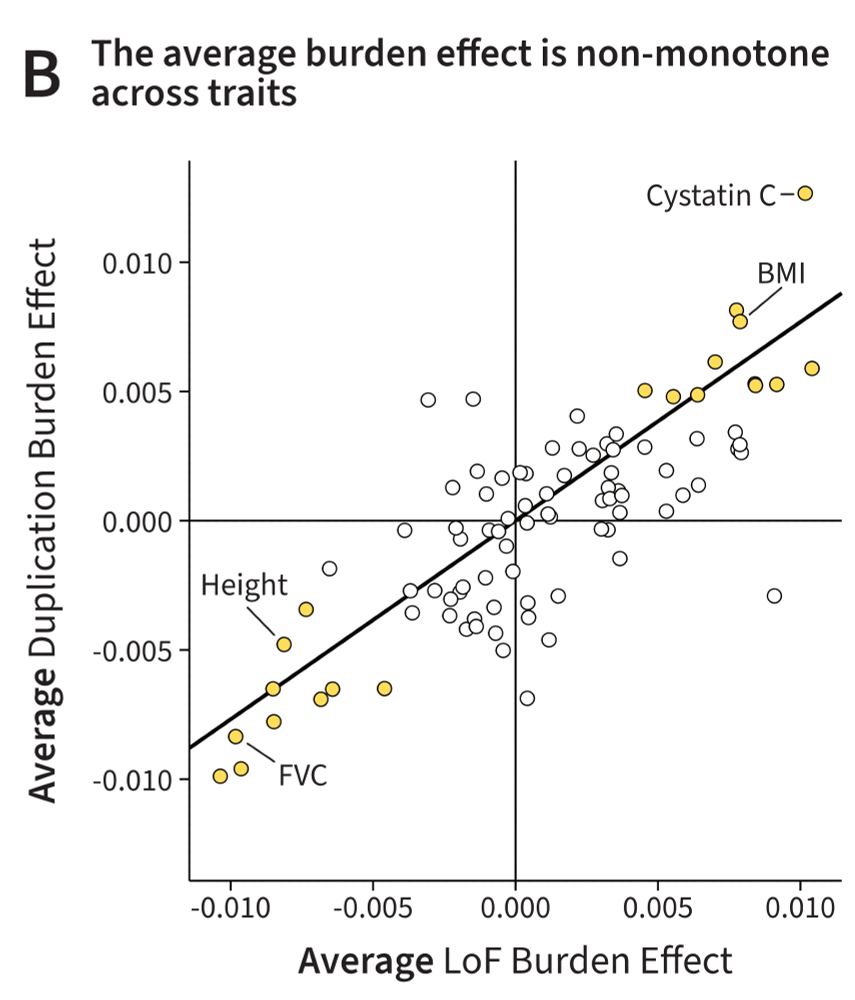
For many traits there is a correlation between the number of duplications or loss-of-function (LoF) mutations someone carries, and their phenotype. Curiously, for most traits, these effects are aligned in the SAME direction. Why?
November 12, 2024 at 6:10 AM
For many traits there is a correlation between the number of duplications or loss-of-function (LoF) mutations someone carries, and their phenotype. Curiously, for most traits, these effects are aligned in the SAME direction. Why?
Reposted

Structural variants are ripe for interrogation using genome engineering. Jonas Koeppel Juliane Weller Thomas Vanderstichele (Wellcome Sanger Institute) and I review technology progress, insights gained to date, and challenges and promise for the road ahead. www.nature.com/articles/s41588-024-01981-7

Engineering structural variants to interrogate genome function - Nature Genetics
Structural variations (SVs) impact gene expression, genome stability and disease susceptibility. This Review discusses recent advances in genome-engineering tools that enable precise SV generation and...
www.nature.com
November 16, 2024 at 3:29 PM
Structural variants are ripe for interrogation using genome engineering. Jonas Koeppel Juliane Weller Thomas Vanderstichele (Wellcome Sanger Institute) and I review technology progress, insights gained to date, and challenges and promise for the road ahead. www.nature.com/articles/s41588-024-01981-7