


Mackenzie Cooley
@mackenziecooley.bsky.social
Renaissance woman by profession. Associate Professor
@HamiltonCollege. Director of the New World Nature Project https://mackenzie-cooley.com
@HamiltonCollege. Director of the New World Nature Project https://mackenzie-cooley.com
Please submit essays via email to [email protected] by February 15, 2026 with a cover letter stating your name and the title of the article; the winner will be notified in the spring of 2026, in plenty of time to arrange for travel.
January 21, 2026 at 4:40 PM
Please submit essays via email to [email protected] by February 15, 2026 with a cover letter stating your name and the title of the article; the winner will be notified in the spring of 2026, in plenty of time to arrange for travel.
Please follow the ESM style guide and make sure that your paper has been anonymized. ESM publishes images in color and black-and-white; the author will handle permissions.
January 21, 2026 at 4:40 PM
Please follow the ESM style guide and make sure that your paper has been anonymized. ESM publishes images in color and black-and-white; the author will handle permissions.
The prize is sponsored by the Department of History and Philosophy of Science, University of Cambridge.
We invite you to submit unpublished essays between 6,000 and 10,000 words in English that are not under consideration at another journal.
We invite you to submit unpublished essays between 6,000 and 10,000 words in English that are not under consideration at another journal.
January 21, 2026 at 4:40 PM
The prize is sponsored by the Department of History and Philosophy of Science, University of Cambridge.
We invite you to submit unpublished essays between 6,000 and 10,000 words in English that are not under consideration at another journal.
We invite you to submit unpublished essays between 6,000 and 10,000 words in English that are not under consideration at another journal.
The winner will be strongly encouraged to attend the 2026 History of Science Society Conference in Edinburgh on July 13-16, 2024 as the prize will be awarded at the Early Sciences Forum Meeting. ...
January 21, 2026 at 4:39 PM
The winner will be strongly encouraged to attend the 2026 History of Science Society Conference in Edinburgh on July 13-16, 2024 as the prize will be awarded at the Early Sciences Forum Meeting. ...
The author of the winning essay will receive a $200 award and the piece will be published as an article in Early Science and Medicine subject to peer review; the committee will provide mentorship throughout the process. ...
January 21, 2026 at 4:39 PM
The author of the winning essay will receive a $200 award and the piece will be published as an article in Early Science and Medicine subject to peer review; the committee will provide mentorship throughout the process. ...
focusing on early science, medicine, technology, and other forms of natural knowledge across the globe before 1800.
We welcome submissions from early career research and also from more senior scholars...
We welcome submissions from early career research and also from more senior scholars...
January 21, 2026 at 4:39 PM
focusing on early science, medicine, technology, and other forms of natural knowledge across the globe before 1800.
We welcome submissions from early career research and also from more senior scholars...
We welcome submissions from early career research and also from more senior scholars...
Thank you for the shout-out!!
January 21, 2026 at 4:36 PM
Thank you for the shout-out!!
Reposted by Mackenzie Cooley

Oh, so you mean present-day exhibitions of early modern objects? I'll have a think. This volume co-edited by @mackenziecooley.bsky.social, @annatoledano.com, and @duyguyildirim.bsky.social (someone needs to encourage them to hang out here!) may have leads:
www.routledge.com/Natural-Thin...
www.routledge.com/Natural-Thin...

Natural Things in Early Modern Worlds
The essays and original visualizations collected in Natural Things in Early Modern Worlds explore the relationships among natural things - ranging from pollen in a gust of wind to a carnivorous pitche...
www.routledge.com
January 18, 2026 at 8:18 AM
Oh, so you mean present-day exhibitions of early modern objects? I'll have a think. This volume co-edited by @mackenziecooley.bsky.social, @annatoledano.com, and @duyguyildirim.bsky.social (someone needs to encourage them to hang out here!) may have leads:
www.routledge.com/Natural-Thin...
www.routledge.com/Natural-Thin...
The first meeting is this Friday and features mini-presentations on our new Special Issue (hopp.uwpress.org/content/66/2) and meet-and-greets with new collaborators.
hopp.uwpress.org
September 3, 2025 at 4:45 PM
The first meeting is this Friday and features mini-presentations on our new Special Issue (hopp.uwpress.org/content/66/2) and meet-and-greets with new collaborators.
Have an odd pharmacopeia that you’d like to consult on? Could the platform assist you in your studies of related materials? Interested in contributing to the growing dataset?
We meet on the first Friday of the month at 9:30 am NY time via Zoom. Email [email protected] for the link.
We meet on the first Friday of the month at 9:30 am NY time via Zoom. Email [email protected] for the link.
hopp.uwpress.org
September 3, 2025 at 4:45 PM
Have an odd pharmacopeia that you’d like to consult on? Could the platform assist you in your studies of related materials? Interested in contributing to the growing dataset?
We meet on the first Friday of the month at 9:30 am NY time via Zoom. Email [email protected] for the link.
We meet on the first Friday of the month at 9:30 am NY time via Zoom. Email [email protected] for the link.
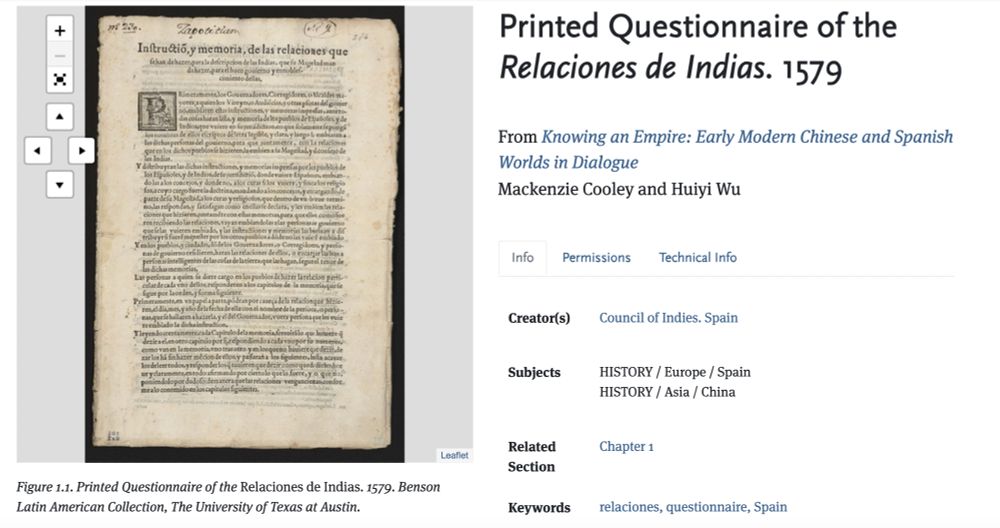
The first two chapters - by Maria Portuondo and Joe Dennis - show the making of two different guidelines.



August 17, 2025 at 3:18 AM
The first two chapters - by Maria Portuondo and Joe Dennis - show the making of two different guidelines.
We go back in time with @lxslcs.bsky.social's elegant chapter on the precedents for the guidelines, "Imperial Territorial Data before the Age of Print: “Illustrated Guidelines.”

August 17, 2025 at 3:17 AM
We go back in time with @lxslcs.bsky.social's elegant chapter on the precedents for the guidelines, "Imperial Territorial Data before the Age of Print: “Illustrated Guidelines.”
How did states a world apart develop similar documentary techniques to know the dominions under their control, and how do these techniques help us understand the state in question?
August 17, 2025 at 3:15 AM
How did states a world apart develop similar documentary techniques to know the dominions under their control, and how do these techniques help us understand the state in question?
Between the sixteenth and eighteenth centuries, centrally appointed imperial officials in both China and the Spanish Americas were instructed to gather, compile, and submit information about the locales they administered, following a centrally issued, itemized compilation guideline or questionnaire.
August 17, 2025 at 3:14 AM
Between the sixteenth and eighteenth centuries, centrally appointed imperial officials in both China and the Spanish Americas were instructed to gather, compile, and submit information about the locales they administered, following a centrally issued, itemized compilation guideline or questionnaire.
Sources drawn from the originals, and artwork designed by Olivia Buckton and June Lee, mentored by Zoë Sadokierski, University of Technology Sydney School of Design.
August 14, 2025 at 3:06 PM
Sources drawn from the originals, and artwork designed by Olivia Buckton and June Lee, mentored by Zoë Sadokierski, University of Technology Sydney School of Design.
Thank you to everyone who took part in the conversation at the core of this book.
August 14, 2025 at 1:46 AM
Thank you to everyone who took part in the conversation at the core of this book.
Last but not least, we need global histories that aren't all about loose connections. World history is full of similar inventions to solve similar problems.
August 14, 2025 at 1:46 AM
Last but not least, we need global histories that aren't all about loose connections. World history is full of similar inventions to solve similar problems.