




Marcos Bermejo Ruiz
@marcosbermejo.bsky.social
Bioinformatics doctoral researcher in microbiome science. 🦠🧬
At the Leylab at @maxplanckcampus.bsky.social: Tüebingen, Germany
🇪🇦 -> 🇬🇧 -> 🇩🇪
At the Leylab at @maxplanckcampus.bsky.social: Tüebingen, Germany
🇪🇦 -> 🇬🇧 -> 🇩🇪
Pinned
Super excited to arrive here! Willing to share and read about amazing science. Particularly interested in plasmids and HGT in bacteria 🦠
Busy last couple of weeks sharing science around Tübingen in the Bioconnect symposium and the TüBMI. Another year getting to know more about what the researchers I share the city with are working in!


July 16, 2025 at 3:14 PM
Busy last couple of weeks sharing science around Tübingen in the Bioconnect symposium and the TüBMI. Another year getting to know more about what the researchers I share the city with are working in!
Reposted by Marcos Bermejo Ruiz

FlaPro - a pipeline for quantifying silent and stimulatory flagellins in the human gut - reveals how the flagellome shifts in inflammatory bowel diseases.
Congrats to @anya-bogdanova.bsky.social on her first preprint from the Ley Lab @microbiome.bsky.social !
www.biorxiv.org/content/10.1...
Congrats to @anya-bogdanova.bsky.social on her first preprint from the Ley Lab @microbiome.bsky.social !
www.biorxiv.org/content/10.1...
Human gut flagellome profiling using FlaPro reveals TLR5-related phenotype-specific alterations in IBD
Flagellin is the protein monomer of the bacterial flagellum, which confers motility, allowing bacteria to reach their favored niches. Flagellin is highly conserved across bacterial species and thus the target of the innate immune receptor Toll-like receptor 5 (TLR5). In the gut, bacterial flagellin agonizes human TLR5, triggering a pro-inflammatory response. However, the ability to bind and activate TLR5 varies considerably between different flagellins, suggesting that the composition of an individual's flagellin repertoire - the flagellome - may mediate the inflammatory response to the microbiome, with relevance to inflammatory bowel diseases. However, to date, methods to assess the inflammatory potential of a flagellome are lacking. To address this gap, we constructed a curated database of human gut flagellins. To predict the inflammatory potential of the flagellome by sorting flagellins into either "stimulatory" (strong TLR5 agonists) or "silent" (weak TLR5 agonists), we trained a machine learning model on experimentally characterized flagellins with known binding and stimulatory activities. The FlaPro pipeline was implemented using the Snakemake workflow engine for high-throughput analysis and is available at https://github.com/leylabmpi/FlaPro. To validate our approach and explore clinical associations, we applied FlaPro to a publicly available multi-omics dataset from an inflammatory bowel disease (IBD) cohort. Our analysis demonstrates that FlaPro enables robust profiling of the human gut flagellome from metagenomic and metatranscriptomic data. Analysis of the IBD datasets revealed a depletion of flagellome diversity and a reduced silent-to-stimulatory flagellin abundance ratio in Crohn's disease and ulcerative colitis, observed at both the genomic and transcriptional levels. Multiple condition-specific alterations were identified at the level of individual flagellin clusters. These findings indicate that IBD is associated with distinct alterations in the gut flagellome, particularly in relation to TLR5 recognition. Flagellome features represent a functionally interpretable class of microbiome-derived markers with potential utility in microbiome-wide association studies in the context of human health and disease. ### Competing Interest Statement The authors have declared no competing interest. Max Planck Society and the European Research Council (ERC) under the European Unions Horizon 2020 research and innovation programme Grant agreement
www.biorxiv.org
July 7, 2025 at 6:48 AM
FlaPro - a pipeline for quantifying silent and stimulatory flagellins in the human gut - reveals how the flagellome shifts in inflammatory bowel diseases.
Congrats to @anya-bogdanova.bsky.social on her first preprint from the Ley Lab @microbiome.bsky.social !
www.biorxiv.org/content/10.1...
Congrats to @anya-bogdanova.bsky.social on her first preprint from the Ley Lab @microbiome.bsky.social !
www.biorxiv.org/content/10.1...
Reposted by Marcos Bermejo Ruiz

Please spread the word🙏:
[PhD Position in Computational Evolutionary Transcriptomics]
If you are interested in doing a PhD in gorgeous Scotland on 'Why embryo development goes wrong sometimes?', please consider applying and join our wonderful team in Dundee!
www.dundee.ac.uk/phds/opportu...
[PhD Position in Computational Evolutionary Transcriptomics]
If you are interested in doing a PhD in gorgeous Scotland on 'Why embryo development goes wrong sometimes?', please consider applying and join our wonderful team in Dundee!
www.dundee.ac.uk/phds/opportu...

How do ancient genes regulate animal embryo development at single cell resolution | University of Dundee, UK
A PhD project at the University of Dundee
www.dundee.ac.uk
March 3, 2025 at 11:44 AM
Please spread the word🙏:
[PhD Position in Computational Evolutionary Transcriptomics]
If you are interested in doing a PhD in gorgeous Scotland on 'Why embryo development goes wrong sometimes?', please consider applying and join our wonderful team in Dundee!
www.dundee.ac.uk/phds/opportu...
[PhD Position in Computational Evolutionary Transcriptomics]
If you are interested in doing a PhD in gorgeous Scotland on 'Why embryo development goes wrong sometimes?', please consider applying and join our wonderful team in Dundee!
www.dundee.ac.uk/phds/opportu...
Reposted by Marcos Bermejo Ruiz

Here we delve deeper into what makes a flagellin “silent” - see Michael Bell’s cryo-EM structure of a silent flagellin from the flagellum of Roseburia hominis- it has a different charge distribution compared to FliC and it dissociates rapidly from TLR5 www.biorxiv.org/content/10.1...

Kinetic and structure-based comparisons of silent and stimulatory flagellin interactions with TLR5
The bacterial protein flagellin is the sole ligand of the innate immune receptor Toll-like receptor 5 (TLR5). Flagellins with strong agonism bind TLR5 at their D1 and D0 domains, while poor agonist si...
www.biorxiv.org
December 10, 2024 at 2:20 PM
Here we delve deeper into what makes a flagellin “silent” - see Michael Bell’s cryo-EM structure of a silent flagellin from the flagellum of Roseburia hominis- it has a different charge distribution compared to FliC and it dissociates rapidly from TLR5 www.biorxiv.org/content/10.1...
Reposted by Marcos Bermejo Ruiz

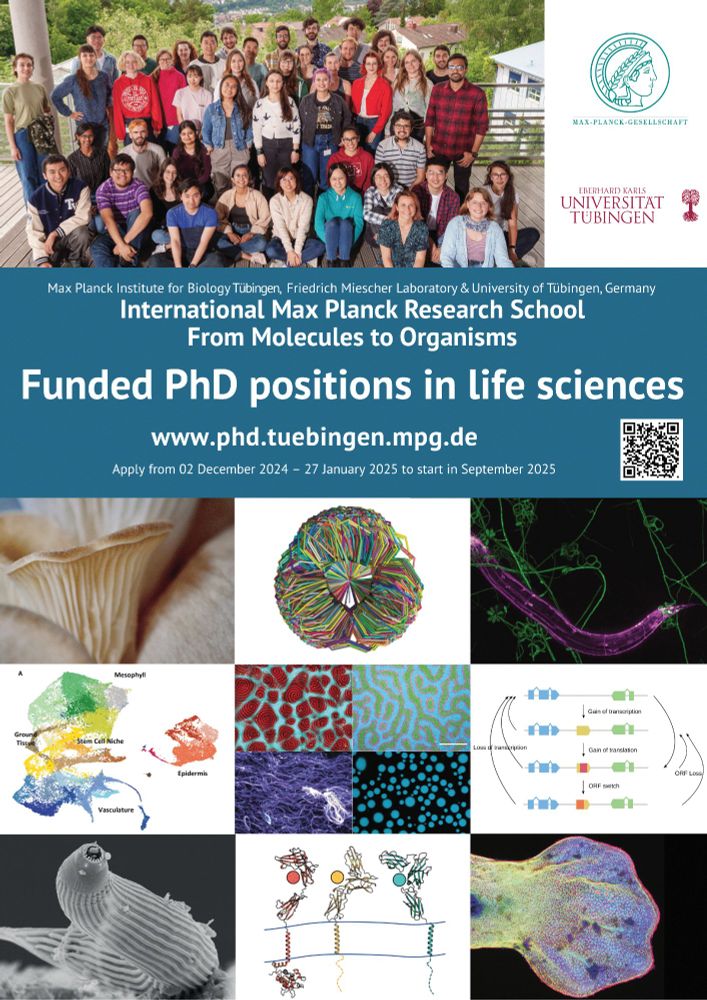
Applications are now open for fully-funded #PhD positions at the Max Planck Institute for Biology and Friedrich Miescher Laboratory. The new cohort starts September 2025.
Find out more about the projects you could be working on: www.phd.tuebingen.mpg.de
#IMPRS
Find out more about the projects you could be working on: www.phd.tuebingen.mpg.de
#IMPRS
December 2, 2024 at 9:03 AM
Applications are now open for fully-funded #PhD positions at the Max Planck Institute for Biology and Friedrich Miescher Laboratory. The new cohort starts September 2025.
Find out more about the projects you could be working on: www.phd.tuebingen.mpg.de
#IMPRS
Find out more about the projects you could be working on: www.phd.tuebingen.mpg.de
#IMPRS
Super excited to arrive here! Willing to share and read about amazing science. Particularly interested in plasmids and HGT in bacteria 🦠
November 28, 2024 at 4:12 PM
Super excited to arrive here! Willing to share and read about amazing science. Particularly interested in plasmids and HGT in bacteria 🦠