



Matt Hindman
@matthindman.bsky.social
Professor at SMPA GWU
Author of *The Internet Trap* and *The Myth of Digital Democracy*
political communication | digital platforms | politics of AI
Washington, DC
Author of *The Internet Trap* and *The Myth of Digital Democracy*
political communication | digital platforms | politics of AI
Washington, DC
To say François Chollet has been a skeptic of current LLM capabilities is an understatement.
So this post from him is all the more remarkable.
arcprize.org/blog/oai-o3-...
So this post from him is all the more remarkable.
arcprize.org/blog/oai-o3-...
OpenAI o3 Breakthrough High Score on ARC-AGI-Pub
OpenAI o3 scores 75.7% on ARC-AGI public leaderboard.
arcprize.org
December 20, 2024 at 7:40 PM
To say François Chollet has been a skeptic of current LLM capabilities is an understatement.
So this post from him is all the more remarkable.
arcprize.org/blog/oai-o3-...
So this post from him is all the more remarkable.
arcprize.org/blog/oai-o3-...
The key finding, though, is that right-wing rhetoric on YouTube isn't simply echoing media messages - it's being actively transformed through user interactions.
Understanding online extremism requires studying the role of users themselves in that transformation process.
Understanding online extremism requires studying the role of users themselves in that transformation process.
December 13, 2024 at 5:58 PM
The key finding, though, is that right-wing rhetoric on YouTube isn't simply echoing media messages - it's being actively transformed through user interactions.
Understanding online extremism requires studying the role of users themselves in that transformation process.
Understanding online extremism requires studying the role of users themselves in that transformation process.
So where ARE users learning these extreme associations, if not from the original videos?
Our methods emphasize the most-engaged content. Commenters may be selectively remixing content from other platforms or less-seen, more-extreme channels like OANN. But this is an important ? for future work.
Our methods emphasize the most-engaged content. Commenters may be selectively remixing content from other platforms or less-seen, more-extreme channels like OANN. But this is an important ? for future work.
December 13, 2024 at 5:58 PM
So where ARE users learning these extreme associations, if not from the original videos?
Our methods emphasize the most-engaged content. Commenters may be selectively remixing content from other platforms or less-seen, more-extreme channels like OANN. But this is an important ? for future work.
Our methods emphasize the most-engaged content. Commenters may be selectively remixing content from other platforms or less-seen, more-extreme channels like OANN. But this is an important ? for future work.
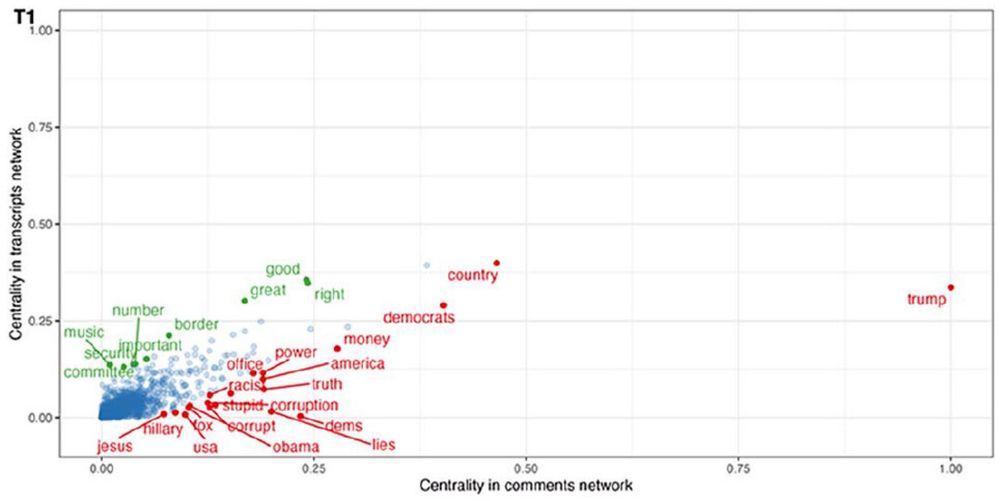
For example, videos on BLM protests focused on news events. But commenters added entirely new associations-- "antifa," "marxist," etc.--the videos never mentioned.
There is also a big Trump effect: he becomes the central node in comment networks despite a modest presence in the original coverage.
There is also a big Trump effect: he becomes the central node in comment networks despite a modest presence in the original coverage.
December 13, 2024 at 5:58 PM
For example, videos on BLM protests focused on news events. But commenters added entirely new associations-- "antifa," "marxist," etc.--the videos never mentioned.
There is also a big Trump effect: he becomes the central node in comment networks despite a modest presence in the original coverage.
There is also a big Trump effect: he becomes the central node in comment networks despite a modest presence in the original coverage.
Our results look much more like the networked framing story.
While media outlets set the broad agenda (COVID, BLM, election), commenters consistently introduce conspiracy theories and emotional rhetoric absent from the original videos.
While media outlets set the broad agenda (COVID, BLM, election), commenters consistently introduce conspiracy theories and emotional rhetoric absent from the original videos.
December 13, 2024 at 5:58 PM
Our results look much more like the networked framing story.
While media outlets set the broad agenda (COVID, BLM, election), commenters consistently introduce conspiracy theories and emotional rhetoric absent from the original videos.
While media outlets set the broad agenda (COVID, BLM, election), commenters consistently introduce conspiracy theories and emotional rhetoric absent from the original videos.
Networked framing research (e.g. Meraz & @zizip.bsky.social) has argued that user discussion on social media actively transforms frames in news coverage. By contrast, network agenda setting argues that the media transfers bundles of associations more-or-less unchanged.
Which do we find?
Which do we find?
December 13, 2024 at 5:58 PM
Networked framing research (e.g. Meraz & @zizip.bsky.social) has argued that user discussion on social media actively transforms frames in news coverage. By contrast, network agenda setting argues that the media transfers bundles of associations more-or-less unchanged.
Which do we find?
Which do we find?
Our data includes every video, w/ comments, from the Fox News, OANN, Daily Wire, and Breitbart YouTube channels from 2019-2021.
We use semantic network analysis to track how language changes between the 19,112 video transcripts and the 661,958,464 comments.
We use semantic network analysis to track how language changes between the 19,112 video transcripts and the 661,958,464 comments.
December 13, 2024 at 5:58 PM
Our data includes every video, w/ comments, from the Fox News, OANN, Daily Wire, and Breitbart YouTube channels from 2019-2021.
We use semantic network analysis to track how language changes between the 19,112 video transcripts and the 661,958,464 comments.
We use semantic network analysis to track how language changes between the 19,112 video transcripts and the 661,958,464 comments.
For example, videos on BLM protests focused on news events. But commenters added entirely new associations--"antifa," "marxist," etc.--the videos never mentioned.
There is an enormous Trump effect: Trump becomes the central node in comment networks despite little presence in the original coverage.
There is an enormous Trump effect: Trump becomes the central node in comment networks despite little presence in the original coverage.
December 13, 2024 at 5:33 PM
For example, videos on BLM protests focused on news events. But commenters added entirely new associations--"antifa," "marxist," etc.--the videos never mentioned.
There is an enormous Trump effect: Trump becomes the central node in comment networks despite little presence in the original coverage.
There is an enormous Trump effect: Trump becomes the central node in comment networks despite little presence in the original coverage.
Our results look much more like the networked framing story.
While media outlets set the broad agenda (COVID, BLM, election), commenters consistently introduce conspiracy theories and emotional rhetoric absent from the original videos.
While media outlets set the broad agenda (COVID, BLM, election), commenters consistently introduce conspiracy theories and emotional rhetoric absent from the original videos.
December 13, 2024 at 5:33 PM
Our results look much more like the networked framing story.
While media outlets set the broad agenda (COVID, BLM, election), commenters consistently introduce conspiracy theories and emotional rhetoric absent from the original videos.
While media outlets set the broad agenda (COVID, BLM, election), commenters consistently introduce conspiracy theories and emotional rhetoric absent from the original videos.
Networked framing research (e.g. Meraz & @zizip.bsky.social) has argued that user discussion on social media actively transforms frames in news coverage. By contrast, network agenda setting argues that the media transfers bundles of associations more-or-less unchanged.
Which do we find?
Which do we find?
December 13, 2024 at 5:33 PM
Networked framing research (e.g. Meraz & @zizip.bsky.social) has argued that user discussion on social media actively transforms frames in news coverage. By contrast, network agenda setting argues that the media transfers bundles of associations more-or-less unchanged.
Which do we find?
Which do we find?
Our data includes every video, w/ comments, from the Fox News, OANN, Daily Wire, and Breitbart YouTube channels from 2019-2021.
We use semantic network analysis to track how language changes between the 19,112 video transcripts and the 661,958,464 comments.
We use semantic network analysis to track how language changes between the 19,112 video transcripts and the 661,958,464 comments.
December 13, 2024 at 5:33 PM
Our data includes every video, w/ comments, from the Fox News, OANN, Daily Wire, and Breitbart YouTube channels from 2019-2021.
We use semantic network analysis to track how language changes between the 19,112 video transcripts and the 661,958,464 comments.
We use semantic network analysis to track how language changes between the 19,112 video transcripts and the 661,958,464 comments.

For messaging to work, you need a media apparatus to convey the message to swing voters.
December 12, 2024 at 7:51 PM