


Alison Vacca
@medievalqabq.bsky.social
editor of @alusuralwusta.bsky.social
historian of Umayyad & early Abbasid rule in Armenia & Caucasian Albania
currently working on marriage and matriliny in the Khazar Khaganate
associate prof at Columbia University
historian of Umayyad & early Abbasid rule in Armenia & Caucasian Albania
currently working on marriage and matriliny in the Khazar Khaganate
associate prof at Columbia University
of course, this sort of collaborative project would not be possible w/o a great interdisciplinary team. We met in Chicago & Dublin to work, so here’s the obligatory Guinness pic

November 18, 2025 at 11:57 PM
of course, this sort of collaborative project would not be possible w/o a great interdisciplinary team. We met in Chicago & Dublin to work, so here’s the obligatory Guinness pic
that gives us 6 different versions of the correspondence btw ʿUmar and Leo, some penned by Christians and others by Muslims, in 4 languages. and in the introduction to this volume we show that they’re all actually related!


November 18, 2025 at 11:57 PM
that gives us 6 different versions of the correspondence btw ʿUmar and Leo, some penned by Christians and others by Muslims, in 4 languages. and in the introduction to this volume we show that they’re all actually related!
but the amazing Latinists on our team found FOUR additional mss of the Latin, different from Champier’s text. 3 from Spain, 1 from Carolingian France. It’s the oldest known ms translated from Arabic

November 18, 2025 at 11:57 PM
but the amazing Latinists on our team found FOUR additional mss of the Latin, different from Champier’s text. 3 from Spain, 1 from Carolingian France. It’s the oldest known ms translated from Arabic
there is another Arabic version in 10th-cent. manuscript from Sinai, but this one reports a Christian version of the correspondence and does not show direct relationship w/ the Muslim Arabic. *it* lays out an argument abt how Christianity is correct...

November 18, 2025 at 11:57 PM
there is another Arabic version in 10th-cent. manuscript from Sinai, but this one reports a Christian version of the correspondence and does not show direct relationship w/ the Muslim Arabic. *it* lays out an argument abt how Christianity is correct...
the Aljamiado overlaps for a few paragraphs w/ the Muslim Arabic version, a 9th or 10th-cent. manuscript once in Damascus & now in Istanbul. only one spare quire remains, also presenting Islamic doctrine

November 18, 2025 at 11:57 PM
the Aljamiado overlaps for a few paragraphs w/ the Muslim Arabic version, a 9th or 10th-cent. manuscript once in Damascus & now in Istanbul. only one spare quire remains, also presenting Islamic doctrine
but the same biblical quotes—in the same order—are cited in the Aljamiado, produced by a Muslim in Spain in 2 mss (one 15th cent, one 16th). The Aljamiado has an isnad back to 8th-cent Syria. *this* version explains how Islam is correct and Christianity is not

November 18, 2025 at 11:57 PM
but the same biblical quotes—in the same order—are cited in the Aljamiado, produced by a Muslim in Spain in 2 mss (one 15th cent, one 16th). The Aljamiado has an isnad back to 8th-cent Syria. *this* version explains how Islam is correct and Christianity is not
we started with the Armenian, which was translated from a lost Greek version. It’s in an 8th-cent. text, preserved in Ilkhanid-era manuscript. It champions Christianity & explains how Islam is incorrect

November 18, 2025 at 11:57 PM
we started with the Armenian, which was translated from a lost Greek version. It’s in an 8th-cent. text, preserved in Ilkhanid-era manuscript. It champions Christianity & explains how Islam is incorrect
in this volume, we edit and translate all known versions of the correspondence btw the Umayyad caliph ʿUmar b. ʿAbd al-ʿAzīz (717-720) & the Byzantine emperor Leo the Isaurian (717-741).
So far, seems reasonable. but the texts jump around the Mediterranean in circuitous paths
So far, seems reasonable. but the texts jump around the Mediterranean in circuitous paths


November 18, 2025 at 11:57 PM
in this volume, we edit and translate all known versions of the correspondence btw the Umayyad caliph ʿUmar b. ʿAbd al-ʿAzīz (717-720) & the Byzantine emperor Leo the Isaurian (717-741).
So far, seems reasonable. but the texts jump around the Mediterranean in circuitous paths
So far, seems reasonable. but the texts jump around the Mediterranean in circuitous paths
we have a cover! super excited to get close to publication on this project!
it’s actually a pretty wild ride, so here’s a brief explanation: 👇
it’s actually a pretty wild ride, so here’s a brief explanation: 👇

November 18, 2025 at 11:57 PM
we have a cover! super excited to get close to publication on this project!
it’s actually a pretty wild ride, so here’s a brief explanation: 👇
it’s actually a pretty wild ride, so here’s a brief explanation: 👇
I desperately wanted to stuff this one in my purse, but I was told customs would stop me

August 24, 2025 at 10:03 AM
I desperately wanted to stuff this one in my purse, but I was told customs would stop me
Enjoying an evening in Khorazm


August 17, 2025 at 4:59 PM
Enjoying an evening in Khorazm
Kindred Voices by Michael Pifer (2021)

July 28, 2025 at 6:05 PM
Kindred Voices by Michael Pifer (2021)
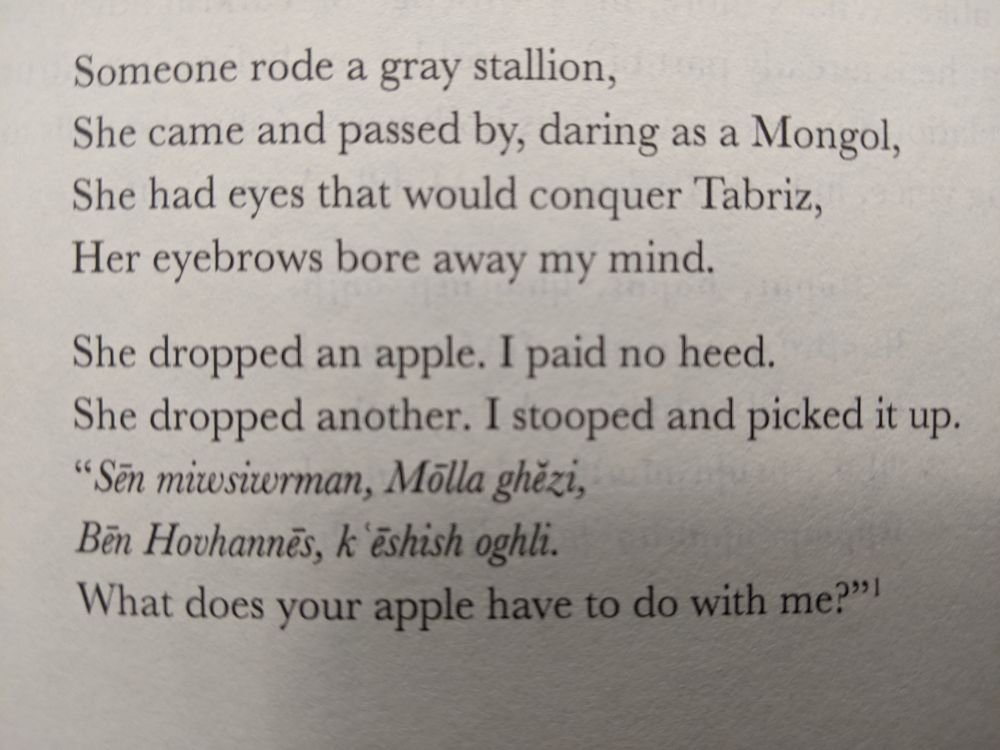
I interrupt your daily existential panic to suggest reading this book on a literary history of Anatolia, blending Armenian, Persian, Turkish, Greek.
This poem switches btw Turkish & Armenian. The girl's last line is in Armenian: "Let us love one another, it will be sweet"
This poem switches btw Turkish & Armenian. The girl's last line is in Armenian: "Let us love one another, it will be sweet"

July 28, 2025 at 6:05 PM
I interrupt your daily existential panic to suggest reading this book on a literary history of Anatolia, blending Armenian, Persian, Turkish, Greek.
This poem switches btw Turkish & Armenian. The girl's last line is in Armenian: "Let us love one another, it will be sweet"
This poem switches btw Turkish & Armenian. The girl's last line is in Armenian: "Let us love one another, it will be sweet"
just learned that Matisse spoke about how he drew inspiration from Byzantine coins, including this one from Tzimiskes's reign


July 20, 2025 at 12:23 AM
just learned that Matisse spoke about how he drew inspiration from Byzantine coins, including this one from Tzimiskes's reign
next on my pile of interesting books to read! if you're in NYC, please come to hear the authors present their newly-published book on 24 March!

March 4, 2025 at 11:12 PM
next on my pile of interesting books to read! if you're in NYC, please come to hear the authors present their newly-published book on 24 March!
If you see this, post an archer
[14th-cent depiction from Spitakavor Church, showing the Proshyan prince Amir Hasan. I love this one bc it has a glyph above the horse's head that combines the letters ԱՄՐ to render the name Amir with just one letter; to the right is ՀԱ, the start of his name Hasan]
[14th-cent depiction from Spitakavor Church, showing the Proshyan prince Amir Hasan. I love this one bc it has a glyph above the horse's head that combines the letters ԱՄՐ to render the name Amir with just one letter; to the right is ՀԱ, the start of his name Hasan]

January 18, 2025 at 2:42 AM
If you see this, post an archer
[14th-cent depiction from Spitakavor Church, showing the Proshyan prince Amir Hasan. I love this one bc it has a glyph above the horse's head that combines the letters ԱՄՐ to render the name Amir with just one letter; to the right is ՀԱ, the start of his name Hasan]
[14th-cent depiction from Spitakavor Church, showing the Proshyan prince Amir Hasan. I love this one bc it has a glyph above the horse's head that combines the letters ԱՄՐ to render the name Amir with just one letter; to the right is ՀԱ, the start of his name Hasan]
for anyone in the New York area: Nzhdeh Yeranyan will give a talk on "The Armenian-Azerbaijani Conflict: Challenges in Preserving Cultural Heritage" on 10 February

January 18, 2025 at 1:36 AM
for anyone in the New York area: Nzhdeh Yeranyan will give a talk on "The Armenian-Azerbaijani Conflict: Challenges in Preserving Cultural Heritage" on 10 February
this is a really striking installation at the Peabody Museum: Eternal Cities is an "urban palimpsest" created by Mohamad Hafez from 3D prints of the museum's objects. a Sasanian incantation bowl becomes a satellite dish; a cuneiform inscription serves as minaret; a cylinder seal is a water tank


January 5, 2025 at 9:40 PM
this is a really striking installation at the Peabody Museum: Eternal Cities is an "urban palimpsest" created by Mohamad Hafez from 3D prints of the museum's objects. a Sasanian incantation bowl becomes a satellite dish; a cuneiform inscription serves as minaret; a cylinder seal is a water tank
thanks 😁 this was for a volume on Arabic & multilingualism that was published earlier this year. the contributions are interesting, check out @robhaug.bsky.social on trilingual coins (Arabic, Bactrian, & MP) & @sasanianshah.bsky.social on Middle Iranian languages


December 15, 2024 at 10:14 PM
thanks 😁 this was for a volume on Arabic & multilingualism that was published earlier this year. the contributions are interesting, check out @robhaug.bsky.social on trilingual coins (Arabic, Bactrian, & MP) & @sasanianshah.bsky.social on Middle Iranian languages
the exhibit also included pre-Islamic material that became part of Umayyad designs. this bust of a Roman woman is from the 1st c. CE and the Dionysian image is from a repurposed 3rd-c. CE sarcophagus. both were found at Madinat al-Zahra


December 6, 2024 at 3:55 AM
the exhibit also included pre-Islamic material that became part of Umayyad designs. this bust of a Roman woman is from the 1st c. CE and the Dionysian image is from a repurposed 3rd-c. CE sarcophagus. both were found at Madinat al-Zahra
a striking marble arched window from 350AH/961-2CE, Madinat al-Zahra, w/ inscription for Hakam, son of the caliph. but I love the peacocks and deer on the 10th-c limestone-- apparently from a street ramp?


December 6, 2024 at 3:55 AM
a striking marble arched window from 350AH/961-2CE, Madinat al-Zahra, w/ inscription for Hakam, son of the caliph. but I love the peacocks and deer on the 10th-c limestone-- apparently from a street ramp?
this 10th-c. gold & glass diadem from Charilla Treasure kind of stole the show, but the 10th-c. silver perfume bottle from Cordoba is also cool w/ its aches along the neck


December 6, 2024 at 3:55 AM
this 10th-c. gold & glass diadem from Charilla Treasure kind of stole the show, but the 10th-c. silver perfume bottle from Cordoba is also cool w/ its aches along the neck
new exhibit on Madinat al-Zahra, once a capital of Umayyad Spain. the exhibit is free to the public at ISAW in New York. 🧵w/ just a few favorites:
[shown here: limestone inscription from the Friday mosque, 333AH/944-5CE: "Abd al-Rahman Commander of the Faithful, may God grant him a long life"]
[shown here: limestone inscription from the Friday mosque, 333AH/944-5CE: "Abd al-Rahman Commander of the Faithful, may God grant him a long life"]

December 6, 2024 at 3:55 AM
new exhibit on Madinat al-Zahra, once a capital of Umayyad Spain. the exhibit is free to the public at ISAW in New York. 🧵w/ just a few favorites:
[shown here: limestone inscription from the Friday mosque, 333AH/944-5CE: "Abd al-Rahman Commander of the Faithful, may God grant him a long life"]
[shown here: limestone inscription from the Friday mosque, 333AH/944-5CE: "Abd al-Rahman Commander of the Faithful, may God grant him a long life"]
when you don't get your box bc your buddy needs a paw-pillow

November 30, 2024 at 4:11 PM
when you don't get your box bc your buddy needs a paw-pillow
Bodega cat. sadly, her name is not actually spoon, she just likes sleeping among spoons

November 24, 2024 at 9:08 PM
Bodega cat. sadly, her name is not actually spoon, she just likes sleeping among spoons