



Fran Oficialdegui
@oficialdegui.bsky.social
Biological invasions, freshwater ecology, crayfish-lover and keen on cycling
Non-native species have accounted for approximately one-third of global annual aquaculture production, with this proportion exceeding 35% nowadays. While offering economic opportunities and sustaining livelihoods, non-native production also pose significant environmental risks.
June 17, 2025 at 9:20 AM
Non-native species have accounted for approximately one-third of global annual aquaculture production, with this proportion exceeding 35% nowadays. While offering economic opportunities and sustaining livelihoods, non-native production also pose significant environmental risks.
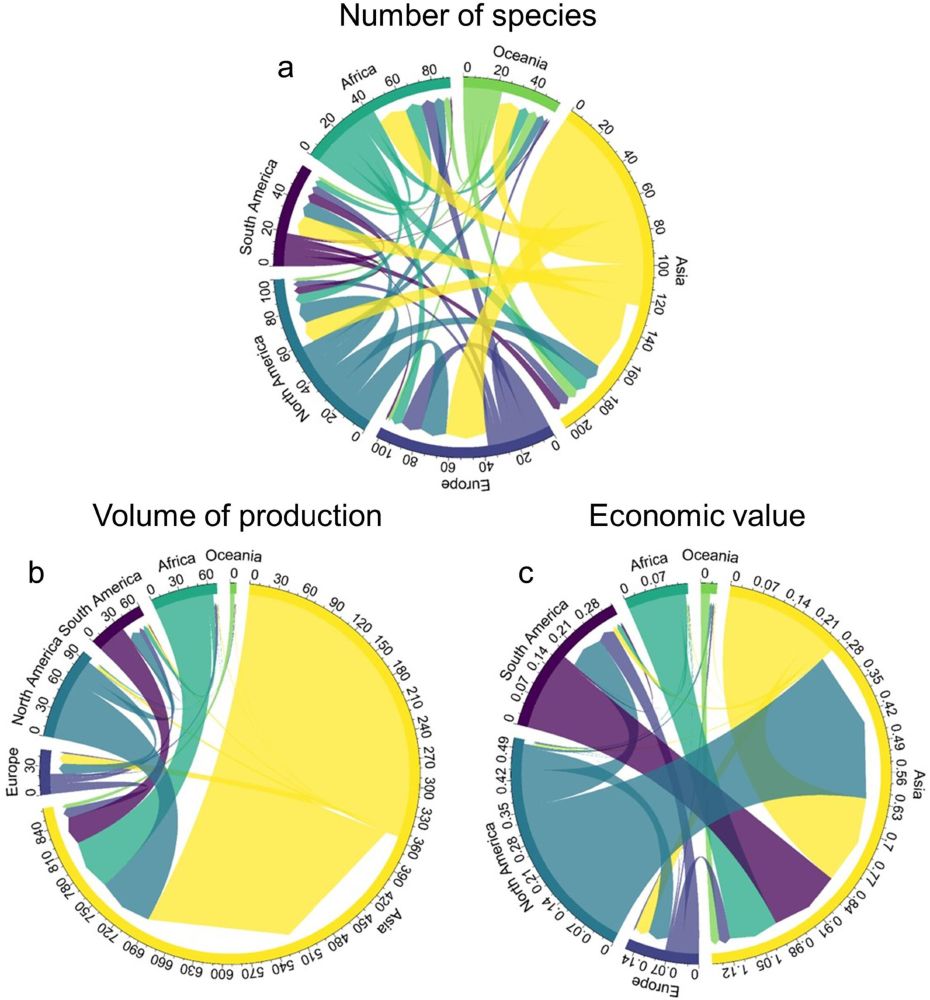
According to the proportion of species donated and received, Asia and North America were the primary donors of non-native species, while Europe and South America receive a large number of species. Asian species have been extensively translocated both inter- and intra-continentally for aquaculture
June 17, 2025 at 9:20 AM
According to the proportion of species donated and received, Asia and North America were the primary donors of non-native species, while Europe and South America receive a large number of species. Asian species have been extensively translocated both inter- and intra-continentally for aquaculture
This total production is largely driven by a handful of commonly farmed species (see Table 2 in the paper), many of which are farmed outside their native ranges and are recognised as high-risk invaders once established in non-native areas with monetary costs

June 17, 2025 at 9:20 AM
This total production is largely driven by a handful of commonly farmed species (see Table 2 in the paper), many of which are farmed outside their native ranges and are recognised as high-risk invaders once established in non-native areas with monetary costs
Over the past decades, production volumes have risen rapidly, with native production being several orders of magnitude higher than its non-native counterpart, but the annual growth rate for non-native species' production (and economic value) is currently surpassed that of native one.

June 17, 2025 at 9:20 AM
Over the past decades, production volumes have risen rapidly, with native production being several orders of magnitude higher than its non-native counterpart, but the annual growth rate for non-native species' production (and economic value) is currently surpassed that of native one.
While the production of native fish and molluscs remains higher than that of non-native ones, algae—and especially crustaceans—are predominantly produced outside their native ranges. The latter with a rate of change exceeding 11,000% since 2000 compared to the previous two decades


June 17, 2025 at 9:20 AM
While the production of native fish and molluscs remains higher than that of non-native ones, algae—and especially crustaceans—are predominantly produced outside their native ranges. The latter with a rate of change exceeding 11,000% since 2000 compared to the previous two decades