




Colin Murphy
@persuasivescience.bsky.social
Co-Lead LCFS and fuel policy research at UC Davis Institute of Transportation Studies. Fuel wonkery, climate policy, sustainable transportation, science comms. Thoughts are my own.
I'd like to announce an exciting new postdoc position we just opened up to work on new approaches to indirect land use change assessment and risk mitigation.
Please share through your networks!
its.ucdavis.edu/about-us/car...
Please share through your networks!
its.ucdavis.edu/about-us/car...
December 3, 2025 at 4:29 PM
I'd like to announce an exciting new postdoc position we just opened up to work on new approaches to indirect land use change assessment and risk mitigation.
Please share through your networks!
its.ucdavis.edu/about-us/car...
Please share through your networks!
its.ucdavis.edu/about-us/car...
Saw this thread on the old platform (apologies for linking there, but I haven't found him here and want to offer credit where it's due) and have some thoughts.
Thread: x.com/OilandGibbs/...
Thread: x.com/OilandGibbs/...

October 8, 2024 at 5:53 PM
Saw this thread on the old platform (apologies for linking there, but I haven't found him here and want to offer credit where it's due) and have some thoughts.
Thread: x.com/OilandGibbs/...
Thread: x.com/OilandGibbs/...
EU policies (mandate plus ETS pricing) get closer. Here's the same graph with the EU policy portfolio. The additional horizontal lines are the non-compliance penalties. Largely the same result, nothing is cost-competitive, though the mandate means they may be required anyway 11/

September 5, 2024 at 10:17 PM
EU policies (mandate plus ETS pricing) get closer. Here's the same graph with the EU policy portfolio. The additional horizontal lines are the non-compliance penalties. Largely the same result, nothing is cost-competitive, though the mandate means they may be required anyway 11/
The combination helps reduce the gap between conventional and alternative fuels, but doesn't close it. This is a graph of the cost gap between conventional and alternative fuels (y-axis) and GHG savings (x-axis). Above the x-axis means not cost-competitive. 8/

September 5, 2024 at 10:16 PM
The combination helps reduce the gap between conventional and alternative fuels, but doesn't close it. This is a graph of the cost gap between conventional and alternative fuels (y-axis) and GHG savings (x-axis). Above the x-axis means not cost-competitive. 8/
Interesting: CARB won't approve additional LMD (light and medium duty) infrastructure capacity credit pathways if the expected credits from all (LMD plus HD) stations exceed the cap (2.5% of prior year deficits). This cap aligns with past practice.


August 17, 2024 at 8:00 PM
Interesting: CARB won't approve additional LMD (light and medium duty) infrastructure capacity credit pathways if the expected credits from all (LMD plus HD) stations exceed the cap (2.5% of prior year deficits). This cap aligns with past practice.
This is potentially meaningful, but I'm not quite if it represents a relaxation of sustainability standards or a tightening of them (have to cross-reference to a few other sections, happy to have y'all chime in to save me the time though).

August 13, 2024 at 5:34 PM
This is potentially meaningful, but I'm not quite if it represents a relaxation of sustainability standards or a tightening of them (have to cross-reference to a few other sections, happy to have y'all chime in to save me the time though).
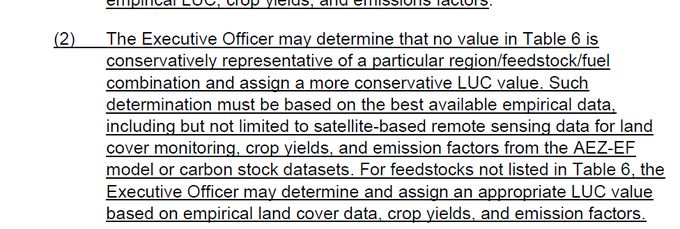
The first surprise, but hard to say how big it could be: The problem w/ ILUC right now is that we are quite confident that existing GTAP-based estimates are low, but we don't have better models to quantify by what extent. So this seems to be saying that CARB reserves the right to update them
August 13, 2024 at 5:28 PM
The first surprise, but hard to say how big it could be: The problem w/ ILUC right now is that we are quite confident that existing GTAP-based estimates are low, but we don't have better models to quantify by what extent. So this seems to be saying that CARB reserves the right to update them
Limiting new pathways doesn't really limit the volumes we consume, and could perversely limit the use of newer, more efficient production processes, but at the same time, this does send an additional signal that current biofuels are a transitional measure.

August 13, 2024 at 5:26 PM
Limiting new pathways doesn't really limit the volumes we consume, and could perversely limit the use of newer, more efficient production processes, but at the same time, this does send an additional signal that current biofuels are a transitional measure.
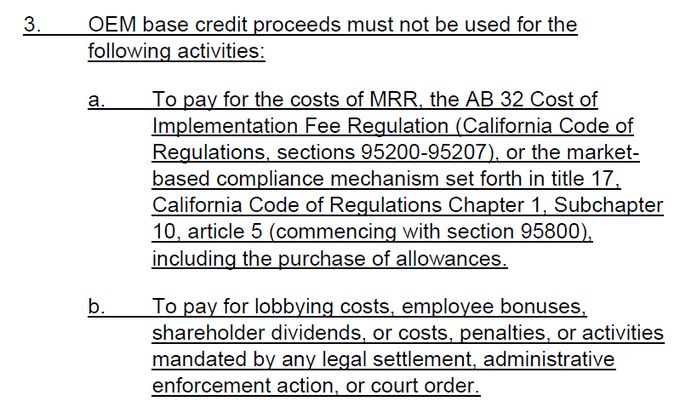
Well, at least they're trying to ensure this doesn't just become a windfall profit. OEM balance sheets are so complex, this seems essentially unenforceable, but there aren't a lot of good tools in this space (that I know of).
August 13, 2024 at 5:21 PM
Well, at least they're trying to ensure this doesn't just become a windfall profit. OEM balance sheets are so complex, this seems essentially unenforceable, but there aren't a lot of good tools in this space (that I know of).
Next interesting development: They're allowing some residential EV charging credits to go straight to EV makers, rather than go to a reward program via the utilities themselves. Seems like the latest attempt to develop a point-of-sale EV rebate strategy that works.

August 13, 2024 at 5:20 PM
Next interesting development: They're allowing some residential EV charging credits to go straight to EV makers, rather than go to a reward program via the utilities themselves. Seems like the latest attempt to develop a point-of-sale EV rebate strategy that works.
The other big thing from the first few dozen pages is this extremely mild restriction on crop-based veg oil renewable diesel. So, no company can go over 20% crop based oils for RD. That's a good step, but unless there's more later in the document that, it's wholly inadequate protection against ILUC

August 13, 2024 at 5:18 PM
The other big thing from the first few dozen pages is this extremely mild restriction on crop-based veg oil renewable diesel. So, no company can go over 20% crop based oils for RD. That's a good step, but unless there's more later in the document that, it's wholly inadequate protection against ILUC
I don't want to dunk on NET power too hard because if the tech works, it could be really important in the fight against climate change...
But this line is *chef's kiss* brilliant understatement.
But this line is *chef's kiss* brilliant understatement.

May 7, 2024 at 8:27 PM
I don't want to dunk on NET power too hard because if the tech works, it could be really important in the fight against climate change...
But this line is *chef's kiss* brilliant understatement.
But this line is *chef's kiss* brilliant understatement.
It's increasingly difficult to see a viable alternative that can be implemented quickly other than a cap. We model several options including crop- and lipid-based fuel caps. For comparison, in 2022 we used about 450 million GGE or crop-based fuel and 1.9 billion of total lipid 25/

February 19, 2024 at 8:18 PM
It's increasingly difficult to see a viable alternative that can be implemented quickly other than a cap. We model several options including crop- and lipid-based fuel caps. For comparison, in 2022 we used about 450 million GGE or crop-based fuel and 1.9 billion of total lipid 25/
The Auto-Acceleration Mechanism (AAM) is meant to help mitigate this kind of risk. We modeled it in the new paper. Proposed amendments are projected to trigger the AAM twice before 2030. The bank is high enough to trigger again in early 2030's but projected declines block it. 20/

February 19, 2024 at 8:13 PM
The Auto-Acceleration Mechanism (AAM) is meant to help mitigate this kind of risk. We modeled it in the new paper. Proposed amendments are projected to trigger the AAM twice before 2030. The bank is high enough to trigger again in early 2030's but projected declines block it. 20/
The bigger issue is renewable diesel deployment. It is going far, far faster than anticipated. This DOE graphic showing anticipated RD capacity in the U.S. was released in 2021. I added the orange indicator to show what actual RD capacity was in 2022. 5/

February 19, 2024 at 8:09 PM
The bigger issue is renewable diesel deployment. It is going far, far faster than anticipated. This DOE graphic showing anticipated RD capacity in the U.S. was released in 2021. I added the orange indicator to show what actual RD capacity was in 2022. 5/