




Prashant Garg
@prashantgarg.bsky.social
Econ PhD @imperial. Visiting researcher at Cambridge.
AI and networks in economics.
www.prashantgarg.org
AI and networks in economics.
www.prashantgarg.org
10/ Yes: outbreaks trigger rapid *and durable* rises in research attention.
Responses are much stronger in the 2010s than before and biggest for high-salience threats.
Capacity matters too: internet penetration, population structure, and research strength predict bigger mobilization.
Responses are much stronger in the 2010s than before and biggest for high-salience threats.
Capacity matters too: internet penetration, population structure, and research strength predict bigger mobilization.

January 22, 2026 at 2:17 PM
10/ Yes: outbreaks trigger rapid *and durable* rises in research attention.
Responses are much stronger in the 2010s than before and biggest for high-salience threats.
Capacity matters too: internet penetration, population structure, and research strength predict bigger mobilization.
Responses are much stronger in the 2010s than before and biggest for high-salience threats.
Capacity matters too: internet penetration, population structure, and research strength predict bigger mobilization.
9/ What about sudden shocks: Ebola, Zika, COVID?
Do countries ramp up research when health emergencies hit?
We test this using 3,134 WHO Disease Outbreak News alerts as quasi-random shocks to disease salience.
Do countries ramp up research when health emergencies hit?
We test this using 3,134 WHO Disease Outbreak News alerts as quasi-random shocks to disease salience.

January 22, 2026 at 2:17 PM
9/ What about sudden shocks: Ebola, Zika, COVID?
Do countries ramp up research when health emergencies hit?
We test this using 3,134 WHO Disease Outbreak News alerts as quasi-random shocks to disease salience.
Do countries ramp up research when health emergencies hit?
We test this using 3,134 WHO Disease Outbreak News alerts as quasi-random shocks to disease salience.
8/ In low-income countries, responsiveness growth depends heavily on these actors.
Without philanthropy, responsiveness growth would shrink by ~38%.
Without government support, by ~32%.
(And similar patterns show up in lower-middle-income settings.)
Without philanthropy, responsiveness growth would shrink by ~38%.
Without government support, by ~32%.
(And similar patterns show up in lower-middle-income settings.)

January 22, 2026 at 2:17 PM
8/ In low-income countries, responsiveness growth depends heavily on these actors.
Without philanthropy, responsiveness growth would shrink by ~38%.
Without government support, by ~32%.
(And similar patterns show up in lower-middle-income settings.)
Without philanthropy, responsiveness growth would shrink by ~38%.
Without government support, by ~32%.
(And similar patterns show up in lower-middle-income settings.)
7/ Funders fund differently.
🔹 Philanthropies → neglected burdens (HIV/NTDs/nutrition)
🔹 Corporations → profitable chronic diseases (cardio, cancer, diabetes/kidney)
🔹 Governments/public → somewhere in between
🔹 Philanthropies → neglected burdens (HIV/NTDs/nutrition)
🔹 Corporations → profitable chronic diseases (cardio, cancer, diabetes/kidney)
🔹 Governments/public → somewhere in between

January 22, 2026 at 2:17 PM
7/ Funders fund differently.
🔹 Philanthropies → neglected burdens (HIV/NTDs/nutrition)
🔹 Corporations → profitable chronic diseases (cardio, cancer, diabetes/kidney)
🔹 Governments/public → somewhere in between
🔹 Philanthropies → neglected burdens (HIV/NTDs/nutrition)
🔹 Corporations → profitable chronic diseases (cardio, cancer, diabetes/kidney)
🔹 Governments/public → somewhere in between
6/ Even after conditioning on burden, some topics are consistently over-/under-studied:
Over: cardiovascular (+16.5%), digestive (+14.1%)
Under: nutritional deficiencies (−14.4%), maternal & neonatal (−12.4%)
So need ≠ attention (yet).
Over: cardiovascular (+16.5%), digestive (+14.1%)
Under: nutritional deficiencies (−14.4%), maternal & neonatal (−12.4%)
So need ≠ attention (yet).

January 22, 2026 at 2:17 PM
6/ Even after conditioning on burden, some topics are consistently over-/under-studied:
Over: cardiovascular (+16.5%), digestive (+14.1%)
Under: nutritional deficiencies (−14.4%), maternal & neonatal (−12.4%)
So need ≠ attention (yet).
Over: cardiovascular (+16.5%), digestive (+14.1%)
Under: nutritional deficiencies (−14.4%), maternal & neonatal (−12.4%)
So need ≠ attention (yet).
5/ The bad news: participation is still lopsided.
The Global South often appears more as a research setting than a research author.
Example: for neglected tropical diseases & malaria, Africa is 33% of research context, but only 14% of authorship.
The Global South often appears more as a research setting than a research author.
Example: for neglected tropical diseases & malaria, Africa is 33% of research context, but only 14% of authorship.

January 22, 2026 at 2:17 PM
5/ The bad news: participation is still lopsided.
The Global South often appears more as a research setting than a research author.
Example: for neglected tropical diseases & malaria, Africa is 33% of research context, but only 14% of authorship.
The Global South often appears more as a research setting than a research author.
Example: for neglected tropical diseases & malaria, Africa is 33% of research context, but only 14% of authorship.
4/ Research is getting less geographically concentrated over time, and “endemic responsiveness”
(elasticity of publications to domestic DALYs) has more than doubled since 1990.
(elasticity of publications to domestic DALYs) has more than doubled since 1990.

January 22, 2026 at 2:17 PM
4/ Research is getting less geographically concentrated over time, and “endemic responsiveness”
(elasticity of publications to domestic DALYs) has more than doubled since 1990.
(elasticity of publications to domestic DALYs) has more than doubled since 1990.
3/ Cardio + cancer dominate papers, while respiratory infections/TB + maternal–neonatal + nutrition + many infectious diseases carry *much* higher burden than their paper ranks suggest.
but there's good news....
but there's good news....

January 22, 2026 at 2:17 PM
3/ Cardio + cancer dominate papers, while respiratory infections/TB + maternal–neonatal + nutrition + many infectious diseases carry *much* higher burden than their paper ranks suggest.
but there's good news....
but there's good news....
Does science follow where people are sick and does it mobilize when outbreaks hit?
@zhou-hy.bsky.social, @trfetzer.com and I answer just that in our revised paper.
1/ A short thread for highlights 👇
@zhou-hy.bsky.social, @trfetzer.com and I answer just that in our revised paper.
1/ A short thread for highlights 👇

January 22, 2026 at 2:17 PM
Does science follow where people are sick and does it mobilize when outbreaks hit?
@zhou-hy.bsky.social, @trfetzer.com and I answer just that in our revised paper.
1/ A short thread for highlights 👇
@zhou-hy.bsky.social, @trfetzer.com and I answer just that in our revised paper.
1/ A short thread for highlights 👇
Can AI tell us anything meaningful about Bob Dylan’s songs? Delighted to share a new essay in @aeon.co breaking down an artists' evolution using AI extracted idea graphs.
aeon.co/essays/can-a...
aeon.co/essays/can-a...

November 8, 2025 at 5:18 PM
Can AI tell us anything meaningful about Bob Dylan’s songs? Delighted to share a new essay in @aeon.co breaking down an artists' evolution using AI extracted idea graphs.
aeon.co/essays/can-a...
aeon.co/essays/can-a...
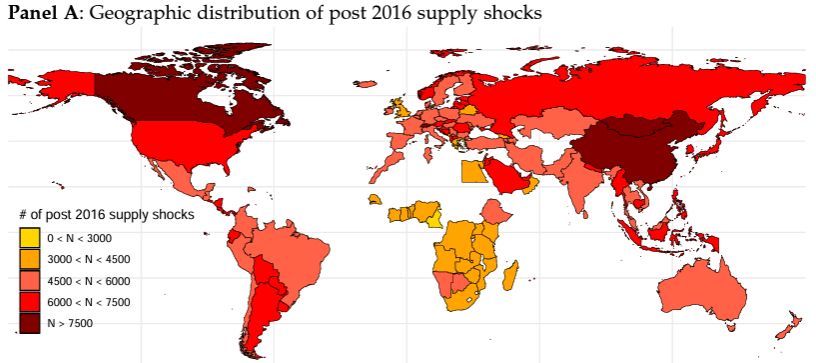
7/ Our paper finds that global supply shocks on internationally traded goods have become more prevalent since 2016, particularly affecting consumer goods and processed intermediates. Here's a map of these supply shocks. Post 2024 map, when data updates, will likely be worse...
July 24, 2025 at 1:32 PM
7/ Our paper finds that global supply shocks on internationally traded goods have become more prevalent since 2016, particularly affecting consumer goods and processed intermediates. Here's a map of these supply shocks. Post 2024 map, when data updates, will likely be worse...
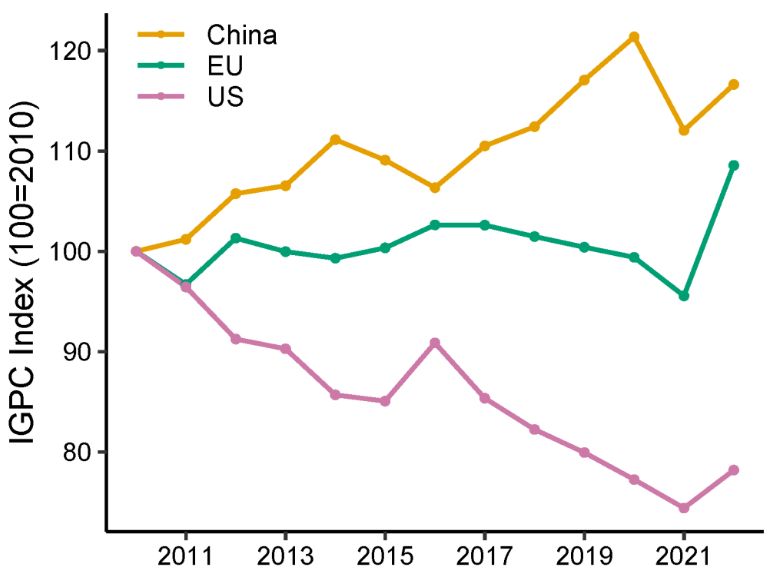
6/ Diverging strategies of U.S. vs. China in global trade. China: Importing more upstream products like Cement to build advanced domestic industries. US: Importing more downstream goods, relying on global supply chains.
July 24, 2025 at 1:32 PM
6/ Diverging strategies of U.S. vs. China in global trade. China: Importing more upstream products like Cement to build advanced domestic industries. US: Importing more downstream goods, relying on global supply chains.
5/ The pending 15% baseline tariff agreement between the US and EU may impact 12 million tonnes of transatlantic clinker, reshaping supply chains, alongside ongoing 50% US steel duties
July 24, 2025 at 1:32 PM
5/ The pending 15% baseline tariff agreement between the US and EU may impact 12 million tonnes of transatlantic clinker, reshaping supply chains, alongside ongoing 50% US steel duties
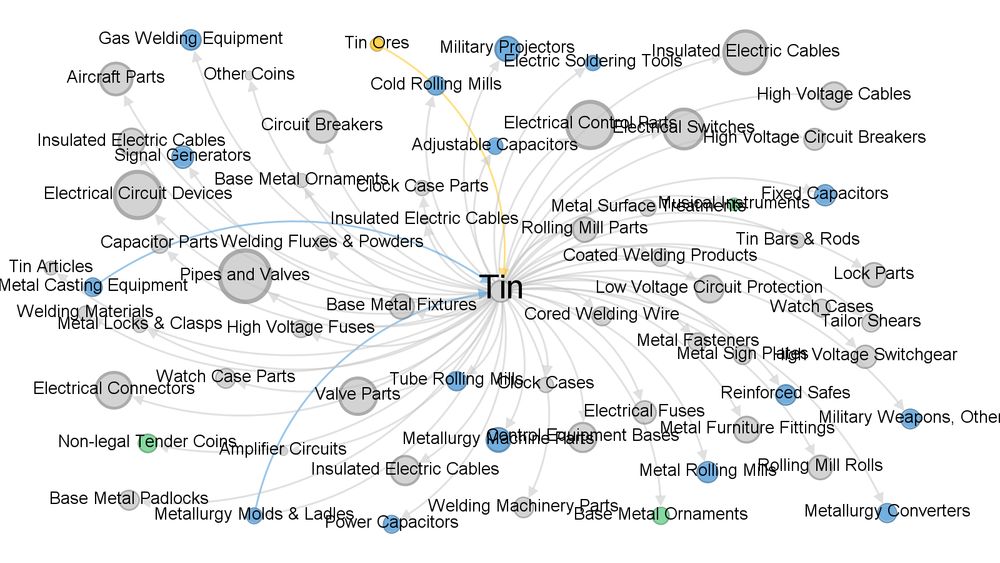
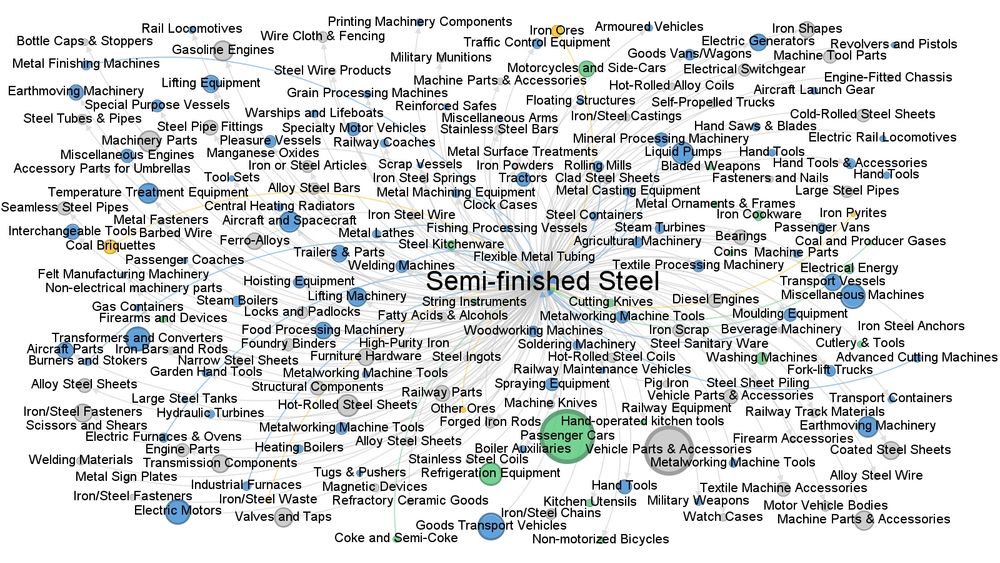
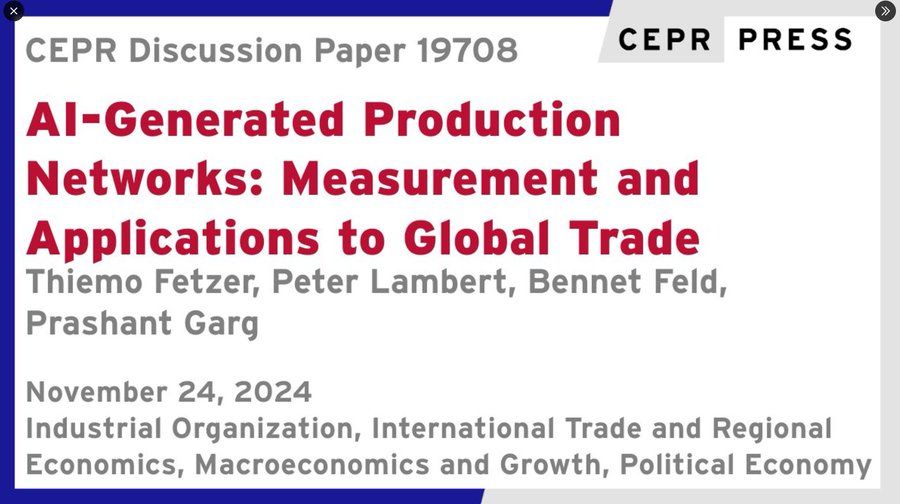
3/ In our paper, AI-Generated Production Networks (2024), joint with @trfetzer.com , @econopete.bsky.social and Bennet Feld, we used AI to build AIPNET, a detailed map of global production networks. It shows how critical inputs like Cement and Steel underpin industries worldwide
July 24, 2025 at 1:32 PM
3/ In our paper, AI-Generated Production Networks (2024), joint with @trfetzer.com , @econopete.bsky.social and Bennet Feld, we used AI to build AIPNET, a detailed map of global production networks. It shows how critical inputs like Cement and Steel underpin industries worldwide
🚨 Tariffs on inputs = tax on downstream products.🚨
Here’s cement’s granular production network. A 50% duty on key inputs propagates costs through roads, buildings, data-centres, and renewable infrastructure.
Public data, method & our paper in thread 🧵 0/8
Here’s cement’s granular production network. A 50% duty on key inputs propagates costs through roads, buildings, data-centres, and renewable infrastructure.
Public data, method & our paper in thread 🧵 0/8

July 24, 2025 at 1:32 PM
🚨 Tariffs on inputs = tax on downstream products.🚨
Here’s cement’s granular production network. A 50% duty on key inputs propagates costs through roads, buildings, data-centres, and renewable infrastructure.
Public data, method & our paper in thread 🧵 0/8
Here’s cement’s granular production network. A 50% duty on key inputs propagates costs through roads, buildings, data-centres, and renewable infrastructure.
Public data, method & our paper in thread 🧵 0/8
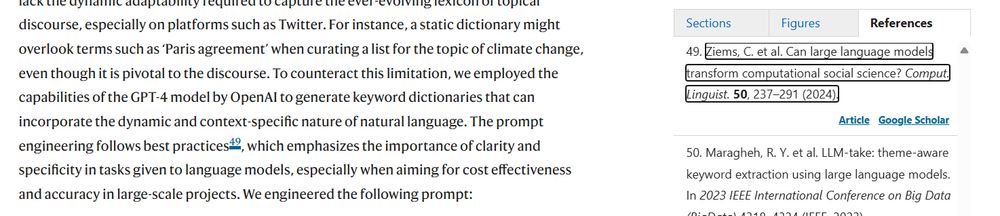
If you read the full paper, especially the content before this excerpt, you will find the citation to best practices.
June 8, 2025 at 12:27 PM
If you read the full paper, especially the content before this excerpt, you will find the citation to best practices.
9/ Tremendous thanks to my co-author @trfetzer.com. We have written a backstory to this paper, both of us talking informally (blog) about how we got to this paper: communities.springernature.com/posts/politi...

June 3, 2025 at 10:21 AM
9/ Tremendous thanks to my co-author @trfetzer.com. We have written a backstory to this paper, both of us talking informally (blog) about how we got to this paper: communities.springernature.com/posts/politi...
6/ Academics based in US, top-ranked institutions or ones in Humanities departments exhibit higher egocentrism and toxicity in their tweets.

June 3, 2025 at 10:21 AM
6/ Academics based in US, top-ranked institutions or ones in Humanities departments exhibit higher egocentrism and toxicity in their tweets.
5/ Finding 3: Do Academics Differ?
- STEM ones are more pro-climate than others, and prefer techno-optimistic solutions (e.g. EVs, Nuclear).
- No Gender difference on climate support, but men are more techno-optimist.
- US academics and non-expert in topic are less supportive of climate action.
- STEM ones are more pro-climate than others, and prefer techno-optimistic solutions (e.g. EVs, Nuclear).
- No Gender difference on climate support, but men are more techno-optimist.
- US academics and non-expert in topic are less supportive of climate action.

June 3, 2025 at 10:21 AM
5/ Finding 3: Do Academics Differ?
- STEM ones are more pro-climate than others, and prefer techno-optimistic solutions (e.g. EVs, Nuclear).
- No Gender difference on climate support, but men are more techno-optimist.
- US academics and non-expert in topic are less supportive of climate action.
- STEM ones are more pro-climate than others, and prefer techno-optimistic solutions (e.g. EVs, Nuclear).
- No Gender difference on climate support, but men are more techno-optimist.
- US academics and non-expert in topic are less supportive of climate action.
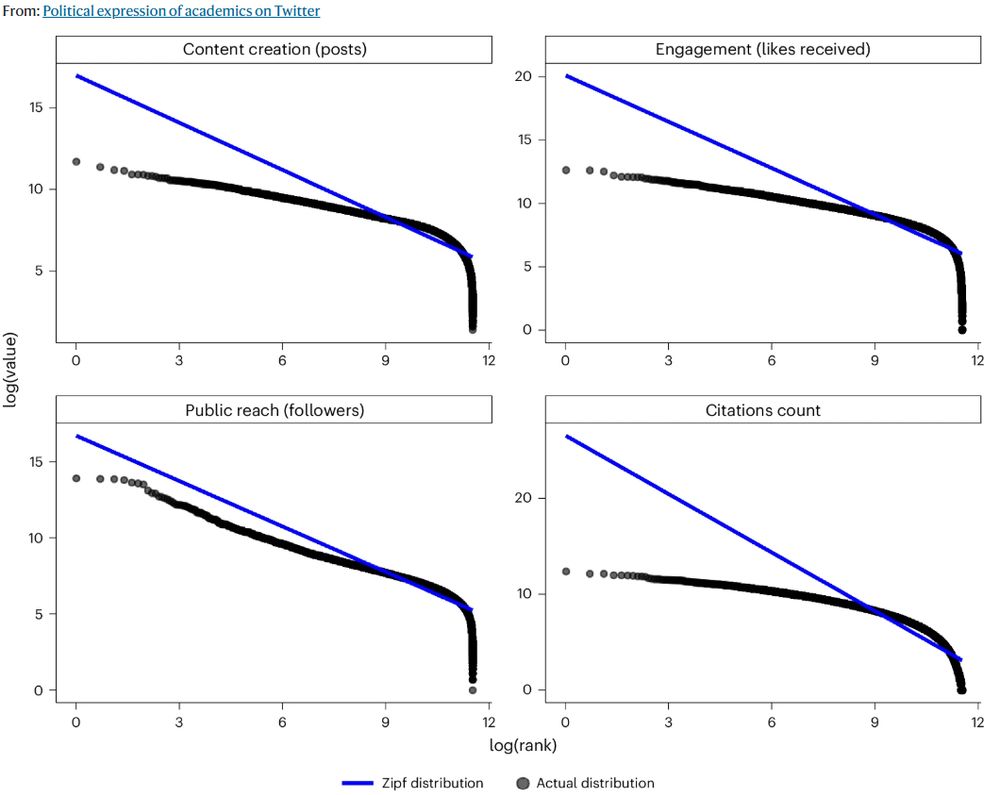
4/ Finding 2: Influence Inequality
A small fraction of academics create the majority of content. Top 5% of accounts receive 30% of likes and 40% of followers, while the bottom 50% receive only 10% in both.
--> Academic recognition doesn’t directly map into Twitter engagement.
A small fraction of academics create the majority of content. Top 5% of accounts receive 30% of likes and 40% of followers, while the bottom 50% receive only 10% in both.
--> Academic recognition doesn’t directly map into Twitter engagement.
June 3, 2025 at 10:21 AM
4/ Finding 2: Influence Inequality
A small fraction of academics create the majority of content. Top 5% of accounts receive 30% of likes and 40% of followers, while the bottom 50% receive only 10% in both.
--> Academic recognition doesn’t directly map into Twitter engagement.
A small fraction of academics create the majority of content. Top 5% of accounts receive 30% of likes and 40% of followers, while the bottom 50% receive only 10% in both.
--> Academic recognition doesn’t directly map into Twitter engagement.
3/ Finding 1: Academics are much more liberal & less toxic on Twitter than the general population.

June 3, 2025 at 10:21 AM
3/ Finding 1: Academics are much more liberal & less toxic on Twitter than the general population.
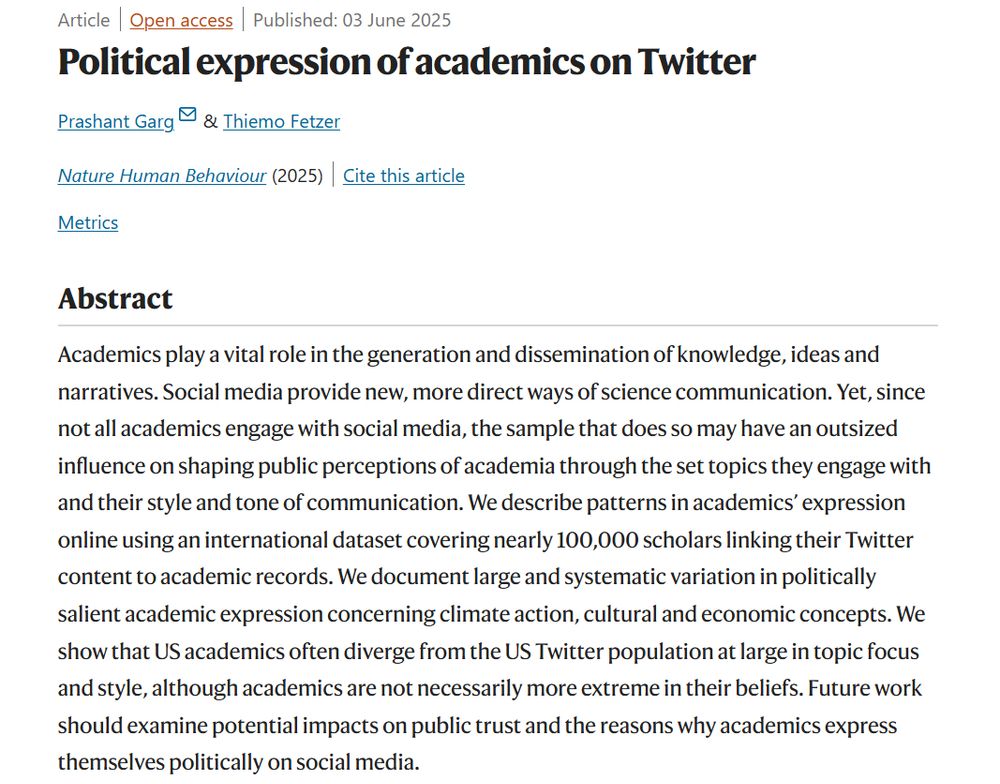
1/ 🚨 Hot off the press! Our study “Political Expression of Academics on Social Media” with @trfetzer.com is now peer-reviewed & live in Nature Human Behaviour @nature.com 🎉. Thread 👇
June 3, 2025 at 10:21 AM
1/ 🚨 Hot off the press! Our study “Political Expression of Academics on Social Media” with @trfetzer.com is now peer-reviewed & live in Nature Human Behaviour @nature.com 🎉. Thread 👇
6/ Network reconstruction strongly predicts Bluesky activity: the very info-source ties that tipped scholars off Twitter keep them glued to the new platform.
10% more overlapped Twitter ties = 1 extra month active on Bluesky.
10% more overlapped Twitter ties = 1 extra month active on Bluesky.

June 2, 2025 at 1:13 PM
6/ Network reconstruction strongly predicts Bluesky activity: the very info-source ties that tipped scholars off Twitter keep them glued to the new platform.
10% more overlapped Twitter ties = 1 extra month active on Bluesky.
10% more overlapped Twitter ties = 1 extra month active on Bluesky.
5/ What kind of contagion?
Simple – (one friend leaves ⇒ you leave) dominates (66%)
Shocks – Drive 16% of departures
Complex contagion is rare
Pol. active users need only simple contagion to jump, but pol. inactive users require shocks or complex to push them over the edge.
Simple – (one friend leaves ⇒ you leave) dominates (66%)
Shocks – Drive 16% of departures
Complex contagion is rare
Pol. active users need only simple contagion to jump, but pol. inactive users require shocks or complex to push them over the edge.

June 2, 2025 at 1:13 PM
5/ What kind of contagion?
Simple – (one friend leaves ⇒ you leave) dominates (66%)
Shocks – Drive 16% of departures
Complex contagion is rare
Pol. active users need only simple contagion to jump, but pol. inactive users require shocks or complex to push them over the edge.
Simple – (one friend leaves ⇒ you leave) dominates (66%)
Shocks – Drive 16% of departures
Complex contagion is rare
Pol. active users need only simple contagion to jump, but pol. inactive users require shocks or complex to push them over the edge.