



Planetary Science Institute
@psi.edu
https://www.psi.edu/
A private nonprofit dedicated to studying the origin, characteristics, and evolution of planetary systems and planets, including the Earth.
A private nonprofit dedicated to studying the origin, characteristics, and evolution of planetary systems and planets, including the Earth.
However, because planets don't have perfectly circular orbits, Jupiter's closest approach to Earth will actually occur tonight, "only" 393 million miles away.
We're sharing this Sky & Telescope article if you're interested in learning more and understand your viewing options! buff.ly/cjLeNNo
We're sharing this Sky & Telescope article if you're interested in learning more and understand your viewing options! buff.ly/cjLeNNo

Big and Bright, Jupiter Beckons in January
Jupiter's having a special moment! Don't miss the giant planet at its best when it reaches opposition this week.
buff.ly
January 9, 2026 at 3:00 PM
However, because planets don't have perfectly circular orbits, Jupiter's closest approach to Earth will actually occur tonight, "only" 393 million miles away.
We're sharing this Sky & Telescope article if you're interested in learning more and understand your viewing options! buff.ly/cjLeNNo
We're sharing this Sky & Telescope article if you're interested in learning more and understand your viewing options! buff.ly/cjLeNNo
The yellow-brown is a Type II dust tail dragged into a fan shape by the solar radiation pressure on tiny dust grains, along with the orbital motion of the comet. The green around the nucleus is fluorescence from diatomic carbon with possible contribution from cyanogen, Clark said.
January 8, 2026 at 3:01 PM
The yellow-brown is a Type II dust tail dragged into a fan shape by the solar radiation pressure on tiny dust grains, along with the orbital motion of the comet. The green around the nucleus is fluorescence from diatomic carbon with possible contribution from cyanogen, Clark said.
Did you know that there are different kinds of cometary tails? Type I are ion tails & Type II are dust tails. There are also less common tail types, such as the Type III sodium tail. In this photo, the blue is a Type I which gets it color from carbon monoxide cations emitting blue light.
January 8, 2026 at 3:01 PM
Did you know that there are different kinds of cometary tails? Type I are ion tails & Type II are dust tails. There are also less common tail types, such as the Type III sodium tail. In this photo, the blue is a Type I which gets it color from carbon monoxide cations emitting blue light.
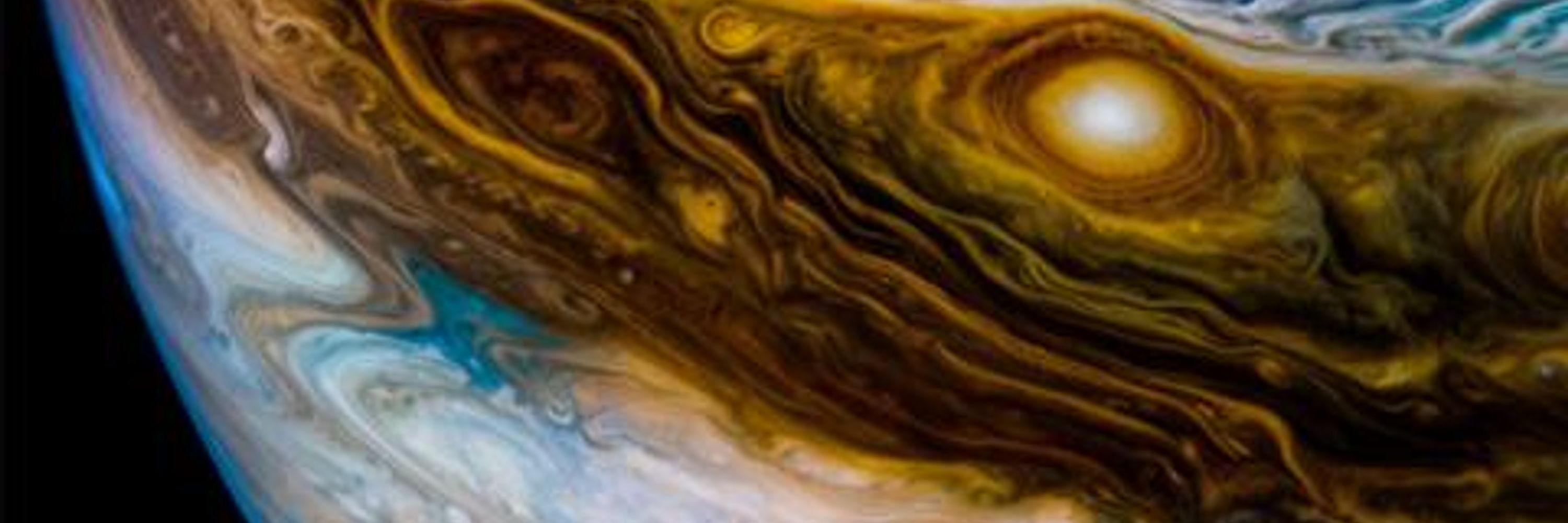
These views of Jupiter were processed by participatory scientist Thomas Thomopoulos. Interested in processing your own JunoCam images? Visit: buff.ly/9YvnJFy

JunoCam - Mission Juno
Upload your images of Jupiter, comment on the images, and vote on what pictures JunoCam will take when it reaches Jupiter.
buff.ly
January 7, 2026 at 5:00 PM
These views of Jupiter were processed by participatory scientist Thomas Thomopoulos. Interested in processing your own JunoCam images? Visit: buff.ly/9YvnJFy
More from our newsletter: buff.ly/we0bXKt
buff.ly
January 5, 2026 at 3:02 PM
More from our newsletter: buff.ly/we0bXKt
The code was written by NASA computer scientist Margaret Hamilton in 1969. It was during this project that she invented the term “software engineering” to describe the process of developing code. 🧪 🔭 🎨
Learn more about this piece and see Jamie's other works of art: buff.ly/UFYnVzP
Learn more about this piece and see Jamie's other works of art: buff.ly/UFYnVzP

Art
I make art using data collected by robotic spacecrafts sent to explore objects throughout the Solar System. My series of paper planets (below) are made using topography data and images of the Moon,…
buff.ly
December 19, 2025 at 3:04 PM
The code was written by NASA computer scientist Margaret Hamilton in 1969. It was during this project that she invented the term “software engineering” to describe the process of developing code. 🧪 🔭 🎨
Learn more about this piece and see Jamie's other works of art: buff.ly/UFYnVzP
Learn more about this piece and see Jamie's other works of art: buff.ly/UFYnVzP