



regular slime guy
@regularslimeguy.bsky.social
amateur slime mold enthusiast
They usually look more regular in shape & surface (not always though). It can be hard to tell because maturation is a dramatic transformation & the full process is not documented for many species. You can see some examples below, in a video by instagram.com/yeweijun98
January 10, 2026 at 4:40 PM
They usually look more regular in shape & surface (not always though). It can be hard to tell because maturation is a dramatic transformation & the full process is not documented for many species. You can see some examples below, in a video by instagram.com/yeweijun98
Hello! This isn't actually fungi, which is more closely related to you and me. This is an Amoebozoan, which differs from Fungi in every relevant way: mobility, internal digestion, live prey, no cell wall, no multicellularity, harmless to all plants & animals.

December 28, 2025 at 8:45 PM
Hello! This isn't actually fungi, which is more closely related to you and me. This is an Amoebozoan, which differs from Fungi in every relevant way: mobility, internal digestion, live prey, no cell wall, no multicellularity, harmless to all plants & animals.
Incredible news



December 26, 2025 at 11:36 PM
Incredible news
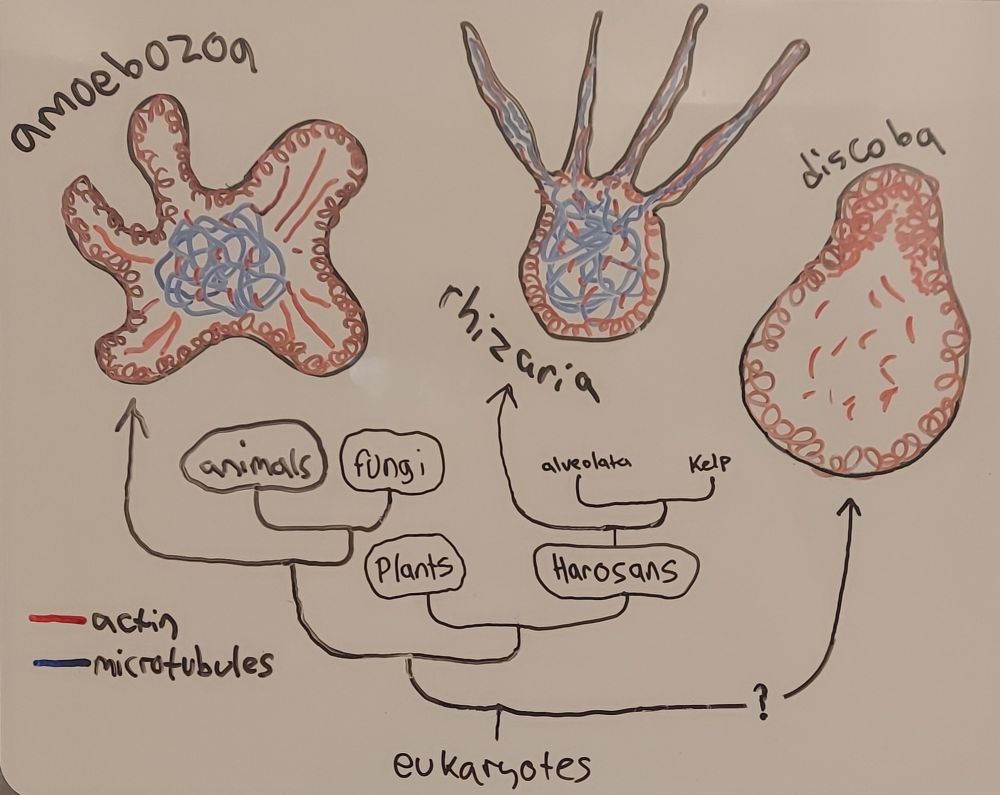
Classifications can be confusing & inaccessible imo, but we have decades of data indicating 6 branches with multicellular life, 5 of which have species large enough to see without a microscope. The image below is a simplified representation of how some different critters are related.

December 26, 2025 at 11:33 PM
Classifications can be confusing & inaccessible imo, but we have decades of data indicating 6 branches with multicellular life, 5 of which have species large enough to see without a microscope. The image below is a simplified representation of how some different critters are related.
Fungi are defined by genes, not chitin: they are more closely related to each other than to other life. Water molds are quite similar but they are actually a type of kelp: chitin & mycelium are not unique to fungi. Slime molds are not similar to fungi genetically, structurally, or ecologically.
December 26, 2025 at 11:28 PM
Fungi are defined by genes, not chitin: they are more closely related to each other than to other life. Water molds are quite similar but they are actually a type of kelp: chitin & mycelium are not unique to fungi. Slime molds are not similar to fungi genetically, structurally, or ecologically.


Green spiders from the Kingdom Rhizaria

December 22, 2025 at 10:56 AM
Green spiders from the Kingdom Rhizaria
When I was a kid my dad used to take my brother & me to see them in tide pools during the full moon

December 18, 2025 at 10:04 PM
When I was a kid my dad used to take my brother & me to see them in tide pools during the full moon
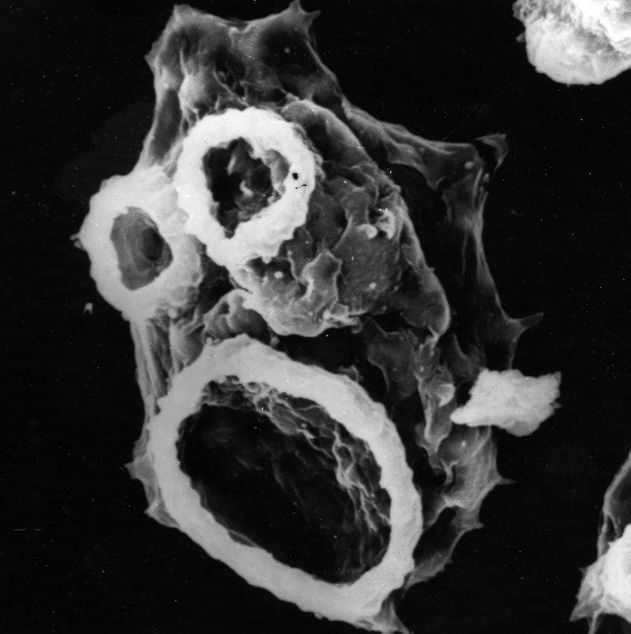
@ultralaser.bsky.social Harosa has 3 major branches with kelp, water molds, some ciliates, rhizarian jelly tubes, & sandcastle amoebas being big enough to see with eyeballs. Discoba has the brain eating amoeba & euglenid algae, which is microscopic but forms visible blooms. Amoebozoa has slime molds


December 18, 2025 at 9:59 PM
@ultralaser.bsky.social Harosa has 3 major branches with kelp, water molds, some ciliates, rhizarian jelly tubes, & sandcastle amoebas being big enough to see with eyeballs. Discoba has the brain eating amoeba & euglenid algae, which is microscopic but forms visible blooms. Amoebozoa has slime molds
Do you know about comb jellies? They apparently evolved a neuromuscular system entirely independent of other animals. They have also recently been more definitively placed at the base of multicellular animals

December 18, 2025 at 7:03 PM
Do you know about comb jellies? They apparently evolved a neuromuscular system entirely independent of other animals. They have also recently been more definitively placed at the base of multicellular animals

Hello, algae is not an evolutionary group. Kelp is a Harosan, in the Stramenopiles
December 18, 2025 at 2:19 PM
Hello, algae is not an evolutionary group. Kelp is a Harosan, in the Stramenopiles
There is no "protist kingdom." There are 6 major branches with multicellular life: plants, animals, and fungi have most species, but the genetic diversity of the remaining 3 kingdoms Discoba, Amoebozoa, and Harosa is significantly larger and includes some macroscopic organisms. Kelp is in Harosa
December 18, 2025 at 2:05 PM
There is no "protist kingdom." There are 6 major branches with multicellular life: plants, animals, and fungi have most species, but the genetic diversity of the remaining 3 kingdoms Discoba, Amoebozoa, and Harosa is significantly larger and includes some macroscopic organisms. Kelp is in Harosa
What a horribly incorrect graphic!

December 18, 2025 at 2:01 PM
What a horribly incorrect graphic!
Kelp is a Harosan
December 18, 2025 at 1:59 PM
Kelp is a Harosan
Slime molds are Amoebozoans: a natural evolutionary kingdom of amoebas more closely related to each other tgan to anyone else. A handful of traditionally included slime molds exist outside Amoebozoa but all are microscopic & immobile when aggregated
December 17, 2025 at 1:00 PM
Slime molds are Amoebozoans: a natural evolutionary kingdom of amoebas more closely related to each other tgan to anyone else. A handful of traditionally included slime molds exist outside Amoebozoa but all are microscopic & immobile when aggregated
@surrealsuzi.bsky.social here is the full process from Yajima, 2023: doi.org/10.1080/0027...

December 16, 2025 at 3:21 PM
@surrealsuzi.bsky.social here is the full process from Yajima, 2023: doi.org/10.1080/0027...
The outer membranes crinkle up as they dry (this is how the fruit body matures). As the light travels through tiny layers of air between those dry membranes, thin film interference splits and bends the light so we see many colors, sort of like a prism


December 16, 2025 at 2:56 PM
The outer membranes crinkle up as they dry (this is how the fruit body matures). As the light travels through tiny layers of air between those dry membranes, thin film interference splits and bends the light so we see many colors, sort of like a prism
It is reproducing! It used to be a huge single cell called a plasmodium (see below). It has reorganized into these balls which are full of spores, & they mature by dehydration. Then insects & the wind take them off to have their own adventure
video of a relative from instagram.com/sluzowce.sud...
video of a relative from instagram.com/sluzowce.sud...
December 16, 2025 at 2:48 PM
It is reproducing! It used to be a huge single cell called a plasmodium (see below). It has reorganized into these balls which are full of spores, & they mature by dehydration. Then insects & the wind take them off to have their own adventure
video of a relative from instagram.com/sluzowce.sud...
video of a relative from instagram.com/sluzowce.sud...
fungi have their uses
December 15, 2025 at 7:03 PM
fungi have their uses
The spores are in the hat (pic 1). Mushrooms are multicellular, but slime molds are not. The plasmodium (pic 2) is a single cell with many nuclei which rearranges & dehydrates to form the fruit bodies. This process is called myxocarpy & is unique to the Amoebozoan Kingdom (3, 4)


December 15, 2025 at 5:40 PM
The spores are in the hat (pic 1). Mushrooms are multicellular, but slime molds are not. The plasmodium (pic 2) is a single cell with many nuclei which rearranges & dehydrates to form the fruit bodies. This process is called myxocarpy & is unique to the Amoebozoan Kingdom (3, 4)
Comatricha from instagram.com/yeweijun98
December 15, 2025 at 3:36 PM
Comatricha from instagram.com/yeweijun98