




Rob Johnson
@rjson.bsky.social
Senior analyst, Centre for Cities. All things urban economics - mainly labour markets, living standards, transport, and innovation. Fan of working with data and visualising it.
Unironically a North West with 3 Warringtons would be great for local living standards 👀

January 14, 2026 at 8:00 PM
Unironically a North West with 3 Warringtons would be great for local living standards 👀
Mancunians can expect a big yellow christmas present - next year - in the form of Bee Network rail services.
GM's future transport vision strikes all the right notes, and could be a blueprint for other metro mayors - just requires GBR/DfT to be aligned to help realise it
GM's future transport vision strikes all the right notes, and could be a blueprint for other metro mayors - just requires GBR/DfT to be aligned to help realise it

December 22, 2025 at 9:53 AM
Mancunians can expect a big yellow christmas present - next year - in the form of Bee Network rail services.
GM's future transport vision strikes all the right notes, and could be a blueprint for other metro mayors - just requires GBR/DfT to be aligned to help realise it
GM's future transport vision strikes all the right notes, and could be a blueprint for other metro mayors - just requires GBR/DfT to be aligned to help realise it
Mixed feelings. Sadly predictable result from lack of fiscal space, sclerotic planning system, and seeming blindspot on the limiting factor to growth here.
But buses are where the real marginal gains are in Leeds. Let's hope this means redoubled focus on a fully integrated system in the short term.
But buses are where the real marginal gains are in Leeds. Let's hope this means redoubled focus on a fully integrated system in the short term.


December 18, 2025 at 10:22 AM
Mixed feelings. Sadly predictable result from lack of fiscal space, sclerotic planning system, and seeming blindspot on the limiting factor to growth here.
But buses are where the real marginal gains are in Leeds. Let's hope this means redoubled focus on a fully integrated system in the short term.
But buses are where the real marginal gains are in Leeds. Let's hope this means redoubled focus on a fully integrated system in the short term.
3. I know you're all full of burning questions about what devolution in Glasgow could look like. Why is it important? What are the options? Should it be a 'mayor' or a 'provost'?
Thankfully we've got a comprehensive FAQ to answer all that and more:
Thankfully we've got a comprehensive FAQ to answer all that and more:


December 15, 2025 at 3:25 PM
3. I know you're all full of burning questions about what devolution in Glasgow could look like. Why is it important? What are the options? Should it be a 'mayor' or a 'provost'?
Thankfully we've got a comprehensive FAQ to answer all that and more:
Thankfully we've got a comprehensive FAQ to answer all that and more:
Great demonstration of what funding and powers could achieve for integrated transport in the city region. All changes would achieve faster and more frequent buses, and better integration with Merseyrail, which could boost Liverpool's connectivity by a third based on our modelling
December 5, 2025 at 11:21 AM
Great demonstration of what funding and powers could achieve for integrated transport in the city region. All changes would achieve faster and more frequent buses, and better integration with Merseyrail, which could boost Liverpool's connectivity by a third based on our modelling
Exactly - a model that is a relatively light touch intervention which will drastically increase connectivity in city regions.
The sort of revenue raising powers we called for in our integrated transport so mayors (and the national economy) can maximise benefits through urban connectivity
The sort of revenue raising powers we called for in our integrated transport so mayors (and the national economy) can maximise benefits through urban connectivity


November 25, 2025 at 4:41 PM
Exactly - a model that is a relatively light touch intervention which will drastically increase connectivity in city regions.
The sort of revenue raising powers we called for in our integrated transport so mayors (and the national economy) can maximise benefits through urban connectivity
The sort of revenue raising powers we called for in our integrated transport so mayors (and the national economy) can maximise benefits through urban connectivity
Urban anti-car measures may seem like political dynamite. But metro mayors should note the lack of fanfare over London's recent congestion charge increases.
For integrated transport to be most effective requires both carrots and sticks in big cities - selling them as a package is the way forward
For integrated transport to be most effective requires both carrots and sticks in big cities - selling them as a package is the way forward

November 25, 2025 at 11:14 AM
Urban anti-car measures may seem like political dynamite. But metro mayors should note the lack of fanfare over London's recent congestion charge increases.
For integrated transport to be most effective requires both carrots and sticks in big cities - selling them as a package is the way forward
For integrated transport to be most effective requires both carrots and sticks in big cities - selling them as a package is the way forward
A blunt instrument that will hit all unis, given their funding model has driven them to overseas recruitment.
Which means many non-South East cities will get an export tax on one of their largest exporting industries.
Hard to square with govt's 'raising living standards across the country' mission
Which means many non-South East cities will get an export tax on one of their largest exporting industries.
Hard to square with govt's 'raising living standards across the country' mission

November 24, 2025 at 11:50 AM
A blunt instrument that will hit all unis, given their funding model has driven them to overseas recruitment.
Which means many non-South East cities will get an export tax on one of their largest exporting industries.
Hard to square with govt's 'raising living standards across the country' mission
Which means many non-South East cities will get an export tax on one of their largest exporting industries.
Hard to square with govt's 'raising living standards across the country' mission
Exactly what we argue for metro mayors looking to meet sustainable travel goals. Our modeled benefits of integrated transport in their cities are mediated by how convenient it is to drive.
Can't have the carrot without the stick as London - with the UK's most integrated public transport - shows.
Can't have the carrot without the stick as London - with the UK's most integrated public transport - shows.

November 15, 2025 at 12:48 PM
Exactly what we argue for metro mayors looking to meet sustainable travel goals. Our modeled benefits of integrated transport in their cities are mediated by how convenient it is to drive.
Can't have the carrot without the stick as London - with the UK's most integrated public transport - shows.
Can't have the carrot without the stick as London - with the UK's most integrated public transport - shows.
Away from the headlines of the Railways Bill, the piece of legislation could be the missing piece of the puzzle for big cities to have truly integrated public transport.
Lots of details to be set yet. But not recognising the economic role of commuter rail would be a mis-step at this early stage 👇
Lots of details to be set yet. But not recognising the economic role of commuter rail would be a mis-step at this early stage 👇

November 11, 2025 at 12:24 PM
Away from the headlines of the Railways Bill, the piece of legislation could be the missing piece of the puzzle for big cities to have truly integrated public transport.
Lots of details to be set yet. But not recognising the economic role of commuter rail would be a mis-step at this early stage 👇
Lots of details to be set yet. But not recognising the economic role of commuter rail would be a mis-step at this early stage 👇
Encouraging, and a positive signal that govt is taking big city transport integration seriously.
It's the right focus for Manchester too - our modelling suggests better rail/tram integration would have the single biggest impact on connectivity.
Ticketing soon, hopefully timetables next in 2026
It's the right focus for Manchester too - our modelling suggests better rail/tram integration would have the single biggest impact on connectivity.
Ticketing soon, hopefully timetables next in 2026

November 6, 2025 at 9:43 AM
Encouraging, and a positive signal that govt is taking big city transport integration seriously.
It's the right focus for Manchester too - our modelling suggests better rail/tram integration would have the single biggest impact on connectivity.
Ticketing soon, hopefully timetables next in 2026
It's the right focus for Manchester too - our modelling suggests better rail/tram integration would have the single biggest impact on connectivity.
Ticketing soon, hopefully timetables next in 2026
For the mayors - a big prize is good news! This means sticking to their plans already in motion to make public transport function better.
This will still require some hard policy choices. But the tools will be on the table from early next year. Next step is to go for it 🚌
This will still require some hard policy choices. But the tools will be on the table from early next year. Next step is to go for it 🚌

November 4, 2025 at 5:01 PM
For the mayors - a big prize is good news! This means sticking to their plans already in motion to make public transport function better.
This will still require some hard policy choices. But the tools will be on the table from early next year. Next step is to go for it 🚌
This will still require some hard policy choices. But the tools will be on the table from early next year. Next step is to go for it 🚌
Back to the prize. Let's translate it to cold hard cash. By increasing effective city size, we estimate £17 billion in additional economic output through 'agglomeration' productivity gains.
So the prize is big. To win it, government must continue to support mayors improving their local transport.
So the prize is big. To win it, government must continue to support mayors improving their local transport.


November 4, 2025 at 4:59 PM
Back to the prize. Let's translate it to cold hard cash. By increasing effective city size, we estimate £17 billion in additional economic output through 'agglomeration' productivity gains.
So the prize is big. To win it, government must continue to support mayors improving their local transport.
So the prize is big. To win it, government must continue to support mayors improving their local transport.
It's not just about improving public transport though, especially for mayors with sustainable travel goals.
Impacts will be limited (in the Yorkshire city regions, cut in half), if no changes are made on residents' relative ease of driving.
Impacts will be limited (in the Yorkshire city regions, cut in half), if no changes are made on residents' relative ease of driving.

November 4, 2025 at 4:55 PM
It's not just about improving public transport though, especially for mayors with sustainable travel goals.
Impacts will be limited (in the Yorkshire city regions, cut in half), if no changes are made on residents' relative ease of driving.
Impacts will be limited (in the Yorkshire city regions, cut in half), if no changes are made on residents' relative ease of driving.
You could also get similar connectivity impacts through densifying cities - Newcastle is a good example here.
But again integration complements this - better transport makes these projects more viable, and public land assembly easier.
But again integration complements this - better transport makes these projects more viable, and public land assembly easier.

November 4, 2025 at 4:53 PM
You could also get similar connectivity impacts through densifying cities - Newcastle is a good example here.
But again integration complements this - better transport makes these projects more viable, and public land assembly easier.
But again integration complements this - better transport makes these projects more viable, and public land assembly easier.
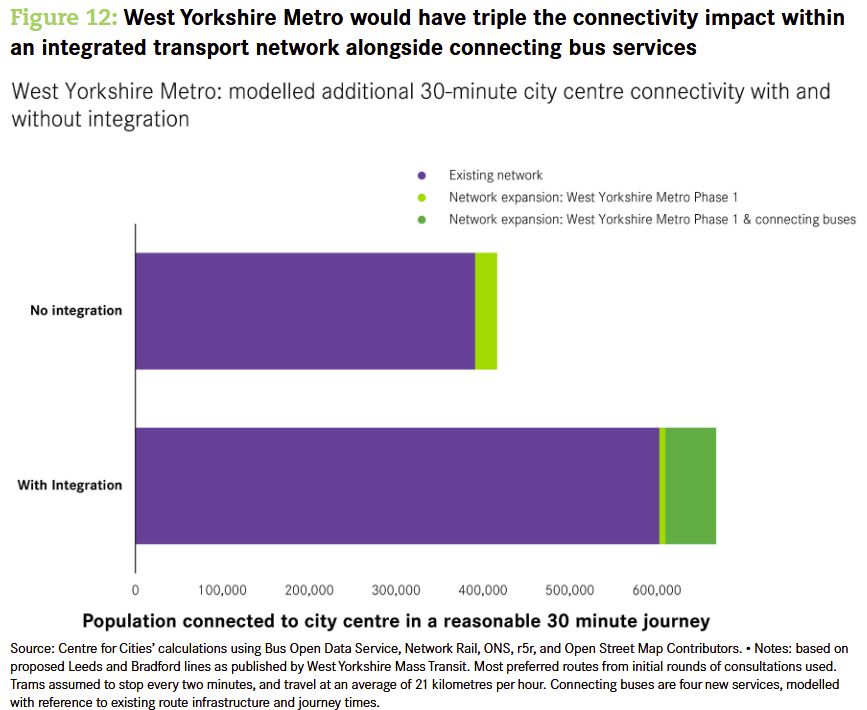
Integration makes other levers to increase citys' effective size easier to pull.
Connectivity impacts of West Yorkshire Metro Phase 1 plans (on best current information) would be trebled if they happened within an integrated network.
Fixing the fundamentals unlocks these bigger projects.
Connectivity impacts of West Yorkshire Metro Phase 1 plans (on best current information) would be trebled if they happened within an integrated network.
Fixing the fundamentals unlocks these bigger projects.
November 4, 2025 at 4:49 PM
Integration makes other levers to increase citys' effective size easier to pull.
Connectivity impacts of West Yorkshire Metro Phase 1 plans (on best current information) would be trebled if they happened within an integrated network.
Fixing the fundamentals unlocks these bigger projects.
Connectivity impacts of West Yorkshire Metro Phase 1 plans (on best current information) would be trebled if they happened within an integrated network.
Fixing the fundamentals unlocks these bigger projects.
But mayors should not stop at one. Steps are complementary. Doing one multiplies the impact of the next.
As this map of Liverpool shows. Increasing frequencies and modal integration together has double the impact of each on its own - see the light blue areas only unlocked with both.
As this map of Liverpool shows. Increasing frequencies and modal integration together has double the impact of each on its own - see the light blue areas only unlocked with both.

November 4, 2025 at 4:47 PM
But mayors should not stop at one. Steps are complementary. Doing one multiplies the impact of the next.
As this map of Liverpool shows. Increasing frequencies and modal integration together has double the impact of each on its own - see the light blue areas only unlocked with both.
As this map of Liverpool shows. Increasing frequencies and modal integration together has double the impact of each on its own - see the light blue areas only unlocked with both.
Different steps work best in different places.
For Leeds (and other smaller city regions), filling in bus frequencies is the biggest first step.
For Manchester, it is better use of existing tram and train services, linking to already frequent bus routes
For Leeds (and other smaller city regions), filling in bus frequencies is the biggest first step.
For Manchester, it is better use of existing tram and train services, linking to already frequent bus routes


November 4, 2025 at 4:43 PM
Different steps work best in different places.
For Leeds (and other smaller city regions), filling in bus frequencies is the biggest first step.
For Manchester, it is better use of existing tram and train services, linking to already frequent bus routes
For Leeds (and other smaller city regions), filling in bus frequencies is the biggest first step.
For Manchester, it is better use of existing tram and train services, linking to already frequent bus routes
Sheffield shows you how these steps work together in practice. Better bus frequencies fill in under-served gaps, modal integration allows train and tram stops to reach further, and faster journeys mean existing services can stretch out the network's area.

November 4, 2025 at 4:37 PM
Sheffield shows you how these steps work together in practice. Better bus frequencies fill in under-served gaps, modal integration allows train and tram stops to reach further, and faster journeys mean existing services can stretch out the network's area.
The size of the prize. We estimate that 1.2 million more people across these six cities would be better connected to their city centres under integrated public transport within a reasonable journey. That's 4.3 million total, a 40% increase. And it would bring them much closer to European standards.

November 4, 2025 at 4:33 PM
The size of the prize. We estimate that 1.2 million more people across these six cities would be better connected to their city centres under integrated public transport within a reasonable journey. That's 4.3 million total, a 40% increase. And it would bring them much closer to European standards.
So we modelled this. Tracking thousands of live bus locations on weekday mornings, and matching with trains and timetables, we wanted to see what connectivity looked like in each place, and how the three steps above could expand that.
Months of staring at (and dreaming about) buses lead to...
Months of staring at (and dreaming about) buses lead to...


November 4, 2025 at 4:30 PM
So we modelled this. Tracking thousands of live bus locations on weekday mornings, and matching with trains and timetables, we wanted to see what connectivity looked like in each place, and how the three steps above could expand that.
Months of staring at (and dreaming about) buses lead to...
Months of staring at (and dreaming about) buses lead to...
The powers unlock three big steps mayors can take to improve their networks: increasing frequencies and reducing journey times on key bus routes, and better linking up bus, tram, and train routes. All increase city centre connectivity, deepening labour markets and expanding access to opportunity.

November 4, 2025 at 4:23 PM
The powers unlock three big steps mayors can take to improve their networks: increasing frequencies and reducing journey times on key bus routes, and better linking up bus, tram, and train routes. All increase city centre connectivity, deepening labour markets and expanding access to opportunity.
This is about fixing the 'nuts and bolts' of public transport, making a network function efficiently as one system.
For England's 6 largest cities outside London, the policy pipeline will give them unprecedented powers to better connect residents to economic opportunities through integration.
For England's 6 largest cities outside London, the policy pipeline will give them unprecedented powers to better connect residents to economic opportunities through integration.

November 4, 2025 at 4:17 PM
This is about fixing the 'nuts and bolts' of public transport, making a network function efficiently as one system.
For England's 6 largest cities outside London, the policy pipeline will give them unprecedented powers to better connect residents to economic opportunities through integration.
For England's 6 largest cities outside London, the policy pipeline will give them unprecedented powers to better connect residents to economic opportunities through integration.
Big cities like Birmingham could get many more people well connected to its city centre by a 30 minute public transport journey.
But this doesn't involve expanding the network - no new trams or new bus routes.
This is simply from making the existing network function better: integration.
Thread 🧵
But this doesn't involve expanding the network - no new trams or new bus routes.
This is simply from making the existing network function better: integration.
Thread 🧵

November 4, 2025 at 4:14 PM
Big cities like Birmingham could get many more people well connected to its city centre by a 30 minute public transport journey.
But this doesn't involve expanding the network - no new trams or new bus routes.
This is simply from making the existing network function better: integration.
Thread 🧵
But this doesn't involve expanding the network - no new trams or new bus routes.
This is simply from making the existing network function better: integration.
Thread 🧵
What to see how I turned thousands of live buses into charts like this? And what it all means for mayors wanting to integrate their public transport systems?
Come to see me talk about all this and more to our event at 1pm: www.centreforcities.org/event/report...
Come to see me talk about all this and more to our event at 1pm: www.centreforcities.org/event/report...

November 4, 2025 at 11:42 AM
What to see how I turned thousands of live buses into charts like this? And what it all means for mayors wanting to integrate their public transport systems?
Come to see me talk about all this and more to our event at 1pm: www.centreforcities.org/event/report...
Come to see me talk about all this and more to our event at 1pm: www.centreforcities.org/event/report...