



Robert Tropek
@robtrop.bsky.social
Tropical ecologist, community ecologist, and entomologist at
@sciencecharles.bsky.social and Biology Centre Czech Academy of Science; head of Insect Community Ecology Group (https://www.insect-communities.cz/)
@sciencecharles.bsky.social and Biology Centre Czech Academy of Science; head of Insect Community Ecology Group (https://www.insect-communities.cz/)
Empirical elevational networks partly follow these MDE predictions, but also show clear deviations.
👉 Mid-domain effect matters, although biology leaves a major fingerprint. Ignoring MDE risks misinterpreting null patterns as biological signals.
👉 Mid-domain effect matters, although biology leaves a major fingerprint. Ignoring MDE risks misinterpreting null patterns as biological signals.

February 2, 2026 at 3:47 PM
Empirical elevational networks partly follow these MDE predictions, but also show clear deviations.
👉 Mid-domain effect matters, although biology leaves a major fingerprint. Ignoring MDE risks misinterpreting null patterns as biological signals.
👉 Mid-domain effect matters, although biology leaves a major fingerprint. Ignoring MDE risks misinterpreting null patterns as biological signals.
Our null-model simulations show that MDE alone can generate strong structure:
- unimodal peaks in realised links, generality and vulnerability
- U-shaped patterns in connectance and often nestedness
All emerging from geometry, not biology...
- unimodal peaks in realised links, generality and vulnerability
- U-shaped patterns in connectance and often nestedness
All emerging from geometry, not biology...

February 2, 2026 at 3:47 PM
Our null-model simulations show that MDE alone can generate strong structure:
- unimodal peaks in realised links, generality and vulnerability
- U-shaped patterns in connectance and often nestedness
All emerging from geometry, not biology...
- unimodal peaks in realised links, generality and vulnerability
- U-shaped patterns in connectance and often nestedness
All emerging from geometry, not biology...
If species overlap most in the middle of a gradient, interactions among overlapping species should too. Under MDE alone, network metrics are predicted to show unimodal or U-shaped patterns, even without any niche differences or environmental filtering.

February 2, 2026 at 3:47 PM
If species overlap most in the middle of a gradient, interactions among overlapping species should too. Under MDE alone, network metrics are predicted to show unimodal or U-shaped patterns, even without any niche differences or environmental filtering.
Take-home message: upslope range shifts under climate warming won’t automatically mean successful reproduction. Near mountaintops, plants face a double bottleneck – fewer pollinators and physiological limits. Pollination + climate must be considered together.
January 15, 2026 at 9:26 PM
Take-home message: upslope range shifts under climate warming won’t automatically mean successful reproduction. Near mountaintops, plants face a double bottleneck – fewer pollinators and physiological limits. Pollination + climate must be considered together.
Pollinators were part of the story: visitation frequency and diversity declined upslope and were linked to seed production. But pollen limitation and reproductive failure weren’t explained by pollinators alone – abiotic constraints kick in hard at the top.
January 15, 2026 at 9:26 PM
Pollinators were part of the story: visitation frequency and diversity declined upslope and were linked to seed production. But pollen limitation and reproductive failure weren’t explained by pollinators alone – abiotic constraints kick in hard at the top.
You might expect plants to compensate by selfing when pollinators decline. They didn’t.
Despite partial self-compatibility, there was no consistent shift towards selfing at high elevations. Reproductive assurance failed to rescue summit populations.
Despite partial self-compatibility, there was no consistent shift towards selfing at high elevations. Reproductive assurance failed to rescue summit populations.
January 15, 2026 at 9:26 PM
You might expect plants to compensate by selfing when pollinators decline. They didn’t.
Despite partial self-compatibility, there was no consistent shift towards selfing at high elevations. Reproductive assurance failed to rescue summit populations.
Despite partial self-compatibility, there was no consistent shift towards selfing at high elevations. Reproductive assurance failed to rescue summit populations.
Reproductive success peaked at mid-elevations but collapsed near the summit. Seed set dropped sharply, while pollen limitation increased strongly. In some species, plants barely produced seeds even when we hand-added pollen. Harsh environments matter.

January 15, 2026 at 9:26 PM
Reproductive success peaked at mid-elevations but collapsed near the summit. Seed set dropped sharply, while pollen limitation increased strongly. In some species, plants barely produced seeds even when we hand-added pollen. Harsh environments matter.
This split between broadening across the gradient and selectivity within elevations reveals hidden complexity in montane specialisation. As the first test of habitat niches in tropical insects, it may also reshape how we think about their responses to environmental change.

December 8, 2025 at 10:25 AM
This split between broadening across the gradient and selectivity within elevations reveals hidden complexity in montane specialisation. As the first test of habitat niches in tropical insects, it may also reshape how we think about their responses to environmental change.
But here’s the twist:
despite broader niches across elevations, insects don’t loosen their selectivity within each forest zone. They still use only a slice of what’s locally available. Behaviour, microclimate and competition likely keep them picky.
despite broader niches across elevations, insects don’t loosen their selectivity within each forest zone. They still use only a slice of what’s locally available. Behaviour, microclimate and competition likely keep them picky.

December 8, 2025 at 10:25 AM
But here’s the twist:
despite broader niches across elevations, insects don’t loosen their selectivity within each forest zone. They still use only a slice of what’s locally available. Behaviour, microclimate and competition likely keep them picky.
despite broader niches across elevations, insects don’t loosen their selectivity within each forest zone. They still use only a slice of what’s locally available. Behaviour, microclimate and competition likely keep them picky.
We found a striking pattern:
Butterflies become clear habitat generalists upslope, while moths show subtler versions of the same trend. High-elevation forests seem to open up more “ecological space”, and some taxa readily expand into it.
Butterflies become clear habitat generalists upslope, while moths show subtler versions of the same trend. High-elevation forests seem to open up more “ecological space”, and some taxa readily expand into it.

December 8, 2025 at 10:25 AM
We found a striking pattern:
Butterflies become clear habitat generalists upslope, while moths show subtler versions of the same trend. High-elevation forests seem to open up more “ecological space”, and some taxa readily expand into it.
Butterflies become clear habitat generalists upslope, while moths show subtler versions of the same trend. High-elevation forests seem to open up more “ecological space”, and some taxa readily expand into it.
The study showed that natural processes can be better than some technocratic restoration approaches. Its results has also been incorporated in numerous projects of postindustrial sites, in strategic documents, and others.
I am happy to not follow my supervisor's opinion!
doi.org/10.1111/j.13...
I am happy to not follow my supervisor's opinion!
doi.org/10.1111/j.13...

December 4, 2025 at 11:14 AM
The study showed that natural processes can be better than some technocratic restoration approaches. Its results has also been incorporated in numerous projects of postindustrial sites, in strategic documents, and others.
I am happy to not follow my supervisor's opinion!
doi.org/10.1111/j.13...
I am happy to not follow my supervisor's opinion!
doi.org/10.1111/j.13...
Warmer and less seasonal climates promote generalisation. This means climate change may erode the world’s most specialised pollination systems, although unevenly across taxa and regions.
This synthesis was possible only through a global collaboration of 140+ researchers...
This synthesis was possible only through a global collaboration of 140+ researchers...

October 10, 2025 at 8:32 AM
Warmer and less seasonal climates promote generalisation. This means climate change may erode the world’s most specialised pollination systems, although unevenly across taxa and regions.
This synthesis was possible only through a global collaboration of 140+ researchers...
This synthesis was possible only through a global collaboration of 140+ researchers...
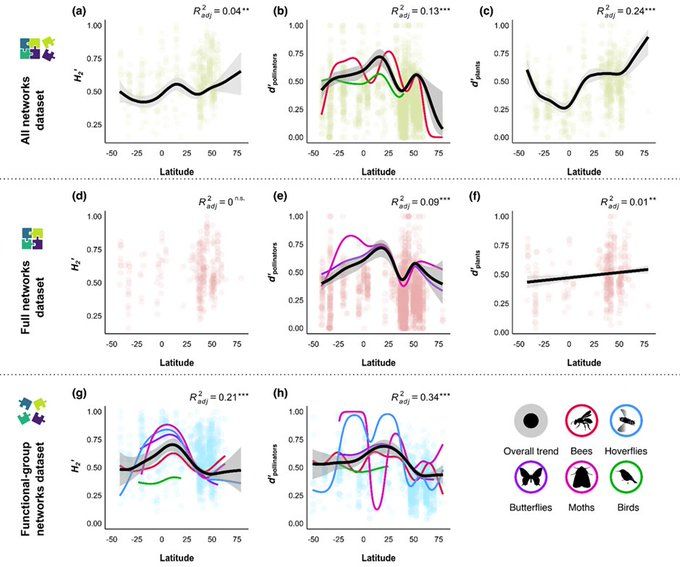
Pollination is often least specialised in the tropics and peaks at northern mid-latitudes.
Plants and pollinators show contrasting, non-linear trends, and climate, not latitude, is the key driver. Temperature, rainfall, and seasonality explain global variation in interaction specialisation.
Plants and pollinators show contrasting, non-linear trends, and climate, not latitude, is the key driver. Temperature, rainfall, and seasonality explain global variation in interaction specialisation.

October 10, 2025 at 8:32 AM
Pollination is often least specialised in the tropics and peaks at northern mid-latitudes.
Plants and pollinators show contrasting, non-linear trends, and climate, not latitude, is the key driver. Temperature, rainfall, and seasonality explain global variation in interaction specialisation.
Plants and pollinators show contrasting, non-linear trends, and climate, not latitude, is the key driver. Temperature, rainfall, and seasonality explain global variation in interaction specialisation.
to mě napadlo taky, ale tahle blbost už opadla, ne?
April 9, 2025 at 4:58 PM
to mě napadlo taky, ale tahle blbost už opadla, ne?
já mám už posledních ca 10 dní problém s chatGPT každé odpoledne, když Amerika pracuje. Je neskutečně pomalý a často padá, i u triviálních úloh. Docela by mě zajímalo, co se děje...
April 9, 2025 at 4:46 PM
já mám už posledních ca 10 dní problém s chatGPT každé odpoledne, když Amerika pracuje. Je neskutečně pomalý a často padá, i u triviálních úloh. Docela by mě zajímalo, co se děje...