



jorge
@seafoodfry.bsky.social
still setting this up...
but i['ll] tweet about science and ML.
but i['ll] tweet about science and ML.
Reposted by jorge

went fucking around w/ a super simple CNN on the SVHN dataset and look!only took an hr-ish to train.
code: github.com/seafoodfry/m...
running script: github.com/seafoodfry/m...
I'll keep on tweaking it -> wanna reproduce the series of goodfellow papers on all dis stuff. 🧪
code: github.com/seafoodfry/m...
running script: github.com/seafoodfry/m...
I'll keep on tweaking it -> wanna reproduce the series of goodfellow papers on all dis stuff. 🧪

April 5, 2025 at 5:55 PM
went fucking around w/ a super simple CNN on the SVHN dataset and look!only took an hr-ish to train.
code: github.com/seafoodfry/m...
running script: github.com/seafoodfry/m...
I'll keep on tweaking it -> wanna reproduce the series of goodfellow papers on all dis stuff. 🧪
code: github.com/seafoodfry/m...
running script: github.com/seafoodfry/m...
I'll keep on tweaking it -> wanna reproduce the series of goodfellow papers on all dis stuff. 🧪
🧪 wanna goof off w/ the google street view dataset this weekend. so I started w/ this (just visualizations and dataloader mess arounds) github.com/seafoodfry/m...
more coming after I go out and live life a lil
more coming after I go out and live life a lil

ml-workspace/gpu-sandbox/vision/cnns/svhn-intro.ipynb at main · seafoodfry/ml-workspace
Sandbox ML, computer vision, GPUs, graphics, and low-level related experiments. - seafoodfry/ml-workspace
github.com
March 29, 2025 at 9:15 PM
🧪 wanna goof off w/ the google street view dataset this weekend. so I started w/ this (just visualizations and dataloader mess arounds) github.com/seafoodfry/m...
more coming after I go out and live life a lil
more coming after I go out and live life a lil
Kubernetes tip of the year (prob wont do another tip anytime soon 'cas kube is boring <3 ): timoni.sh
I thought that plain YAML | kustomize were the best options to live in kubeland. (manage helm charts w/ whatever didn't leave you hating the world.)
But Timoni + Cue is the shit!
I thought that plain YAML | kustomize were the best options to live in kubeland. (manage helm charts w/ whatever didn't leave you hating the world.)
But Timoni + Cue is the shit!

Timoni
Timoni is a package manager for Kubernetes powered by CUE lang.
timoni.sh
March 26, 2025 at 2:24 AM
Kubernetes tip of the year (prob wont do another tip anytime soon 'cas kube is boring <3 ): timoni.sh
I thought that plain YAML | kustomize were the best options to live in kubeland. (manage helm charts w/ whatever didn't leave you hating the world.)
But Timoni + Cue is the shit!
I thought that plain YAML | kustomize were the best options to live in kubeland. (manage helm charts w/ whatever didn't leave you hating the world.)
But Timoni + Cue is the shit!
Reposted by jorge
81 genomes reveal North Pontic foragers were a blend of Balkan, Eastern HGs, European farmers & sometimes Caucasus HGs. #GenomicsRevolution PMID:39910299, Nature 2025, @Nature https://doi.org/10.1038/s41586-024-08372-2 #Medsky #Pharmsky #RNA @geneticssociety @eshg 🧪

A genomic history of the North Pontic Region from the Neolithic to the Bronze Age | Nature
The North Pontic Region was the meeting point of the farmers of Old Europe and the foragers and pastoralists of the Eurasian steppe1,2, and the source of migrations deep into Europe3–5. Here we report genome-wide data from 81 prehistoric North Pontic individuals to understand the genetic makeup of its people. North Pontic foragers had ancestry from Balkan and Eastern hunter-gatherers6 as well as European farmers and, occasionally, Caucasus hunter-gatherers. During the Eneolithic period, a wave of migrants from the Caucasus–Lower Volga area7 bypassed local foragers to mix in equal parts with Trypillian farmers, forming the people of the Usatove culture around 4500 bce. A temporally overlapping wave of migrants from the Caucasus–Lower Volga blended with foragers instead of farmers to form Serednii Stih people7. The third wave was the Yamna—descendants of the Serednii Stih who formed by mixture around 4000 bce and expanded during the Early Bronze Age (3300 bce). The temporal gap between S
doi.org
March 23, 2025 at 6:52 PM
81 genomes reveal North Pontic foragers were a blend of Balkan, Eastern HGs, European farmers & sometimes Caucasus HGs. #GenomicsRevolution PMID:39910299, Nature 2025, @Nature https://doi.org/10.1038/s41586-024-08372-2 #Medsky #Pharmsky #RNA @geneticssociety @eshg 🧪
started reading: www.pennpress.org/978161363018... and am liking it a lot thus far!

Financial Literacy for Managers – Penn Press
The language of businessIn order to understand how your business is performing right now and to evaluate, assess, and devise new strategies to boost future p...
www.pennpress.org
March 23, 2025 at 7:11 PM
started reading: www.pennpress.org/978161363018... and am liking it a lot thus far!
And reasons for benchmarking: gonna attempt to replicate
1. pubs.rsc.org/en/content/a...
2. pubs.acs.org/doi/abs/10.1...
both really interesting works exploring folding pathways using replica exchange MD. the papers even propose P-T phase diagrams (!!!)
🧪
1. pubs.rsc.org/en/content/a...
2. pubs.acs.org/doi/abs/10.1...
both really interesting works exploring folding pathways using replica exchange MD. the papers even propose P-T phase diagrams (!!!)
🧪
March 17, 2025 at 1:14 AM
And reasons for benchmarking: gonna attempt to replicate
1. pubs.rsc.org/en/content/a...
2. pubs.acs.org/doi/abs/10.1...
both really interesting works exploring folding pathways using replica exchange MD. the papers even propose P-T phase diagrams (!!!)
🧪
1. pubs.rsc.org/en/content/a...
2. pubs.acs.org/doi/abs/10.1...
both really interesting works exploring folding pathways using replica exchange MD. the papers even propose P-T phase diagrams (!!!)
🧪
And to the surprise of maybe no one but me: GPUs are the way!
Had to figure out how to build gromacs on a GPU -> used a g5g.xlarge w/ a DL AMI. Had to get a newer version of CMAKE and specify CUDACXX along w/ DCMAKE_CUDA_ARCHITECTURES BUT LOOK AT THIS!!!
156 ns / day!!!
or ~ 1 ns every 9.5 mins!!
Had to figure out how to build gromacs on a GPU -> used a g5g.xlarge w/ a DL AMI. Had to get a newer version of CMAKE and specify CUDACXX along w/ DCMAKE_CUDA_ARCHITECTURES BUT LOOK AT THIS!!!
156 ns / day!!!
or ~ 1 ns every 9.5 mins!!

March 16, 2025 at 8:25 PM
And to the surprise of maybe no one but me: GPUs are the way!
Had to figure out how to build gromacs on a GPU -> used a g5g.xlarge w/ a DL AMI. Had to get a newer version of CMAKE and specify CUDACXX along w/ DCMAKE_CUDA_ARCHITECTURES BUT LOOK AT THIS!!!
156 ns / day!!!
or ~ 1 ns every 9.5 mins!!
Had to figure out how to build gromacs on a GPU -> used a g5g.xlarge w/ a DL AMI. Had to get a newer version of CMAKE and specify CUDACXX along w/ DCMAKE_CUDA_ARCHITECTURES BUT LOOK AT THIS!!!
156 ns / day!!!
or ~ 1 ns every 9.5 mins!!
Reposted by jorge
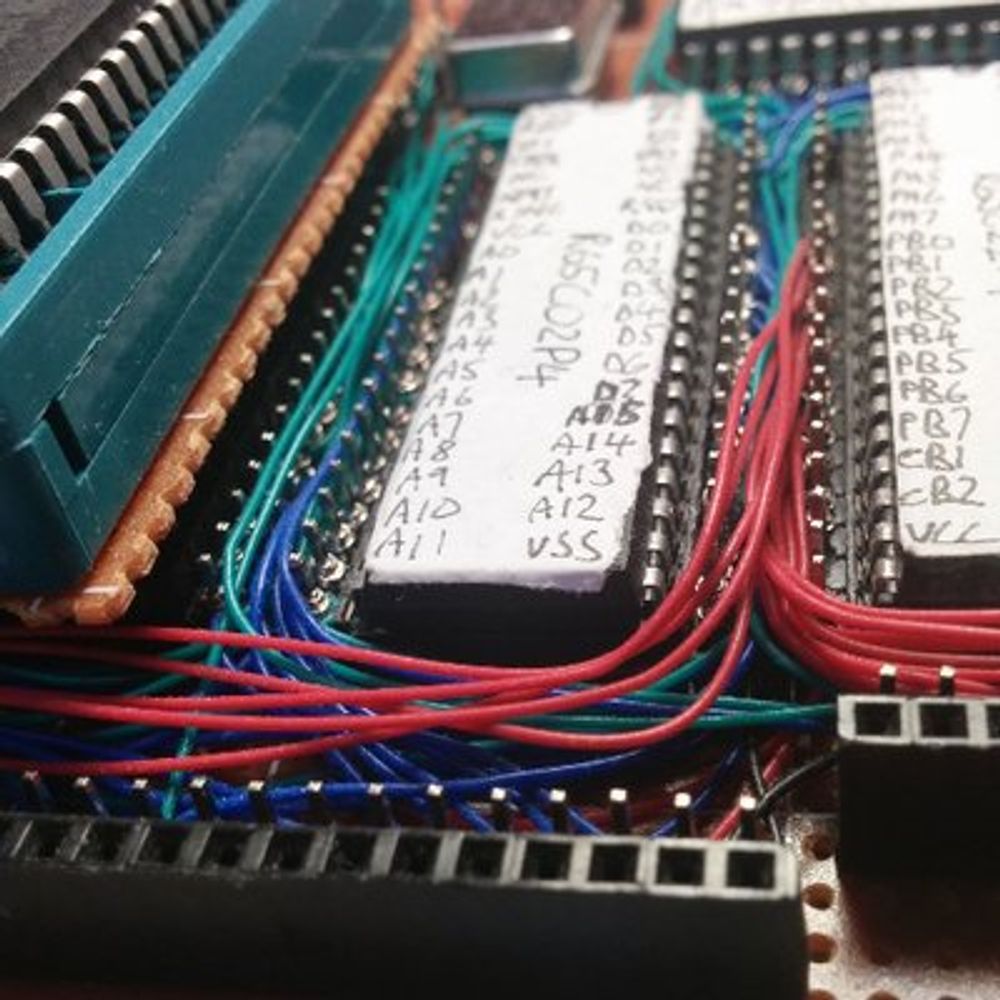
shout out to fastplotlib, matplotlib would choke on this many data points
March 15, 2025 at 3:48 PM
shout out to fastplotlib, matplotlib would choke on this many data points
Reposted by jorge
I encrypted a random buffer with a fixed key ~thousands of times, and recorded the power consumption of the CPU over time.
Amazingly, at certain points in time, the CPUs power consumption is correlated with the number of "1" bits in the data it's processing at that instant (aka the hamming weight)
Amazingly, at certain points in time, the CPUs power consumption is correlated with the number of "1" bits in the data it's processing at that instant (aka the hamming weight)
A single key index with 13768 traces (I left it overnight capturing traces because I thought I might need that many lol)

March 16, 2025 at 3:47 PM
I encrypted a random buffer with a fixed key ~thousands of times, and recorded the power consumption of the CPU over time.
Amazingly, at certain points in time, the CPUs power consumption is correlated with the number of "1" bits in the data it's processing at that instant (aka the hamming weight)
Amazingly, at certain points in time, the CPUs power consumption is correlated with the number of "1" bits in the data it's processing at that instant (aka the hamming weight)
Reposted by jorge


today's rando fact: running a gromacs MD simulation w/ a system of about ~50k particles on an m8g.xlarge or c8g.xlarge AWS EC2 can get you about 10 ns per day
March 16, 2025 at 4:54 PM
today's rando fact: running a gromacs MD simulation w/ a system of about ~50k particles on an m8g.xlarge or c8g.xlarge AWS EC2 can get you about 10 ns per day
Reposted by jorge

C’mere u big cutie! 🤗〰️🐮〰️ #manatee #manateesofcoralcity #seacow #seapotato #cutie #sirenia #coral #coralhead #coralcitycamera #miami #portmiami #miamibeach #biscaynebay #aoml #coralcity #civicpridethroughbiodiversity #glennnevis #coralcityfoundation #ccf #kbcf
March 15, 2025 at 11:42 PM
started going through teamtopologies.com and it is very good!

Team Topologies - Organizing for fast flow of value
Team Topologies is the leading approach to organizing business and technology teams for fast flow of value and business agility, providing a practical, step-by‑step, adaptive model for organizational ...
teamtopologies.com
March 16, 2025 at 12:40 AM
started going through teamtopologies.com and it is very good!
its been yrs since i last did this so i wrote down the recipe: github.com/seafoodfry/m...
a quick and simple ec2 w/ openmpi + openmp + some scripts to configure ssh between [mpi] cluster nodes 🧪
a quick and simple ec2 w/ openmpi + openmp + some scripts to configure ssh between [mpi] cluster nodes 🧪
github.com
March 3, 2025 at 3:49 AM
its been yrs since i last did this so i wrote down the recipe: github.com/seafoodfry/m...
a quick and simple ec2 w/ openmpi + openmp + some scripts to configure ssh between [mpi] cluster nodes 🧪
a quick and simple ec2 w/ openmpi + openmp + some scripts to configure ssh between [mpi] cluster nodes 🧪
Reposted by jorge

Anyway antimatter is cool and you can do fun stuff with it even though it's super unstable. It even has practical applications, like how positrons are used in PET scans (and the fact that postitronium forms sometimes gives you some extra information when analyzing disease progression in the body).
February 28, 2025 at 6:37 PM
Anyway antimatter is cool and you can do fun stuff with it even though it's super unstable. It even has practical applications, like how positrons are used in PET scans (and the fact that postitronium forms sometimes gives you some extra information when analyzing disease progression in the body).
One of the best books i've read: www.amazon.com/Validation-R...
and huuuge thank you to @adamgrant.bsky.social for helping me discover it!!! 🧪
and huuuge thank you to @adamgrant.bsky.social for helping me discover it!!! 🧪

Validation: How the Skill Set That Revolutionized Psychology Will Transform Your Relationships, Increase Your Influence, and Change Your Life
Validation: How the Skill Set That Revolutionized Psychology Will Transform Your Relationships, Increase Your Influence, and Change Your Life [Fleck PhD, Caroline] on Amazon.com. *FREE* shipping on qualifying offers. Validation: How the Skill Set That Revolutionized Psychology Will Transform Your Relationships, Increase Your Influence, and Change Your Life
www.amazon.com
March 1, 2025 at 3:42 PM
One of the best books i've read: www.amazon.com/Validation-R...
and huuuge thank you to @adamgrant.bsky.social for helping me discover it!!! 🧪
and huuuge thank you to @adamgrant.bsky.social for helping me discover it!!! 🧪
Reposted by jorge

Here is the link: arxiv.org/abs/2502.10979
February 18, 2025 at 12:41 PM
Here is the link: arxiv.org/abs/2502.10979
Reposted by jorge

🧪⚒️⚛️

Here's an updated map with time series!
You can also check out the visualizations from Marius Isken at GFZ, who has a method to more precisely locate the seismicity: x.com/seismoliciou...
You can also check out the visualizations from Marius Isken at GFZ, who has a method to more precisely locate the seismicity: x.com/seismoliciou...

February 13, 2025 at 3:36 AM
🧪⚒️⚛️
Reposted by jorge


Finish my dive on "how to reconstruct images from their Fourier transform" mini project 🧪
code is here: github.com/seafoodfry/m...
code is here: github.com/seafoodfry/m...
February 1, 2025 at 4:31 PM
Finish my dive on "how to reconstruct images from their Fourier transform" mini project 🧪
code is here: github.com/seafoodfry/m...
code is here: github.com/seafoodfry/m...
Reposted by jorge
It's easy to say, "Weather rock, cool the planet", but there is more than just one reaction in place. Weathering releases a lot of phosphate, which promotes productivity (and CO2 removal) but also consumes oceanic oxygen at depth.
🧪⚒️🌊
www.nature.com/articles/s41...
w/ @paleoclimategirl.bsky.social
🧪⚒️🌊
www.nature.com/articles/s41...
w/ @paleoclimategirl.bsky.social

February 1, 2025 at 2:40 PM
It's easy to say, "Weather rock, cool the planet", but there is more than just one reaction in place. Weathering releases a lot of phosphate, which promotes productivity (and CO2 removal) but also consumes oceanic oxygen at depth.
🧪⚒️🌊
www.nature.com/articles/s41...
w/ @paleoclimategirl.bsky.social
🧪⚒️🌊
www.nature.com/articles/s41...
w/ @paleoclimategirl.bsky.social
Reposted by jorge
🧪🔭
Good Morning! The latest episode of the Astrophysics Podcast is out today! I'm interviewing Dr. Lindsey Kwok, a research fellow at Northwestern University. She uses JWST to learn how supernovae exploded!
rss.com/podcasts/ast...
#astrophysics #podcast
Good Morning! The latest episode of the Astrophysics Podcast is out today! I'm interviewing Dr. Lindsey Kwok, a research fellow at Northwestern University. She uses JWST to learn how supernovae exploded!
rss.com/podcasts/ast...
#astrophysics #podcast


February 1, 2025 at 3:18 PM
🧪🔭
Good Morning! The latest episode of the Astrophysics Podcast is out today! I'm interviewing Dr. Lindsey Kwok, a research fellow at Northwestern University. She uses JWST to learn how supernovae exploded!
rss.com/podcasts/ast...
#astrophysics #podcast
Good Morning! The latest episode of the Astrophysics Podcast is out today! I'm interviewing Dr. Lindsey Kwok, a research fellow at Northwestern University. She uses JWST to learn how supernovae exploded!
rss.com/podcasts/ast...
#astrophysics #podcast
guess what this is a picture of! (www.europeanguanxi.com/post/all-you...)

January 31, 2025 at 4:36 PM
guess what this is a picture of! (www.europeanguanxi.com/post/all-you...)