




Simon Lang
@simonlang.bsky.social
Postdoctoral Researcher at ETH Zurich | PhD, Yale University | Research on climate change, inequality, and international climate finance | www.simonflang.com
Thanks for your interest!
Much more in the full paper:
tinyurl.com/bdexzjm9
For more information about me, visit my website:
www.simonflang.com
Much more in the full paper:
tinyurl.com/bdexzjm9
For more information about me, visit my website:
www.simonflang.com

Simon Lang
Welcome!
I am a PhD candidate in Environmental Economics at Yale University, specializing in climate economics.
My research bridges the fields of environmental economics, public economics, and macroec...
www.simonflang.com
December 3, 2024 at 1:51 AM
Thanks for your interest!
Much more in the full paper:
tinyurl.com/bdexzjm9
For more information about me, visit my website:
www.simonflang.com
Much more in the full paper:
tinyurl.com/bdexzjm9
For more information about me, visit my website:
www.simonflang.com
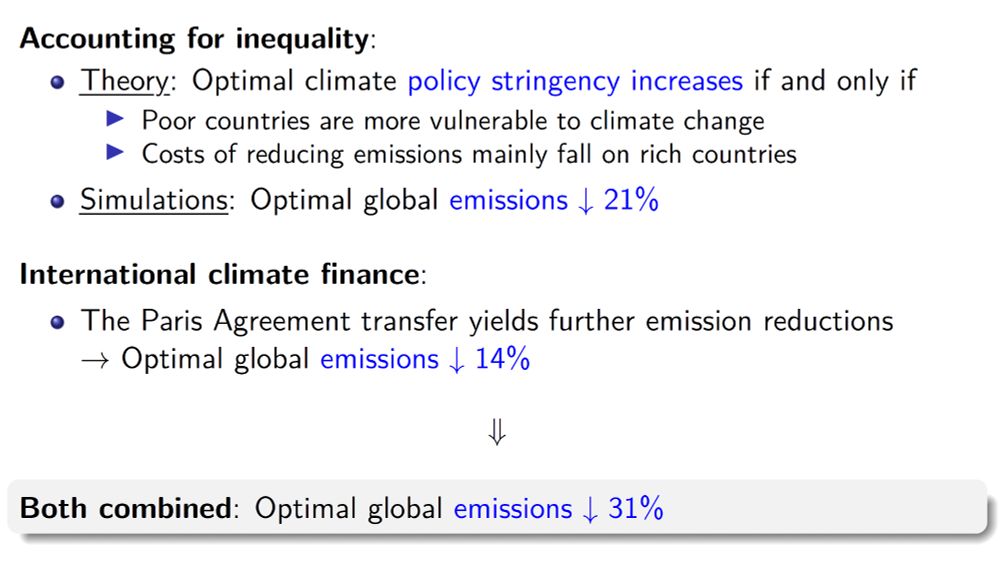
1️⃣+2️⃣ Together, accounting for inequality and international climate finance reduces optimal global emissions by 31% compared to a policy that excludes these factors.
December 3, 2024 at 1:51 AM
1️⃣+2️⃣ Together, accounting for inequality and international climate finance reduces optimal global emissions by 31% compared to a policy that excludes these factors.
👉I find that financial support for mitigation in developing countries substantially increases the stringency of optimal climate policy by lowering the welfare cost of abatement.
👉Notably, the optimal uniform carbon price in 2025 almost doubles.
👉Notably, the optimal uniform carbon price in 2025 almost doubles.
December 3, 2024 at 1:51 AM
👉I find that financial support for mitigation in developing countries substantially increases the stringency of optimal climate policy by lowering the welfare cost of abatement.
👉Notably, the optimal uniform carbon price in 2025 almost doubles.
👉Notably, the optimal uniform carbon price in 2025 almost doubles.
2️⃣ How does international climate finance affect utilitarian carbon prices?
I’m focusing on the “Paris Agreement transfer” of $100 billion/yr (from developed to developing countries), and the main type of climate finance, which are payments for emission reductions.
I’m focusing on the “Paris Agreement transfer” of $100 billion/yr (from developed to developing countries), and the main type of climate finance, which are payments for emission reductions.
December 3, 2024 at 1:51 AM
2️⃣ How does international climate finance affect utilitarian carbon prices?
I’m focusing on the “Paris Agreement transfer” of $100 billion/yr (from developed to developing countries), and the main type of climate finance, which are payments for emission reductions.
I’m focusing on the “Paris Agreement transfer” of $100 billion/yr (from developed to developing countries), and the main type of climate finance, which are payments for emission reductions.
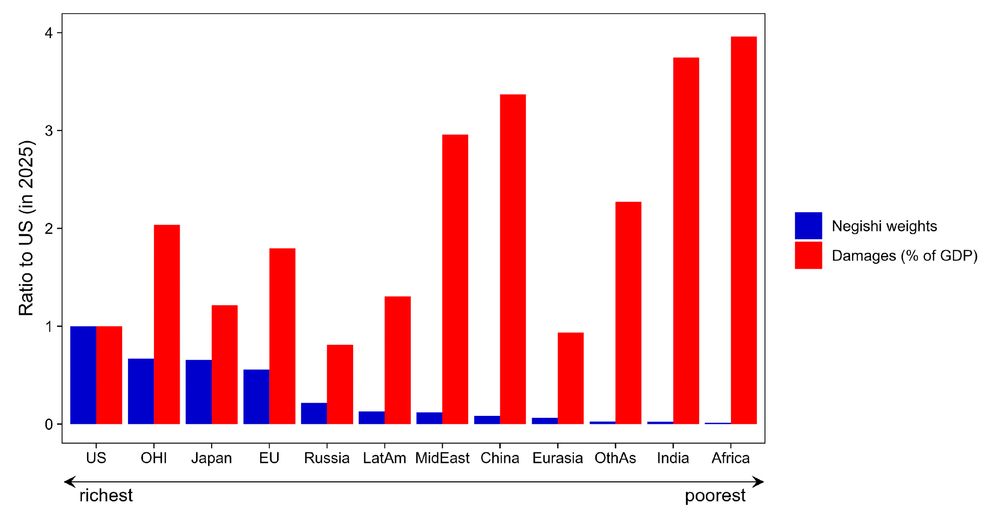
Leveraging the theoretical results provides additional intuition: The poorest region of the model, Africa, also has the highest preferred uniform carbon price—more than twice the preferred price of the US and the Negishi-weighted carbon price.
December 3, 2024 at 1:51 AM
Leveraging the theoretical results provides additional intuition: The poorest region of the model, Africa, also has the highest preferred uniform carbon price—more than twice the preferred price of the US and the Negishi-weighted carbon price.
Main reason: disproportionately high climate damages in poorer countries.
Key intuition: By assigning lower weight to the welfare of poorer regions, Negishi weights effectively also downweight the regions most impacted by climate change (especially Africa).
Key intuition: By assigning lower weight to the welfare of poorer regions, Negishi weights effectively also downweight the regions most impacted by climate change (especially Africa).
December 3, 2024 at 1:51 AM
Main reason: disproportionately high climate damages in poorer countries.
Key intuition: By assigning lower weight to the welfare of poorer regions, Negishi weights effectively also downweight the regions most impacted by climate change (especially Africa).
Key intuition: By assigning lower weight to the welfare of poorer regions, Negishi weights effectively also downweight the regions most impacted by climate change (especially Africa).
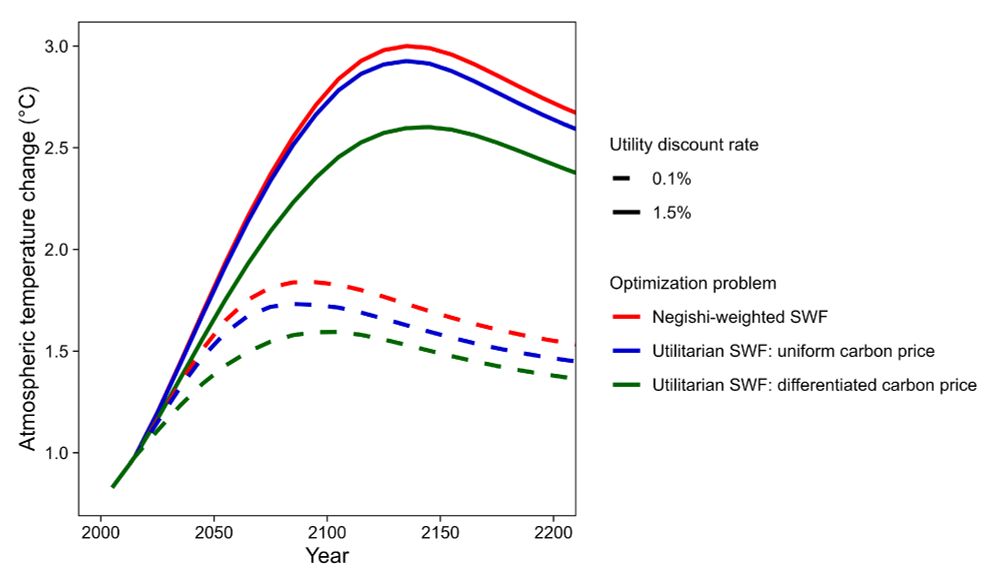
In simulations with the integrated assessment model RICE, I find that accounting for global inequality increases the optimal stringency of global climate policy, both if carbon prices are allowed to be regionally differentiated and if they are constrained to be globally uniform.
December 3, 2024 at 1:51 AM
In simulations with the integrated assessment model RICE, I find that accounting for global inequality increases the optimal stringency of global climate policy, both if carbon prices are allowed to be regionally differentiated and if they are constrained to be globally uniform.
Regionally differentiated utilitarian carbon prices are welfare-cost-effective, while Negishi-weighted carbon prices are cost-effective (in monetary terms).
December 3, 2024 at 1:51 AM
Regionally differentiated utilitarian carbon prices are welfare-cost-effective, while Negishi-weighted carbon prices are cost-effective (in monetary terms).
Furthermore, I introduce the concept of “welfare-cost-effectiveness”, which refers to emission reductions at the lowest possible welfare (utility) cost, and argue that this concept provides a useful perspective in settings with restricted transfers.
December 3, 2024 at 1:51 AM
Furthermore, I introduce the concept of “welfare-cost-effectiveness”, which refers to emission reductions at the lowest possible welfare (utility) cost, and argue that this concept provides a useful perspective in settings with restricted transfers.
I link this result to nations’ preferred uniform carbon prices, a notion from Weitzman (2014) and Kotchen (2018):
The utilitarian uniform carbon price exceeds the Negishi-weighted carbon price iff poorer nations prefer higher uniform carbon prices than wealthier nations.
The utilitarian uniform carbon price exceeds the Negishi-weighted carbon price iff poorer nations prefer higher uniform carbon prices than wealthier nations.
December 3, 2024 at 1:51 AM
I link this result to nations’ preferred uniform carbon prices, a notion from Weitzman (2014) and Kotchen (2018):
The utilitarian uniform carbon price exceeds the Negishi-weighted carbon price iff poorer nations prefer higher uniform carbon prices than wealthier nations.
The utilitarian uniform carbon price exceeds the Negishi-weighted carbon price iff poorer nations prefer higher uniform carbon prices than wealthier nations.
I identify the conditions under which accounting for global inequality leads to more stringent global climate policy.
This is the case if poorer nations have comparatively high marginal climate damages, steep marginal abatement cost functions, and fast-growing populations.
This is the case if poorer nations have comparatively high marginal climate damages, steep marginal abatement cost functions, and fast-growing populations.
December 3, 2024 at 1:51 AM
I identify the conditions under which accounting for global inequality leads to more stringent global climate policy.
This is the case if poorer nations have comparatively high marginal climate damages, steep marginal abatement cost functions, and fast-growing populations.
This is the case if poorer nations have comparatively high marginal climate damages, steep marginal abatement cost functions, and fast-growing populations.
I focus on the two most commonly used welfare weights:
• Negishi weights: higher for rich nations, offsetting differences in marginal utilities of consumption across rich and poor countries, thereby disregarding global inequality
• Utilitarian weights: same for all countries
• Negishi weights: higher for rich nations, offsetting differences in marginal utilities of consumption across rich and poor countries, thereby disregarding global inequality
• Utilitarian weights: same for all countries
December 3, 2024 at 1:51 AM
I focus on the two most commonly used welfare weights:
• Negishi weights: higher for rich nations, offsetting differences in marginal utilities of consumption across rich and poor countries, thereby disregarding global inequality
• Utilitarian weights: same for all countries
• Negishi weights: higher for rich nations, offsetting differences in marginal utilities of consumption across rich and poor countries, thereby disregarding global inequality
• Utilitarian weights: same for all countries
Using theory and calibrated simulations, I first examine how regional welfare weights affect optimal carbon prices (in the absence of international transfers).
December 3, 2024 at 1:51 AM
Using theory and calibrated simulations, I first examine how regional welfare weights affect optimal carbon prices (in the absence of international transfers).
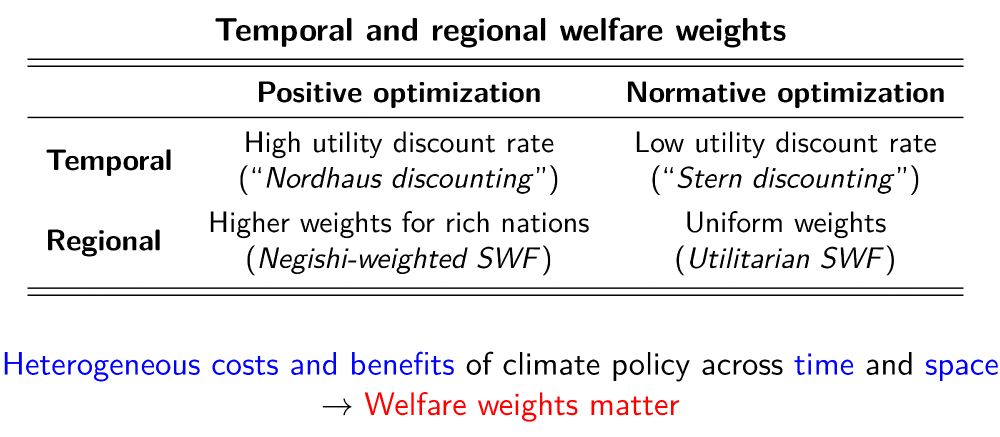
1️⃣ Climate change is global & long-term➡️ Optimal carbon prices depend on how we aggregate costs & benefits across countries and over time.
🕓Carbon prices are famously sensitive to discount rates.
🌐I focus on how costs & benefits are aggregated across countries.
🕓Carbon prices are famously sensitive to discount rates.
🌐I focus on how costs & benefits are aggregated across countries.
December 3, 2024 at 1:51 AM
1️⃣ Climate change is global & long-term➡️ Optimal carbon prices depend on how we aggregate costs & benefits across countries and over time.
🕓Carbon prices are famously sensitive to discount rates.
🌐I focus on how costs & benefits are aggregated across countries.
🕓Carbon prices are famously sensitive to discount rates.
🌐I focus on how costs & benefits are aggregated across countries.
Global inequality and international climate finance play central roles in international climate policy.
Yet, they are not reflected in standard estimates of optimal carbon prices.
I ask how these two aspects affect optimal carbon prices.
Let's start with global inequality 👇
Yet, they are not reflected in standard estimates of optimal carbon prices.
I ask how these two aspects affect optimal carbon prices.
Let's start with global inequality 👇
December 3, 2024 at 1:51 AM
Global inequality and international climate finance play central roles in international climate policy.
Yet, they are not reflected in standard estimates of optimal carbon prices.
I ask how these two aspects affect optimal carbon prices.
Let's start with global inequality 👇
Yet, they are not reflected in standard estimates of optimal carbon prices.
I ask how these two aspects affect optimal carbon prices.
Let's start with global inequality 👇