



Ephaptic coupling inhibition implements Drosophila sweetness taste neuron dominance
www.pnas.org/doi/10.1073/...
www.pnas.org/doi/10.1073/...
PNAS
Proceedings of the National Academy of Sciences (PNAS), a peer reviewed journal of the National Academy of Sciences (NAS) - an authoritative source of high-impact, original research that broadly spans...
www.pnas.org
November 25, 2025 at 5:57 PM
Ephaptic coupling inhibition implements Drosophila sweetness taste neuron dominance
www.pnas.org/doi/10.1073/...
www.pnas.org/doi/10.1073/...
Insect brains do beta feature attention too pmc.ncbi.nlm.nih.gov/articles/PMC...

Oscillations in the central brain of Drosophila are phase locked to attended visual features
There is increasing evidence that even the smallest animal brains provide a capacity for selective attention and subjective awareness, but it is unknown if similar mechanisms might be employed as in higher animals. Recent work in insects highlights ...
pmc.ncbi.nlm.nih.gov
November 24, 2025 at 2:53 PM
Insect brains do beta feature attention too pmc.ncbi.nlm.nih.gov/articles/PMC...
Those single-neuron control studies involve a controlled sensory feedback loop (vision, touch, etc). I don't think single-neuron ghrelin feedback control is very feasible.
November 23, 2025 at 5:06 PM
Those single-neuron control studies involve a controlled sensory feedback loop (vision, touch, etc). I don't think single-neuron ghrelin feedback control is very feasible.
Possibly www.frontiersin.org/journals/mol...

Frontiers | From molecule to oblivion: dedicated brain circuitry underlies anesthetic loss of consciousness permitting pain-free surgery
The canonical view of how general anesthetics induce loss-of-consciousness (LOC) permitting pain-free surgery posits that anesthetic molecules, distributed t...
www.frontiersin.org
November 19, 2025 at 8:08 PM
Possibly www.frontiersin.org/journals/mol...
If I can't parse it, then it's not parsimonious
September 20, 2025 at 6:01 PM
If I can't parse it, then it's not parsimonious
The right paracingulate sulcus would be a prime suspect pmc.ncbi.nlm.nih.gov/articles/PMC...
A Specific Brain Structural Basis for Individual Differences in Reality Monitoring
Much recent interest has centered on understanding the relationship between brain structure variability and individual differences in cognition, but there has been little progress in identifying speci...
pmc.ncbi.nlm.nih.gov
June 12, 2025 at 2:20 AM
The right paracingulate sulcus would be a prime suspect pmc.ncbi.nlm.nih.gov/articles/PMC...
I mangled the conclusion: millisecond predator vulnerability is a small price to pay for bilateral blinking.
June 11, 2025 at 12:33 AM
I mangled the conclusion: millisecond predator vulnerability is a small price to pay for bilateral blinking.
Blink once if you are the VTA, three times if you are p32pr.
So why do both eyes blink at once? Probably because with single-eye blinking, the eyeblink signal can no longer be interpreted as an episode boundary. A small price to pay for millisecond predator vulnerability. @markolas.bsky.social
So why do both eyes blink at once? Probably because with single-eye blinking, the eyeblink signal can no longer be interpreted as an episode boundary. A small price to pay for millisecond predator vulnerability. @markolas.bsky.social
June 11, 2025 at 12:28 AM
Blink once if you are the VTA, three times if you are p32pr.
So why do both eyes blink at once? Probably because with single-eye blinking, the eyeblink signal can no longer be interpreted as an episode boundary. A small price to pay for millisecond predator vulnerability. @markolas.bsky.social
So why do both eyes blink at once? Probably because with single-eye blinking, the eyeblink signal can no longer be interpreted as an episode boundary. A small price to pay for millisecond predator vulnerability. @markolas.bsky.social
Another conjecture I will add: there exists a cingulate eye field (CEF) inside the area of midcingulate cortex associated with cognitive dissonance (p32pr in HCP). We all recognize eye flutter as confusion.


June 11, 2025 at 12:28 AM
Another conjecture I will add: there exists a cingulate eye field (CEF) inside the area of midcingulate cortex associated with cognitive dissonance (p32pr in HCP). We all recognize eye flutter as confusion.
Another function of blinking seems to be to reset the retina to adjust to visual conditions, such as luminosity or blur. We have all unconsciously performed blinking to correct blurry vision. www.pnas.org/doi/10.1073/...

Eye blinks as a visual processing stage | PNAS
Humans blink their eyes frequently during normal viewing, more often than it seems
necessary for keeping the cornea well lubricated. Since the clos...
www.pnas.org
June 11, 2025 at 12:28 AM
Another function of blinking seems to be to reset the retina to adjust to visual conditions, such as luminosity or blur. We have all unconsciously performed blinking to correct blurry vision. www.pnas.org/doi/10.1073/...
Eyeblinks also momentarily disengage the dorsal attention network and activate the default mode network. This might be like 'autosave' for episodic memory. www.pnas.org/doi/full/10....

Blink-related momentary activation of the default mode network while viewing videos | PNAS
It remains unknown why we generate spontaneous eyeblinks every few seconds, more often
than necessary for ocular lubrication. Because eyeblinks ten...
www.pnas.org
June 11, 2025 at 12:28 AM
Eyeblinks also momentarily disengage the dorsal attention network and activate the default mode network. This might be like 'autosave' for episodic memory. www.pnas.org/doi/full/10....
A recent finding is that blinking correlates with VTA activation, the brain's central dopamine center. This may serve a kind of timestamping function in episodic memory. If the eyes are the window into the soul, blinking may be a window into the VTA. pmc.ncbi.nlm.nih.gov/articles/PMC...

Dopaminergic processes predict temporal distortions in event memory
Our memories do not simply keep time — they warp it, bending the past to fit the structure of our experiences. For example, people tend to remember items as occurring farther apart in time if they spa...
pmc.ncbi.nlm.nih.gov
June 11, 2025 at 12:28 AM
A recent finding is that blinking correlates with VTA activation, the brain's central dopamine center. This may serve a kind of timestamping function in episodic memory. If the eyes are the window into the soul, blinking may be a window into the VTA. pmc.ncbi.nlm.nih.gov/articles/PMC...
As early as 1945, it was observed that blinking during reading seemed to correspond to gaps in words on the page. We also blink on unfamiliar words. www.newscientist.com/article/2461...

Blinking may give your brain a micro break during cognitive tasks
When reading a book, we tend to blink over less familiar words, which suggests it may have a cognitive role
www.newscientist.com
June 11, 2025 at 12:28 AM
As early as 1945, it was observed that blinking during reading seemed to correspond to gaps in words on the page. We also blink on unfamiliar words. www.newscientist.com/article/2461...
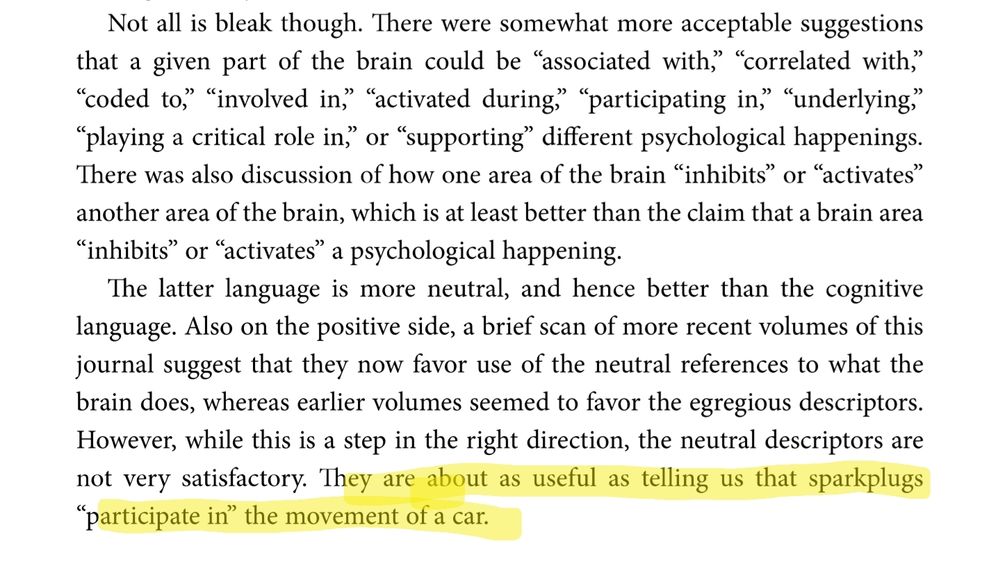
Love the sparkplug metaphor for the weak language used for roles and telos
April 26, 2025 at 1:59 PM
Love the sparkplug metaphor for the weak language used for roles and telos
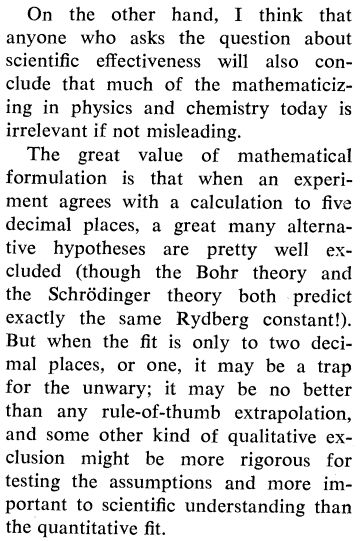
Platt seems downright suspicious of theory here
February 26, 2025 at 5:28 PM
Platt seems downright suspicious of theory here
I think it is important to distinguish
1. theory - 'the dopamine theory of schizophrenia'
2. iteratively testing hypothesis spaces - 'antagonizing D2 should alleviate sch symptoms'
3. insight into hyp spaces - 'what if that's all downstream of NMDAR loss?'
Platt called for 2-3; 1-2 not so much.
1. theory - 'the dopamine theory of schizophrenia'
2. iteratively testing hypothesis spaces - 'antagonizing D2 should alleviate sch symptoms'
3. insight into hyp spaces - 'what if that's all downstream of NMDAR loss?'
Platt called for 2-3; 1-2 not so much.
February 26, 2025 at 5:28 PM
I think it is important to distinguish
1. theory - 'the dopamine theory of schizophrenia'
2. iteratively testing hypothesis spaces - 'antagonizing D2 should alleviate sch symptoms'
3. insight into hyp spaces - 'what if that's all downstream of NMDAR loss?'
Platt called for 2-3; 1-2 not so much.
1. theory - 'the dopamine theory of schizophrenia'
2. iteratively testing hypothesis spaces - 'antagonizing D2 should alleviate sch symptoms'
3. insight into hyp spaces - 'what if that's all downstream of NMDAR loss?'
Platt called for 2-3; 1-2 not so much.
The Big Five is just a lexical aggregation of *English personality adjectives* used in test questions. That is why it is circular, and language-dependent.
Four dimensions are just continuous versions of MBTI dims; Jung mapped neuroticism to "Shadow". McCrae & Acosta discussed this ~1990 IIRC.
Four dimensions are just continuous versions of MBTI dims; Jung mapped neuroticism to "Shadow". McCrae & Acosta discussed this ~1990 IIRC.
January 23, 2025 at 11:10 PM
The Big Five is just a lexical aggregation of *English personality adjectives* used in test questions. That is why it is circular, and language-dependent.
Four dimensions are just continuous versions of MBTI dims; Jung mapped neuroticism to "Shadow". McCrae & Acosta discussed this ~1990 IIRC.
Four dimensions are just continuous versions of MBTI dims; Jung mapped neuroticism to "Shadow". McCrae & Acosta discussed this ~1990 IIRC.
I don't think hypothesis-driven neuroscience, nor the psych repl crisis, can be rescued by choosing btw "all swans are white", "swanness causes whiteness", or "if no swanness, then there would be no whiteness"
January 12, 2025 at 4:16 PM
I don't think hypothesis-driven neuroscience, nor the psych repl crisis, can be rescued by choosing btw "all swans are white", "swanness causes whiteness", or "if no swanness, then there would be no whiteness"
That aspirin reduces headache is a reliable large effect observation.
The causal theory of why aspirin does so is provisional, and subject to ceteris paribus caveats about unknown mediators awaiting discovery.
cornellsun.com/2015/10/20/b...
The causal theory of why aspirin does so is provisional, and subject to ceteris paribus caveats about unknown mediators awaiting discovery.
cornellsun.com/2015/10/20/b...

Boyce Thompson Researchers Discover Aspirin Works Differently Than Thought
Researchers at the University’s Boyce Thompson Institute have recently uncovered that aspirin might not be working the way most doctors think it does. Prof. Daniel Klessig, plant science at BTI, has b...
cornellsun.com
January 11, 2025 at 4:54 PM
That aspirin reduces headache is a reliable large effect observation.
The causal theory of why aspirin does so is provisional, and subject to ceteris paribus caveats about unknown mediators awaiting discovery.
cornellsun.com/2015/10/20/b...
The causal theory of why aspirin does so is provisional, and subject to ceteris paribus caveats about unknown mediators awaiting discovery.
cornellsun.com/2015/10/20/b...