


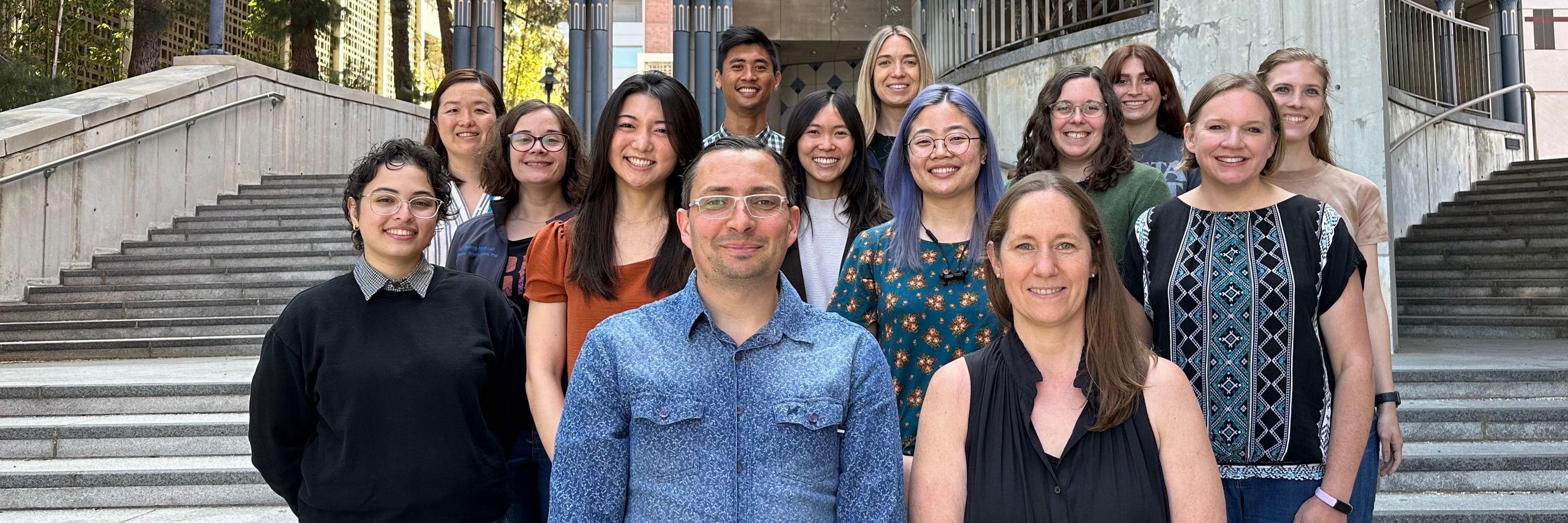

The Tarling-Vallim Lab
@tarlingvallimlab.bsky.social
The Tarling-Vallim Laboratory @UCLA led by Drs Elizabeth Tarling 🇬🇧 and Thomas Vallim 🇧🇷. We study Lipids, Bile acids, Metabolism in Liver and Lung (tarlingvallimlab.com)
Thank you to @cp-cellmetabolism.bsky.social @cellpress.bsky.social for the opportunity to share our work!
December 11, 2025 at 6:56 PM
Thank you to @cp-cellmetabolism.bsky.social @cellpress.bsky.social for the opportunity to share our work!
This work was made possible by funding from the #NIH (NHLBI, NIDDK), @ahascience.bsky.social, @uclahealth.org, @domucla.bsky.social, @damonrunyon.org, @themarkfdn.bsky.social, #ADA, #CTSI
December 11, 2025 at 6:54 PM
This work was made possible by funding from the #NIH (NHLBI, NIDDK), @ahascience.bsky.social, @uclahealth.org, @domucla.bsky.social, @damonrunyon.org, @themarkfdn.bsky.social, #ADA, #CTSI
🎉 Our findings reveal exciting therapeutic potential: targeting bile acids could offer novel treatments for obesity, MASLD, and metabolic disorders. 🎉
December 11, 2025 at 6:28 PM
🎉 Our findings reveal exciting therapeutic potential: targeting bile acids could offer novel treatments for obesity, MASLD, and metabolic disorders. 🎉
Next, we used AAV-CRISPR to disrupt CYP8B1 (⬇️CA), CYP2C70 (⬆️CDCA, ⬇️MCAs), and CYP2A12 (⬆️DCA). Only CYP8B1 disruption replicated selective absorption, proving CA drives🚗 this effect. ⛑️Rescuing CYP7A1-deficient mice with dietary bile acids confirmed that strong detergent bile acids restore absorption.
December 11, 2025 at 6:28 PM
Next, we used AAV-CRISPR to disrupt CYP8B1 (⬇️CA), CYP2C70 (⬆️CDCA, ⬇️MCAs), and CYP2A12 (⬆️DCA). Only CYP8B1 disruption replicated selective absorption, proving CA drives🚗 this effect. ⛑️Rescuing CYP7A1-deficient mice with dietary bile acids confirmed that strong detergent bile acids restore absorption.
🥁The mechanism: physio-chemical properties of both fats and bile acids matter, ‼️ but not all bile acids are equal ‼️ Cholic acid (CA) selectively solubilizes fats, while other bile acids did not, identifying CA as the 🔑 key mediator of selective fat absorption.
December 11, 2025 at 6:28 PM
🥁The mechanism: physio-chemical properties of both fats and bile acids matter, ‼️ but not all bile acids are equal ‼️ Cholic acid (CA) selectively solubilizes fats, while other bile acids did not, identifying CA as the 🔑 key mediator of selective fat absorption.
We then measured individual fatty acid absorption. Reduced bile acids decreased saturated fat absorption, but adding double bonds reversed this. MUFAs and PUFAs were nearly fully absorbed! 🤯 Orlistat reduced all fatty acids equally, revealing 2️⃣ distinct absorption mechanisms.
December 11, 2025 at 6:28 PM
We then measured individual fatty acid absorption. Reduced bile acids decreased saturated fat absorption, but adding double bonds reversed this. MUFAs and PUFAs were nearly fully absorbed! 🤯 Orlistat reduced all fatty acids equally, revealing 2️⃣ distinct absorption mechanisms.
Liver lipidomics 👩🔬🧑💻 revealed both models reduced steatosis, but with key differences: CYP7A1 loss increased PUFA-containing TAGs while most TAG species decreased. Orlistat decreased PUFAs, triggering compensatory SREBP1c-dependent lipogenesis.
December 11, 2025 at 6:28 PM
Liver lipidomics 👩🔬🧑💻 revealed both models reduced steatosis, but with key differences: CYP7A1 loss increased PUFA-containing TAGs while most TAG species decreased. Orlistat decreased PUFAs, triggering compensatory SREBP1c-dependent lipogenesis.
🤔 Why no increased food intake? CYP7A1-deficient mice showed elevated GLP-1 and PYY secretion (unlike orlistat-treated mice). This GLP-1 increase required GPR120, suggesting fatty acids reach the distal gut to activate this receptor when bile acids are reduced.
December 11, 2025 at 6:28 PM
🤔 Why no increased food intake? CYP7A1-deficient mice showed elevated GLP-1 and PYY secretion (unlike orlistat-treated mice). This GLP-1 increase required GPR120, suggesting fatty acids reach the distal gut to activate this receptor when bile acids are reduced.
Next, we compared decreasing bile acids to lipase inhibition (orlistat). Despite increased 💩 fecal output, orlistat didn't prevent obesity: mice ate more 😋. Critically, CYP7A1-deficient mice didn't increase food intake, a key finding since hyperphagia typically follows reduced absorption.
December 11, 2025 at 6:28 PM
Next, we compared decreasing bile acids to lipase inhibition (orlistat). Despite increased 💩 fecal output, orlistat didn't prevent obesity: mice ate more 😋. Critically, CYP7A1-deficient mice didn't increase food intake, a key finding since hyperphagia typically follows reduced absorption.
Using AAV-CRISPR to target liver bile acid enzymes 🧬, we knocked down CYP7A1 (rate-limiting enzyme in bile acid synthesis) and protected mice 🐭 from diet-induced obesity 🍔. This increased fecal calories, indicating reduced absorption, with no changes in energy expenditure or food intake.
December 11, 2025 at 6:28 PM
Using AAV-CRISPR to target liver bile acid enzymes 🧬, we knocked down CYP7A1 (rate-limiting enzyme in bile acid synthesis) and protected mice 🐭 from diet-induced obesity 🍔. This increased fecal calories, indicating reduced absorption, with no changes in energy expenditure or food intake.