



Thomas Karlsson
@thomaskarlsson.bsky.social
Swedish amateur astronomer and Ukraine supporter.
TT Aur is an eclipsing binary of subtype EB. The star was discovered in 1907 by Henrietta Leavitt at Harvard. The phase diagram shows my observations from 2009-2018 from images I took with my DSLR camera of epsilon Aurigae during its eclipse.

December 30, 2025 at 2:39 PM
TT Aur is an eclipsing binary of subtype EB. The star was discovered in 1907 by Henrietta Leavitt at Harvard. The phase diagram shows my observations from 2009-2018 from images I took with my DSLR camera of epsilon Aurigae during its eclipse.
V673 Cyg is a mira among the SAAF's 50 Forgotten miras. It was discovered in 1943 by Cuno Hoffmeister at Sonneberg. Since SAAF began observing it in 2012, its period has been 327.0 days. Since 1890, the average period has been almost the same, 326.4 days.

December 21, 2025 at 8:05 PM
V673 Cyg is a mira among the SAAF's 50 Forgotten miras. It was discovered in 1943 by Cuno Hoffmeister at Sonneberg. Since SAAF began observing it in 2012, its period has been 327.0 days. Since 1890, the average period has been almost the same, 326.4 days.
From my database of maxima for mira variables.
R Lep, or Hind's Crimson Star, is a carbon star that is on my list of meandering miras. The star has a deep red color, beautiful to watch but harder to observe. Since 1853 its period has varied 417-447 days.
More miras at var.saaf.se/mirainfooc.php
R Lep, or Hind's Crimson Star, is a carbon star that is on my list of meandering miras. The star has a deep red color, beautiful to watch but harder to observe. Since 1853 its period has varied 417-447 days.
More miras at var.saaf.se/mirainfooc.php


December 10, 2025 at 2:42 PM
From my database of maxima for mira variables.
R Lep, or Hind's Crimson Star, is a carbon star that is on my list of meandering miras. The star has a deep red color, beautiful to watch but harder to observe. Since 1853 its period has varied 417-447 days.
More miras at var.saaf.se/mirainfooc.php
R Lep, or Hind's Crimson Star, is a carbon star that is on my list of meandering miras. The star has a deep red color, beautiful to watch but harder to observe. Since 1853 its period has varied 417-447 days.
More miras at var.saaf.se/mirainfooc.php
V718 Tau is a red carbon-mira (B-V=4.5) observed within SAAF since 2011. In recent years it has become noticeably brighter by 1.5 magnitudes. Its period from SAAF data is 405 days.


December 1, 2025 at 1:12 PM
V718 Tau is a red carbon-mira (B-V=4.5) observed within SAAF since 2011. In recent years it has become noticeably brighter by 1.5 magnitudes. Its period from SAAF data is 405 days.
On the evening of Nov 21, a big bolide passed over eastern Sweden. It was visible for a long time, more than 20 sec. According to Erik Stempels at Uppsala University, it was probably a very unusual earth-grazing meteoroid that only bounced off the Earth's atmosphere.
www.youtube.com/watch?v=otnC...
www.youtube.com/watch?v=otnC...

Bolid över Västerås 22/11 2025
YouTube video by VARF Akesta
www.youtube.com
November 24, 2025 at 12:56 PM
On the evening of Nov 21, a big bolide passed over eastern Sweden. It was visible for a long time, more than 20 sec. According to Erik Stempels at Uppsala University, it was probably a very unusual earth-grazing meteoroid that only bounced off the Earth's atmosphere.
www.youtube.com/watch?v=otnC...
www.youtube.com/watch?v=otnC...
V663 Cyg is another mira among the SAAF's 50 forgotten miras. Discovered in 1949 by Cuno Hoffmeister at Sonneberg. The current period is 361.5, about the same as it has been historically. The fact that the period is close to a year means that observations are missing at the same phase in the diagram

November 19, 2025 at 2:09 PM
V663 Cyg is another mira among the SAAF's 50 forgotten miras. Discovered in 1949 by Cuno Hoffmeister at Sonneberg. The current period is 361.5, about the same as it has been historically. The fact that the period is close to a year means that observations are missing at the same phase in the diagram
From my database of maxima for mira variables.
V Del is a long period mira that is on my list of miras with a decreasing period. Since 1890, its period has decreased by 22 days, although with great variation over time.
More miras at var.saaf.se/mirainfooc.php
V Del is a long period mira that is on my list of miras with a decreasing period. Since 1890, its period has decreased by 22 days, although with great variation over time.
More miras at var.saaf.se/mirainfooc.php


November 10, 2025 at 4:28 PM
From my database of maxima for mira variables.
V Del is a long period mira that is on my list of miras with a decreasing period. Since 1890, its period has decreased by 22 days, although with great variation over time.
More miras at var.saaf.se/mirainfooc.php
V Del is a long period mira that is on my list of miras with a decreasing period. Since 1890, its period has decreased by 22 days, although with great variation over time.
More miras at var.saaf.se/mirainfooc.php
T Mon is a bright Cepheid with a fairly long period. Here is a phase diagram with my observations of the star from 2010 to 2023. The light curve has a rapidly rising phase over 7 days and a slow decline over 20 days. Its period has a small continuous increase of about 13 seconds/year.

October 30, 2025 at 2:01 PM
T Mon is a bright Cepheid with a fairly long period. Here is a phase diagram with my observations of the star from 2010 to 2023. The light curve has a rapidly rising phase over 7 days and a slow decline over 20 days. Its period has a small continuous increase of about 13 seconds/year.
V462 Cyg is a mira star among the SAAF's 50 Forgotten Miras. It also has a meandering behavior where the period has varied between 362 and 381 days. This is visible through the large spread in the phase diagram.


October 24, 2025 at 12:39 PM
V462 Cyg is a mira star among the SAAF's 50 Forgotten Miras. It also has a meandering behavior where the period has varied between 362 and 381 days. This is visible through the large spread in the phase diagram.
SX Aur is an eclipsing binary of type EB that I observed from 2008 to 2018. The star is a bycatch in the images I took with my DSLR camera when I followed the eclipse of epsilon Aurigae. The phase diagram contains 379 observations.

October 17, 2025 at 2:52 PM
SX Aur is an eclipsing binary of type EB that I observed from 2008 to 2018. The star is a bycatch in the images I took with my DSLR camera when I followed the eclipse of epsilon Aurigae. The phase diagram contains 379 observations.
From my database of maxima for mira variables.
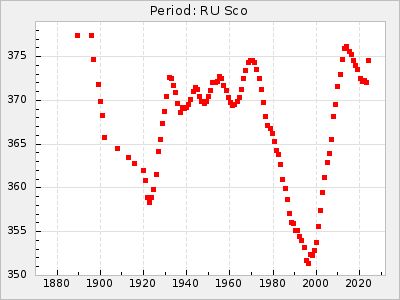
RU Sco is on my list of meandering mira stars. Since 1889, the period has varied between 351 and 377 days. The star was discovered in 1895 at Harvard by Williamina Fleming.
More miras at var.saaf.se/mirainfooc.php
RU Sco is on my list of meandering mira stars. Since 1889, the period has varied between 351 and 377 days. The star was discovered in 1895 at Harvard by Williamina Fleming.
More miras at var.saaf.se/mirainfooc.php

October 10, 2025 at 1:47 PM
From my database of maxima for mira variables.
RU Sco is on my list of meandering mira stars. Since 1889, the period has varied between 351 and 377 days. The star was discovered in 1895 at Harvard by Williamina Fleming.
More miras at var.saaf.se/mirainfooc.php
RU Sco is on my list of meandering mira stars. Since 1889, the period has varied between 351 and 377 days. The star was discovered in 1895 at Harvard by Williamina Fleming.
More miras at var.saaf.se/mirainfooc.php
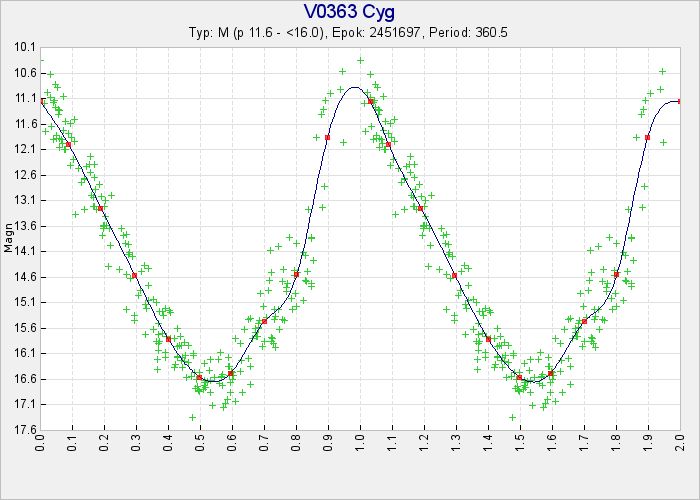
V363 Cyg is a mira among the SAAF's 50 Forgotten Miras. The star was discovered in 1928 by Frank E. Ross at Yerkes Observatory. The phase diagram shows observations made by SAAF members 2012-2025. From DASCH data, the average period since 1899 is 358.9 days. Since 2012, the period is 360.5 days.
October 3, 2025 at 12:47 PM
V363 Cyg is a mira among the SAAF's 50 Forgotten Miras. The star was discovered in 1928 by Frank E. Ross at Yerkes Observatory. The phase diagram shows observations made by SAAF members 2012-2025. From DASCH data, the average period since 1899 is 358.9 days. Since 2012, the period is 360.5 days.
KUV 18217+6419 is a variable quasar, 3 billion light-years away, in the constellation Draco that I have been following photometrically since 2016. In the past year it has been unusually bright and close to its maximum stated brightness.

September 23, 2025 at 1:32 PM
KUV 18217+6419 is a variable quasar, 3 billion light-years away, in the constellation Draco that I have been following photometrically since 2016. In the past year it has been unusually bright and close to its maximum stated brightness.
From my database of maxima for mira variables.
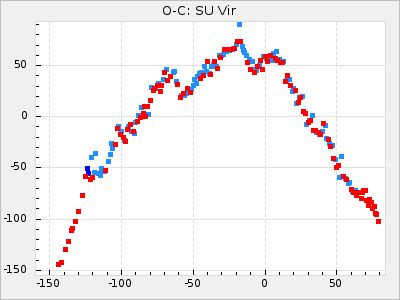
SU Vir is on my list of miras with continuously changing periods. SU Vir has a behavior similar to the previously presented stars WX Her and DO Her. Since 1897, its period has decreased from 213 to 206 days.
More miras at var.saaf.se/mirainfooc.php
SU Vir is on my list of miras with continuously changing periods. SU Vir has a behavior similar to the previously presented stars WX Her and DO Her. Since 1897, its period has decreased from 213 to 206 days.
More miras at var.saaf.se/mirainfooc.php

September 12, 2025 at 3:19 PM
From my database of maxima for mira variables.
SU Vir is on my list of miras with continuously changing periods. SU Vir has a behavior similar to the previously presented stars WX Her and DO Her. Since 1897, its period has decreased from 213 to 206 days.
More miras at var.saaf.se/mirainfooc.php
SU Vir is on my list of miras with continuously changing periods. SU Vir has a behavior similar to the previously presented stars WX Her and DO Her. Since 1897, its period has decreased from 213 to 206 days.
More miras at var.saaf.se/mirainfooc.php
GS Cyg is one of the longer-period miras among the SAAF's 50 Forgotten Mira Stars. The star was discovered in 1927 by Frank E. Ross at Yerkes Observatory. Since 1891 the average period has been 413.6 days. The current period is 412.9 days. The phase diagram shows 284 observations 2012-2025.

September 3, 2025 at 1:11 PM
GS Cyg is one of the longer-period miras among the SAAF's 50 Forgotten Mira Stars. The star was discovered in 1927 by Frank E. Ross at Yerkes Observatory. Since 1891 the average period has been 413.6 days. The current period is 412.9 days. The phase diagram shows 284 observations 2012-2025.
When Petter Åström, SAAF, photographed NGC 7380, he discovered that a star varied in brightness between the images. It turned out to be the rather unknown eclipsing binary WISE J224344.9+575603. From the ZTF data I was able to determine its period element to Min (HJD) = 2458226.58 + 8.62688 E.

August 27, 2025 at 11:13 AM
When Petter Åström, SAAF, photographed NGC 7380, he discovered that a star varied in brightness between the images. It turned out to be the rather unknown eclipsing binary WISE J224344.9+575603. From the ZTF data I was able to determine its period element to Min (HJD) = 2458226.58 + 8.62688 E.
CL Cyg is one of the SAAF's 50 forgotten miras. It was discovered in 1923 by Zarewitsch, an observer at the Pulkovo Observatory in Saint Petersburg. The phase diagram shows 416 observations since 2012. Mine are marked in yellow. The period seems fairly stable, currently at 305.2 days.

August 14, 2025 at 1:25 PM
CL Cyg is one of the SAAF's 50 forgotten miras. It was discovered in 1923 by Zarewitsch, an observer at the Pulkovo Observatory in Saint Petersburg. The phase diagram shows 416 observations since 2012. Mine are marked in yellow. The period seems fairly stable, currently at 305.2 days.
Here are my observations of the mira star RT Tri in a phase diagram. 71 made between 2017 and 2025. The star was discovered in 1934 by the German astronomer Otto Morgenroth. From my observations I have determined its period to be 147.0 days.

August 7, 2025 at 1:55 PM
Here are my observations of the mira star RT Tri in a phase diagram. 71 made between 2017 and 2025. The star was discovered in 1934 by the German astronomer Otto Morgenroth. From my observations I have determined its period to be 147.0 days.
Y Cap is on my list of meandering miras. It is a star that is quite poorly observed, but with some gaps I have data from 1885 onwards. Based on the period diagram, the meandering behavior seems to have only started around 1970.


August 1, 2025 at 5:12 PM
Y Cap is on my list of meandering miras. It is a star that is quite poorly observed, but with some gaps I have data from 1885 onwards. Based on the period diagram, the meandering behavior seems to have only started around 1970.
XY Cyg is a mira among the SAAF's 50 forgotten miras. It was discovered in 1905 by the couple Max and Gisela Wolf. The average period since 1890 is 300.1 days and the period since 2012 is 300.8 days. The color index B-V=2.8 is unusually high, normal for miras with this period is 1.7.

July 26, 2025 at 9:40 AM
XY Cyg is a mira among the SAAF's 50 forgotten miras. It was discovered in 1905 by the couple Max and Gisela Wolf. The average period since 1890 is 300.1 days and the period since 2012 is 300.8 days. The color index B-V=2.8 is unusually high, normal for miras with this period is 1.7.
In anticipation of the next nova eruption, here is a phase diagram for T CrB with observations from #SAAF 1951-2025. 1635 observations, mostly visual. Despite the small amplitude, the star's binary 228-day period is visible in the visual observations.

July 15, 2025 at 12:07 PM
In anticipation of the next nova eruption, here is a phase diagram for T CrB with observations from #SAAF 1951-2025. 1635 observations, mostly visual. Despite the small amplitude, the star's binary 228-day period is visible in the visual observations.
From my database of maxima for mira variables.
LX Cyg is a mira known for its large period increase 1970-2005. New DASCH-data show that it had an earlier event of period increase 1905-1920. In recent years, it has also gotten an increasingly lower amplitude
More miras at var.saaf.se/mirainfooc.php
LX Cyg is a mira known for its large period increase 1970-2005. New DASCH-data show that it had an earlier event of period increase 1905-1920. In recent years, it has also gotten an increasingly lower amplitude
More miras at var.saaf.se/mirainfooc.php


July 8, 2025 at 1:11 PM
From my database of maxima for mira variables.
LX Cyg is a mira known for its large period increase 1970-2005. New DASCH-data show that it had an earlier event of period increase 1905-1920. In recent years, it has also gotten an increasingly lower amplitude
More miras at var.saaf.se/mirainfooc.php
LX Cyg is a mira known for its large period increase 1970-2005. New DASCH-data show that it had an earlier event of period increase 1905-1920. In recent years, it has also gotten an increasingly lower amplitude
More miras at var.saaf.se/mirainfooc.php
AW Cep is a mira in the SAAF's observation program "50 Forgotten Miras". The variable was discovered in 1936 by the great German variable discoverer Cuno Hoffmeister. The current period of 241.3 days appears to have been fairly constant since the beginning of the 20th century.

July 3, 2025 at 10:02 AM
AW Cep is a mira in the SAAF's observation program "50 Forgotten Miras". The variable was discovered in 1936 by the great German variable discoverer Cuno Hoffmeister. The current period of 241.3 days appears to have been fairly constant since the beginning of the 20th century.
The database has now been updated with 1400 new max for 2023 and 2024! Therefore, here is the period curve for omicron Cet, or Mira, the star that gave its name to this class of stars. It is the star with the oldest history in the collection, 1596-2024.
More miras at var.saaf.se/mirainfooc.php
More miras at var.saaf.se/mirainfooc.php

June 25, 2025 at 2:49 PM
The database has now been updated with 1400 new max for 2023 and 2024! Therefore, here is the period curve for omicron Cet, or Mira, the star that gave its name to this class of stars. It is the star with the oldest history in the collection, 1596-2024.
More miras at var.saaf.se/mirainfooc.php
More miras at var.saaf.se/mirainfooc.php
TW Cep is a mira in the SAAF's "50 Forgotten Miras" program. The star was discovered in 1914 by d'Esterre, an English amateur astronomer who had an observatory in Tatsfield, Surrey. The current period of 282 days seems fairly stable.

June 18, 2025 at 9:27 AM
TW Cep is a mira in the SAAF's "50 Forgotten Miras" program. The star was discovered in 1914 by d'Esterre, an English amateur astronomer who had an observatory in Tatsfield, Surrey. The current period of 282 days seems fairly stable.