


Wildlife Wizard
@wildlifewizard.bsky.social
Bat ecologist, naturalist, lover of wildlife & wild spaces. Agnostic, secular Buddhist, AODA member /|\.
I post photos of plants, insects, sometimes bats, & other wildlife, accompanied by interesting facts about their ecology.
I post photos of plants, insects, sometimes bats, & other wildlife, accompanied by interesting facts about their ecology.
These cool #mushrooms popped up overnight. I love how the morning dew looks on them.
I’m not confident with mushroom ID, but iNaturalist thinks it’s the poisonous green-spored parasol (Chlorophyllum molybdites), commonly mistaken for 3 edible species in the same genus called shaggy parasols. 🍄🟫
I’m not confident with mushroom ID, but iNaturalist thinks it’s the poisonous green-spored parasol (Chlorophyllum molybdites), commonly mistaken for 3 edible species in the same genus called shaggy parasols. 🍄🟫


September 29, 2025 at 12:13 PM
These cool #mushrooms popped up overnight. I love how the morning dew looks on them.
I’m not confident with mushroom ID, but iNaturalist thinks it’s the poisonous green-spored parasol (Chlorophyllum molybdites), commonly mistaken for 3 edible species in the same genus called shaggy parasols. 🍄🟫
I’m not confident with mushroom ID, but iNaturalist thinks it’s the poisonous green-spored parasol (Chlorophyllum molybdites), commonly mistaken for 3 edible species in the same genus called shaggy parasols. 🍄🟫
A female yellow garden spider (Argiope aurantia). Look at that beauty!
#Spiders in this genus are known for making webs with a thick zigzag of silk called a stabilimentum, its purpose being disputed. 🧵
#nature #animalfacts #orbweavers
#Spiders in this genus are known for making webs with a thick zigzag of silk called a stabilimentum, its purpose being disputed. 🧵
#nature #animalfacts #orbweavers

September 28, 2025 at 2:16 PM
A female yellow garden spider (Argiope aurantia). Look at that beauty!
#Spiders in this genus are known for making webs with a thick zigzag of silk called a stabilimentum, its purpose being disputed. 🧵
#nature #animalfacts #orbweavers
#Spiders in this genus are known for making webs with a thick zigzag of silk called a stabilimentum, its purpose being disputed. 🧵
#nature #animalfacts #orbweavers
I just learned that Desmodium is in the pea/legume family Fabaceae. But unlike a typical legume that splits lengthwise (think green beans), tick trefoils split between seeds, creating strings of loosely-connected triangular stickers. These break off individually when an animal brushes past. 🧵

September 28, 2025 at 1:21 PM
I just learned that Desmodium is in the pea/legume family Fabaceae. But unlike a typical legume that splits lengthwise (think green beans), tick trefoils split between seeds, creating strings of loosely-connected triangular stickers. These break off individually when an animal brushes past. 🧵
Tick trefoil (Desmodium spp.) is a diverse genus with broad native distribution. I’ve long hated their Velcro seeds, adapted for animal dispersal. But the plant is beneficial to a variety of animals, and their roots help neighboring plants access nitrogen.
I just learned that🧵
#plantfacts #nature
I just learned that🧵
#plantfacts #nature

September 28, 2025 at 1:21 PM
Tick trefoil (Desmodium spp.) is a diverse genus with broad native distribution. I’ve long hated their Velcro seeds, adapted for animal dispersal. But the plant is beneficial to a variety of animals, and their roots help neighboring plants access nitrogen.
I just learned that🧵
#plantfacts #nature
I just learned that🧵
#plantfacts #nature
Wild cannas are native to the tropical and subtropical Americas from South Carolina, west to Texas, and south to Argentina.
It’s also known as Indian shot, edible canna, and arrowroot. Arrowroot powder is used widely as a food starch and is produced from the plant’s rhizomes.
It’s also known as Indian shot, edible canna, and arrowroot. Arrowroot powder is used widely as a food starch and is produced from the plant’s rhizomes.

September 14, 2025 at 1:23 AM
Wild cannas are native to the tropical and subtropical Americas from South Carolina, west to Texas, and south to Argentina.
It’s also known as Indian shot, edible canna, and arrowroot. Arrowroot powder is used widely as a food starch and is produced from the plant’s rhizomes.
It’s also known as Indian shot, edible canna, and arrowroot. Arrowroot powder is used widely as a food starch and is produced from the plant’s rhizomes.
When the seed pods ripen, they dry, turn brown, and open to release the seeds. The seed pods’ 3 chambers are visible in these photos.
Reproduction by seed can be seen as secondary, as cannas spread via rhizomes, and seed hibernation is made possible by a hard seed coat.
Reproduction by seed can be seen as secondary, as cannas spread via rhizomes, and seed hibernation is made possible by a hard seed coat.


September 14, 2025 at 1:23 AM
When the seed pods ripen, they dry, turn brown, and open to release the seeds. The seed pods’ 3 chambers are visible in these photos.
Reproduction by seed can be seen as secondary, as cannas spread via rhizomes, and seed hibernation is made possible by a hard seed coat.
Reproduction by seed can be seen as secondary, as cannas spread via rhizomes, and seed hibernation is made possible by a hard seed coat.
As a monocot, the flower parts are in multiples of three. The three petals and sepals are inconspicuous. What’s appear to be bright, showy petals are modified stamens and pistil. The pistil is connected to a 3-chambered ovary, which matures into a 3-chambered seed pod (pictured below, unripe).

September 14, 2025 at 1:23 AM
As a monocot, the flower parts are in multiples of three. The three petals and sepals are inconspicuous. What’s appear to be bright, showy petals are modified stamens and pistil. The pistil is connected to a 3-chambered ovary, which matures into a 3-chambered seed pod (pictured below, unripe).
Sometimes called “canna lilies”, cannas aren’t true lilies. They’re in their own family (Cannaceae), which has 10 species in a single genus.
Pictured is an unopened flower bud, early flower, spent flowers, and maturing seed pods.
Pictured is an unopened flower bud, early flower, spent flowers, and maturing seed pods.

September 14, 2025 at 1:23 AM
Sometimes called “canna lilies”, cannas aren’t true lilies. They’re in their own family (Cannaceae), which has 10 species in a single genus.
Pictured is an unopened flower bud, early flower, spent flowers, and maturing seed pods.
Pictured is an unopened flower bud, early flower, spent flowers, and maturing seed pods.
The cannas (Canna Indica) have been blooming in TN. They bloom long enough for early flower buds and mature seeds to be present simultaneously on one plant. 🌱🌺🌎🧵
View the rest of the #photothread for more pictures of the different #flower stages and #plantfacts
View the rest of the #photothread for more pictures of the different #flower stages and #plantfacts

September 14, 2025 at 1:23 AM
The cannas (Canna Indica) have been blooming in TN. They bloom long enough for early flower buds and mature seeds to be present simultaneously on one plant. 🌱🌺🌎🧵
View the rest of the #photothread for more pictures of the different #flower stages and #plantfacts
View the rest of the #photothread for more pictures of the different #flower stages and #plantfacts
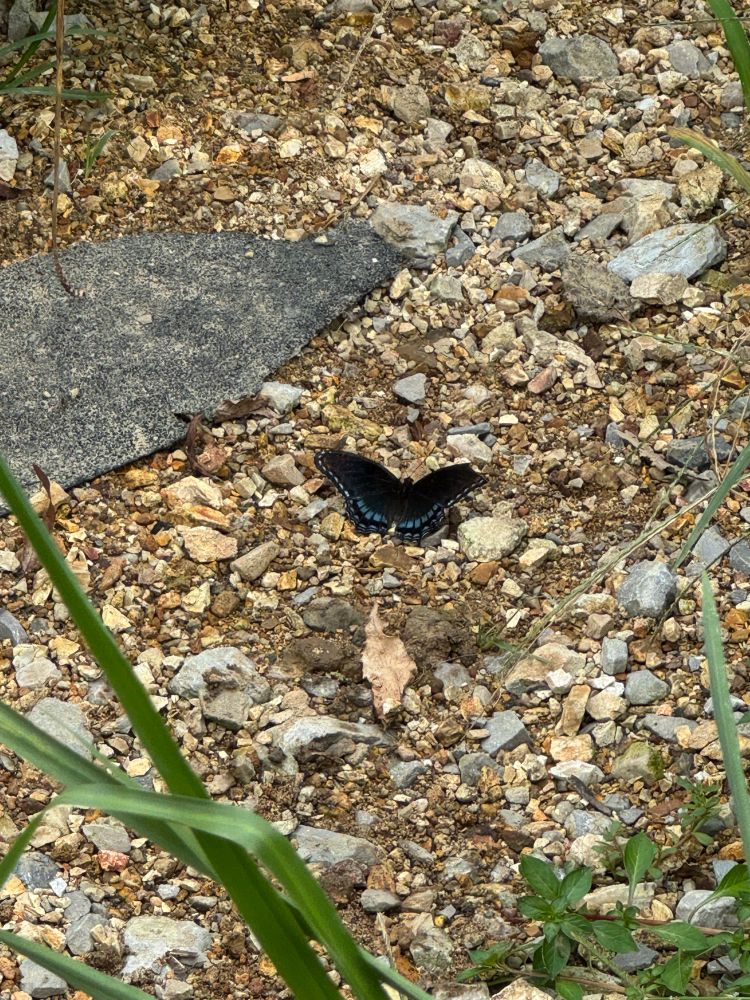
The red-spotted purple #butterfly (Limenitis arthemis astyanax) is a non-poisonous mimic of the pipevine swallowtail I posted earlier. This is called Batesian #mimicry. This species rarely rests with its wings open, so I was lucky to get a photo.
August 31, 2025 at 1:01 PM
The red-spotted purple #butterfly (Limenitis arthemis astyanax) is a non-poisonous mimic of the pipevine swallowtail I posted earlier. This is called Batesian #mimicry. This species rarely rests with its wings open, so I was lucky to get a photo.
A gulf fritillary (Dione vanillae), a member of the longwing #butterfly family. The bright orange color is an example of #aposematism, a “Warning: do not eat” sign for birds, as defensive odor glands make them unpalatable. 🧵


August 29, 2025 at 12:39 PM
A gulf fritillary (Dione vanillae), a member of the longwing #butterfly family. The bright orange color is an example of #aposematism, a “Warning: do not eat” sign for birds, as defensive odor glands make them unpalatable. 🧵
Not just beautiful but a very #coolspecies, the Pipevine swallowtail #butterfly (Battus philenor) mainly feeds on poisonous pipevines (Aristolochia spp.) making it poisonous to predators. Many other species take advantage of this through different types of #mimicry. 🧵

August 10, 2025 at 3:41 PM
Not just beautiful but a very #coolspecies, the Pipevine swallowtail #butterfly (Battus philenor) mainly feeds on poisonous pipevines (Aristolochia spp.) making it poisonous to predators. Many other species take advantage of this through different types of #mimicry. 🧵
Here’s another edible but flavorless #mushroom: white coral fungus (Ramariopsis kunzei) - named for their color and the branched structure resembling certain marine corals. They’re found in wet leaf litter and decayed wood. Several lookalikes are edible; at least one is poisonous. #coolspecies


August 10, 2025 at 3:07 PM
Here’s another edible but flavorless #mushroom: white coral fungus (Ramariopsis kunzei) - named for their color and the branched structure resembling certain marine corals. They’re found in wet leaf litter and decayed wood. Several lookalikes are edible; at least one is poisonous. #coolspecies
Here’s one for you #mushroom freaks. The basidiocarps of orange jelly spot (Dacrymyces chrysospermus) fungus are gelatinous and edible, but the flavor is bland. They can be used to add texture to soups. The species grows on dead coniferous wood. I found these on dead fir trees in western NC. #nature


August 9, 2025 at 7:40 PM
Here’s one for you #mushroom freaks. The basidiocarps of orange jelly spot (Dacrymyces chrysospermus) fungus are gelatinous and edible, but the flavor is bland. They can be used to add texture to soups. The species grows on dead coniferous wood. I found these on dead fir trees in western NC. #nature


This is a big brown bat (Eptesicus fuscus), one of North America’s most common #bat species.
Don’t be fooled by that “smile”. These photos were taken 4 seconds apart! Look at those teeth!
Yes they bite, & yes it hurts, but only if you handle them. Please don’t touch #wildlife.
#nature #animals 🌎🦇
Don’t be fooled by that “smile”. These photos were taken 4 seconds apart! Look at those teeth!
Yes they bite, & yes it hurts, but only if you handle them. Please don’t touch #wildlife.
#nature #animals 🌎🦇


July 22, 2025 at 1:49 AM
These crepe myrtle #flowers are perfect! That’s a technical term meaning they have male & female parts. The stamens are the numerous, yellow, pollen-laden parts. The pistils are the 6 donuts around the stamens. Each flower has 6 frilly petals and 6 sepals (the outer segments of the spherical bud) 🌺🔬


July 20, 2025 at 2:22 AM
These crepe myrtle #flowers are perfect! That’s a technical term meaning they have male & female parts. The stamens are the numerous, yellow, pollen-laden parts. The pistils are the 6 donuts around the stamens. Each flower has 6 frilly petals and 6 sepals (the outer segments of the spherical bud) 🌺🔬
Check out the amazing camouflage on this white-banded fishing spider! It was almost impossible to see in natural light, and moved lightning fast around the tree when I startled it. Fishing spiders can walk on water, and trap air bubbles on their abdomens to help them dive and swim to hunt. 🕷️🌎🔬


July 10, 2025 at 3:54 AM
Check out the amazing camouflage on this white-banded fishing spider! It was almost impossible to see in natural light, and moved lightning fast around the tree when I startled it. Fishing spiders can walk on water, and trap air bubbles on their abdomens to help them dive and swim to hunt. 🕷️🌎🔬
All summer in SW Virginia…
Forecast at noon: 5% chance
Forecast at 7pm: 5% chance
Forecast at 7:45: 65% chance
Weather at 7:50: ⚡️⛈️🌧️
Forecast at noon: 5% chance
Forecast at 7pm: 5% chance
Forecast at 7:45: 65% chance
Weather at 7:50: ⚡️⛈️🌧️
July 8, 2025 at 12:00 AM
All summer in SW Virginia…
Forecast at noon: 5% chance
Forecast at 7pm: 5% chance
Forecast at 7:45: 65% chance
Weather at 7:50: ⚡️⛈️🌧️
Forecast at noon: 5% chance
Forecast at 7pm: 5% chance
Forecast at 7:45: 65% chance
Weather at 7:50: ⚡️⛈️🌧️
We’re not catching a lot of #bats this summer, but check out these cool #mushrooms! They *might* be lynx paw oysters, but don’t quote me on that. 🍄🟫🧪🔬📷 #fieldbiologist #naturephotos


July 5, 2025 at 9:15 PM
We’re not catching a lot of #bats this summer, but check out these cool #mushrooms! They *might* be lynx paw oysters, but don’t quote me on that. 🍄🟫🧪🔬📷 #fieldbiologist #naturephotos
Here’s a nice mushroom for @lukelukeluke.bsky.social. I don’t know what it was, but it was growing on the side of a standing dead oak tree in a late stage of decay in SW Virginia, and it caught my eye.

July 5, 2025 at 5:32 AM
Here’s a nice mushroom for @lukelukeluke.bsky.social. I don’t know what it was, but it was growing on the side of a standing dead oak tree in a late stage of decay in SW Virginia, and it caught my eye.
Wow! What a treat to find this chunky #beetle! It’s a Broad-Necked Root Borer (Prionus laticollis), and was about 4-5 cm long. Likely female based on size (females are 2x the size of males). She may have been about to lay eggs, which she’ll deposit 10cm underground with 1/
#naturephoto #wildlife
#naturephoto #wildlife


June 30, 2025 at 3:28 AM
Wow! What a treat to find this chunky #beetle! It’s a Broad-Necked Root Borer (Prionus laticollis), and was about 4-5 cm long. Likely female based on size (females are 2x the size of males). She may have been about to lay eggs, which she’ll deposit 10cm underground with 1/
#naturephoto #wildlife
#naturephoto #wildlife
Southern flying squirrel (Glaucomys volans). A common bycatch in bat surveys, and destructive to mist nets. I usually don’t photograph these adorable little turds because they’re nasty biters and very squirmy. This one was more docile for a minute.


June 26, 2025 at 1:39 AM
Southern flying squirrel (Glaucomys volans). A common bycatch in bat surveys, and destructive to mist nets. I usually don’t photograph these adorable little turds because they’re nasty biters and very squirmy. This one was more docile for a minute.

Dwarf larkspur (Delphinium tricorne) found on a rural mountain roadside in western Virginia.


June 15, 2025 at 4:55 PM
Dwarf larkspur (Delphinium tricorne) found on a rural mountain roadside in western Virginia.