



Wim Thiery
@wimthiery.bsky.social
Climate scientist modelling extreme events in a changing climate, Full Professor @vubrussel.bsky.social. Previously research fellow @kuleuvenuniversity.bsky.social and @ethz.ch. Website: https://sites.google.com/site/wimthiery/
Tien Shan glaciers are projected to lose around one-third of their 2020 ice mass before 2040, and 69-93% by 2100, depending on the climate scenario. By the late 21stC, the probability of unmet water demand in summer will increase substantially agupubs.onlinelibrary.wiley.com/doi/10.1029/...

February 10, 2026 at 4:41 PM
Tien Shan glaciers are projected to lose around one-third of their 2020 ice mass before 2040, and 69-93% by 2100, depending on the climate scenario. By the late 21stC, the probability of unmet water demand in summer will increase substantially agupubs.onlinelibrary.wiley.com/doi/10.1029/...
In our new paper in GMD @egu.eu by @seppelampe.bsky.social, we present BuRNN v1.0: an open-access, data-driven fire model. BuRNN largely outperforms current-generation process-based fire model across a range of metrics
model: github.com/VUB-HYDR/BuRNN
paper: gmd.copernicus.org/articles/19/...
model: github.com/VUB-HYDR/BuRNN
paper: gmd.copernicus.org/articles/19/...

January 29, 2026 at 6:11 PM
In our new paper in GMD @egu.eu by @seppelampe.bsky.social, we present BuRNN v1.0: an open-access, data-driven fire model. BuRNN largely outperforms current-generation process-based fire model across a range of metrics
model: github.com/VUB-HYDR/BuRNN
paper: gmd.copernicus.org/articles/19/...
model: github.com/VUB-HYDR/BuRNN
paper: gmd.copernicus.org/articles/19/...
📢 Working on land atmosphere-interactions and their role in shaping climate extremes?
🌍 Consider submitting an abstract to our European Geosciences Union (@egu.eu) 2026 session:
Land-atmosphere interactions and climate extremes (CL4.4): www.egu26.eu/session/56763
🌍 Consider submitting an abstract to our European Geosciences Union (@egu.eu) 2026 session:
Land-atmosphere interactions and climate extremes (CL4.4): www.egu26.eu/session/56763

January 5, 2026 at 1:19 PM
📢 Working on land atmosphere-interactions and their role in shaping climate extremes?
🌍 Consider submitting an abstract to our European Geosciences Union (@egu.eu) 2026 session:
Land-atmosphere interactions and climate extremes (CL4.4): www.egu26.eu/session/56763
🌍 Consider submitting an abstract to our European Geosciences Union (@egu.eu) 2026 session:
Land-atmosphere interactions and climate extremes (CL4.4): www.egu26.eu/session/56763
"In regions dominated by small and rapidly responding glaciers, such as [...] the European Alps, over 50% of the glaciers are projected to disappear within the next two decades." New @natclimate.nature.com study by @landervt.bsky.social @harryzeko.bsky.social @hydr-vub.bsky.social


December 16, 2025 at 4:13 PM
"In regions dominated by small and rapidly responding glaciers, such as [...] the European Alps, over 50% of the glaciers are projected to disappear within the next two decades." New @natclimate.nature.com study by @landervt.bsky.social @harryzeko.bsky.social @hydr-vub.bsky.social
In our new study led by @amaurylaridon.bsky.social in #ORE, we present a nonlinear two-forcing emulator for the #AMOC. By accounting for Greenland Ice Sheet melt, it captures 3 additional collapse trajectories for scenarios SSP3-7.0 to SSP5-8.5. open-research-europe.ec.europa.eu/articles/5-87

December 2, 2025 at 9:41 AM
In our new study led by @amaurylaridon.bsky.social in #ORE, we present a nonlinear two-forcing emulator for the #AMOC. By accounting for Greenland Ice Sheet melt, it captures 3 additional collapse trajectories for scenarios SSP3-7.0 to SSP5-8.5. open-research-europe.ec.europa.eu/articles/5-87
📢 Working on land atmosphere-interactions and their role in shaping climate extremes?
🌍 Consider submitting an abstract to our European Geosciences Union (@egu.eu) 2026 session:
Land-atmosphere interactions and climate extremes (CL4.4): meetingorganizer.copernicus.org/EGU26/sessio...
🌍 Consider submitting an abstract to our European Geosciences Union (@egu.eu) 2026 session:
Land-atmosphere interactions and climate extremes (CL4.4): meetingorganizer.copernicus.org/EGU26/sessio...

December 2, 2025 at 8:49 AM
📢 Working on land atmosphere-interactions and their role in shaping climate extremes?
🌍 Consider submitting an abstract to our European Geosciences Union (@egu.eu) 2026 session:
Land-atmosphere interactions and climate extremes (CL4.4): meetingorganizer.copernicus.org/EGU26/sessio...
🌍 Consider submitting an abstract to our European Geosciences Union (@egu.eu) 2026 session:
Land-atmosphere interactions and climate extremes (CL4.4): meetingorganizer.copernicus.org/EGU26/sessio...
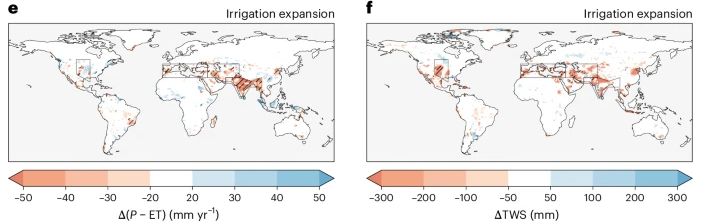
For example, irrigation expansion more then doubled the trend in water loss to the atmosphere (P-E) in South Asia after 1960. As a consequence, the local terrestrial water storage (TWS) depletes over time following irrigation expansion.
November 6, 2025 at 9:38 AM
For example, irrigation expansion more then doubled the trend in water loss to the atmosphere (P-E) in South Asia after 1960. As a consequence, the local terrestrial water storage (TWS) depletes over time following irrigation expansion.
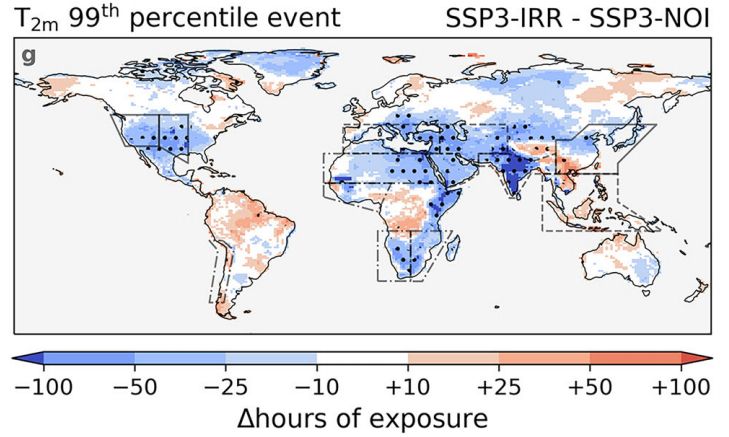
In contract, moist-heat extreme event frequency increases substantially due to irrigation (by ≥1600 h yr−1 under SSP3-7.0 in tropics), and irrigation amplifies the hours of exposure (by ≥100 h yr−1 in South Asia), raising the risk of moist-heat-related illnesses & mortality for exposed communities

October 31, 2025 at 8:46 AM
In contract, moist-heat extreme event frequency increases substantially due to irrigation (by ≥1600 h yr−1 under SSP3-7.0 in tropics), and irrigation amplifies the hours of exposure (by ≥100 h yr−1 in South Asia), raising the risk of moist-heat-related illnesses & mortality for exposed communities
Irrigation is projected to reduce the occurrence of dry-heat stress under both scenarios, but cannot reverse the warming trend due to greenhouse gas emissions
October 31, 2025 at 8:46 AM
Irrigation is projected to reduce the occurrence of dry-heat stress under both scenarios, but cannot reverse the warming trend due to greenhouse gas emissions
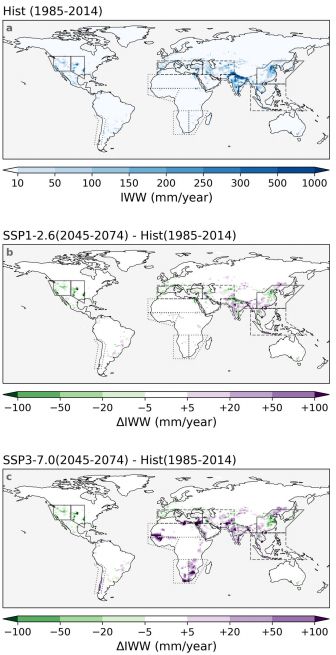
We project that annual irrigation water withdrawal decreases under SSP1-2.6 (from ~2100 to ~1700 km3 yr−1) but increases under SSP3-7.0 (to ~2400 km3 yr−1), with some new irrigation hot spots emerging, especially in Africa

October 31, 2025 at 8:46 AM
We project that annual irrigation water withdrawal decreases under SSP1-2.6 (from ~2100 to ~1700 km3 yr−1) but increases under SSP3-7.0 (to ~2400 km3 yr−1), with some new irrigation hot spots emerging, especially in Africa
Irrigation is an important historical climate forcing, but so far no study explored its future climatic impacts considering possible changes in both extent and efficiency.
We develop irrigation efficiency scenarios along the SSPs, implement these in CESM, and generate projections for 2015–2074.
We develop irrigation efficiency scenarios along the SSPs, implement these in CESM, and generate projections for 2015–2074.

October 31, 2025 at 8:46 AM
Irrigation is an important historical climate forcing, but so far no study explored its future climatic impacts considering possible changes in both extent and efficiency.
We develop irrigation efficiency scenarios along the SSPs, implement these in CESM, and generate projections for 2015–2074.
We develop irrigation efficiency scenarios along the SSPs, implement these in CESM, and generate projections for 2015–2074.
Lopende projectoproep voor interuniversitair wetenschappelijke onderzoek in Vlaanderen wordt geannuleerd als gevolg van besparingen Vlaamse regering.

September 29, 2025 at 6:50 AM
Lopende projectoproep voor interuniversitair wetenschappelijke onderzoek in Vlaanderen wordt geannuleerd als gevolg van besparingen Vlaamse regering.
In our new study led by Delphine Ramon in @ioppublishing.bsky.social, we project exposure to dangerous heat stress around Lake Victoria under a high-end scenario. By end of century, up to 122 million people may experience dangerous heat stress for more than 5% of the year doi.org/10.1088/1748...

September 26, 2025 at 9:20 PM
In our new study led by Delphine Ramon in @ioppublishing.bsky.social, we project exposure to dangerous heat stress around Lake Victoria under a high-end scenario. By end of century, up to 122 million people may experience dangerous heat stress for more than 5% of the year doi.org/10.1088/1748...
Open access article by Quilcaille et al., 2025 now out in print: www.nature.com/nature/volum...

September 18, 2025 at 1:02 PM
Open access article by Quilcaille et al., 2025 now out in print: www.nature.com/nature/volum...
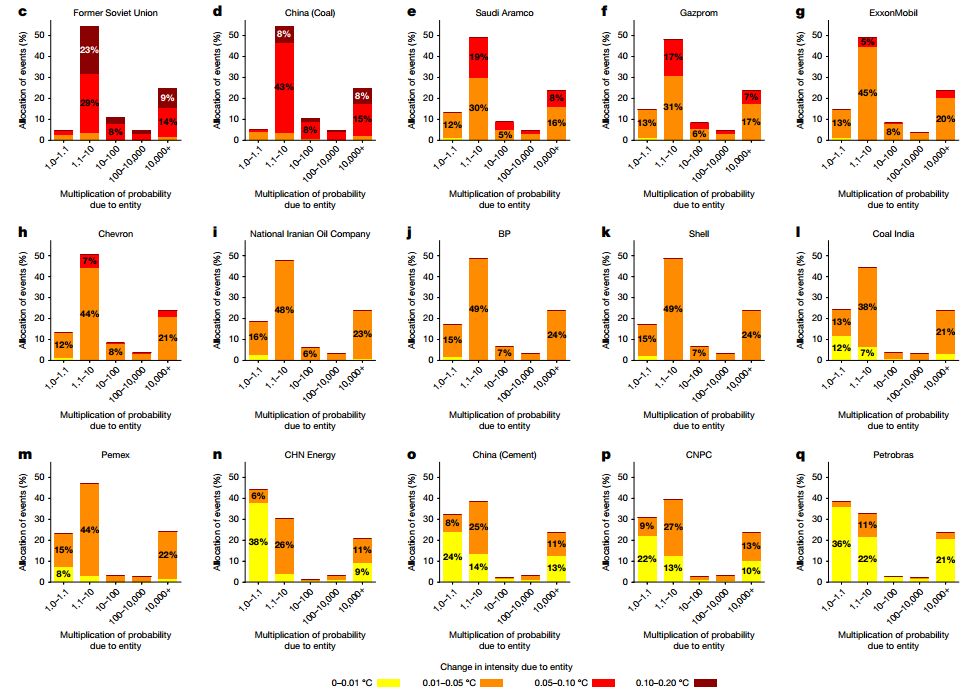
Each of the carbon majors has a discernible influence on these impactful heatwaves. With reference to 1850–1900, climate change has increased the median intensity of heatwaves by 1.68 °C over 2010–2019, of which 0.47 °C is traced back to the 14 top carbon majors and 0.38 °C to the 166 others.
September 10, 2025 at 6:54 PM
Each of the carbon majors has a discernible influence on these impactful heatwaves. With reference to 1850–1900, climate change has increased the median intensity of heatwaves by 1.68 °C over 2010–2019, of which 0.47 °C is traced back to the 14 top carbon majors and 0.38 °C to the 166 others.
In a next step, we employ the carbonmajors.org database to quantify the contribution of each of the 180 carbon majors to (i) global mean temperature, and (ii) the probability and intensity of each of the 213 heatwaves.

September 10, 2025 at 6:54 PM
In a next step, we employ the carbonmajors.org database to quantify the contribution of each of the 180 carbon majors to (i) global mean temperature, and (ii) the probability and intensity of each of the 213 heatwaves.
The imprint of climate change rapidly rises over time: according to the median probability ratio, it made heatwaves around 20 times more likely between 2000 and 2009... and around 200 times more likely between 2010 and 2019.

September 10, 2025 at 6:54 PM
The imprint of climate change rapidly rises over time: according to the median probability ratio, it made heatwaves around 20 times more likely between 2000 and 2009... and around 200 times more likely between 2010 and 2019.
We use a well-established extreme event attribution method from www.worldweatherattribution.org to compute the change in frequency & intensity of each of these heatwaves. Man-made climate change made each of them worse, & for a quarter of them, the probability increased by at least a factor 10 000.

September 10, 2025 at 6:54 PM
We use a well-established extreme event attribution method from www.worldweatherattribution.org to compute the change in frequency & intensity of each of these heatwaves. Man-made climate change made each of them worse, & for a quarter of them, the probability increased by at least a factor 10 000.
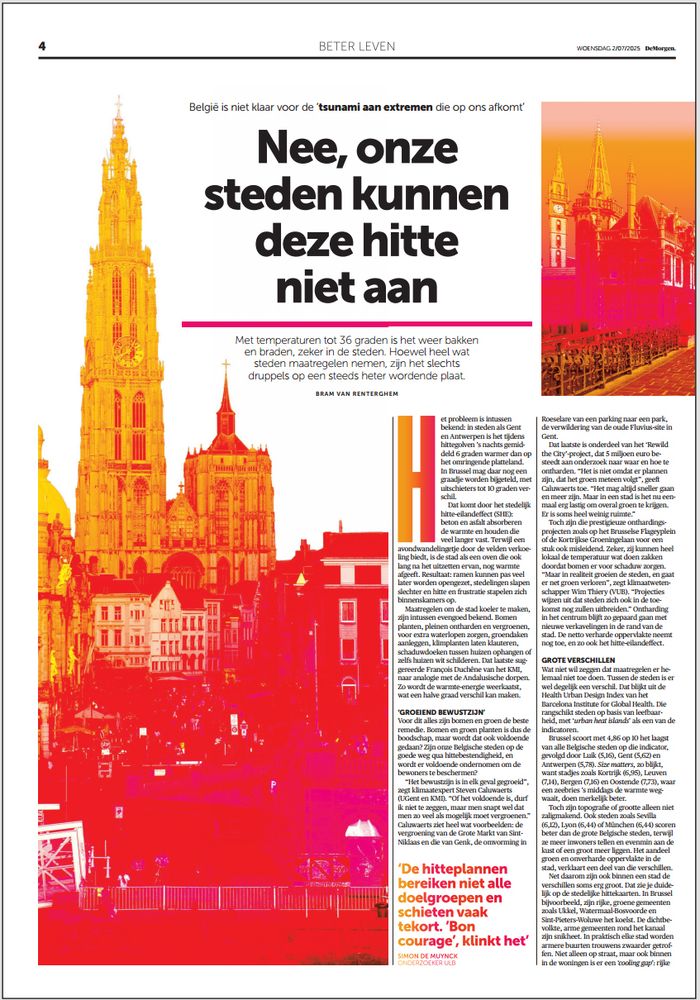
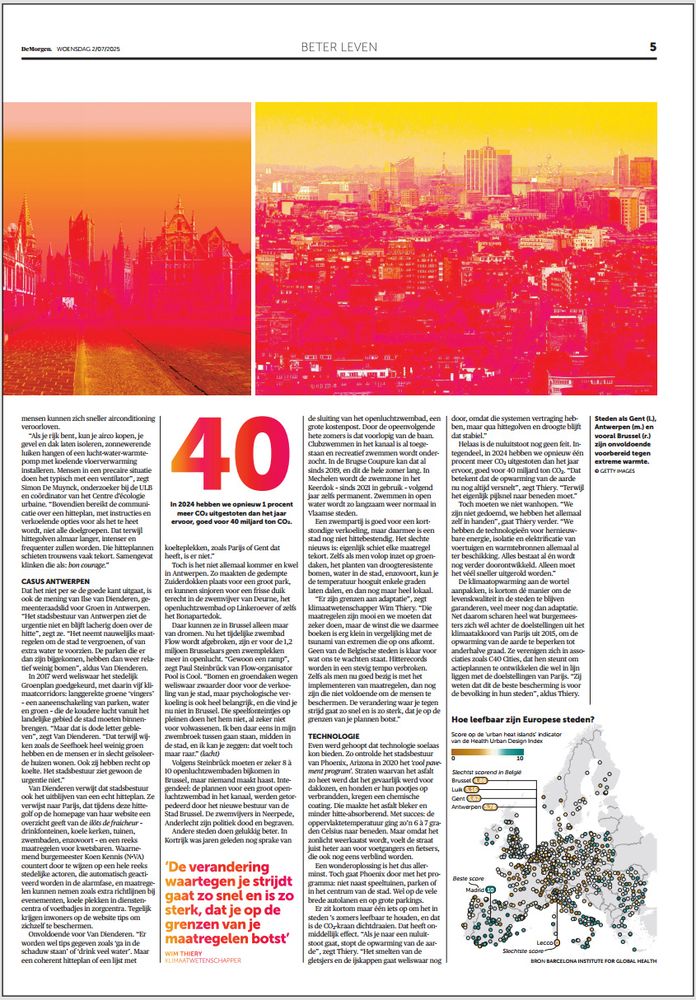
"De klimaatopwarming aan de wortel aanpakken, is kortom dé manier om de levenskwaliteit in de steden te blijven garanderen. Net daarom scharen heel wat burgemeesters zich wél achter het akkoord van Parijs uit 2015." Zij weten dat dit de beste bescherming is voor de bevolking in hun steden
July 2, 2025 at 3:24 PM
"De klimaatopwarming aan de wortel aanpakken, is kortom dé manier om de levenskwaliteit in de steden te blijven garanderen. Net daarom scharen heel wat burgemeesters zich wél achter het akkoord van Parijs uit 2015." Zij weten dat dit de beste bescherming is voor de bevolking in hun steden
In the absence of global climate mitigation, we project a regime shift to a world dominated by compound hazards or impacts. In our new paper by Gabriele Messori, we find that compound hazard occurrences will become the norm in many regions under RCP6.0 agupubs.onlinelibrary.wiley.com/doi/10.1029/...

June 13, 2025 at 10:16 PM
In the absence of global climate mitigation, we project a regime shift to a world dominated by compound hazards or impacts. In our new paper by Gabriele Messori, we find that compound hazard occurrences will become the norm in many regions under RCP6.0 agupubs.onlinelibrary.wiley.com/doi/10.1029/...
A news article in @nature.com provides more information about the study:
www.nature.com/articles/d41...
24/n
www.nature.com/articles/d41...
24/n

May 12, 2025 at 10:54 AM
A news article in @nature.com provides more information about the study:
www.nature.com/articles/d41...
24/n
www.nature.com/articles/d41...
24/n
Working with @savethechildren.org on the 'Born Into The Climate Crisis 2' report has been a wonderful experience. And the front cover inspired by @edhawkins.org warming stripes clearly show that what is at stake today is the safety of current (young) generations, not just future ones. 18/n

May 12, 2025 at 10:54 AM
Working with @savethechildren.org on the 'Born Into The Climate Crisis 2' report has been a wonderful experience. And the front cover inspired by @edhawkins.org warming stripes clearly show that what is at stake today is the safety of current (young) generations, not just future ones. 18/n
The @savethechildren.org report builds on our scientific article and explicitly includes vulnerability. The report provides compelling text, visuals, and testimonies and calls for ambitious climate action at COP30. 17/n
resourcecentre.savethechildren.net/document/bor...
resourcecentre.savethechildren.net/document/bor...

May 12, 2025 at 10:54 AM
The @savethechildren.org report builds on our scientific article and explicitly includes vulnerability. The report provides compelling text, visuals, and testimonies and calls for ambitious climate action at COP30. 17/n
resourcecentre.savethechildren.net/document/bor...
resourcecentre.savethechildren.net/document/bor...
This highlights two critical inequalities linked to impacts of climate change: the intergenerational inequality and the socioeconomic inequality. 16/n

May 12, 2025 at 10:54 AM
This highlights two critical inequalities linked to impacts of climate change: the intergenerational inequality and the socioeconomic inequality. 16/n
We introduce climate change into the age pyramid, and find that in each birth cohort and under current policies, the 20% most deprived run significantly higher risk of unprecedented lifetime heatwave exposure compared to the 20% least deprived. 15/n

May 12, 2025 at 10:54 AM
We introduce climate change into the age pyramid, and find that in each birth cohort and under current policies, the 20% most deprived run significantly higher risk of unprecedented lifetime heatwave exposure compared to the 20% least deprived. 15/n