



Zi-jian Feng (ZAKI)
@zijianfeng.bsky.social
Doctoral Researcher in cognitive neuroscience (TMS and MRI)
Max Planck Institute for Human Cognitive and Brain Sciences
@brainnetleipzig.bsky.social
@copla.bsky.social
@mpicbs.bsky.social
Max Planck Institute for Human Cognitive and Brain Sciences
@brainnetleipzig.bsky.social
@copla.bsky.social
@mpicbs.bsky.social
Reposted by Zi-jian Feng (ZAKI)

🎥🌍 Over 1,000 neuroscience talks now free on YouTube and published at @apertureohbm.bsky.social. 🧠 “Now anyone, anywhere can binge-watch brain science like a box set,” says @stephforkel.bsky.social:
www.ru.nl/en/donders-i...
@alfiewearn.bsky.social @sitek.bsky.social @sofievalk.bsky.social
www.ru.nl/en/donders-i...
@alfiewearn.bsky.social @sitek.bsky.social @sofievalk.bsky.social

Global access to brain science: OHBM launches channel with 1,000+ talks | Radboud University
What if you could journey back in time to hear world-leading neuroscientists present the ideas that shaped today's brain science? A new open-access initiative led by researchers from the Donders Insti...
www.ru.nl
June 27, 2025 at 2:07 PM
🎥🌍 Over 1,000 neuroscience talks now free on YouTube and published at @apertureohbm.bsky.social. 🧠 “Now anyone, anywhere can binge-watch brain science like a box set,” says @stephforkel.bsky.social:
www.ru.nl/en/donders-i...
@alfiewearn.bsky.social @sitek.bsky.social @sofievalk.bsky.social
www.ru.nl/en/donders-i...
@alfiewearn.bsky.social @sitek.bsky.social @sofievalk.bsky.social
Reposted by Zi-jian Feng (ZAKI)

When I first started working with resting state fMRI as a postdoc, there was a lot of skepticism about what we could learn from it. 20 years later, it's hard to imagine where the field of neuroscience would be without it. Here's a summary 🧠 www.nature.com/articles/s41...

The history and future of resting-state functional magnetic resonance imaging - Nature
This Review provides an overview of the history of resting-state functional MRI research, which has helped to reveal the spatiotemporal organization of the brain, and discusses how it can contribute f...
www.nature.com
May 28, 2025 at 3:52 PM
When I first started working with resting state fMRI as a postdoc, there was a lot of skepticism about what we could learn from it. 20 years later, it's hard to imagine where the field of neuroscience would be without it. Here's a summary 🧠 www.nature.com/articles/s41...
Reposted by Zi-jian Feng (ZAKI)
I’m extremely excited that this work of 3 years is finally published in @braistimjournal.bsky.social. Using condition-and-perturb TMS with e-field-based optimized targeting and dosing, we provide causal evidence for hybrid theories of semantic cognition: www.researchgate.net/publication/...
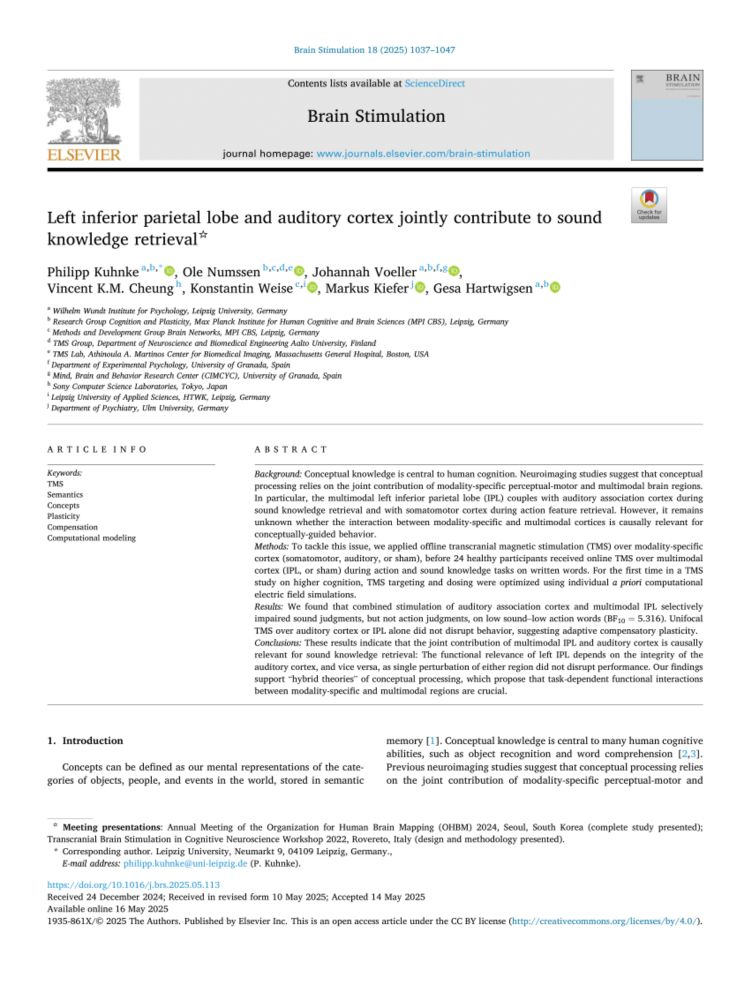
(PDF) Left inferior parietal lobe and auditory cortex jointly contribute to sound knowledge retrieval
PDF | Background Conceptual knowledge is central to human cognition. Neuroimaging studies suggest that conceptual processing relies on the joint... | Find, read and cite all the research you need on R...
www.researchgate.net
May 24, 2025 at 10:29 AM
I’m extremely excited that this work of 3 years is finally published in @braistimjournal.bsky.social. Using condition-and-perturb TMS with e-field-based optimized targeting and dosing, we provide causal evidence for hybrid theories of semantic cognition: www.researchgate.net/publication/...
Reposted by Zi-jian Feng (ZAKI)

🧠 How do semantic and executive control dissociate in the frontal lobe? Applying TMS to IFG and pre-SMA, we find:
⚡ Specialization
▸ IFG = semantic (and executive) control
▸ pre-SMA = executive functions
🔄 Compensation between both regions during single-site disruption!
Read more: shorturl.at/UVtRk
⚡ Specialization
▸ IFG = semantic (and executive) control
▸ pre-SMA = executive functions
🔄 Compensation between both regions during single-site disruption!
Read more: shorturl.at/UVtRk

Causal Contributions of Left Inferior and Medial Frontal Cortex to Semantic and Executive Control
Semantic control guides the targeted and context-based retrieval from semantic memory. The overlap with and dissociation from domain-general executive control in the frontal lobe remains contentious. ...
doi.org
April 23, 2025 at 6:48 PM
🧠 How do semantic and executive control dissociate in the frontal lobe? Applying TMS to IFG and pre-SMA, we find:
⚡ Specialization
▸ IFG = semantic (and executive) control
▸ pre-SMA = executive functions
🔄 Compensation between both regions during single-site disruption!
Read more: shorturl.at/UVtRk
⚡ Specialization
▸ IFG = semantic (and executive) control
▸ pre-SMA = executive functions
🔄 Compensation between both regions during single-site disruption!
Read more: shorturl.at/UVtRk
Reposted by Zi-jian Feng (ZAKI)
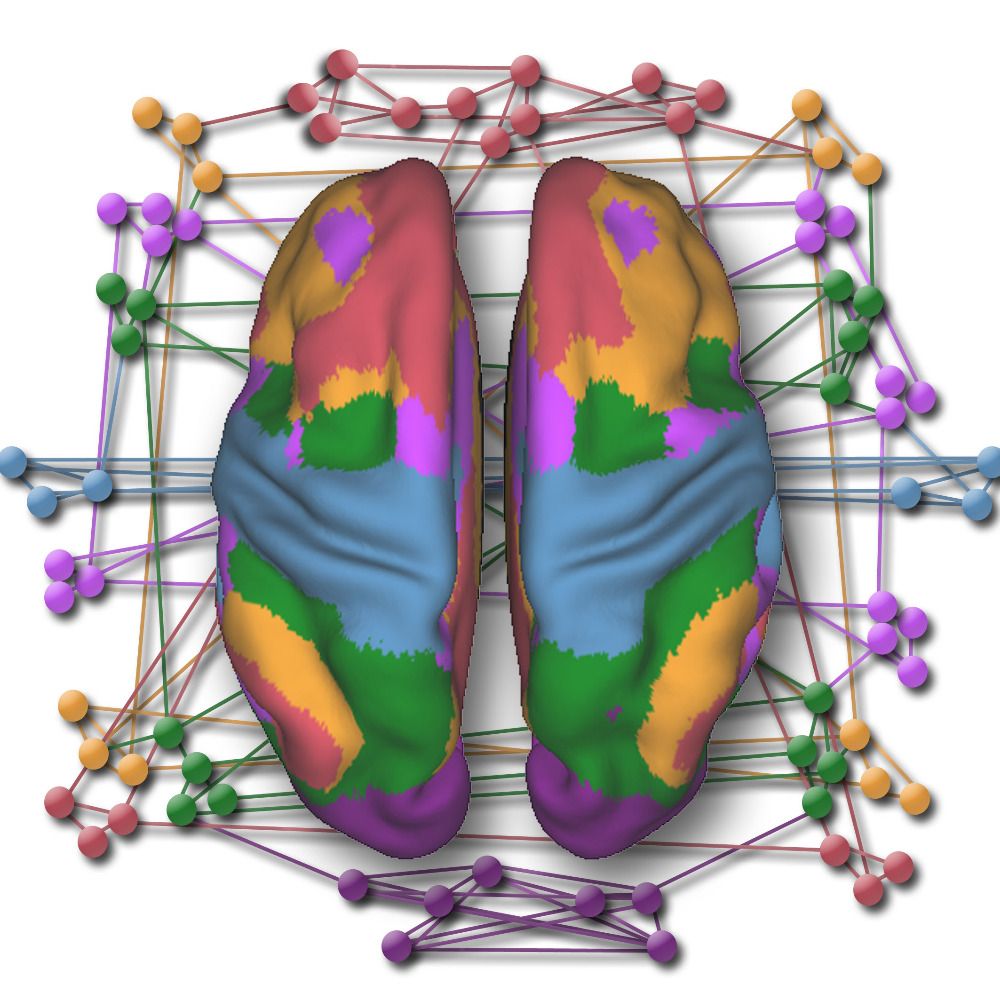
It's finally here! Use the Network Correspondence Toolbox to help contextualize your neuroimaging findings 🧠
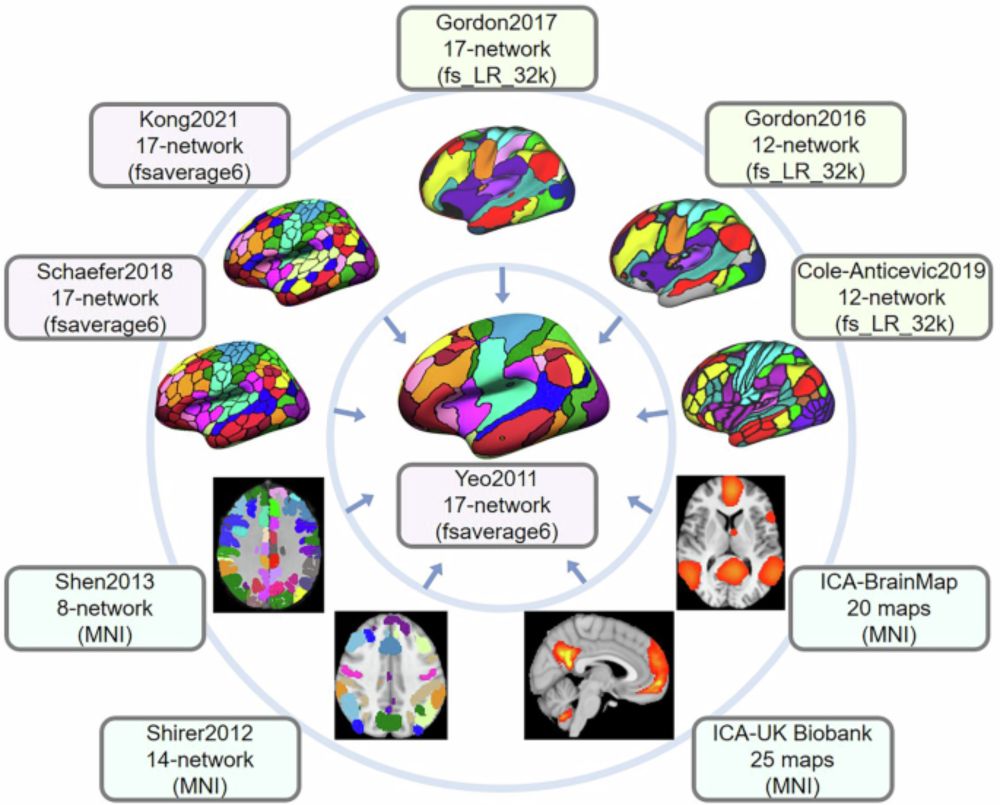
A network correspondence toolbox for quantitative evaluation of novel neuroimaging results - Nature Communications
Here, the authors present the Network Correspondence Toolbox, which enables researchers to examine and report spatial correspondence between their neuroimaging results and widely used brain atlases.
www.nature.com
March 26, 2025 at 1:54 AM
It's finally here! Use the Network Correspondence Toolbox to help contextualize your neuroimaging findings 🧠
Reposted by Zi-jian Feng (ZAKI)

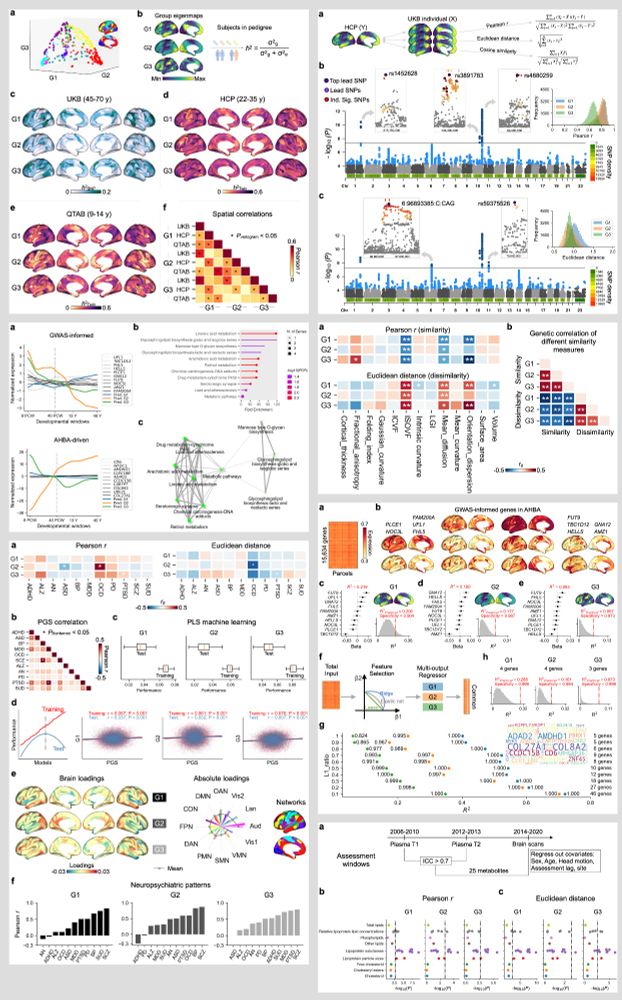
Happy to share my last PhD work "Genetic, transcriptomic, metabolic, and neuropsychiatric underpinnings of cortical functional gradients". We used UKB, HCP, and QTAB to analyze the genetics of functional gradients. The results are so good, consistent, and inspiring! (1/3)
March 5, 2025 at 10:21 AM
Happy to share my last PhD work "Genetic, transcriptomic, metabolic, and neuropsychiatric underpinnings of cortical functional gradients". We used UKB, HCP, and QTAB to analyze the genetics of functional gradients. The results are so good, consistent, and inspiring! (1/3)
Reposted by Zi-jian Feng (ZAKI)
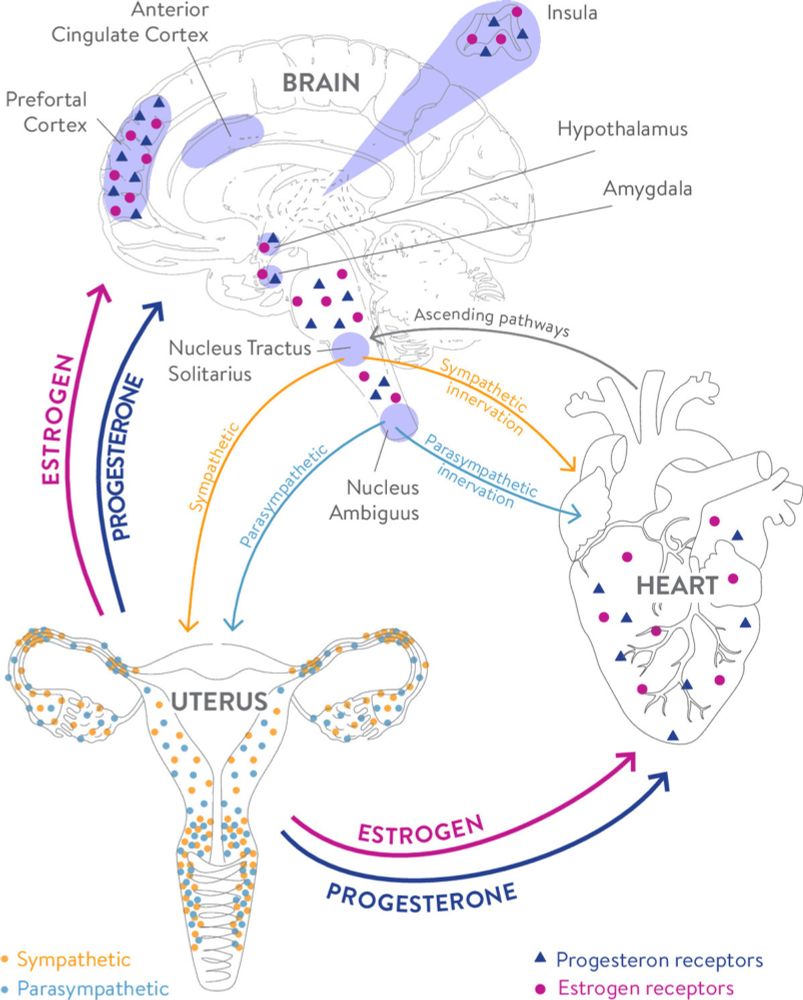
How the #MenstrualCycle shapes #heart and #brain health -
@jellinap.bsky.social together with Julia Sacher @cogneuroend.bsky.social & Arno Villringer describe how these naturally occurring variations might influence #stress, mood, and long-term #womenshealth: tinyurl.com/35pu6447
@jellinap.bsky.social together with Julia Sacher @cogneuroend.bsky.social & Arno Villringer describe how these naturally occurring variations might influence #stress, mood, and long-term #womenshealth: tinyurl.com/35pu6447
How the menstrual cycle shapes heart and brain health
How the menstrual cycle shapes heart and brain health
tinyurl.com
March 6, 2025 at 9:50 AM
How the #MenstrualCycle shapes #heart and #brain health -
@jellinap.bsky.social together with Julia Sacher @cogneuroend.bsky.social & Arno Villringer describe how these naturally occurring variations might influence #stress, mood, and long-term #womenshealth: tinyurl.com/35pu6447
@jellinap.bsky.social together with Julia Sacher @cogneuroend.bsky.social & Arno Villringer describe how these naturally occurring variations might influence #stress, mood, and long-term #womenshealth: tinyurl.com/35pu6447
Reposted by Zi-jian Feng (ZAKI)
Co-authored with Merle Schuckart, @gesahartwigsen.bsky.social, and @jonasobleser.bsky.social. Find the preprint with all the really cool methods (n = 175 + replication!) and insights here: www.biorxiv.org/content/10.1... #PredictiveProcessing #Aging #LanguagePredictions

Executive Resources Shape the Effects of Language Predictability Across the Adult Lifespan
Humans predict upcoming language effortlessly, but the cognitive costs of these predictions remain debated. In this study, we demonstrate that limiting executive resources through a concurrent task re...
www.biorxiv.org
February 24, 2025 at 5:24 PM
Co-authored with Merle Schuckart, @gesahartwigsen.bsky.social, and @jonasobleser.bsky.social. Find the preprint with all the really cool methods (n = 175 + replication!) and insights here: www.biorxiv.org/content/10.1... #PredictiveProcessing #Aging #LanguagePredictions
For the first time, we are able to demonstrate reliable target- and intensity-specific HBC modulation across multiple NCG-TMS 2.0 sessions.
🔍 Key findings: ✅TMS produces a significant site-specific non-linear increase in HBC. ✅Non-linear interplay between stimulation intensity and pain-related side effects, as well as the repeatability of HBC measurements across sessions Check it out and let us know your thoughts! 🚀
February 25, 2025 at 1:44 PM
For the first time, we are able to demonstrate reliable target- and intensity-specific HBC modulation across multiple NCG-TMS 2.0 sessions.
Reposted by Zi-jian Feng (ZAKI)
Thrilled to share our latest research with PhD student @zijianfeng.bsky.social and Postdoc @drsandramartin.bsky.social! We investigated TMS-induced heart–brain coupling (HBC) as a potential biomarker for personalized stimulation targets in the left DLPFC: doi.org/10.1101/2025...
doi.org
February 25, 2025 at 12:14 PM
Thrilled to share our latest research with PhD student @zijianfeng.bsky.social and Postdoc @drsandramartin.bsky.social! We investigated TMS-induced heart–brain coupling (HBC) as a potential biomarker for personalized stimulation targets in the left DLPFC: doi.org/10.1101/2025...
Reposted by Zi-jian Feng (ZAKI)

Excited to share our latest preprint on the retest reliability of measuring 'bilateral' hemispheric language dominance using functional neuroimaging! 🔎🧠🔍 Discover how our findings inform the challenging classification of 'small' asymmetries in brain activation: osf.io/ry4sf_v1
OSF
osf.io
February 13, 2025 at 10:54 AM
Excited to share our latest preprint on the retest reliability of measuring 'bilateral' hemispheric language dominance using functional neuroimaging! 🔎🧠🔍 Discover how our findings inform the challenging classification of 'small' asymmetries in brain activation: osf.io/ry4sf_v1
Reposted by Zi-jian Feng (ZAKI)
Postdoc @drsandramartin.bsky.social presented her research on aging effects on predictive processing in language at the Dallas Aging and Cognition Conference this week. Results show that as we age, we increasingly rely on our internal predictions, possibly as compensation for executive decline. 1/2

February 24, 2025 at 5:24 PM
Postdoc @drsandramartin.bsky.social presented her research on aging effects on predictive processing in language at the Dallas Aging and Cognition Conference this week. Results show that as we age, we increasingly rely on our internal predictions, possibly as compensation for executive decline. 1/2
Reposted by Zi-jian Feng (ZAKI)
New press release by @unileipzig.bsky.social about our BRAIN paper on connectivity changes during post-stroke aphasia recovery: www.uni-leipzig.de/en/newsdetai...

New insights into the mechanisms of language recovery after stroke
A new study shows how the brain reorganises itself in the first few months after a stroke to improve the ability to speak again. The findings will help researchers understand how functional networks w...
www.uni-leipzig.de
February 21, 2025 at 4:27 PM
New press release by @unileipzig.bsky.social about our BRAIN paper on connectivity changes during post-stroke aphasia recovery: www.uni-leipzig.de/en/newsdetai...
Semantics-pragmatics continuum through a multimodal lens, integrating Cognitive Linguistics and Neurolinguistics to advance Cognitive Neuropragmatics by examining the cognitive and neural mechanisms of semantic construction and pragmatic inference!
🚀 Preprint alert! New work by @nicohinrichs.bsky.social, a recent member of our lab, explores multimodal dialogue annotation for neurophysiological mapping of communication—plus insights on speech acts, implicatures & turn-taking: doi.org/10.31234/osf... #Neuropragmatics #CognitiveLinguistics
OSF
doi.org
February 14, 2025 at 6:59 PM
Semantics-pragmatics continuum through a multimodal lens, integrating Cognitive Linguistics and Neurolinguistics to advance Cognitive Neuropragmatics by examining the cognitive and neural mechanisms of semantic construction and pragmatic inference!
Reposted by Zi-jian Feng (ZAKI)
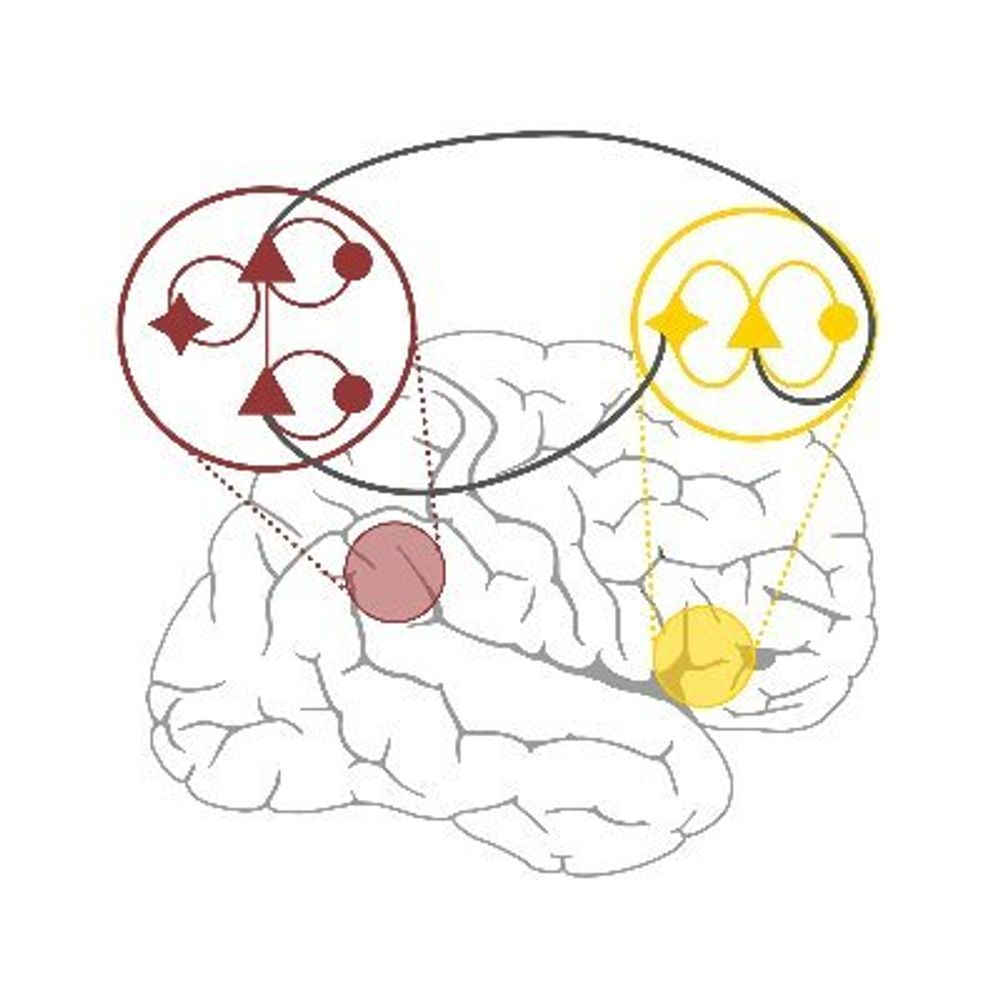
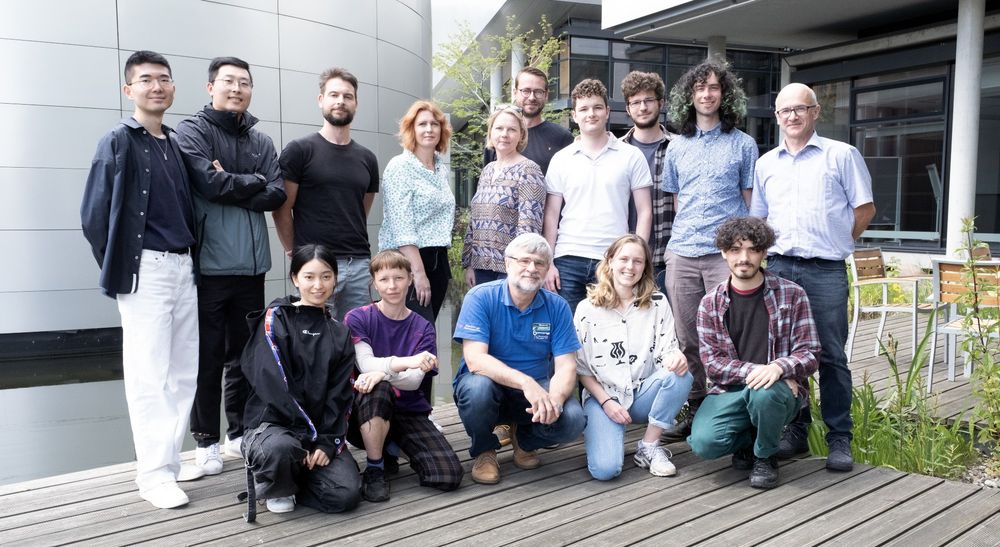
Hi Bluesky! We are the research group Brain Networks from the Max Planck Institute for Human Cognitive and Brain Sciences. We focus on Noninvasive Brain Stimulation, Neuronal Circuits, EEG Source Reconstruction and Artificial Intelligence. Follow us for research updates and events! 🧠🔬🦾
January 27, 2025 at 4:07 PM
Hi Bluesky! We are the research group Brain Networks from the Max Planck Institute for Human Cognitive and Brain Sciences. We focus on Noninvasive Brain Stimulation, Neuronal Circuits, EEG Source Reconstruction and Artificial Intelligence. Follow us for research updates and events! 🧠🔬🦾
Reposted by Zi-jian Feng (ZAKI)
Hello world! We are the Cognition and Plasticity (CoPla) lab @mpicbs.bsky.social in Leipzig, Germany. Our lab combines neuroimaging methods (like fMRI) with non-invasive brain stimulation (like TMS) to investigate plasticity in cognitive brain networks.

January 21, 2025 at 12:28 PM
Hello world! We are the Cognition and Plasticity (CoPla) lab @mpicbs.bsky.social in Leipzig, Germany. Our lab combines neuroimaging methods (like fMRI) with non-invasive brain stimulation (like TMS) to investigate plasticity in cognitive brain networks.
Reposted by Zi-jian Feng (ZAKI)
New publication from our lab! @sabrinaturker.bsky.social, @philkuhnke.bsky.social, @vincentcheung.bsky.social, Konstantin Weise and @gesahartwigsen.bsky.social show that neurostimulation can improve reading skills in dyslexia, mediated via functional coupling changes within the reading network.
Finally published! 🥳 New TMS-fMRI study led by @sabrinaturker.bsky.social shows that temporoparietal stimulation can alleviate dyslexia. This was associated with changes in effective connectivity between left IFG and the visual word form area: doi.org/10.1111/nyas...

NYAS Publications
The left temporo-parietal cortex is critical for phonological decoding during reading and appears hypoactive in dyslexia. Here, we combined facilitatory neurostimulation to this brain region with fun...
doi.org
February 2, 2025 at 1:36 PM
New publication from our lab! @sabrinaturker.bsky.social, @philkuhnke.bsky.social, @vincentcheung.bsky.social, Konstantin Weise and @gesahartwigsen.bsky.social show that neurostimulation can improve reading skills in dyslexia, mediated via functional coupling changes within the reading network.