


#architectureandenergy We calculate kWh - human labour as well as firewood, oil etc. - in our book www.routledge.com/9781032636542 . Buckminster Fuller spoke of "energy slaves" - the human labour equivalent of fossil fuel energy. Look at the great comic www.bfi.org/2018/09/28/b...

Form Follows Fuel: 14 Buildings from Antiquity to the Oil Age
Modernists believed that “form follows function.” Form Follows Fuel shows that in fact energy has been the biggest influence on the world’s architecture throughout the history of our species. The avai...
www.routledge.com
September 26, 2025 at 1:57 PM
#architectureandenergy We calculate kWh - human labour as well as firewood, oil etc. - in our book www.routledge.com/9781032636542 . Buckminster Fuller spoke of "energy slaves" - the human labour equivalent of fossil fuel energy. Look at the great comic www.bfi.org/2018/09/28/b...
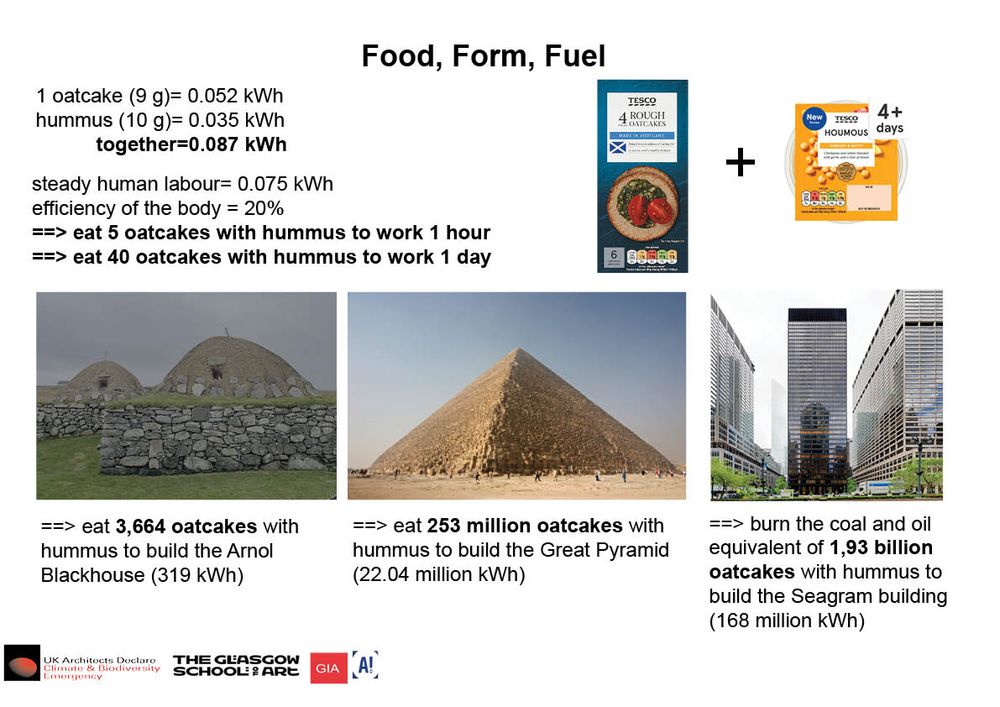
#architectureandenergy And apologies for not providing 253 million oatcakes with hummus at our opening event. We tried.
September 26, 2025 at 1:49 PM
#architectureandenergy And apologies for not providing 253 million oatcakes with hummus at our opening event. We tried.
#architectureandenergy Thanks to the 100+ people who joined our book launch event last night at the Glasgow School of Art! Well done Chloe and Kieran @architectsdeclare.bsky.social for organising this event, and thanks to @barnabascalder.bsky.social and www.instagram.com/john_joseph_...

September 26, 2025 at 1:46 PM
#architectureandenergy Thanks to the 100+ people who joined our book launch event last night at the Glasgow School of Art! Well done Chloe and Kieran @architectsdeclare.bsky.social for organising this event, and thanks to @barnabascalder.bsky.social and www.instagram.com/john_joseph_...
@architectureandenergy Please join us for our book presentation "Form Follows Fuel" on Thu 25 September 2025, 18:30 hrs, at the Glasgow School of Art, Reid Lecture Theatre.
Presentations by John Joseph Burns, Barnabas Calder, and Florian Urban
Free entry - please register with Eventbrite
Presentations by John Joseph Burns, Barnabas Calder, and Florian Urban
Free entry - please register with Eventbrite

September 13, 2025 at 9:30 AM
@architectureandenergy Please join us for our book presentation "Form Follows Fuel" on Thu 25 September 2025, 18:30 hrs, at the Glasgow School of Art, Reid Lecture Theatre.
Presentations by John Joseph Burns, Barnabas Calder, and Florian Urban
Free entry - please register with Eventbrite
Presentations by John Joseph Burns, Barnabas Calder, and Florian Urban
Free entry - please register with Eventbrite
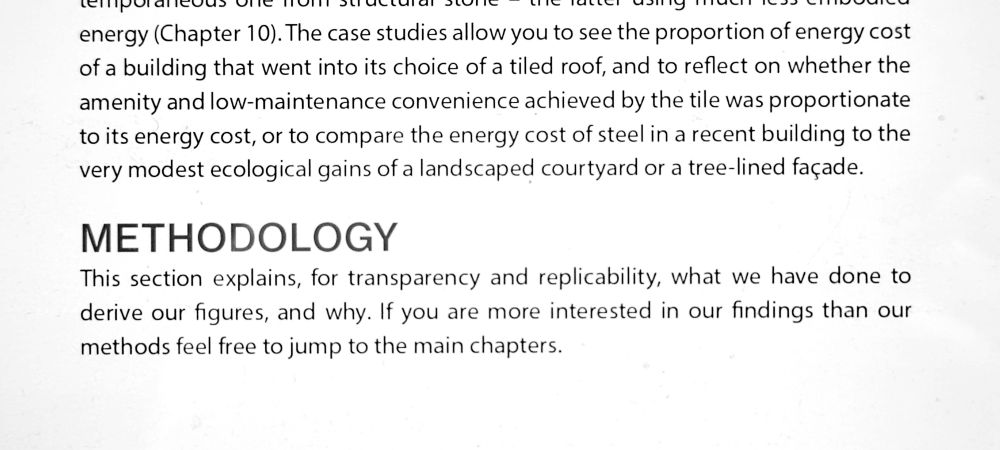
Not to blow our own trumpets, but I reckon more academic books could do with disclaimers like that with which @florianurban.bsky.social and I begin our methodology section.
#FormFollowsFuel
#ArchitectureAndEnergy
#FormFollowsFuel
#ArchitectureAndEnergy
July 7, 2025 at 6:31 AM
Not to blow our own trumpets, but I reckon more academic books could do with disclaimers like that with which @florianurban.bsky.social and I begin our methodology section.
#FormFollowsFuel
#ArchitectureAndEnergy
#FormFollowsFuel
#ArchitectureAndEnergy
#architectureandenergy Humans are weak. A lumberman working without machines had an output of about 0.135 kW per hour (Swedish study by Lundgren/Zotterman 1946). Compare this to 11.63 kWh in a kg of crude oil, which last year cost only US$0.61– the equivalent of about 86 hrs of hard labour.

March 24, 2025 at 9:38 AM
#architectureandenergy Humans are weak. A lumberman working without machines had an output of about 0.135 kW per hour (Swedish study by Lundgren/Zotterman 1946). Compare this to 11.63 kWh in a kg of crude oil, which last year cost only US$0.61– the equivalent of about 86 hrs of hard labour.
#architectureandenergy Look at the radiators behind single-glazed windows in Gropius’s much-celebrated 1926 Bauhaus building in Dessau, and check out the excellent analysis by @danielbarber.bsky.social why this beautiful building is not fit for purpose kleinmanenergy.upenn.edu/research/pub...

March 13, 2025 at 8:42 AM
#architectureandenergy Look at the radiators behind single-glazed windows in Gropius’s much-celebrated 1926 Bauhaus building in Dessau, and check out the excellent analysis by @danielbarber.bsky.social why this beautiful building is not fit for purpose kleinmanenergy.upenn.edu/research/pub...
#architectureandenergy
Please join me at the event "Eco-Brutalism" at the Farrell Centre in Newcastle on Wed 5/3/25 at 18.00 www.farrellcentre.org.uk/whats-on/eco...
and if you can't make it, check out the exhibit, online or in person!
Please join me at the event "Eco-Brutalism" at the Farrell Centre in Newcastle on Wed 5/3/25 at 18.00 www.farrellcentre.org.uk/whats-on/eco...
and if you can't make it, check out the exhibit, online or in person!

Eco-Brutalism - Farrell Centre
www.farrellcentre.org.uk
March 5, 2025 at 5:08 PM
#architectureandenergy
Please join me at the event "Eco-Brutalism" at the Farrell Centre in Newcastle on Wed 5/3/25 at 18.00 www.farrellcentre.org.uk/whats-on/eco...
and if you can't make it, check out the exhibit, online or in person!
Please join me at the event "Eco-Brutalism" at the Farrell Centre in Newcastle on Wed 5/3/25 at 18.00 www.farrellcentre.org.uk/whats-on/eco...
and if you can't make it, check out the exhibit, online or in person!
#architectureandenergy Happy to announce that our book "Form Follows Fuel" will be released in September 2025
www.amazon.co.uk/Form-Follows...
www.amazon.co.uk/Form-Follows...

March 4, 2025 at 10:00 AM
#architectureandenergy Happy to announce that our book "Form Follows Fuel" will be released in September 2025
www.amazon.co.uk/Form-Follows...
www.amazon.co.uk/Form-Follows...
#architectureandenergy What do the Khufu pyramid, the Arnol blackhouse on Lewis, the Baths of Caracalla, and the Great Temple in Tenochtitlan have in common? Not very much – except that they were all built without fossil fuel – and figure in our book “Form Follows Fuel” (Routledge, summer 2025).

February 20, 2025 at 11:15 AM
#architectureandenergy What do the Khufu pyramid, the Arnol blackhouse on Lewis, the Baths of Caracalla, and the Great Temple in Tenochtitlan have in common? Not very much – except that they were all built without fossil fuel – and figure in our book “Form Follows Fuel” (Routledge, summer 2025).
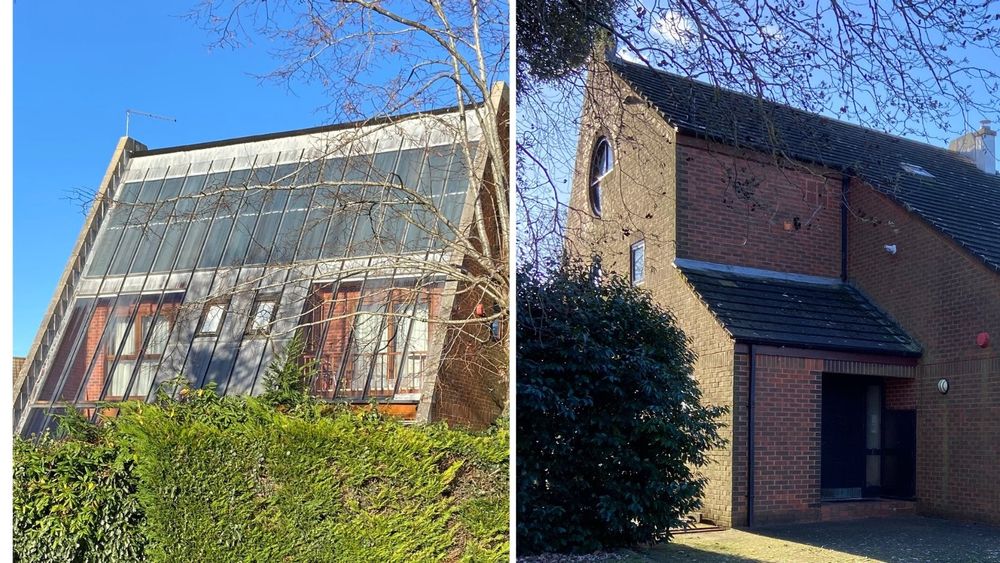
#architectureandenergy Futuristic front, neo-traditional back: the Solar House in Milton Keynes, (Dominic Michaelis, 1981), part of the Homeworld Exhibit. The glazed front saves energy through passive solar heating - the embodied energy of steel and glass was no concern.
February 10, 2025 at 7:13 AM
#architectureandenergy Futuristic front, neo-traditional back: the Solar House in Milton Keynes, (Dominic Michaelis, 1981), part of the Homeworld Exhibit. The glazed front saves energy through passive solar heating - the embodied energy of steel and glass was no concern.
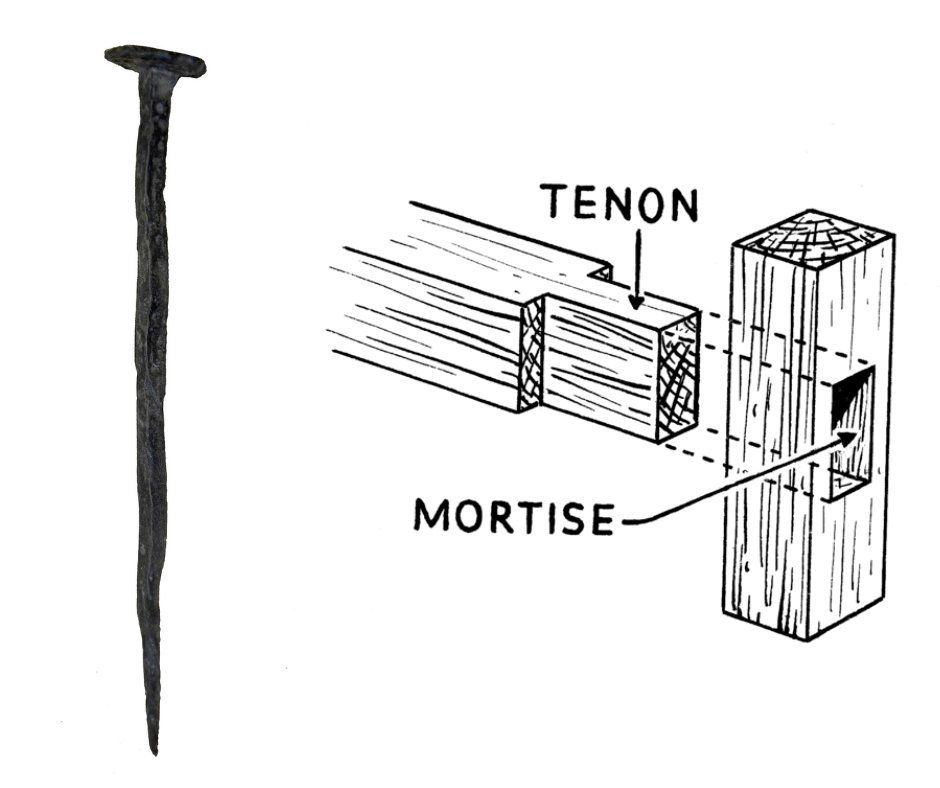
#architectureandenergy A single nail, 20 g of iron—in the 16th century it took at least 3.8 kWh in heat energy to produce it, the equivalent of the muscle energy a labourer spends in 50 hours of steady work. No wonder why builders rather opted for mortise-and-tenon joints.
January 7, 2025 at 7:02 AM
#architectureandenergy A single nail, 20 g of iron—in the 16th century it took at least 3.8 kWh in heat energy to produce it, the equivalent of the muscle energy a labourer spends in 50 hours of steady work. No wonder why builders rather opted for mortise-and-tenon joints.
#architectureandenergy Jianyeli, a 1930s lilong development in Shanghai, looks like a brick structure, but was in fact built on a structural timber frame, making sparse use of high-embodied-energy materials brick (thin walls, roof tiles) and concrete (floors, lintels).

January 7, 2025 at 7:01 AM
#architectureandenergy Jianyeli, a 1930s lilong development in Shanghai, looks like a brick structure, but was in fact built on a structural timber frame, making sparse use of high-embodied-energy materials brick (thin walls, roof tiles) and concrete (floors, lintels).
#architectureandenergy Fossil coal enabled scientific progress. Georgian glass panes, produced with cheap coal, were essential for well-lit interiors and thus for research, gatherings and discussion—as at the Royal College of Physicians, London, built ca. 1695.

January 7, 2025 at 7:00 AM
#architectureandenergy Fossil coal enabled scientific progress. Georgian glass panes, produced with cheap coal, were essential for well-lit interiors and thus for research, gatherings and discussion—as at the Royal College of Physicians, London, built ca. 1695.
#architectureandenergy Tenements from local materials, both built ca. 1890: brick in Berlin (left), where stone was unavailable, and sandstone in Glasgow. The use of stone led to much lower embodied energy per m2 in the Glasgow example—a model for future construction?

January 7, 2025 at 6:59 AM
#architectureandenergy Tenements from local materials, both built ca. 1890: brick in Berlin (left), where stone was unavailable, and sandstone in Glasgow. The use of stone led to much lower embodied energy per m2 in the Glasgow example—a model for future construction?
#architectureandenergy
@barnabascalder
Humans are weak. Their muscle power is about 0.6 kWh in 8 hrs, as much as 5 g of crude oil. And oil is still cheap –just $0.03 for 5 g.
No wonder why no one builds their house with muscle power any more, as people did on Lewis in 1875...
@barnabascalder
Humans are weak. Their muscle power is about 0.6 kWh in 8 hrs, as much as 5 g of crude oil. And oil is still cheap –just $0.03 for 5 g.
No wonder why no one builds their house with muscle power any more, as people did on Lewis in 1875...

November 27, 2024 at 9:53 PM
#architectureandenergy
@barnabascalder
Humans are weak. Their muscle power is about 0.6 kWh in 8 hrs, as much as 5 g of crude oil. And oil is still cheap –just $0.03 for 5 g.
No wonder why no one builds their house with muscle power any more, as people did on Lewis in 1875...
@barnabascalder
Humans are weak. Their muscle power is about 0.6 kWh in 8 hrs, as much as 5 g of crude oil. And oil is still cheap –just $0.03 for 5 g.
No wonder why no one builds their house with muscle power any more, as people did on Lewis in 1875...
#architectureandenergy What do the Khufu pyramid, the Arnol blackhouse on Lewis, the Baths of Caracalla, and the Templo Mayor in Tenochtitlan have in common? Not very much – except that they were all built without fossil fuel – and all figure in our book “Architecture and Fuel”

November 27, 2024 at 9:53 PM
#architectureandenergy What do the Khufu pyramid, the Arnol blackhouse on Lewis, the Baths of Caracalla, and the Templo Mayor in Tenochtitlan have in common? Not very much – except that they were all built without fossil fuel – and all figure in our book “Architecture and Fuel”
Digging into embodied energy in historic buildings:
@barnabascalder
and I proudly announce our co-authored book on #architectureandenergy, working title “Form Follows Fuel – 14 Buildings from Antiquity to the Present” (Routledge 2025). Follow us for sneak peeks
@barnabascalder
and I proudly announce our co-authored book on #architectureandenergy, working title “Form Follows Fuel – 14 Buildings from Antiquity to the Present” (Routledge 2025). Follow us for sneak peeks
November 27, 2024 at 9:52 PM
Digging into embodied energy in historic buildings:
@barnabascalder
and I proudly announce our co-authored book on #architectureandenergy, working title “Form Follows Fuel – 14 Buildings from Antiquity to the Present” (Routledge 2025). Follow us for sneak peeks
@barnabascalder
and I proudly announce our co-authored book on #architectureandenergy, working title “Form Follows Fuel – 14 Buildings from Antiquity to the Present” (Routledge 2025). Follow us for sneak peeks
My #books so far. Three more on the way, in various states of incompletion.
#architectureandenergy
#rawconcrete
#architectureandenergy
#rawconcrete

October 23, 2024 at 6:11 PM
My #books so far. Three more on the way, in various states of incompletion.
#architectureandenergy
#rawconcrete
#architectureandenergy
#rawconcrete