



Benedikt Wimmer
@bwmr.net
Using cryo-ET and light microscopy to study bacteria and how they help and hurt us.
PostDoc at the Jacobs-Wagner lab in Stanford. Previously at the Medalia Lab (Zurich) and Chlanda lab (Heidelberg). #teamtomo
PostDoc at the Jacobs-Wagner lab in Stanford. Previously at the Medalia Lab (Zurich) and Chlanda lab (Heidelberg). #teamtomo
All this and many more changes you can find in the published version here - in my (biased) opinion, it is worth a re-read even if you have seen the preprint!
www.nature.com/articles/s41...
And of course, all was only possible thanks to our great collaboration with @mizrahilab.bsky.social
(4/4)
www.nature.com/articles/s41...
And of course, all was only possible thanks to our great collaboration with @mizrahilab.bsky.social
(4/4)

Spatial constraints drive amylosome-mediated resistant starch degradation by Ruminococcus bromii in the human colon - Nature Communications
Here, combining structural, proteomics and biochemical analyses, the authors elucidate how the keystone gut bacterium Ruminococcus bromii assembles a specialized enzyme complex, the amylosome, to effi...
www.nature.com
December 1, 2025 at 7:45 PM
All this and many more changes you can find in the published version here - in my (biased) opinion, it is worth a re-read even if you have seen the preprint!
www.nature.com/articles/s41...
And of course, all was only possible thanks to our great collaboration with @mizrahilab.bsky.social
(4/4)
www.nature.com/articles/s41...
And of course, all was only possible thanks to our great collaboration with @mizrahilab.bsky.social
(4/4)
- We modelled the active sites of two substrate-specific amylosome enzymes and compared it to the bifunctional Amy16, to derive a structural hypothesis for the observed promiscuity.

December 1, 2025 at 7:45 PM
- We modelled the active sites of two substrate-specific amylosome enzymes and compared it to the bifunctional Amy16, to derive a structural hypothesis for the observed promiscuity.
- In collaboration with the Zeeman lab @ethz.ch we further characterized the products released by Amy16, a key enzyme in RS degradation. This revealed that Amy16 is a true bifunctional amylase and pullulanase, hydrolyzing both α(1,4)- and α(1,6)-linkages - supporting its key role in RS degradation.

December 1, 2025 at 7:45 PM
- In collaboration with the Zeeman lab @ethz.ch we further characterized the products released by Amy16, a key enzyme in RS degradation. This revealed that Amy16 is a true bifunctional amylase and pullulanase, hydrolyzing both α(1,4)- and α(1,6)-linkages - supporting its key role in RS degradation.
- We modelled all amylosome proteins detected in our proteomics sample using AlphaFold3 and built a model of amylosome distribution around the cell wall, matching nicely the densities we observed using cryo-ET.

December 1, 2025 at 7:45 PM
- We modelled all amylosome proteins detected in our proteomics sample using AlphaFold3 and built a model of amylosome distribution around the cell wall, matching nicely the densities we observed using cryo-ET.
I'm very happy that the peer-reviewed version of our work on the amazing amylosome is now out in @natcomms.nature.com
Through the review process, we could refine our manuscript in several important areas, for example: (1/4)
Through the review process, we could refine our manuscript in several important areas, for example: (1/4)
December 1, 2025 at 7:45 PM
I'm very happy that the peer-reviewed version of our work on the amazing amylosome is now out in @natcomms.nature.com
Through the review process, we could refine our manuscript in several important areas, for example: (1/4)
Through the review process, we could refine our manuscript in several important areas, for example: (1/4)
Reposted by Benedikt Wimmer

Segmented filamentous bacteria undergo a structural transition at their adhesive tip during unicellular to filament development https://www.biorxiv.org/content/10.1101/2025.04.09.647586v1
April 10, 2025 at 3:16 AM
Segmented filamentous bacteria undergo a structural transition at their adhesive tip during unicellular to filament development https://www.biorxiv.org/content/10.1101/2025.04.09.647586v1
Thanks Marten! With pytom-match-pick, getting the ribosome average ready for the rendering was a breeze! :)
April 4, 2025 at 11:39 AM
Thanks Marten! With pytom-match-pick, getting the ribosome average ready for the rendering was a breeze! :)
(5/5)
It was a particular pleasure to work with a multi-disciplinary and international team on this project, from the University of Zurich, Ben-Gurion University in Beer-Sheva and the University of Greifswald!
It was a particular pleasure to work with a multi-disciplinary and international team on this project, from the University of Zurich, Ben-Gurion University in Beer-Sheva and the University of Greifswald!
April 3, 2025 at 12:41 PM
(5/5)
It was a particular pleasure to work with a multi-disciplinary and international team on this project, from the University of Zurich, Ben-Gurion University in Beer-Sheva and the University of Greifswald!
It was a particular pleasure to work with a multi-disciplinary and international team on this project, from the University of Zurich, Ben-Gurion University in Beer-Sheva and the University of Greifswald!
(4/5)
By combining in-situ #cryoet and #proteomics, we could assemble an integrative model, which illustrates the remarkable architecture of the amylosome - the complex that allows R. bromii to act as keystone degrader in the gut microbiome.
By combining in-situ #cryoet and #proteomics, we could assemble an integrative model, which illustrates the remarkable architecture of the amylosome - the complex that allows R. bromii to act as keystone degrader in the gut microbiome.
April 3, 2025 at 12:41 PM
(4/5)
By combining in-situ #cryoet and #proteomics, we could assemble an integrative model, which illustrates the remarkable architecture of the amylosome - the complex that allows R. bromii to act as keystone degrader in the gut microbiome.
By combining in-situ #cryoet and #proteomics, we could assemble an integrative model, which illustrates the remarkable architecture of the amylosome - the complex that allows R. bromii to act as keystone degrader in the gut microbiome.
(3/5)
We wanted to understand, why it makes such a complicated assembly, and found through structural and biochemical analysis that two key enzymes act synergistically if they are bound in amylosome-like complexes. #proteomics revealed that this complex is enriched when needed.
We wanted to understand, why it makes such a complicated assembly, and found through structural and biochemical analysis that two key enzymes act synergistically if they are bound in amylosome-like complexes. #proteomics revealed that this complex is enriched when needed.
April 3, 2025 at 12:41 PM
(3/5)
We wanted to understand, why it makes such a complicated assembly, and found through structural and biochemical analysis that two key enzymes act synergistically if they are bound in amylosome-like complexes. #proteomics revealed that this complex is enriched when needed.
We wanted to understand, why it makes such a complicated assembly, and found through structural and biochemical analysis that two key enzymes act synergistically if they are bound in amylosome-like complexes. #proteomics revealed that this complex is enriched when needed.
(2/5)
Our gut microbiome is essential for our health, and it relies on dietary fiber to thrive. The nutrients in dietary fiber, however, are very hard to access. Only few bacterial species manage to do so!
Our subject, R. bromii, is one of them - by using an extracellular assembly called amylosome.
Our gut microbiome is essential for our health, and it relies on dietary fiber to thrive. The nutrients in dietary fiber, however, are very hard to access. Only few bacterial species manage to do so!
Our subject, R. bromii, is one of them - by using an extracellular assembly called amylosome.
April 3, 2025 at 12:41 PM
(2/5)
Our gut microbiome is essential for our health, and it relies on dietary fiber to thrive. The nutrients in dietary fiber, however, are very hard to access. Only few bacterial species manage to do so!
Our subject, R. bromii, is one of them - by using an extracellular assembly called amylosome.
Our gut microbiome is essential for our health, and it relies on dietary fiber to thrive. The nutrients in dietary fiber, however, are very hard to access. Only few bacterial species manage to do so!
Our subject, R. bromii, is one of them - by using an extracellular assembly called amylosome.
Check out part 2 of my PhD work out now on bioRxiv, in which we explore an amazing protein machinery from the human gut microbiome, the Ruminococcus bromii amylosome.
A short explainer below (1/5).
www.biorxiv.org/content/10.1...
#microbiology #microbiome #teamtomo
A short explainer below (1/5).
www.biorxiv.org/content/10.1...
#microbiology #microbiome #teamtomo
www.biorxiv.org
April 3, 2025 at 12:41 PM
Check out part 2 of my PhD work out now on bioRxiv, in which we explore an amazing protein machinery from the human gut microbiome, the Ruminococcus bromii amylosome.
A short explainer below (1/5).
www.biorxiv.org/content/10.1...
#microbiology #microbiome #teamtomo
A short explainer below (1/5).
www.biorxiv.org/content/10.1...
#microbiology #microbiome #teamtomo
Reposted by Benedikt Wimmer

We're running a monthly lab sustainability challenge for labs at @ethzurich.bsky.social and UZH - join in to complete 10-minute challenges to make your lab more sustainable! uzh.us3.list-manage.com/subscribe?u=...
GreenLabs Zurich
GreenLabs Zurich Email Forms
uzh.us3.list-manage.com
February 19, 2025 at 10:16 AM
We're running a monthly lab sustainability challenge for labs at @ethzurich.bsky.social and UZH - join in to complete 10-minute challenges to make your lab more sustainable! uzh.us3.list-manage.com/subscribe?u=...
You can find the plugin on napari-hub here: www.napari-hub.org/plugins/napa...
and the GitHub repository here: github.com/bwmr/napari-...
and the GitHub repository here: github.com/bwmr/napari-...
SegSelect - napari Plugin - Benedikt Wimmer
Select a connected component from a membrain-seg segmentation.
www.napari-hub.org
February 6, 2025 at 11:02 AM
You can find the plugin on napari-hub here: www.napari-hub.org/plugins/napa...
and the GitHub repository here: github.com/bwmr/napari-...
and the GitHub repository here: github.com/bwmr/napari-...
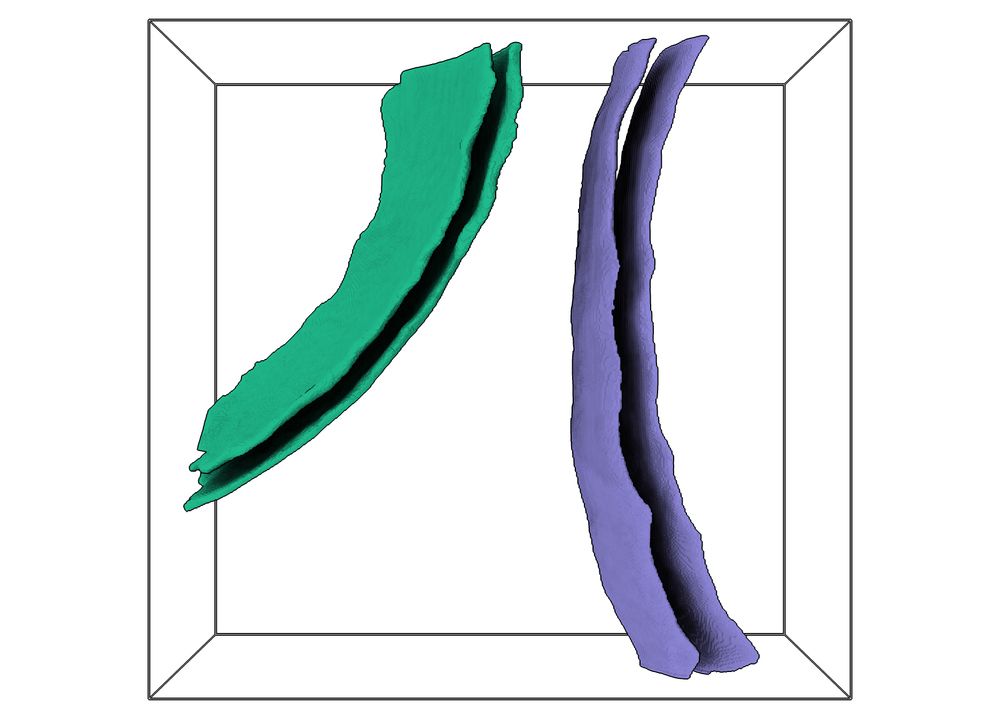
... which can then be written out as binary masks in the mrc format and visualized or used however you like:
February 6, 2025 at 11:02 AM
... which can then be written out as binary masks in the mrc format and visualized or used however you like:
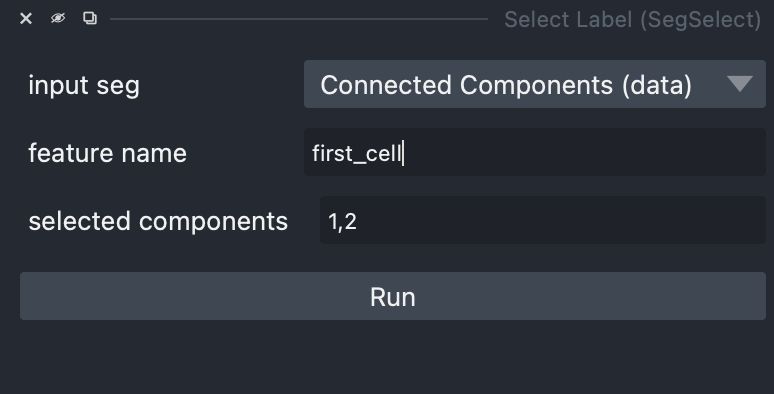
... and allows you to easily create labels containing only the IDs of interest.
February 6, 2025 at 11:02 AM
... and allows you to easily create labels containing only the IDs of interest.
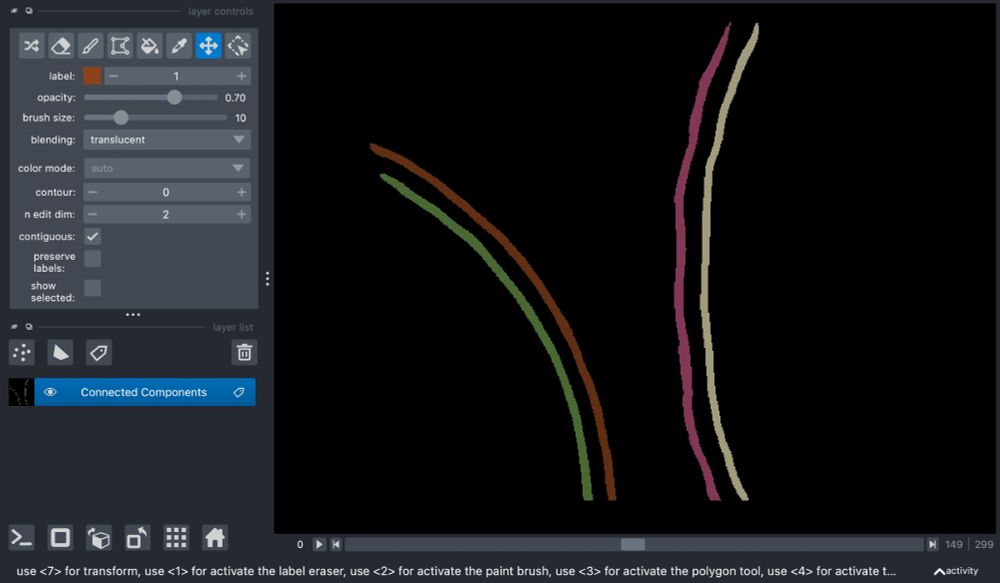
"napari-segselect" automatically opens the "*_segmented.mrc" files from membrain-seg as a label field...
February 6, 2025 at 11:02 AM
"napari-segselect" automatically opens the "*_segmented.mrc" files from membrain-seg as a label field...
If you want to split them up into individual segmentations, to assign different colors, or create masks for further processing, etc., membrain-seg has the flag "--store-connected-components", which assigns each connected volume a unique ID.
February 6, 2025 at 11:02 AM
If you want to split them up into individual segmentations, to assign different colors, or create masks for further processing, etc., membrain-seg has the flag "--store-connected-components", which assigns each connected volume a unique ID.
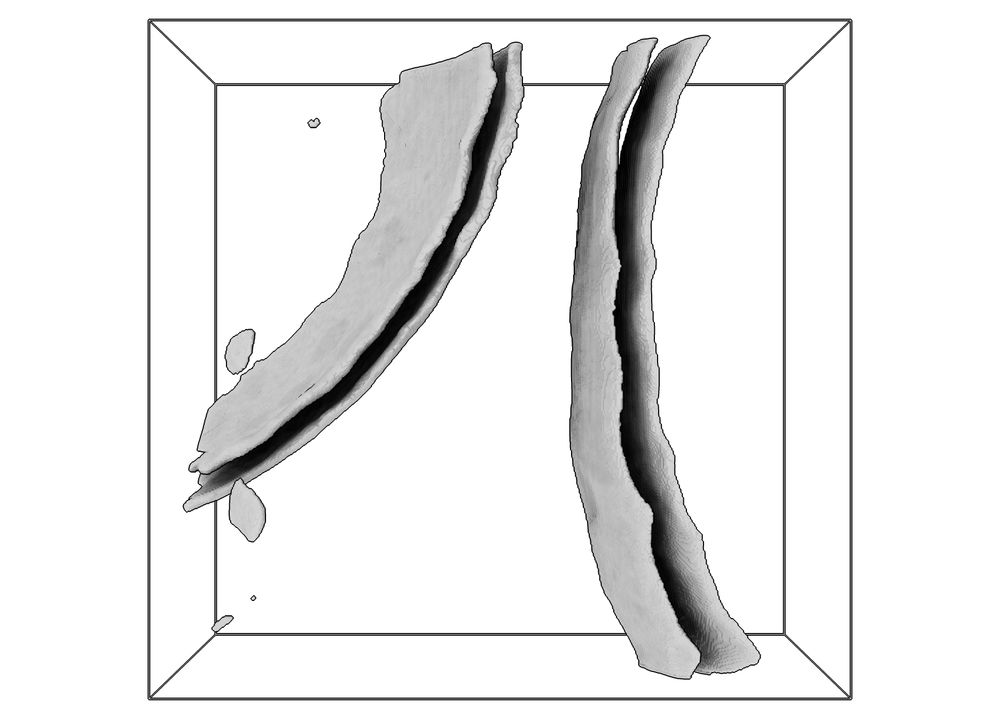
Hey #teamtomo, if you often find yourself using the excellent membrain-seg from @lorenzlamm.bsky.social et al., you might find my napari plugin "napari-segselect" useful. Let's say your tomogram contains the edges of two bacterial cells, each with a membrane and cell wall:
February 6, 2025 at 11:02 AM
Hey #teamtomo, if you often find yourself using the excellent membrain-seg from @lorenzlamm.bsky.social et al., you might find my napari plugin "napari-segselect" useful. Let's say your tomogram contains the edges of two bacterial cells, each with a membrane and cell wall: