



Casey Lewry
@caseylewry.bsky.social
PhD student at Princeton studying causal reasoning, moral judgments, and learning
lewry.princeton.edu
lewry.princeton.edu
Most existing research focuses on judgments of who or what caused inequality to exist. Far less examines how people decide who can or should help reduce it going forward.
We use this framework to organize existing findings, identify gaps, and provide guidance for future research.
We use this framework to organize existing findings, identify gaps, and provide guidance for future research.

January 6, 2026 at 7:57 PM
Most existing research focuses on judgments of who or what caused inequality to exist. Far less examines how people decide who can or should help reduce it going forward.
We use this framework to organize existing findings, identify gaps, and provide guidance for future research.
We use this framework to organize existing findings, identify gaps, and provide guidance for future research.
I am thrilled to announce that this framework is out!
Who is responsible for inequality?
@tanialombrozo.bsky.social and I show that answers depend on whether people are judging causes or obligations, and the past vs the future.
doi.org/10.1177/1745...
Who is responsible for inequality?
@tanialombrozo.bsky.social and I show that answers depend on whether people are judging causes or obligations, and the past vs the future.
doi.org/10.1177/1745...


January 6, 2026 at 7:57 PM
I am thrilled to announce that this framework is out!
Who is responsible for inequality?
@tanialombrozo.bsky.social and I show that answers depend on whether people are judging causes or obligations, and the past vs the future.
doi.org/10.1177/1745...
Who is responsible for inequality?
@tanialombrozo.bsky.social and I show that answers depend on whether people are judging causes or obligations, and the past vs the future.
doi.org/10.1177/1745...
Reposted by Casey Lewry
Congratulations, Dr. Francisco Cruz (@cruzf.bsky.social), on on an incredibly clear and comprehensive PhD dissertation on "The psychology of lay beliefs about science" as well as an engaging and thoughtful defense. And thank you for inviting me to be on your jury; I learned so much from your work!
December 19, 2025 at 6:28 PM
Congratulations, Dr. Francisco Cruz (@cruzf.bsky.social), on on an incredibly clear and comprehensive PhD dissertation on "The psychology of lay beliefs about science" as well as an engaging and thoughtful defense. And thank you for inviting me to be on your jury; I learned so much from your work!
I'll be at SPSSI in Portland this week presenting our latest work on voting behavior.
Come say hi!
Come say hi!

June 23, 2025 at 1:48 PM
I'll be at SPSSI in Portland this week presenting our latest work on voting behavior.
Come say hi!
Come say hi!
Reposted by Casey Lewry

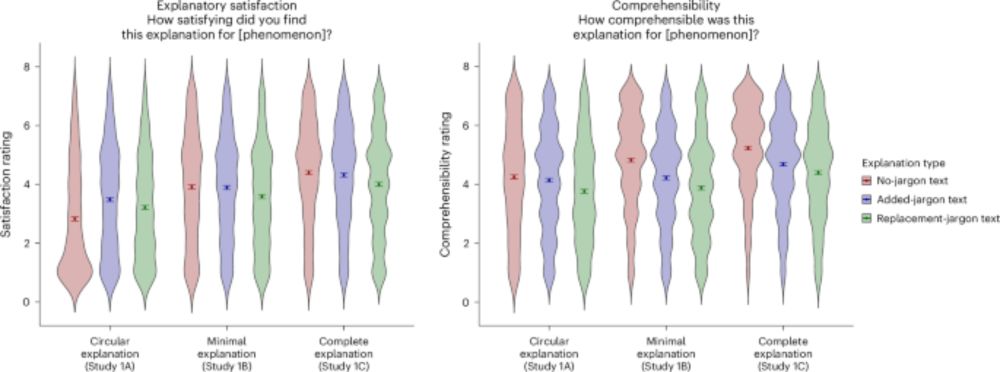
Across 9 experiments (+6600 participants), we explored a paradox: How do non-experts judge scientific explanations they can’t fully understand? We found that scientific jargon can increase people’s satisfaction with explanations, even though it makes them less comprehensible.
2/9
2/9
June 12, 2025 at 9:27 AM
Across 9 experiments (+6600 participants), we explored a paradox: How do non-experts judge scientific explanations they can’t fully understand? We found that scientific jargon can increase people’s satisfaction with explanations, even though it makes them less comprehensible.
2/9
2/9
Reposted by Casey Lewry
A special thanks to @tanialombrozo.bsky.social, my advisor, without whom this wouldn't be possible, for all the guidance and all she taught me!
And shout-out to my lab mates @keremoktar.bsky.social @caseylewry.bsky.social
Read more here: www.nature.com/articles/s41...
9/9
And shout-out to my lab mates @keremoktar.bsky.social @caseylewry.bsky.social
Read more here: www.nature.com/articles/s41...
9/9
How laypeople evaluate scientific explanations containing jargon - Nature Human Behaviour
Cruz and Lombrozo examine how laypeople make sense of scientific explanations and find that although jargon reduces understanding, for short explanations, jargon makes the explanation more satisfying.
www.nature.com
June 12, 2025 at 9:32 AM
A special thanks to @tanialombrozo.bsky.social, my advisor, without whom this wouldn't be possible, for all the guidance and all she taught me!
And shout-out to my lab mates @keremoktar.bsky.social @caseylewry.bsky.social
Read more here: www.nature.com/articles/s41...
9/9
And shout-out to my lab mates @keremoktar.bsky.social @caseylewry.bsky.social
Read more here: www.nature.com/articles/s41...
9/9
May 21, 2025 at 2:09 PM
🎊 New preprint 🎊 w/ Tania Lombrozo
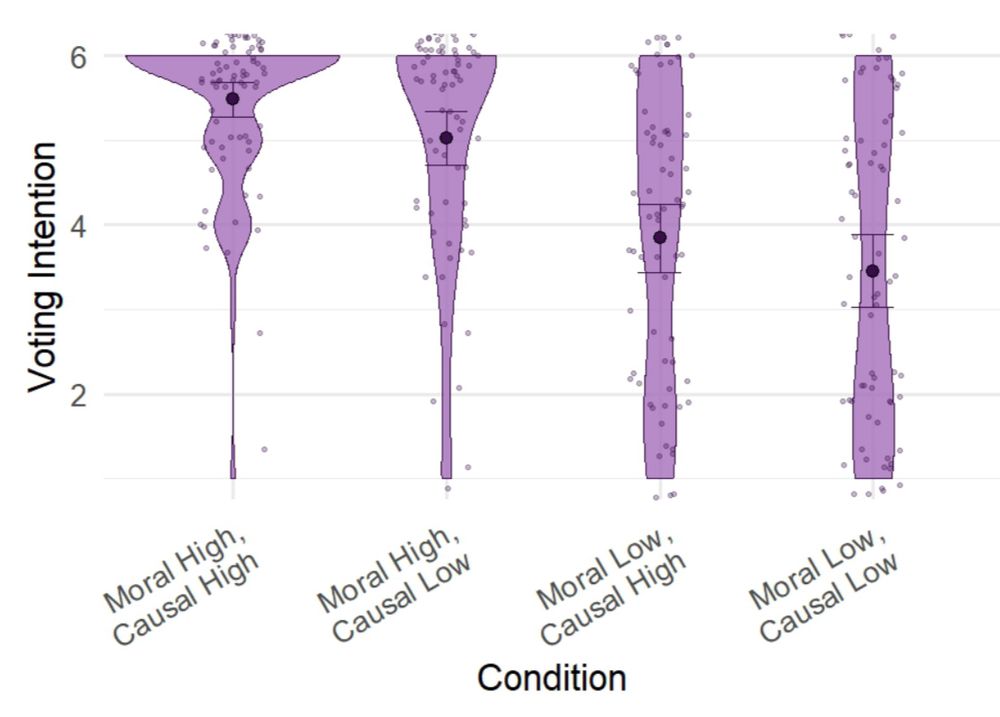
Why do people engage in collective actions, even when they believe their actions won't make a difference?
Based on evidence from the 2024 election and a hypothetical election, we find that *moral* responsibility, not causal, drives voting
osf.io/preprints/ps...
Why do people engage in collective actions, even when they believe their actions won't make a difference?
Based on evidence from the 2024 election and a hypothetical election, we find that *moral* responsibility, not causal, drives voting
osf.io/preprints/ps...
May 21, 2025 at 2:09 PM
🎊 New preprint 🎊 w/ Tania Lombrozo
Why do people engage in collective actions, even when they believe their actions won't make a difference?
Based on evidence from the 2024 election and a hypothetical election, we find that *moral* responsibility, not causal, drives voting
osf.io/preprints/ps...
Why do people engage in collective actions, even when they believe their actions won't make a difference?
Based on evidence from the 2024 election and a hypothetical election, we find that *moral* responsibility, not causal, drives voting
osf.io/preprints/ps...
Thanks for having me and for all the great feedback! Still thinking about the retrospective moral-causal distinction :)
May 12, 2025 at 10:22 PM
Thanks for having me and for all the great feedback! Still thinking about the retrospective moral-causal distinction :)
Reposted by Casey Lewry

Related work: onlinelibrary.wiley.com/doi/10.1111/...

Lay Theories of Moral Progress
Many consider the world to be morally better today than it was in the past and expect moral improvement to continue. How do people explain what drives this change? In this paper, we identify two ways...
onlinelibrary.wiley.com
May 12, 2025 at 8:16 PM
Related work: onlinelibrary.wiley.com/doi/10.1111/...
Reposted by Casey Lewry
Thanks @caseylewry.bsky.social for sharing your work with us on how "Moral responsibility, not causal responsibility, drives voting: Evidence from the 2024 US presidential election".
Casey finds that people who believe that moral progress is caused by human actions were more likely to vote.
Casey finds that people who believe that moral progress is caused by human actions were more likely to vote.

May 12, 2025 at 8:16 PM
Thanks @caseylewry.bsky.social for sharing your work with us on how "Moral responsibility, not causal responsibility, drives voting: Evidence from the 2024 US presidential election".
Casey finds that people who believe that moral progress is caused by human actions were more likely to vote.
Casey finds that people who believe that moral progress is caused by human actions were more likely to vote.
Do you want there to be more funding to do research related to climate action? 🌎
I'm working with XPRIZE to make this happen - fill out this survey so we can figure out how to help researchers like you (and enter to win a $50 gift card)
princetonsurvey.az1.qualtrics.com/jfe/form/SV_...
I'm working with XPRIZE to make this happen - fill out this survey so we can figure out how to help researchers like you (and enter to win a $50 gift card)
princetonsurvey.az1.qualtrics.com/jfe/form/SV_...
March 3, 2025 at 10:18 PM
Do you want there to be more funding to do research related to climate action? 🌎
I'm working with XPRIZE to make this happen - fill out this survey so we can figure out how to help researchers like you (and enter to win a $50 gift card)
princetonsurvey.az1.qualtrics.com/jfe/form/SV_...
I'm working with XPRIZE to make this happen - fill out this survey so we can figure out how to help researchers like you (and enter to win a $50 gift card)
princetonsurvey.az1.qualtrics.com/jfe/form/SV_...