



Doby Rahnev
@dobyrahnev.bsky.social
Perceptual decision making, visual metacognition, computational cognition, cognitive neuroscience, neuroAI. Associate professor at Georgia Tech. Director of Computations of Subjective Perception lab: https://rahnevlab.gatech.edu
Pinned
Doby Rahnev
@dobyrahnev.bsky.social
· Jan 16
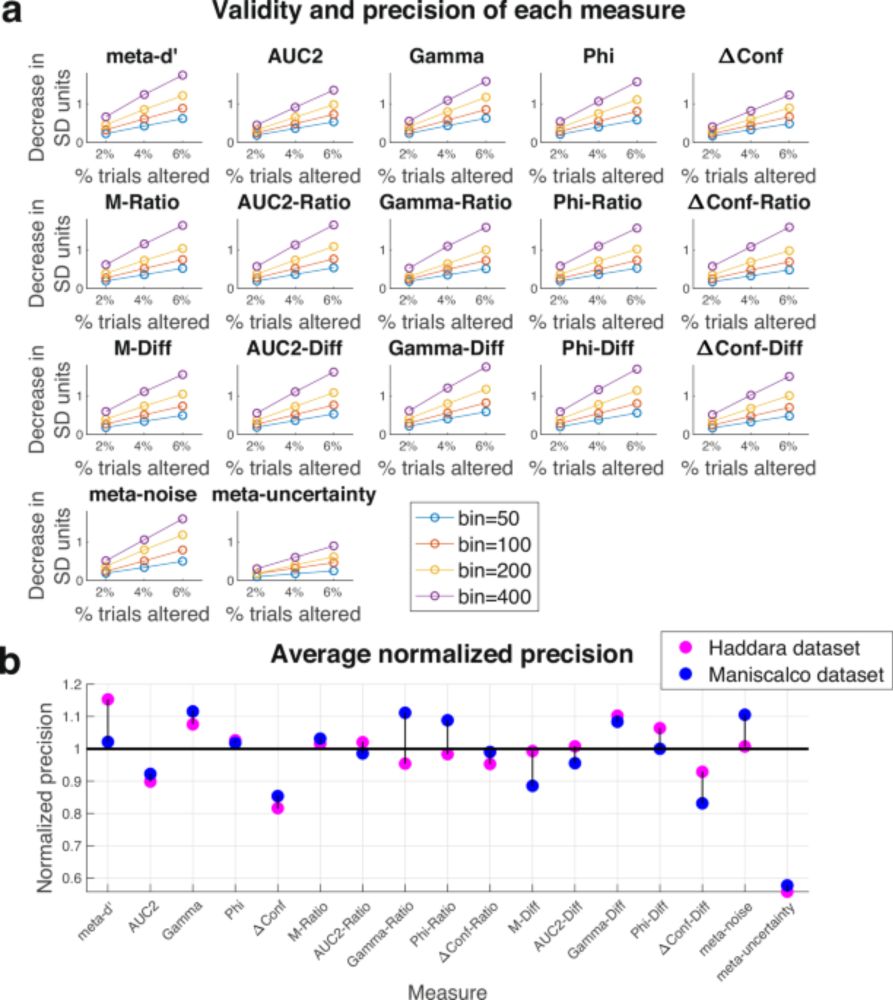
A comprehensive assessment of current methods for measuring metacognition - Nature Communications
Measuring metacognitive ability is one of the enduring challenges in cognitive science. The current paper develops formal tests of the quality of different measures and assesses how current metrics pe...
www.nature.com
My article "A comprehensive assessment of current methods for measuring metacognition" is finally out in Nature Communications 🎉 If you work on metacognition and think you know the psychometric properties of your favorite measure, you may be surprised.
www.nature.com/articles/s41...
www.nature.com/articles/s41...
Reposted by Doby Rahnev

a while back i threatened to share this. finally online
for detection tasks we often systematically estimates sensitivity wrong. we need to control for unequal variance in models, but we often don't coz it needs extra data
now there's a virtually 'free' way to do it
www.cell.com/iscience/pdf...
for detection tasks we often systematically estimates sensitivity wrong. we need to control for unequal variance in models, but we often don't coz it needs extra data
now there's a virtually 'free' way to do it
www.cell.com/iscience/pdf...
www.cell.com
February 13, 2026 at 3:39 AM
a while back i threatened to share this. finally online
for detection tasks we often systematically estimates sensitivity wrong. we need to control for unequal variance in models, but we often don't coz it needs extra data
now there's a virtually 'free' way to do it
www.cell.com/iscience/pdf...
for detection tasks we often systematically estimates sensitivity wrong. we need to control for unequal variance in models, but we often don't coz it needs extra data
now there's a virtually 'free' way to do it
www.cell.com/iscience/pdf...
Turns out that individual differences in accuracy, confidence, and RT among ANNs that only differ in their random initialization mimic the individual differences in humans.
It may be time for NeuroAI to take individual differences even more seriously.
Check out Herrick's thread 👇
It may be time for NeuroAI to take individual differences even more seriously.
Check out Herrick's thread 👇
🚨 New preprint on individual differences in artificial neural networks and human behavior.
We show that individual differences among ANN instances trained with different random initializations capture the individual differences in human behavior.
1/8
We show that individual differences among ANN instances trained with different random initializations capture the individual differences in human behavior.
1/8
www.biorxiv.org
February 12, 2026 at 2:20 PM
Turns out that individual differences in accuracy, confidence, and RT among ANNs that only differ in their random initialization mimic the individual differences in humans.
It may be time for NeuroAI to take individual differences even more seriously.
Check out Herrick's thread 👇
It may be time for NeuroAI to take individual differences even more seriously.
Check out Herrick's thread 👇
Reposted by Doby Rahnev

🚨 New preprint on individual differences in artificial neural networks and human behavior.
We show that individual differences among ANN instances trained with different random initializations capture the individual differences in human behavior.
1/8
We show that individual differences among ANN instances trained with different random initializations capture the individual differences in human behavior.
1/8
www.biorxiv.org
February 12, 2026 at 2:00 PM
🚨 New preprint on individual differences in artificial neural networks and human behavior.
We show that individual differences among ANN instances trained with different random initializations capture the individual differences in human behavior.
1/8
We show that individual differences among ANN instances trained with different random initializations capture the individual differences in human behavior.
1/8
How do you know how visual stimuli are represented internally for decision making? This is perhaps the central question in perceptual decision making. In a new paper, we show that one can use artificial neural networks to crack this problem. #NeuroAi #VisionScience
direct.mit.edu/opmi/article...
direct.mit.edu/opmi/article...

Using Artificial Neural Networks to Relate External Sensory Features to Internal Decisional Evidence
Abstract. All theories of perceptual decision-making postulate that external sensory information is transformed into the internal evidence that is used to judge the identity of the stimulus. However, ...
direct.mit.edu
February 5, 2026 at 3:01 PM
How do you know how visual stimuli are represented internally for decision making? This is perhaps the central question in perceptual decision making. In a new paper, we show that one can use artificial neural networks to crack this problem. #NeuroAi #VisionScience
direct.mit.edu/opmi/article...
direct.mit.edu/opmi/article...
How do people compute a sense of confidence? This question is usually addressed using very simple images because we don't know how complex stimuli are represented internally. In a new paper, we addressed this question using artificial neural networks (ANNs).
journals.plos.org/ploscompbiol...
journals.plos.org/ploscompbiol...

Using artificial neural networks to reveal the human confidence computation
Author summary Human decisions are accompanied by a sense of confidence which reflects the decision accuracy. Conventionally, human confidence has been studied using two-choice tasks with simple stimu...
journals.plos.org
January 26, 2026 at 7:18 PM
How do people compute a sense of confidence? This question is usually addressed using very simple images because we don't know how complex stimuli are represented internally. In a new paper, we addressed this question using artificial neural networks (ANNs).
journals.plos.org/ploscompbiol...
journals.plos.org/ploscompbiol...
Reposted by Doby Rahnev
It won't actually exist for another month or so, but because it now 'exists' on amazon, I'll humbly observe that, after working through this book, your student/trainee would be able to read and understand all but two or three papers in this week's J. Neurosci. Check it out:

January 16, 2026 at 10:38 PM
It won't actually exist for another month or so, but because it now 'exists' on amazon, I'll humbly observe that, after working through this book, your student/trainee would be able to read and understand all but two or three papers in this week's J. Neurosci. Check it out:
New preprint: Confidence-accuracy dissociations in perceptual decision making. A review I was supposed to write 3 years ago for my VSS Young Investigator Award. Better late than never 😅 I tried to organize the literature and explore the likely mechanisms. Feedback welcome!
osf.io/preprints/ps...
osf.io/preprints/ps...
OSF
osf.io
January 13, 2026 at 6:13 PM
New preprint: Confidence-accuracy dissociations in perceptual decision making. A review I was supposed to write 3 years ago for my VSS Young Investigator Award. Better late than never 😅 I tried to organize the literature and explore the likely mechanisms. Feedback welcome!
osf.io/preprints/ps...
osf.io/preprints/ps...
Reposted by Doby Rahnev
New paper: Transcranial Focused Ultrasound for Identifying the Neural Substrate of Conscious Perception. With Dan Freeman, @brianodegaard.bsky.social, and Seung-Schik Yoo. www.sciencedirect.com/science/arti...

Transcranial Focused Ultrasound for Identifying the Neural Substrate of Conscious Perception
Identifying what aspects of brain activity are responsible for conscious perception remains one of the most challenging problems in science. While pro…
www.sciencedirect.com
November 22, 2025 at 4:03 PM
New paper: Transcranial Focused Ultrasound for Identifying the Neural Substrate of Conscious Perception. With Dan Freeman, @brianodegaard.bsky.social, and Seung-Schik Yoo. www.sciencedirect.com/science/arti...
Reposted by Doby Rahnev
No two humans behave exactly alike. But what about neural networks? We found early evidence that human-like individual differences in behavior emerge from networks trained with different initializations. Here’s a peek at our results—to be presented at UniReps & DBM @NeurIPS. Full paper on the way!

Human-like individual differences emerge from random weight initializations in neural networks
Much of AI research targets the behavior of an average human, a focus that traces to Turing's imitation game. Yet, no two human individuals behave exactly alike. In this study, we show that artificial...
www.biorxiv.org
October 26, 2025 at 11:39 PM
No two humans behave exactly alike. But what about neural networks? We found early evidence that human-like individual differences in behavior emerge from networks trained with different initializations. Here’s a peek at our results—to be presented at UniReps & DBM @NeurIPS. Full paper on the way!
Reposted by Doby Rahnev

My lab at Boston University has open positions for a postdoc and PhD students. We study visual perception, attention, and decision making with a focus on temporal dynamics. Check out our recent work here sites.bu.edu/denisonlab/ and email me if you're interested in learning more

November 5, 2025 at 2:05 PM
My lab at Boston University has open positions for a postdoc and PhD students. We study visual perception, attention, and decision making with a focus on temporal dynamics. Check out our recent work here sites.bu.edu/denisonlab/ and email me if you're interested in learning more
Reposted by Doby Rahnev
📣 BIG NEWS EVERYONE. I am so excited to announce…
🎉 I’m moving to University College London @ucl.ac.uk to join the Experimental Psychology department in @uclpals.bsky.social! 🎉
The big move happens in spring/summer. So I’m already exploring recruiting staff & students at UCL for fall 2026!
🎉 I’m moving to University College London @ucl.ac.uk to join the Experimental Psychology department in @uclpals.bsky.social! 🎉
The big move happens in spring/summer. So I’m already exploring recruiting staff & students at UCL for fall 2026!
October 13, 2025 at 4:29 PM
📣 BIG NEWS EVERYONE. I am so excited to announce…
🎉 I’m moving to University College London @ucl.ac.uk to join the Experimental Psychology department in @uclpals.bsky.social! 🎉
The big move happens in spring/summer. So I’m already exploring recruiting staff & students at UCL for fall 2026!
🎉 I’m moving to University College London @ucl.ac.uk to join the Experimental Psychology department in @uclpals.bsky.social! 🎉
The big move happens in spring/summer. So I’m already exploring recruiting staff & students at UCL for fall 2026!
It looks like stimulus manipulations can be divided into "task-defining" and "auxiliary". The manipulations from each group have very different effects on accuracy vs. confidence. And all auxiliary manipulations seem to work in basically the same way. Really cool stuff by @herrickfung.bsky.social.
Glad to see my first-year project is out!
In two experiments, we manipulated multiple stimulus features in a perception task, yet their effects on confidence and accuracy fell into just two distinct behavioral patterns, offering a way to predict the effects of novel stimulus manipulations.
1/n
In two experiments, we manipulated multiple stimulus features in a perception task, yet their effects on confidence and accuracy fell into just two distinct behavioral patterns, offering a way to predict the effects of novel stimulus manipulations.
1/n

Similarities and differences in the effects of different stimulus manipulations on accuracy and confidence
Visual stimuli can vary in multiple dimensions that affect accuracy and confidence in a perceptual decision-making task. However, previous studies hav…
www.sciencedirect.com
October 13, 2025 at 12:09 PM
It looks like stimulus manipulations can be divided into "task-defining" and "auxiliary". The manipulations from each group have very different effects on accuracy vs. confidence. And all auxiliary manipulations seem to work in basically the same way. Really cool stuff by @herrickfung.bsky.social.
Reposted by Doby Rahnev
Glad to see my first-year project is out!
In two experiments, we manipulated multiple stimulus features in a perception task, yet their effects on confidence and accuracy fell into just two distinct behavioral patterns, offering a way to predict the effects of novel stimulus manipulations.
1/n
In two experiments, we manipulated multiple stimulus features in a perception task, yet their effects on confidence and accuracy fell into just two distinct behavioral patterns, offering a way to predict the effects of novel stimulus manipulations.
1/n
Similarities and differences in the effects of different stimulus manipulations on accuracy and confidence
Visual stimuli can vary in multiple dimensions that affect accuracy and confidence in a perceptual decision-making task. However, previous studies hav…
www.sciencedirect.com
October 12, 2025 at 4:10 PM
Glad to see my first-year project is out!
In two experiments, we manipulated multiple stimulus features in a perception task, yet their effects on confidence and accuracy fell into just two distinct behavioral patterns, offering a way to predict the effects of novel stimulus manipulations.
1/n
In two experiments, we manipulated multiple stimulus features in a perception task, yet their effects on confidence and accuracy fell into just two distinct behavioral patterns, offering a way to predict the effects of novel stimulus manipulations.
1/n
Reposted by Doby Rahnev
World models are a highly speculative topic in AI as well as in cognitive science. I’m excited to share my manuscript on investigating internal world models using imagination networks in humans and LLMs! 🧵1/n
arxiv.org/abs/2510.04391
arxiv.org/abs/2510.04391

Internal World Models as Imagination Networks in Cognitive Agents
What is the computational objective of imagination? While classical interpretations suggest imagination is useful for maximizing rewards, recent findings challenge this view. In this study, we propose...
arxiv.org
October 7, 2025 at 2:01 PM
World models are a highly speculative topic in AI as well as in cognitive science. I’m excited to share my manuscript on investigating internal world models using imagination networks in humans and LLMs! 🧵1/n
arxiv.org/abs/2510.04391
arxiv.org/abs/2510.04391
Reposted by Doby Rahnev
Introducing hMFC: A Bayesian hierarchical model of trial-to-trial fluctuations in decision criterion! Now out in @plos.org Comp Bio.
led by Robin Vloeberghs with @anne-urai.bsky.social Scott Linderman
Paper: desenderlab.com/wp-content/u... Thread ↓↓↓
#PsychSciSky #Neuroscience #Neuroskyence
led by Robin Vloeberghs with @anne-urai.bsky.social Scott Linderman
Paper: desenderlab.com/wp-content/u... Thread ↓↓↓
#PsychSciSky #Neuroscience #Neuroskyence
September 25, 2025 at 9:13 AM
Introducing hMFC: A Bayesian hierarchical model of trial-to-trial fluctuations in decision criterion! Now out in @plos.org Comp Bio.
led by Robin Vloeberghs with @anne-urai.bsky.social Scott Linderman
Paper: desenderlab.com/wp-content/u... Thread ↓↓↓
#PsychSciSky #Neuroscience #Neuroskyence
led by Robin Vloeberghs with @anne-urai.bsky.social Scott Linderman
Paper: desenderlab.com/wp-content/u... Thread ↓↓↓
#PsychSciSky #Neuroscience #Neuroskyence
Do you ever compute d' in detection tasks? Because of unequal variance, d' is biased in such tasks and you can't fix the bias without confidence ratings. In this preprint led by Kiyo Miyoshi and @hakwan.bsky.social, we show how to use RT instead of confidence to fix the d'.
osf.io/preprints/ps...
osf.io/preprints/ps...
OSF
osf.io
September 25, 2025 at 7:57 PM
Do you ever compute d' in detection tasks? Because of unequal variance, d' is biased in such tasks and you can't fix the bias without confidence ratings. In this preprint led by Kiyo Miyoshi and @hakwan.bsky.social, we show how to use RT instead of confidence to fix the d'.
osf.io/preprints/ps...
osf.io/preprints/ps...
Our work showing human-like individual differences in perceptual decisions emerge from random weight initializations in deep neural networks has been accepted in two NeurIPS workshops! 🎉 Awesome job by my student @herrickfung.bsky.social in collaboration with the amazing @apurvaratan.bsky.social.
September 23, 2025 at 2:09 PM
Our work showing human-like individual differences in perceptual decisions emerge from random weight initializations in deep neural networks has been accepted in two NeurIPS workshops! 🎉 Awesome job by my student @herrickfung.bsky.social in collaboration with the amazing @apurvaratan.bsky.social.
Reposted by Doby Rahnev
Common neural choice signals reflect accumulated evidence, not confidence! Now out in @cerebralcortex.bsky.social w @helenevanmarcke.bsky.social @pierreledenmat.bsky.social @yfvisser.bsky.social @denizerdil.bsky.social a.o.
Paper: desenderlab.com/wp-content/u... Thread ↓↓↓
Paper: desenderlab.com/wp-content/u... Thread ↓↓↓
September 19, 2025 at 10:47 AM
Common neural choice signals reflect accumulated evidence, not confidence! Now out in @cerebralcortex.bsky.social w @helenevanmarcke.bsky.social @pierreledenmat.bsky.social @yfvisser.bsky.social @denizerdil.bsky.social a.o.
Paper: desenderlab.com/wp-content/u... Thread ↓↓↓
Paper: desenderlab.com/wp-content/u... Thread ↓↓↓
Want to exclude a study from a review or meta-analysis because you don't like it but don't have an objective reason for the exclusion? Fear not. Here's the paper you need to cite.

September 9, 2025 at 12:50 PM
Want to exclude a study from a review or meta-analysis because you don't like it but don't have an objective reason for the exclusion? Fear not. Here's the paper you need to cite.
New lab preprint led by Medha Shekhar in collaboration with @axc.bsky.social. We investigate what drives confidence in decisions of real-world complexity (perception and memory questions about short videos). It turns out confidence is influenced by so many factors!
osf.io/preprints/ps...
osf.io/preprints/ps...
OSF
osf.io
August 14, 2025 at 1:31 PM
New lab preprint led by Medha Shekhar in collaboration with @axc.bsky.social. We investigate what drives confidence in decisions of real-world complexity (perception and memory questions about short videos). It turns out confidence is influenced by so many factors!
osf.io/preprints/ps...
osf.io/preprints/ps...
Reposted by Doby Rahnev
Super excited to kickstart our Metacognitive science satellite meeting, just before the CCN conference in Amsterdam! Organised with @dobyrahnev.bsky.social @meganakpeters.bsky.social and @stvemillertime.bsky.social

August 11, 2025 at 9:41 AM
Super excited to kickstart our Metacognitive science satellite meeting, just before the CCN conference in Amsterdam! Organised with @dobyrahnev.bsky.social @meganakpeters.bsky.social and @stvemillertime.bsky.social
Reposted by Doby Rahnev

1/3) This may be a very important paper, it suggests that there are no prediction error encoding neurons in sensory areas of cortex:
www.biorxiv.org/content/10.1...
I personally am a big fan of the idea that cortical regions (allo and neo) are doing sequence prediction.
But...
🧠📈 🧪
www.biorxiv.org/content/10.1...
I personally am a big fan of the idea that cortical regions (allo and neo) are doing sequence prediction.
But...
🧠📈 🧪

Sensory responses of visual cortical neurons are not prediction errors
Predictive coding is theorized to be a ubiquitous cortical process to explain sensory responses. It asserts that the brain continuously predicts sensory information and imposes those predictions on lo...
www.biorxiv.org
July 11, 2025 at 3:45 PM
1/3) This may be a very important paper, it suggests that there are no prediction error encoding neurons in sensory areas of cortex:
www.biorxiv.org/content/10.1...
I personally am a big fan of the idea that cortical regions (allo and neo) are doing sequence prediction.
But...
🧠📈 🧪
www.biorxiv.org/content/10.1...
I personally am a big fan of the idea that cortical regions (allo and neo) are doing sequence prediction.
But...
🧠📈 🧪
This is promising to be a very exciting event. If you're going to CCN or just want an excuse to come to Amsterdam, make sure to check it out.
Still time to register for our Metacognitive Science satellite at @cogcompneuro.bsky.social on 11th August!
metacognitivescience.org
We have an exciting lineup covering computational, neural and AI approaches to metacognition, plus keynotes from Uta Noppeney and @ingmarposner.bsky.social 🥳
metacognitivescience.org
We have an exciting lineup covering computational, neural and AI approaches to metacognition, plus keynotes from Uta Noppeney and @ingmarposner.bsky.social 🥳
Home
This satellite meeting showcases the latest research on metacognition, in the form of both keynotes and short oral presentations.
About this meeting
The Metacognitive Science Meeting grew out of an ...
metacognitivescience.org
July 28, 2025 at 12:36 PM
This is promising to be a very exciting event. If you're going to CCN or just want an excuse to come to Amsterdam, make sure to check it out.
Reposted by Doby Rahnev
Still time to register for our Metacognitive Science satellite at @cogcompneuro.bsky.social on 11th August!
metacognitivescience.org
We have an exciting lineup covering computational, neural and AI approaches to metacognition, plus keynotes from Uta Noppeney and @ingmarposner.bsky.social 🥳
metacognitivescience.org
We have an exciting lineup covering computational, neural and AI approaches to metacognition, plus keynotes from Uta Noppeney and @ingmarposner.bsky.social 🥳
Home
This satellite meeting showcases the latest research on metacognition, in the form of both keynotes and short oral presentations.
About this meeting
The Metacognitive Science Meeting grew out of an ...
metacognitivescience.org
July 28, 2025 at 10:56 AM
Still time to register for our Metacognitive Science satellite at @cogcompneuro.bsky.social on 11th August!
metacognitivescience.org
We have an exciting lineup covering computational, neural and AI approaches to metacognition, plus keynotes from Uta Noppeney and @ingmarposner.bsky.social 🥳
metacognitivescience.org
We have an exciting lineup covering computational, neural and AI approaches to metacognition, plus keynotes from Uta Noppeney and @ingmarposner.bsky.social 🥳
Reposted by Doby Rahnev

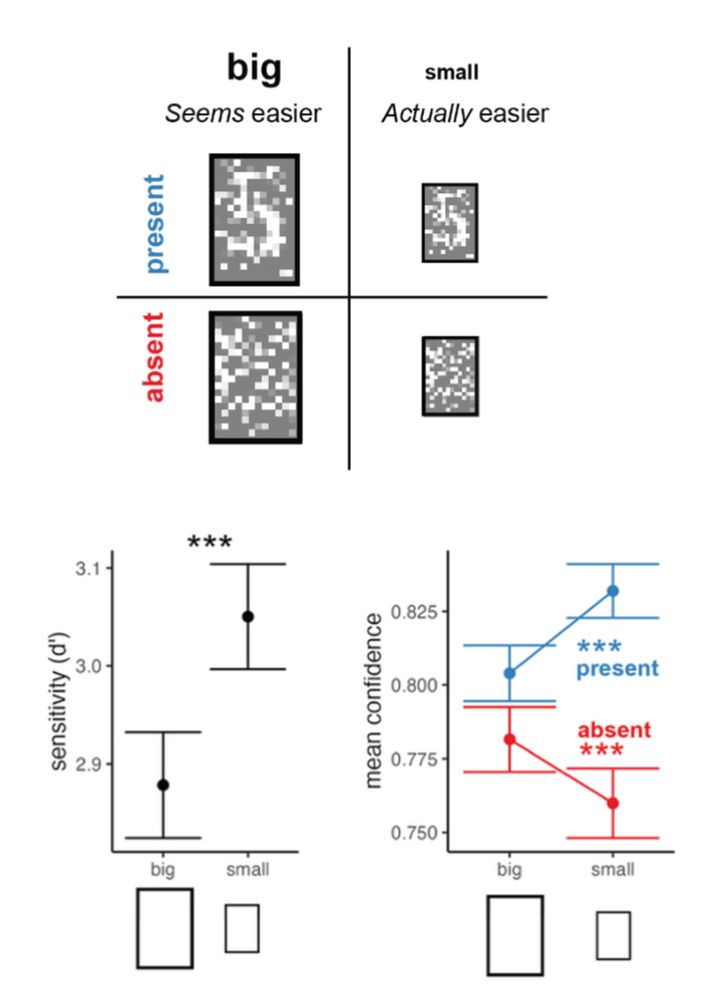
Confidence in absence as confidence in counterfactual visibility: a CogSci proceedings paper with star MSc student Maya Schipper, is now out on PsyArXiv:
osf.io/preprints/ps...
🧵👇
osf.io/preprints/ps...
🧵👇
July 23, 2025 at 3:23 AM
Confidence in absence as confidence in counterfactual visibility: a CogSci proceedings paper with star MSc student Maya Schipper, is now out on PsyArXiv:
osf.io/preprints/ps...
🧵👇
osf.io/preprints/ps...
🧵👇