


@faurelab.bsky.social
Neuroscience lab. We study decision making, exploration and addiction. We are interested in inter-individual variability.
Congratulations Lauren
@laurenmac.bsky.social, chercheuse en neurosciences au laboratoire Plasticité du cerveau est lauréate du Prix Bernard Bioulac 2025.
👋 @cnrs-paris.bsky.social @espciparispsl.bsky.social @faurelab.bsky.social
www.youtube.com/watch?v=yneN...
👋 @cnrs-paris.bsky.social @espciparispsl.bsky.social @faurelab.bsky.social
www.youtube.com/watch?v=yneN...

Lauren Reynolds, chercheuse en neurosciences | Prix Bernard Bioulac 2025
YouTube video by CNRS - En direct des labos
www.youtube.com
January 9, 2026 at 3:18 PM
Congratulations Lauren
Reposted
⚠️ New paper alert and what a way to end 2025! 🎉
Happy to share our story “Sleep-dependent infraslow rhythms are evolutionarily conserved across reptiles and mammals.” published today in Nature Neuroscience.
Sleeping dragons 🦎 and functional ultrasound!
Read the full paper here: rdcu.be/eWJHb 1/8
Happy to share our story “Sleep-dependent infraslow rhythms are evolutionarily conserved across reptiles and mammals.” published today in Nature Neuroscience.
Sleeping dragons 🦎 and functional ultrasound!
Read the full paper here: rdcu.be/eWJHb 1/8

Sleep-dependent infraslow rhythms are evolutionarily conserved across reptiles and mammals
Nature Neuroscience - Bergel et al. show that an infraslow rhythm connecting the brain and body during sleep is shared by lizards, mammals and birds, revealing an ancestral process and reshaping...
rdcu.be
December 29, 2025 at 4:17 PM
⚠️ New paper alert and what a way to end 2025! 🎉
Happy to share our story “Sleep-dependent infraslow rhythms are evolutionarily conserved across reptiles and mammals.” published today in Nature Neuroscience.
Sleeping dragons 🦎 and functional ultrasound!
Read the full paper here: rdcu.be/eWJHb 1/8
Happy to share our story “Sleep-dependent infraslow rhythms are evolutionarily conserved across reptiles and mammals.” published today in Nature Neuroscience.
Sleeping dragons 🦎 and functional ultrasound!
Read the full paper here: rdcu.be/eWJHb 1/8
Congrats, well deserve
Huge thanks to all my mentors over the years for their time, help, and advice. In particular @mickaeltanter.bsky.social, @apeyrache.bsky.social, K. Benchenane and @faurelab.bsky.social. Very grateful 🙏.
December 10, 2025 at 4:17 PM
Congrats, well deserve
Reposted

You just finished your PhD and you are looking for a postdoc to study stress-dependent modulation of learning. We are using the powerful fly model to understand the underlying circuits and mechanisms. You can apply here:
emploi.cnrs.fr/Offres/CDD/U...
emploi.cnrs.fr/Offres/CDD/U...
Portail Emploi CNRS - Offre d'emploi - Postdoc position (M/F) in Neuroscience, stress modulation of learning (H/F)
emploi.cnrs.fr
September 15, 2025 at 10:25 AM
You just finished your PhD and you are looking for a postdoc to study stress-dependent modulation of learning. We are using the powerful fly model to understand the underlying circuits and mechanisms. You can apply here:
emploi.cnrs.fr/Offres/CDD/U...
emploi.cnrs.fr/Offres/CDD/U...
Big news for @laurenmac.bsky.social !
2025 is quite a year: CNRS position + ERC Starting Grant
Her project DeMARRe will study how adolescent exploration & risk-taking shape neural circuits and resilience in adulthood.
@cnrs.fr @espciparispsl.bsky.social
www.insb.cnrs.fr/fr/personne/...
2025 is quite a year: CNRS position + ERC Starting Grant
Her project DeMARRe will study how adolescent exploration & risk-taking shape neural circuits and resilience in adulthood.
@cnrs.fr @espciparispsl.bsky.social
www.insb.cnrs.fr/fr/personne/...

Lauren Reynolds
www.insb.cnrs.fr
September 17, 2025 at 8:44 AM
Big news for @laurenmac.bsky.social !
2025 is quite a year: CNRS position + ERC Starting Grant
Her project DeMARRe will study how adolescent exploration & risk-taking shape neural circuits and resilience in adulthood.
@cnrs.fr @espciparispsl.bsky.social
www.insb.cnrs.fr/fr/personne/...
2025 is quite a year: CNRS position + ERC Starting Grant
Her project DeMARRe will study how adolescent exploration & risk-taking shape neural circuits and resilience in adulthood.
@cnrs.fr @espciparispsl.bsky.social
www.insb.cnrs.fr/fr/personne/...
Reposted

1
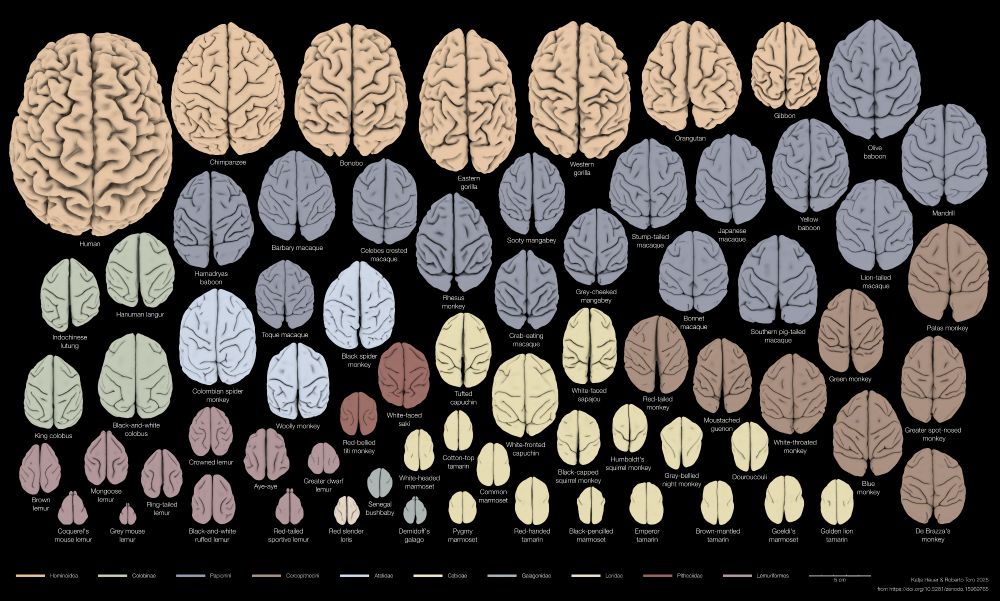
To predict the behaviour of a primate, would you rather base your guess on a closely related species or one with a similar brain shape? We looked at brains & behaviours of 70 species, you’ll be surprised!
🧵Thread on our new preprint with @r3rt0.bsky.social , doi.org/10.1101/2025...
To predict the behaviour of a primate, would you rather base your guess on a closely related species or one with a similar brain shape? We looked at brains & behaviours of 70 species, you’ll be surprised!
🧵Thread on our new preprint with @r3rt0.bsky.social , doi.org/10.1101/2025...
July 27, 2025 at 5:26 PM
1
To predict the behaviour of a primate, would you rather base your guess on a closely related species or one with a similar brain shape? We looked at brains & behaviours of 70 species, you’ll be surprised!
🧵Thread on our new preprint with @r3rt0.bsky.social , doi.org/10.1101/2025...
To predict the behaviour of a primate, would you rather base your guess on a closely related species or one with a similar brain shape? We looked at brains & behaviours of 70 species, you’ll be surprised!
🧵Thread on our new preprint with @r3rt0.bsky.social , doi.org/10.1101/2025...
Reposted

Alcool et nicotine : un même circuit cérébral à l’origine de la récompense et de l’anxiété
👋 @cnrs-paris.bsky.social @espciparispsl.bsky.social
✍️ @faurelab.bsky.social & Fabio Marti
👉 Lire l'article dans buff.ly/vE1j6LP
buff.ly/fD5DOxu
👋 @cnrs-paris.bsky.social @espciparispsl.bsky.social
✍️ @faurelab.bsky.social & Fabio Marti
👉 Lire l'article dans buff.ly/vE1j6LP
buff.ly/fD5DOxu
July 10, 2025 at 5:00 AM
Alcool et nicotine : un même circuit cérébral à l’origine de la récompense et de l’anxiété
👋 @cnrs-paris.bsky.social @espciparispsl.bsky.social
✍️ @faurelab.bsky.social & Fabio Marti
👉 Lire l'article dans buff.ly/vE1j6LP
buff.ly/fD5DOxu
👋 @cnrs-paris.bsky.social @espciparispsl.bsky.social
✍️ @faurelab.bsky.social & Fabio Marti
👉 Lire l'article dans buff.ly/vE1j6LP
buff.ly/fD5DOxu
Congratulations to first author Tinaïg Le Borgne for her outstanding work and Fabio marti for leading this project. Many thanks as well to our collaborators across @espciparispsl.bsky.social , @cnrsbiologie.bsky.social, @sorbonne-universite.fr and beyond!
July 5, 2025 at 1:19 PM
Congratulations to first author Tinaïg Le Borgne for her outstanding work and Fabio marti for leading this project. Many thanks as well to our collaborators across @espciparispsl.bsky.social , @cnrsbiologie.bsky.social, @sorbonne-universite.fr and beyond!
Nicotine and alcohol seem very different, but they converge on the same circuit. Both activate NAc-projecting dopamine neurons and inhibit those projecting to the amygdala. We show that this shared loop shapes reward and emotion, helping explain their high co-use.
July 5, 2025 at 1:19 PM
Nicotine and alcohol seem very different, but they converge on the same circuit. Both activate NAc-projecting dopamine neurons and inhibit those projecting to the amygdala. We show that this shared loop shapes reward and emotion, helping explain their high co-use.
A circuit-level explanation for nicotine’s dual impact: Nicotine activates VTA→NAc dopamine neurons (reward), but this comes at a cost: It triggers a GABAergic feedback loop that inhibits VTA→amygdala neurons (emotion).
One drug, the dopaminergic circuits, 2 effects: reinforcement + negative affect.
One drug, the dopaminergic circuits, 2 effects: reinforcement + negative affect.
July 5, 2025 at 1:19 PM
A circuit-level explanation for nicotine’s dual impact: Nicotine activates VTA→NAc dopamine neurons (reward), but this comes at a cost: It triggers a GABAergic feedback loop that inhibits VTA→amygdala neurons (emotion).
One drug, the dopaminergic circuits, 2 effects: reinforcement + negative affect.
One drug, the dopaminergic circuits, 2 effects: reinforcement + negative affect.
Nicotine doesn’t just “turn on” the brain’s reward circuits — it reshapes them. Our new paper in Nature Communications shows that activating reward-linked dopamine neurons also sets off a feedback loop that drives negative emotional states.
www.nature.com/articles/s41...
www.nature.com/articles/s41...
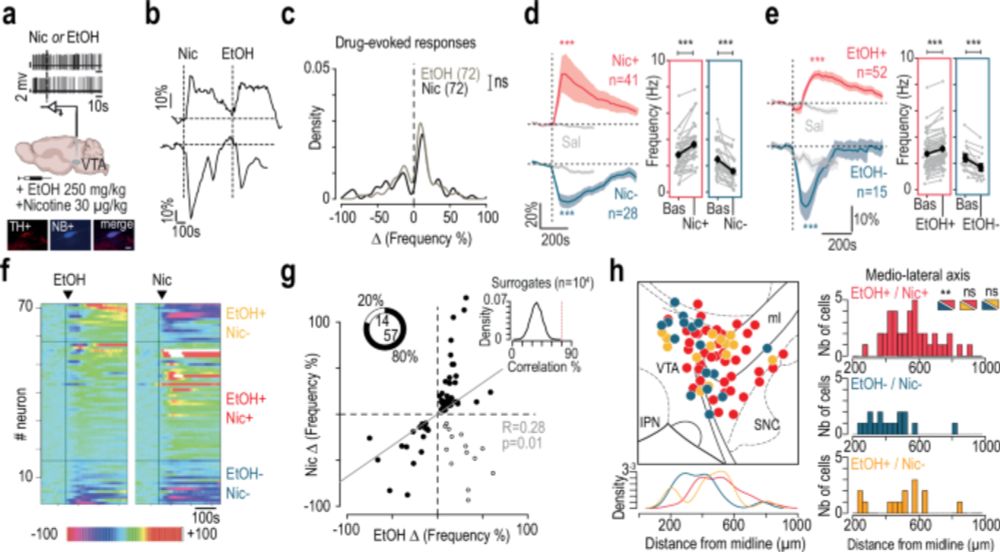
Nicotine engages a VTA-NAc feedback loop to inhibit amygdala-projecting dopamine neurons and induce anxiety-like behaviors - Nature Communications
Drugs of abuse exert both motivational and emotional effects. Here, the authors show that nicotine and ethanol activate a VTA–NAc loop that inhibits dopamine neurons projecting to the amygdala, thereb...
www.nature.com
July 5, 2025 at 1:19 PM
Nicotine doesn’t just “turn on” the brain’s reward circuits — it reshapes them. Our new paper in Nature Communications shows that activating reward-linked dopamine neurons also sets off a feedback loop that drives negative emotional states.
www.nature.com/articles/s41...
www.nature.com/articles/s41...
Our work on the role of the interpeduncular nucleus in nicotine reward ( www.cell.com/neuron/abstr... ) is featured in a Neuron Preview ! Brandon J Henderson highlights how a new regulatory circuit controlling nicotine reinforcement has been uncovered. www.cell.com/neuron/abstr...

Slowing the drive: A new regulatory break for nicotine reward-related behaviors
In this issue of Neuron, Jehl et al. developed a “suicide” antagonist to demonstrate
that the interpeduncular nucleus acts as a regulatory controller of nicotine reward-related
behavior through connec...
www.cell.com
June 19, 2025 at 1:02 PM
Our work on the role of the interpeduncular nucleus in nicotine reward ( www.cell.com/neuron/abstr... ) is featured in a Neuron Preview ! Brandon J Henderson highlights how a new regulatory circuit controlling nicotine reinforcement has been uncovered. www.cell.com/neuron/abstr...
Yesss! So happy to see this, totally deserved!

Thrilled to share that I have obtained a permanent position at CNRS 🎉🎉🎉
Thanks so much to everyone that supported me along the way, and especially @faurelab.bsky.social !
Thanks so much to everyone that supported me along the way, and especially @faurelab.bsky.social !

June 13, 2025 at 4:18 PM
Yesss! So happy to see this, totally deserved!
Reposted

Our work on rubber hand embodiment in mice is out @plosbiology.org! We show that just like in humans, visuo-tactile pairing can lead mice to an embodiment-like behavior with respect to an artificial limb.
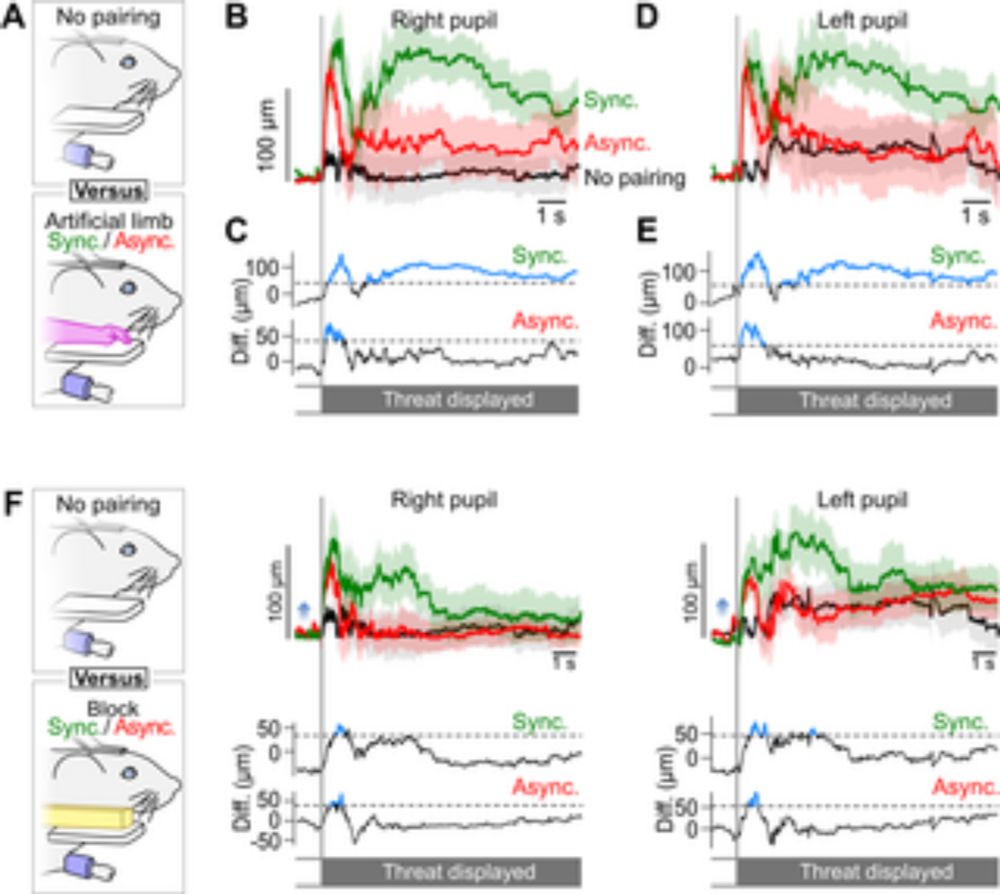
Embodiment of an artificial limb in mice
Body ownership disorders can be triggered by disease or body damage in humans. This study shows, using an automated, videography-based procedure, that mice also display quantifiable behavioral markers...
journals.plos.org
June 5, 2025 at 9:06 PM
Our work on rubber hand embodiment in mice is out @plosbiology.org! We show that just like in humans, visuo-tactile pairing can lead mice to an embodiment-like behavior with respect to an artificial limb.
Reposted

Nouvel article avec mes ami-es belges E. Chaves et A. de Kerchove où on décrit l'effet de l'activation de populations de neurones du striatum sur les stratégies de décision. On a essayé de sortir d'une définition "par l'expérimentateur" de la performance des souris.
www.science.org/doi/10.1126/...
www.science.org/doi/10.1126/...
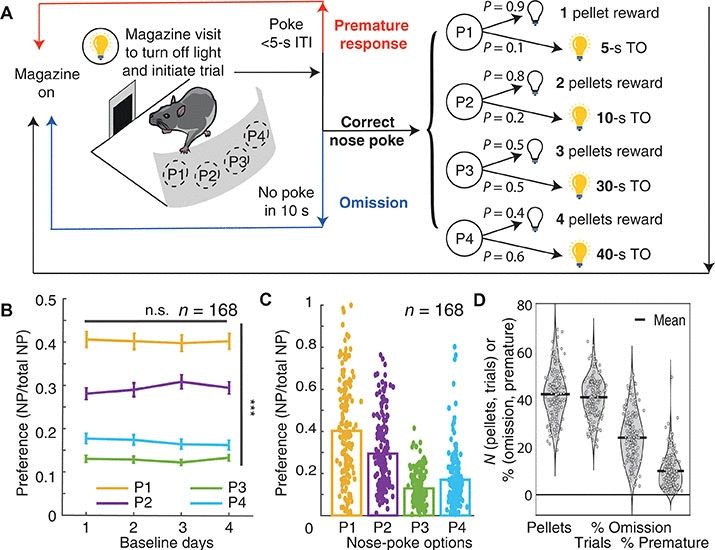
Direct and indirect striatal projecting neurons exert strategy-dependent effects on decision-making
In the dorsomedial striatum, d-SPNs increase risk seeking, while iSPNs amplify the value of large gains in decision making.
www.science.org
May 28, 2025 at 7:20 PM
Nouvel article avec mes ami-es belges E. Chaves et A. de Kerchove où on décrit l'effet de l'activation de populations de neurones du striatum sur les stratégies de décision. On a essayé de sortir d'une définition "par l'expérimentateur" de la performance des souris.
www.science.org/doi/10.1126/...
www.science.org/doi/10.1126/...
Reposted

Hot off the press:
The excellent Maheva Andriatsilavo and colleagues show how a temporal sequence of stochastic molecular mechanisms allow the emergence of stereotyped individualised neuronal circuits. Just published in Nature Neuroscience:
rdcu.be/ek010
The excellent Maheva Andriatsilavo and colleagues show how a temporal sequence of stochastic molecular mechanisms allow the emergence of stereotyped individualised neuronal circuits. Just published in Nature Neuroscience:
rdcu.be/ek010
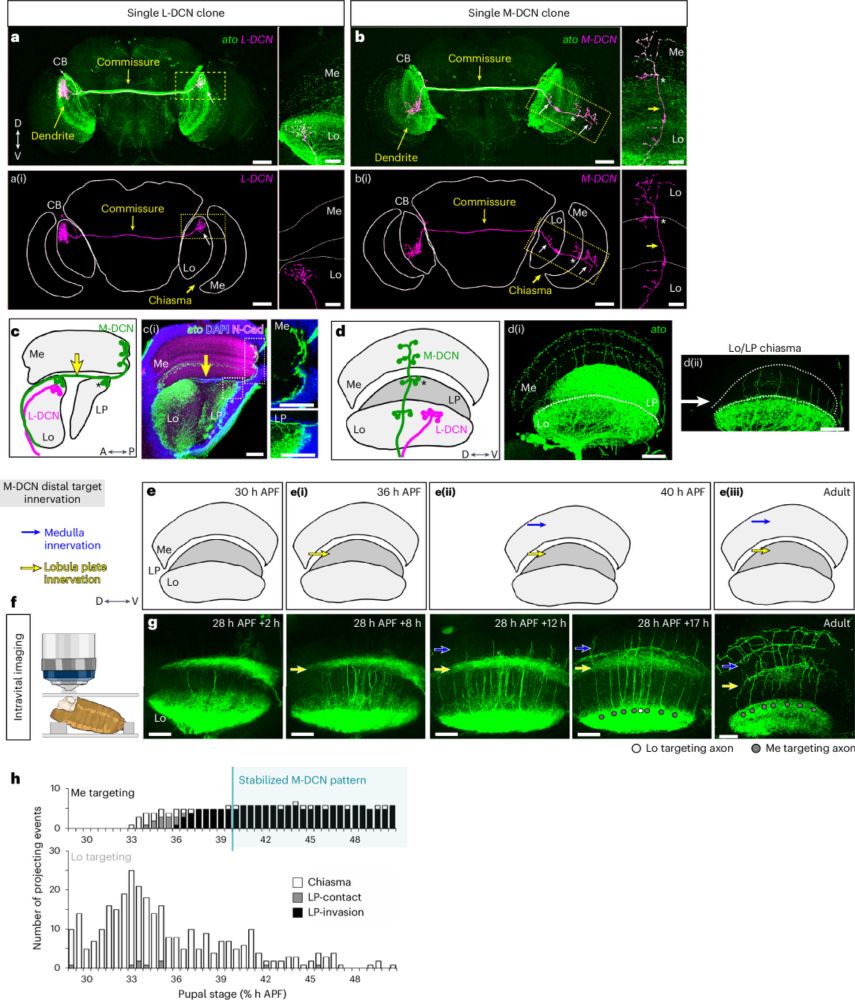
Sequential and independent probabilistic events regulate differential axon targeting during development in Drosophila melanogaster
Nature Neuroscience - The developmental origin of behavioral individuality is unclear. The authors show that a temporal sequence of genetically encoded stochastic mechanisms explains variation in...
rdcu.be
May 7, 2025 at 11:26 AM
Hot off the press:
The excellent Maheva Andriatsilavo and colleagues show how a temporal sequence of stochastic molecular mechanisms allow the emergence of stereotyped individualised neuronal circuits. Just published in Nature Neuroscience:
rdcu.be/ek010
The excellent Maheva Andriatsilavo and colleagues show how a temporal sequence of stochastic molecular mechanisms allow the emergence of stereotyped individualised neuronal circuits. Just published in Nature Neuroscience:
rdcu.be/ek010
Reposted

I have an opening in my lab for a postdoctoral fellow to work on projects that relate to the mechanisms of neurotransmitter release by dopamine neurons and/or on how inflammatory signals infuence the functionning of these neurons. Please share.
April 24, 2025 at 9:34 PM
I have an opening in my lab for a postdoctoral fellow to work on projects that relate to the mechanisms of neurotransmitter release by dopamine neurons and/or on how inflammatory signals infuence the functionning of these neurons. Please share.
free access here authors.elsevier.com/c/1kzRE3BtfH...
authors.elsevier.com
April 21, 2025 at 5:01 PM
free access here authors.elsevier.com/c/1kzRE3BtfH...
Congrat J. Jehl, M. Ciscato, E. Vicq & @nicolasguyon.bsky.social . Thanks to our amazing team, and collaborators! @cnrsbiologie.bsky.social , @inserm.fr , @sorbonne-universite.fr , @espciparispsl.bsky.social , @institutpasteur.bsky.social, @frm-officiel.bsky.social
April 21, 2025 at 5:01 PM
Congrat J. Jehl, M. Ciscato, E. Vicq & @nicolasguyon.bsky.social . Thanks to our amazing team, and collaborators! @cnrsbiologie.bsky.social , @inserm.fr , @sorbonne-universite.fr , @espciparispsl.bsky.social , @institutpasteur.bsky.social, @frm-officiel.bsky.social
This was made possible by a new chemogenetic method: a covalently tethered suicide antagonist for β4* nAChRs. Sustained, subtype-specific silencing in vivo, with single-site precision. A method developed by Alexandre Mourot in the lab @faurelab.bsky.social
April 21, 2025 at 5:01 PM
This was made possible by a new chemogenetic method: a covalently tethered suicide antagonist for β4* nAChRs. Sustained, subtype-specific silencing in vivo, with single-site precision. A method developed by Alexandre Mourot in the lab @faurelab.bsky.social
The interpeduncular nucleus (IPN) dampens nicotine reward via β4* nAChRs and IPN→LDTg projections. Blocking this pathway enhances VTA responses and CPP: A nicotine-specific brake embedded in the mesolimbic system.
New paper from the lab out in @cp-neuron.bsky.social www.cell.com/neuron/abstr...
New paper from the lab out in @cp-neuron.bsky.social www.cell.com/neuron/abstr...
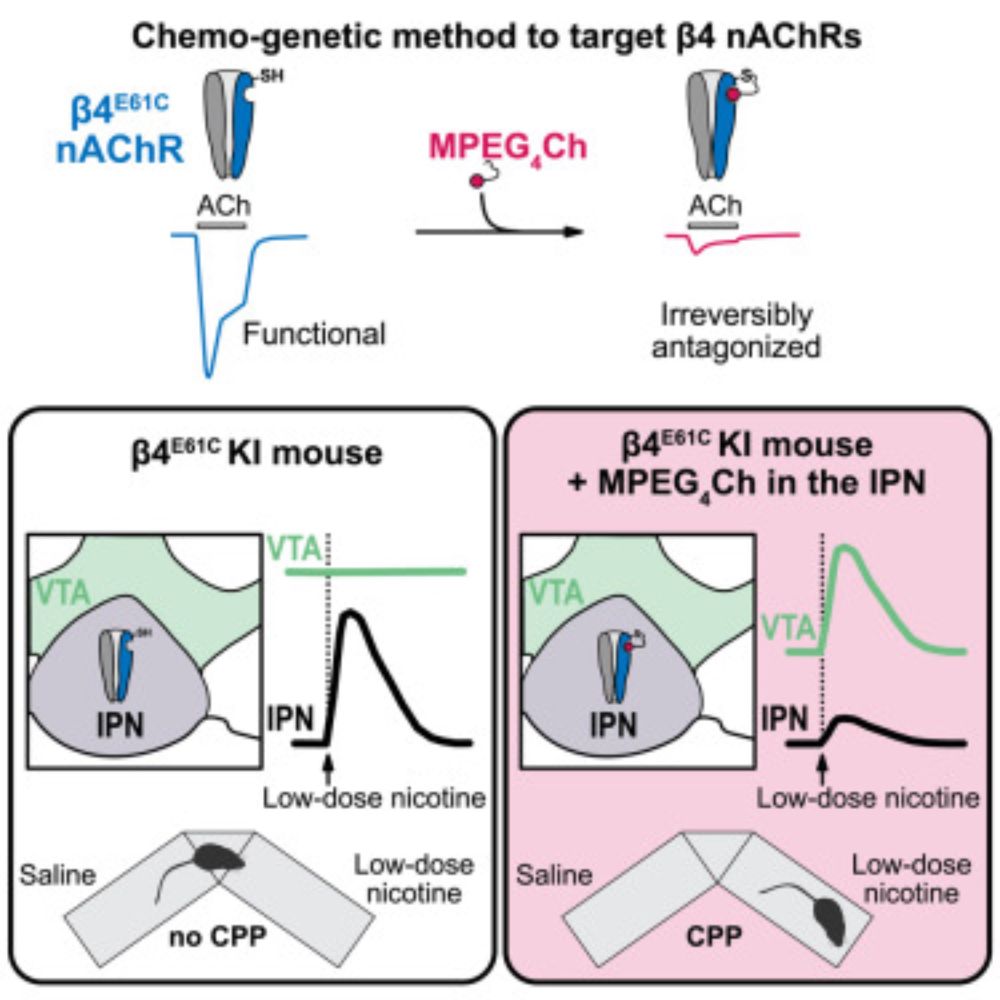
The interpeduncular nucleus blunts the rewarding effect of nicotine
Nicotine activates the dopamine reward system to promote consumption and addiction,
but the brain has a natural brake to counteract it. Jehl, Ciscato, Vicq, Guyon, et al.
identified the interpeduncula...
www.cell.com
April 21, 2025 at 5:01 PM
The interpeduncular nucleus (IPN) dampens nicotine reward via β4* nAChRs and IPN→LDTg projections. Blocking this pathway enhances VTA responses and CPP: A nicotine-specific brake embedded in the mesolimbic system.
New paper from the lab out in @cp-neuron.bsky.social www.cell.com/neuron/abstr...
New paper from the lab out in @cp-neuron.bsky.social www.cell.com/neuron/abstr...
Reposted

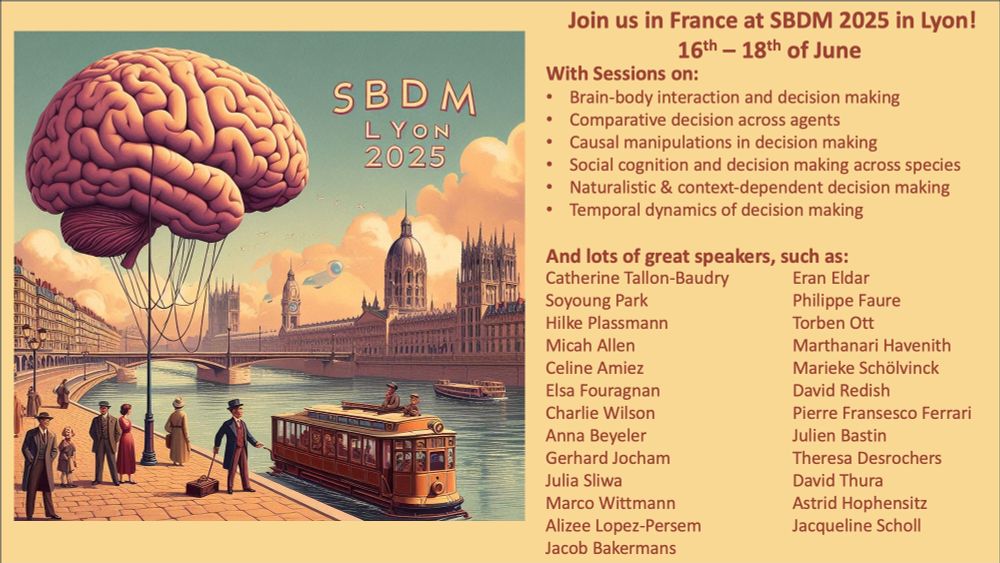
Registrations for the Symposium for the Biology of decision making (SBDM) in Lyon 2025 are finally open! sbdm2025.github.io Please spread the message!
April 8, 2025 at 6:18 PM
Registrations for the Symposium for the Biology of decision making (SBDM) in Lyon 2025 are finally open! sbdm2025.github.io Please spread the message!
Social structures are dynamic: manipulating dopamine activity reshapes role distribution, confirming a feedback loop where social context modulates neural states, which in turn reinforce specialization.
February 11, 2025 at 12:47 PM
Social structures are dynamic: manipulating dopamine activity reshapes role distribution, confirming a feedback loop where social context modulates neural states, which in turn reinforce specialization.
A reinforcement learning model reveals how competition for ressources drives behavioral specialization, with varying degrees of exploitation shaping social roles development and driving sex differences.
February 11, 2025 at 12:47 PM
A reinforcement learning model reveals how competition for ressources drives behavioral specialization, with varying degrees of exploitation shaping social roles development and driving sex differences.
Neural and computational analyses during the task reveal that dopaminergic activity in the ventral tegmental area (VTA) plays a key role in stabilizing social roles.
February 11, 2025 at 12:47 PM
Neural and computational analyses during the task reveal that dopaminergic activity in the ventral tegmental area (VTA) plays a key role in stabilizing social roles.