



GAIN4CROPS
@gain4crops.eu
H2020 EU project developing nature-inspired solutions sustainably to increase crop yield 🌻 We focus on sunflowers, embracing nature and plant breeding.
Grant agreement ID: 862087
Visit the project website at gain4crops.eu
Grant agreement ID: 862087
Visit the project website at gain4crops.eu
Hear from our partner Laia Segura Broncano from the @hhu.de on how she and her team translated knowledge from model plants to crops like the sunflower.
“We tried to improve carbon fixation and optimize the photosynthetic efficiency in Arabidopsis thaliana — our model organism for plants.”
“We tried to improve carbon fixation and optimize the photosynthetic efficiency in Arabidopsis thaliana — our model organism for plants.”
January 16, 2026 at 4:01 PM
Hear from our partner Laia Segura Broncano from the @hhu.de on how she and her team translated knowledge from model plants to crops like the sunflower.
“We tried to improve carbon fixation and optimize the photosynthetic efficiency in Arabidopsis thaliana — our model organism for plants.”
“We tried to improve carbon fixation and optimize the photosynthetic efficiency in Arabidopsis thaliana — our model organism for plants.”
After some fieldwork at Durrell Wildlife Conservation Trust and teaching at a secondary school, Riccardo is now working on the lab Ülo Niinemets. He collects anatomical and physiological data from higher plants to study which factors affect mesophyll conductance.
January 15, 2026 at 2:05 PM
After some fieldwork at Durrell Wildlife Conservation Trust and teaching at a secondary school, Riccardo is now working on the lab Ülo Niinemets. He collects anatomical and physiological data from higher plants to study which factors affect mesophyll conductance.
Today we share our interview with Riccardo Scodeller, our partner from the Estonian University of Life Sciences who recently joined the project to support our research into plant anatomy to improve photosynthesis. 🌿🔬
More about our hashtag#H2020 project at gain4crops.eu
More about our hashtag#H2020 project at gain4crops.eu
January 15, 2026 at 2:05 PM
Today we share our interview with Riccardo Scodeller, our partner from the Estonian University of Life Sciences who recently joined the project to support our research into plant anatomy to improve photosynthesis. 🌿🔬
More about our hashtag#H2020 project at gain4crops.eu
More about our hashtag#H2020 project at gain4crops.eu
Our partner, Tiina Tosen, from the Estonian University of Life Sciences, studies the fundamentals of photosynthesis in the sunflower family. 🌼🌻
“For example, what are the trait combinations underlying more efficient photosynthesis?”
Visit us at gain4crops.eu to learn more about our #H2020 project.
“For example, what are the trait combinations underlying more efficient photosynthesis?”
Visit us at gain4crops.eu to learn more about our #H2020 project.
January 13, 2026 at 3:29 PM
Our partner, Tiina Tosen, from the Estonian University of Life Sciences, studies the fundamentals of photosynthesis in the sunflower family. 🌼🌻
“For example, what are the trait combinations underlying more efficient photosynthesis?”
Visit us at gain4crops.eu to learn more about our #H2020 project.
“For example, what are the trait combinations underlying more efficient photosynthesis?”
Visit us at gain4crops.eu to learn more about our #H2020 project.
Meet our partner Urte Schlüter @urtes.bsky.social, from the @hhu.de. She and her team helped our #H2020 project explore natural improvements to photosynthesis that could be useful for plant breeding or synthetic solutions. 🌿🌻
Watch the full interview or visit us at gain4crops.eu to learn more.
Watch the full interview or visit us at gain4crops.eu to learn more.
January 12, 2026 at 4:45 PM
Meet our partner Urte Schlüter @urtes.bsky.social, from the @hhu.de. She and her team helped our #H2020 project explore natural improvements to photosynthesis that could be useful for plant breeding or synthetic solutions. 🌿🌻
Watch the full interview or visit us at gain4crops.eu to learn more.
Watch the full interview or visit us at gain4crops.eu to learn more.
He and his team supported our hashtag#H2020 project by translating what we learned in relatively simple organisms — bacteria and algae — to model plants and crops like the sunflower.
January 9, 2026 at 2:53 PM
He and his team supported our hashtag#H2020 project by translating what we learned in relatively simple organisms — bacteria and algae — to model plants and crops like the sunflower.
Our partner, Goetz Hensel from the @hhu.de, reflects on a defining feature of GAIN4CROPS: the complete translational pipeline. 🧪➡️🌻
“I‘m not aware of many other projects where you go from the design of the enzymes until the proof of concept in plants.”
More about our #H2020 project at gain4crops.eu
“I‘m not aware of many other projects where you go from the design of the enzymes until the proof of concept in plants.”
More about our #H2020 project at gain4crops.eu
January 9, 2026 at 2:53 PM
Our partner, Goetz Hensel from the @hhu.de, reflects on a defining feature of GAIN4CROPS: the complete translational pipeline. 🧪➡️🌻
“I‘m not aware of many other projects where you go from the design of the enzymes until the proof of concept in plants.”
More about our #H2020 project at gain4crops.eu
“I‘m not aware of many other projects where you go from the design of the enzymes until the proof of concept in plants.”
More about our #H2020 project at gain4crops.eu
We sat down with @tianshu-sun.bsky.social, our partner from the @deptofwar.bsky.social, who shared her journey and contributions throughout our #H2020 project.
“We’re are looking to generate data that’s valuable to the whole project and to anyone interested in photosynthesis.”
“We’re are looking to generate data that’s valuable to the whole project and to anyone interested in photosynthesis.”
January 8, 2026 at 3:30 PM
We sat down with @tianshu-sun.bsky.social, our partner from the @deptofwar.bsky.social, who shared her journey and contributions throughout our #H2020 project.
“We’re are looking to generate data that’s valuable to the whole project and to anyone interested in photosynthesis.”
“We’re are looking to generate data that’s valuable to the whole project and to anyone interested in photosynthesis.”
Andreas and his team are developing metabolic models of natural and synthetic pathways leading to increased photosynthetic efficiency. 🧑🔬
We will be sharing interviews from other project members soon, so stay tuned!
We will be sharing interviews from other project members soon, so stay tuned!
January 8, 2026 at 3:06 PM
Andreas and his team are developing metabolic models of natural and synthetic pathways leading to increased photosynthetic efficiency. 🧑🔬
We will be sharing interviews from other project members soon, so stay tuned!
We will be sharing interviews from other project members soon, so stay tuned!
As our #H2020 project enters its last month, our coordinator, @apmweber.bsky.social, reflects on the importance and potential of the GAIN4CROPS to boost crop yields! 🌻
“Our project can [contribute] to a more sustainable agriculture in Europe, but also in other places in the world.”🌍
“Our project can [contribute] to a more sustainable agriculture in Europe, but also in other places in the world.”🌍
January 8, 2026 at 3:06 PM
As our #H2020 project enters its last month, our coordinator, @apmweber.bsky.social, reflects on the importance and potential of the GAIN4CROPS to boost crop yields! 🌻
“Our project can [contribute] to a more sustainable agriculture in Europe, but also in other places in the world.”🌍
“Our project can [contribute] to a more sustainable agriculture in Europe, but also in other places in the world.”🌍
Reposted by GAIN4CROPS
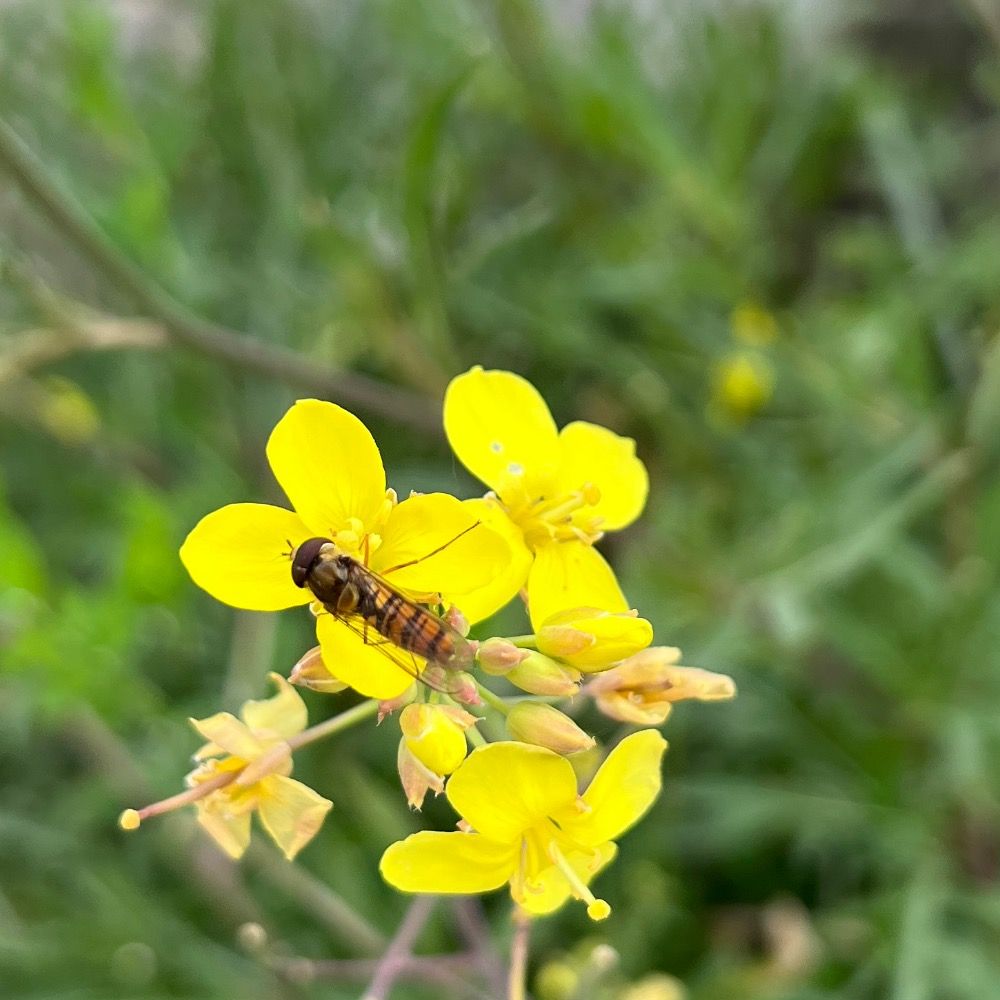
Cleomaceae are the sister group to the Brassicaceae. In contrast to the Brassicaceae, they contain true C4 photosynthetic species. This indicates that the genetic capacity to evolve C4 is ancestral to the split of Brassicaceae and Cleomaceae.
onlinelibrary.wiley.com/doi/10.1111/...
onlinelibrary.wiley.com/doi/10.1111/...

Cleomaceae: diversity and potential of a model family for studies on the evolution of photosynthesis
The Cleomaceae family integrates floral diversity, physiological plasticity, and the evolution of C4 photosynthesis, serving as an important model to investigate plant adaptation and evolutionary inn...
onlinelibrary.wiley.com
December 6, 2025 at 1:58 PM
Cleomaceae are the sister group to the Brassicaceae. In contrast to the Brassicaceae, they contain true C4 photosynthetic species. This indicates that the genetic capacity to evolve C4 is ancestral to the split of Brassicaceae and Cleomaceae.
onlinelibrary.wiley.com/doi/10.1111/...
onlinelibrary.wiley.com/doi/10.1111/...
Reposted by GAIN4CROPS
"Plant single cell RNAseq workshop: From current technologies to data analyses" Saclay Plant Sciences Summer School, June 28 - July 3, 2026 – Versailles (France)

"Plant single cell RNAseq workshop: From current technologies to data analyses" Saclay Plant Sciences Summer School, June 28 - July 3, 2026 – Versailles (France)
This Summer school is organized by the Saclay Plant Sciences (SPS) network, one of the largest European plant sciences communities.
scRNAseq approaches have revolutionized the way biologists approach their research subjects, by making it possible to dissect molecular mechanisms at the single-cell level. But although technological developments have recently made these approaches more accessible, their expensive use still requires significant technical training, including the good conception of experimental designs, the preparation of samples as well as their bioinformatics analyses. In addition, different protocols and various bioinformatics and statistical analyzes are available, and it can be difficult to choose the most relevant ones for the biological question at hand.
Over five days, the SPS Summer School 2026 will cover all the stages of a scRNAseq project in plants. Through a combination of lectures and practical work, the many specific features of plant models will be highlighted by experts from the Saclay Plant Sciences network (CNRS and INRAE), the ViB in Ghent and the Pasteur Institute.
After this international school, participants will:
– Have an overview of the different scRNAseq technologies and understand their pros and cons.
– Be able to design experiments depending on the biological question.
– Be trained on sample preparation techniques for single cell and single nuclei
– Understand the different steps of bioinformatics and statistical analysis
– Have a better biological interpretation of results
– Have facilitated exchanges with technology platforms, bioinformaticians, and biostatisticians in order to successfully complete their scRNAseq project
The summer school will bring together outstanding and enthusiastic young scientists (PhD students and post-docs) from all over the world in order to exchange knowledge and ideas. It is limited to a small group of participants (20 maximum) to privilege informal interactions and scientific discussions
Application deadline: March 12, 2026 (midnight)
Answers will be sent mid-April at the latest.
eng-saclay-plant-sciences.hub.inrae.fr
November 26, 2025 at 7:53 PM
"Plant single cell RNAseq workshop: From current technologies to data analyses" Saclay Plant Sciences Summer School, June 28 - July 3, 2026 – Versailles (France)
Amazing news! It was a great way to start the day today. 🌻
December 4, 2025 at 2:55 PM
Amazing news! It was a great way to start the day today. 🌻
Reposted by GAIN4CROPS
Reposted by GAIN4CROPS

👀 Early Career Researchers in #PlantSci:
There are only 4 days left ... if you want to join
Molecular Biology of Plants (#MBP2026) Conference in Hennef, Germany
Registration + abstract submission end on
🗓️ 23rd November 2025
www.pflanzen-molekularbiologie.de/en/conferenc...
There are only 4 days left ... if you want to join
Molecular Biology of Plants (#MBP2026) Conference in Hennef, Germany
Registration + abstract submission end on
🗓️ 23rd November 2025
www.pflanzen-molekularbiologie.de/en/conferenc...

November 20, 2025 at 11:56 AM
👀 Early Career Researchers in #PlantSci:
There are only 4 days left ... if you want to join
Molecular Biology of Plants (#MBP2026) Conference in Hennef, Germany
Registration + abstract submission end on
🗓️ 23rd November 2025
www.pflanzen-molekularbiologie.de/en/conferenc...
There are only 4 days left ... if you want to join
Molecular Biology of Plants (#MBP2026) Conference in Hennef, Germany
Registration + abstract submission end on
🗓️ 23rd November 2025
www.pflanzen-molekularbiologie.de/en/conferenc...
Reposted by GAIN4CROPS
I highly recommend the #MBP2026 #PlantScience Meeting in Hennef, especially if you're an ECR or #NewPI trying to connect to the German Plant Science Community.
It's interactive, fun and relaxed.
Unfortunately, I won't be there this year, but I'll be back in 2027 👍
It's interactive, fun and relaxed.
Unfortunately, I won't be there this year, but I'll be back in 2027 👍
👀 Early Career Researchers in #PlantSci:
There are only 4 days left ... if you want to join
Molecular Biology of Plants (#MBP2026) Conference in Hennef, Germany
Registration + abstract submission end on
🗓️ 23rd November 2025
www.pflanzen-molekularbiologie.de/en/conferenc...
There are only 4 days left ... if you want to join
Molecular Biology of Plants (#MBP2026) Conference in Hennef, Germany
Registration + abstract submission end on
🗓️ 23rd November 2025
www.pflanzen-molekularbiologie.de/en/conferenc...
November 20, 2025 at 6:35 PM
I highly recommend the #MBP2026 #PlantScience Meeting in Hennef, especially if you're an ECR or #NewPI trying to connect to the German Plant Science Community.
It's interactive, fun and relaxed.
Unfortunately, I won't be there this year, but I'll be back in 2027 👍
It's interactive, fun and relaxed.
Unfortunately, I won't be there this year, but I'll be back in 2027 👍
Reposted by GAIN4CROPS
"The expanding world of plant NLR pairs"
Cheng-Wei Sang, Yan-Mei Zhang, Sai-Xi Li, Jian-Qun Chen, and Zhu-Qing Shao in @cp-trendsplantsci.bsky.social.
#PlantScience #PlantImmunity
www.sciencedirect.com/science/arti...
Cheng-Wei Sang, Yan-Mei Zhang, Sai-Xi Li, Jian-Qun Chen, and Zhu-Qing Shao in @cp-trendsplantsci.bsky.social.
#PlantScience #PlantImmunity
www.sciencedirect.com/science/arti...

The expanding world of plant NLR pairs
Three recent studies, by Zhu et al.,Klymiuk et al., and Hu et al., identified paired nucleotide-binding site–leucine-rich repeat receptors (NLRs) in w…
www.sciencedirect.com
November 12, 2025 at 1:26 PM
"The expanding world of plant NLR pairs"
Cheng-Wei Sang, Yan-Mei Zhang, Sai-Xi Li, Jian-Qun Chen, and Zhu-Qing Shao in @cp-trendsplantsci.bsky.social.
#PlantScience #PlantImmunity
www.sciencedirect.com/science/arti...
Cheng-Wei Sang, Yan-Mei Zhang, Sai-Xi Li, Jian-Qun Chen, and Zhu-Qing Shao in @cp-trendsplantsci.bsky.social.
#PlantScience #PlantImmunity
www.sciencedirect.com/science/arti...
Researchers made use of recent advances in sequencing techniques to study how “cellular specialisation affects interconnected pathways”.
This could help us understand the genetic basis for C3-C4 intermediacy in specific plants. 🌿
This could help us understand the genetic basis for C3-C4 intermediacy in specific plants. 🌿
🌿 RESEARCH 🌿
Single-nucleus RNAseq reveals bundle sheath cell-specific photorespiration pathways in Moricandia arvensis, incl ammonium assimilation & redox regulation, highlighting metabolic compartmentalization in C3–C4 photosynthesis – Triesch et al.
🔗 doi.org/10.1093/jxb/...
#PlantScience 🧪
Single-nucleus RNAseq reveals bundle sheath cell-specific photorespiration pathways in Moricandia arvensis, incl ammonium assimilation & redox regulation, highlighting metabolic compartmentalization in C3–C4 photosynthesis – Triesch et al.
🔗 doi.org/10.1093/jxb/...
#PlantScience 🧪

November 11, 2025 at 3:07 PM
Researchers made use of recent advances in sequencing techniques to study how “cellular specialisation affects interconnected pathways”.
This could help us understand the genetic basis for C3-C4 intermediacy in specific plants. 🌿
This could help us understand the genetic basis for C3-C4 intermediacy in specific plants. 🌿
Reposted by GAIN4CROPS
Rick van de Zedde was here at @kwsgroup.bsky.social to talk about his work making sense of the tons of data generated by the #PlantScience NPEC phenotyping platform run by @wurplant.bsky.social & @utrechtuniversity.bsky.social. Very interesting work, including producing smartphone apps for easy use.


November 7, 2025 at 7:21 AM
Rick van de Zedde was here at @kwsgroup.bsky.social to talk about his work making sense of the tons of data generated by the #PlantScience NPEC phenotyping platform run by @wurplant.bsky.social & @utrechtuniversity.bsky.social. Very interesting work, including producing smartphone apps for easy use.
Reposted by GAIN4CROPS

The European Commission is pleased to launch this new Science, Research & Innovation account. We look forward to connecting with the community on Bluesky! 🧪
Here you will find:
- EU scientific news
- Horizon Europe funding opportunities
- Innovative EU-supported projects
- Events, tools & resources
Here you will find:
- EU scientific news
- Horizon Europe funding opportunities
- Innovative EU-supported projects
- Events, tools & resources
September 30, 2025 at 9:05 AM
The European Commission is pleased to launch this new Science, Research & Innovation account. We look forward to connecting with the community on Bluesky! 🧪
Here you will find:
- EU scientific news
- Horizon Europe funding opportunities
- Innovative EU-supported projects
- Events, tools & resources
Here you will find:
- EU scientific news
- Horizon Europe funding opportunities
- Innovative EU-supported projects
- Events, tools & resources
Reposted by GAIN4CROPS
A new crop in the lab. 🌱 Field day with TaCoCass team members — working to boost photosynthetic efficiency in cassava and secure a more sustainable food future. #Cassava #Photosynthesis #FoodSecurity


September 29, 2025 at 7:00 AM
A new crop in the lab. 🌱 Field day with TaCoCass team members — working to boost photosynthetic efficiency in cassava and secure a more sustainable food future. #Cassava #Photosynthesis #FoodSecurity
Reposted by GAIN4CROPS
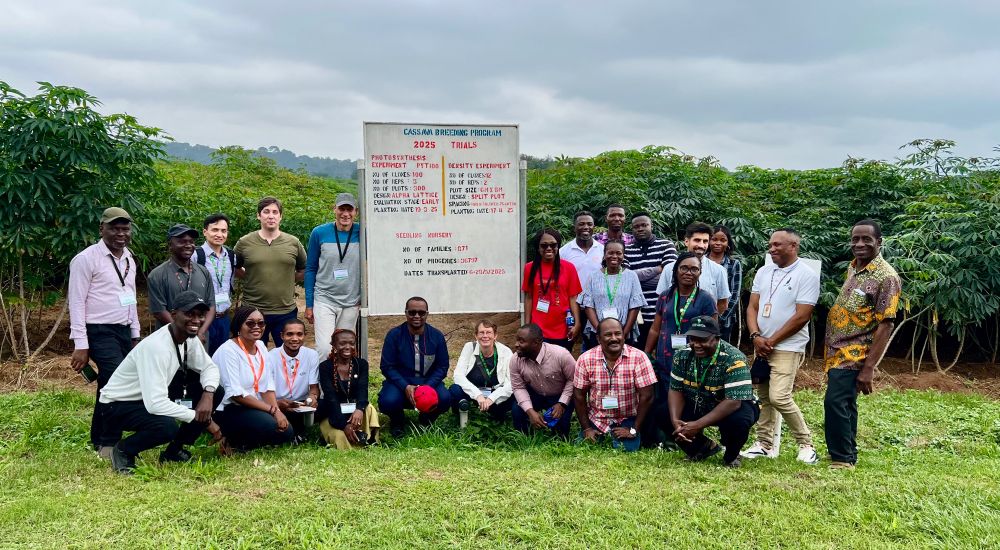
🌱 The #TaCoCass Team in the field: evaluating #cassava lines with diverse architecture and productivity. The trials highlight the genetic variation that underpins efforts to boost photosynthetic efficiency in cassava, paving the way toward more resilience and higher yield
#Cassava #Photosynthesis
#Cassava #Photosynthesis


September 30, 2025 at 4:22 PM
🌱 The #TaCoCass Team in the field: evaluating #cassava lines with diverse architecture and productivity. The trials highlight the genetic variation that underpins efforts to boost photosynthetic efficiency in cassava, paving the way toward more resilience and higher yield
#Cassava #Photosynthesis
#Cassava #Photosynthesis
Reposted by GAIN4CROPS
A research team led by the @leibnizipk.bsky.social has revealed that modern barley has a “mosaic origin”, meaning it stems from several wild populations across the Fertile Crescent. The findings were published in @nature.com.
➡️Paper: tinyurl.com/ytzyn4re
➡️PR: tinyurl.com/5e2v7cp5
➡️Paper: tinyurl.com/ytzyn4re
➡️PR: tinyurl.com/5e2v7cp5

September 24, 2025 at 2:58 PM
A research team led by the @leibnizipk.bsky.social has revealed that modern barley has a “mosaic origin”, meaning it stems from several wild populations across the Fertile Crescent. The findings were published in @nature.com.
➡️Paper: tinyurl.com/ytzyn4re
➡️PR: tinyurl.com/5e2v7cp5
➡️Paper: tinyurl.com/ytzyn4re
➡️PR: tinyurl.com/5e2v7cp5
Than you for joining Robert! It was our pleasure to have you with us.
September 22, 2025 at 1:47 PM
Than you for joining Robert! It was our pleasure to have you with us.
@forscherrobert.bsky.social from @leibnizipk.bsky.social explained how his research team used genome editing to replicate wild mutations found in East Asian barley, successfully transferring virus resistance to European breeding lines. 🌾🛡
#GiveGenesAChance
#GiveGenesAChance

September 19, 2025 at 12:28 PM
@forscherrobert.bsky.social from @leibnizipk.bsky.social explained how his research team used genome editing to replicate wild mutations found in East Asian barley, successfully transferring virus resistance to European breeding lines. 🌾🛡
#GiveGenesAChance
#GiveGenesAChance