



Giulio Gabrieli
@giuliog.bsky.social
Researcher by Day, Nerd by Night.
PostDoc at Digital Futures Research Hub, Technological University Dublin (TU Dublin)
Turns coffee into Open Science & Open Source.
PostDoc at Digital Futures Research Hub, Technological University Dublin (TU Dublin)
Turns coffee into Open Science & Open Source.
🚨Our latest paper, Electrical Spinal Imaging: A noninvasive, high‑resolution approach that enables electrophysiological mapping of the human spinal cord is out now in PLOS Biology doi.org/10.1371/jour...
It's not only fancy figures, let me show you ⬇️
🧵1/10
It's not only fancy figures, let me show you ⬇️
🧵1/10

December 18, 2025 at 10:22 AM
🚨Our latest paper, Electrical Spinal Imaging: A noninvasive, high‑resolution approach that enables electrophysiological mapping of the human spinal cord is out now in PLOS Biology doi.org/10.1371/jour...
It's not only fancy figures, let me show you ⬇️
🧵1/10
It's not only fancy figures, let me show you ⬇️
🧵1/10
Reposted by Giulio Gabrieli

Electrical Spinal Imaging: A noninvasive, high-resolution approach that enables electrophysiological mapping of the human spinal cord @PLOSBiology.org
Electrical Spinal Imaging: A noninvasive, high-resolution approach that enables electrophysiological mapping of the human spinal cord
by Giulio Gabrieli, Richard Somervail, André Mouraux, Massimo Leandri, Patrick Haggard, Gian Domenico Iannetti
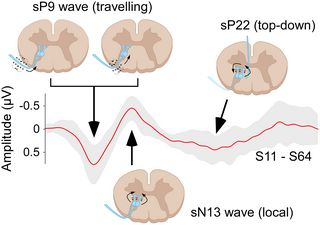
The spinal cord is the key bridge between the brain and the body. However, scientific understanding of healthy spinal cord function has historically been limited because noninvasive measures of its neural activity have proven exceptionally challenging. In this work, we describe an enhanced recording and analysis approach, Electrical Spinal Imaging (ESI), to obtain noninvasive, high-resolution images of the spinal cord electrical activity in humans. ESI is analytically simple, easy to implement, and data-driven: it does not involve template-based strategies prone to produce spurious signals. Using this approach, we provide a detailed description and physiological characterization of the spatiotemporal dynamics of the peripheral, spinal, and cortical activity elicited by somatosensory stimulation. We also demonstrate that attention modulates postsynaptic activity at spinal cord level. Our method has enabled five important insights regarding spinal cord activity. (1) We identified three distinct responses in the time domain: sP9, sN13, and sP22. (2) The sP9 is a traveling wave reflecting the afferent volley entering the spinal cord through the dorsal root. (3) In contrast, the sN13 and sP22 reflect segmental postsynaptic activity. (4) While the sP9 response is first seen on the dorsal electrodes ipsilateral to the stimulated side, the sN13 and sP22 were not lateralized with respect to the side of stimulation. (5) Unimodal attention strongly modulates the amplitude of the sP22, but not that of the sP9 and sN13 components. The proposed method offers critical insights into the spatiotemporal dynamics of somatosensory processing within the spinal cord, paving the way for precise noninvasive functional monitoring of the spinal cord in basic and clinical neurophysiology.
dlvr.it
December 13, 2025 at 10:41 PM
Electrical Spinal Imaging: A noninvasive, high-resolution approach that enables electrophysiological mapping of the human spinal cord @PLOSBiology.org
Reposted by Giulio Gabrieli

The role of the #SpinalCord in relaying brain-body signals has been hard to study noninvasively. @giuliog.bsky.social &co develop Electrical Spinal Imaging (ESI), enabling high-resolution, noninvasive recordings, revealing how #attention modulates spinal activity @plosbiology.org 🧪 plos.io/3MswZOf

November 28, 2025 at 2:05 PM
The role of the #SpinalCord in relaying brain-body signals has been hard to study noninvasively. @giuliog.bsky.social &co develop Electrical Spinal Imaging (ESI), enabling high-resolution, noninvasive recordings, revealing how #attention modulates spinal activity @plosbiology.org 🧪 plos.io/3MswZOf
Reposted by Giulio Gabrieli
The role of the #SpinalCord in relaying brain-body signals has been hard to study noninvasively. @giuliog.bsky.social &co develop Electrical Spinal Imaging (ESI), enabling high-resolution, noninvasive recordings, revealing how #attention modulates spinal activity @plosbiology.org 🧪 plos.io/3MswZOf
November 28, 2025 at 5:25 PM
The role of the #SpinalCord in relaying brain-body signals has been hard to study noninvasively. @giuliog.bsky.social &co develop Electrical Spinal Imaging (ESI), enabling high-resolution, noninvasive recordings, revealing how #attention modulates spinal activity @plosbiology.org 🧪 plos.io/3MswZOf
Reposted by Giulio Gabrieli
The role of the #SpinalCord in relaying brain-body signals has been hard to study noninvasively. @giuliog.bsky.social &co develop Electrical Spinal Imaging (ESI), enabling high-resolution, noninvasive recordings, revealing how #attention modulates spinal activity @plosbiology.org 🧪 plos.io/3MswZOf

December 1, 2025 at 8:55 AM
The role of the #SpinalCord in relaying brain-body signals has been hard to study noninvasively. @giuliog.bsky.social &co develop Electrical Spinal Imaging (ESI), enabling high-resolution, noninvasive recordings, revealing how #attention modulates spinal activity @plosbiology.org 🧪 plos.io/3MswZOf
BOOM! This looks like quite the advance: www.biorxiv.org/content/10.1...

Electrical Spinal Imaging (ESI): Analysing spinal cord activity with non-invasive, high-resolution mapping
The spinal cord is the key bridge between the brain and the body. However, scientific understanding of healthy spinal cord function has historically been limited because noninvasive measures of its ne...
www.biorxiv.org
March 27, 2025 at 9:23 PM
Reposted by Giulio Gabrieli

BOOM! This looks like quite the advance: www.biorxiv.org/content/10.1...
Electrical Spinal Imaging (ESI): Analysing spinal cord activity with non-invasive, high-resolution mapping
The spinal cord is the key bridge between the brain and the body. However, scientific understanding of healthy spinal cord function has historically been limited because noninvasive measures of its ne...
www.biorxiv.org
March 18, 2025 at 1:22 AM
BOOM! This looks like quite the advance: www.biorxiv.org/content/10.1...