




Jonathan Nicholas
@jonathannicholas.bsky.social
postdoc at nyu | (episodic) memory and decision making | jonathanicholas.github.io
Pinned

Episodic memory facilitates flexible decision-making via access to detailed events - Nature Human Behaviour
Nicholas and Mattar found that people use episodic memory to make decisions when it is unclear what will be needed in the future. These findings reveal how the rich representational capacity of episod...
www.nature.com
Our experiences have countless details, and it can be hard to know which matter.
How can we behave effectively in the future when, right now, we don't know what we'll need?
Out today in @nathumbehav.nature.com , @marcelomattar.bsky.social and I find that people solve this by using episodic memory.
How can we behave effectively in the future when, right now, we don't know what we'll need?
Out today in @nathumbehav.nature.com , @marcelomattar.bsky.social and I find that people solve this by using episodic memory.
Thanks, and agreed, I think our findings fit squarely with your ideas!
January 23, 2026 at 4:28 PM
Thanks, and agreed, I think our findings fit squarely with your ideas!
In general, our work suggests that perhaps one reason why we maintain so many seemingly unnecessary details is to construct new preferences as they are needed, allowing us to flexibly adapt to changing goals.
January 23, 2026 at 1:18 PM
In general, our work suggests that perhaps one reason why we maintain so many seemingly unnecessary details is to construct new preferences as they are needed, allowing us to flexibly adapt to changing goals.
This latter result comes from a new experiment added since our preprint (doi.org/10.1101/2025...), where we also find that people consistently use episodic memory this way when faced with an arbitrary number of features and episodes.
The preprint is up-to-date, in case you run into a paywall!
The preprint is up-to-date, in case you run into a paywall!
January 23, 2026 at 1:18 PM
This latter result comes from a new experiment added since our preprint (doi.org/10.1101/2025...), where we also find that people consistently use episodic memory this way when faced with an arbitrary number of features and episodes.
The preprint is up-to-date, in case you run into a paywall!
The preprint is up-to-date, in case you run into a paywall!
i) people generally use episodic memories in this way
ii) they mainly do so when future task demands are uncertain
iii) they store “backup” episodes to help if irrelevant details later become relevant
iv) people with more efficient retrieval strategies make better choices
ii) they mainly do so when future task demands are uncertain
iii) they store “backup” episodes to help if irrelevant details later become relevant
iv) people with more efficient retrieval strategies make better choices
January 23, 2026 at 1:18 PM
i) people generally use episodic memories in this way
ii) they mainly do so when future task demands are uncertain
iii) they store “backup” episodes to help if irrelevant details later become relevant
iv) people with more efficient retrieval strategies make better choices
ii) they mainly do so when future task demands are uncertain
iii) they store “backup” episodes to help if irrelevant details later become relevant
iv) people with more efficient retrieval strategies make better choices
Episodic memory allows us to store individual experiences in high fidelity. Why?
One reason may be to enable flexible behavior: we can reuse whichever details from our memories become relevant for new decisions and goals.
We tested this idea and found that…
One reason may be to enable flexible behavior: we can reuse whichever details from our memories become relevant for new decisions and goals.
We tested this idea and found that…
January 23, 2026 at 1:18 PM
Episodic memory allows us to store individual experiences in high fidelity. Why?
One reason may be to enable flexible behavior: we can reuse whichever details from our memories become relevant for new decisions and goals.
We tested this idea and found that…
One reason may be to enable flexible behavior: we can reuse whichever details from our memories become relevant for new decisions and goals.
We tested this idea and found that…
Our experiences have countless details, and it can be hard to know which matter.
How can we behave effectively in the future when, right now, we don't know what we'll need?
Out today in @nathumbehav.nature.com , @marcelomattar.bsky.social and I find that people solve this by using episodic memory.
How can we behave effectively in the future when, right now, we don't know what we'll need?
Out today in @nathumbehav.nature.com , @marcelomattar.bsky.social and I find that people solve this by using episodic memory.
Episodic memory facilitates flexible decision-making via access to detailed events - Nature Human Behaviour
Nicholas and Mattar found that people use episodic memory to make decisions when it is unclear what will be needed in the future. These findings reveal how the rich representational capacity of episod...
www.nature.com
January 23, 2026 at 1:18 PM
Our experiences have countless details, and it can be hard to know which matter.
How can we behave effectively in the future when, right now, we don't know what we'll need?
Out today in @nathumbehav.nature.com , @marcelomattar.bsky.social and I find that people solve this by using episodic memory.
How can we behave effectively in the future when, right now, we don't know what we'll need?
Out today in @nathumbehav.nature.com , @marcelomattar.bsky.social and I find that people solve this by using episodic memory.
Reposted by Jonathan Nicholas

Last term I tried an experiment: I walked into my Tech and Design Ethics class, admitted that I had *no idea* what to do about ChatGPT - so I would let them figure it out.
As in: their first project was to decide and write the ChatGPT policy for the class.
Here's what happened:
As in: their first project was to decide and write the ChatGPT policy for the class.
Here's what happened:
January 22, 2026 at 11:36 PM
Last term I tried an experiment: I walked into my Tech and Design Ethics class, admitted that I had *no idea* what to do about ChatGPT - so I would let them figure it out.
As in: their first project was to decide and write the ChatGPT policy for the class.
Here's what happened:
As in: their first project was to decide and write the ChatGPT policy for the class.
Here's what happened:
Reposted by Jonathan Nicholas

🚨New Paper Alert!🚨 Now out in Emotion!
The Memory Palace Architect: Effect of Valence on Loci-Dependent Recall Performance.
We ask a simple question: does the emotional tone of a memory palace matter for recall?
Turns out: yes—and negative palaces work best.
The Memory Palace Architect: Effect of Valence on Loci-Dependent Recall Performance.
We ask a simple question: does the emotional tone of a memory palace matter for recall?
Turns out: yes—and negative palaces work best.
APA PsycNet
doi.org
January 20, 2026 at 7:00 PM
🚨New Paper Alert!🚨 Now out in Emotion!
The Memory Palace Architect: Effect of Valence on Loci-Dependent Recall Performance.
We ask a simple question: does the emotional tone of a memory palace matter for recall?
Turns out: yes—and negative palaces work best.
The Memory Palace Architect: Effect of Valence on Loci-Dependent Recall Performance.
We ask a simple question: does the emotional tone of a memory palace matter for recall?
Turns out: yes—and negative palaces work best.
Reposted by Jonathan Nicholas

When does new learning interfere with existing knowledge in people and ANNs? Great to have this out today in @nathumbehav.nature.com
Work with @summerfieldlab.bsky.social, @tsonj.bsky.social, Lukas Braun and Jan Grohn
www.nature.com/articles/s41...
Work with @summerfieldlab.bsky.social, @tsonj.bsky.social, Lukas Braun and Jan Grohn
www.nature.com/articles/s41...
October 31, 2025 at 2:47 PM
When does new learning interfere with existing knowledge in people and ANNs? Great to have this out today in @nathumbehav.nature.com
Work with @summerfieldlab.bsky.social, @tsonj.bsky.social, Lukas Braun and Jan Grohn
www.nature.com/articles/s41...
Work with @summerfieldlab.bsky.social, @tsonj.bsky.social, Lukas Braun and Jan Grohn
www.nature.com/articles/s41...
Reposted by Jonathan Nicholas

I'm recruiting PhD students for my lab at Northwestern! I'm reviewing applications for the Department of Psychology for the Cognitive Affective Neuroscience and Clinical areas, due 12/1. 🧠
Come join the CATS Lab: nucatslab.com
Learn about our latest research: iamh.northwestern.edu/research/res...
Come join the CATS Lab: nucatslab.com
Learn about our latest research: iamh.northwestern.edu/research/res...
CATS Lab
Child & Adolescent Translational Science Lab at Northwestern University
nucatslab.com
October 29, 2025 at 6:39 PM
I'm recruiting PhD students for my lab at Northwestern! I'm reviewing applications for the Department of Psychology for the Cognitive Affective Neuroscience and Clinical areas, due 12/1. 🧠
Come join the CATS Lab: nucatslab.com
Learn about our latest research: iamh.northwestern.edu/research/res...
Come join the CATS Lab: nucatslab.com
Learn about our latest research: iamh.northwestern.edu/research/res...
Reposted by Jonathan Nicholas

I’m excited to share my recent preprint on a neural network model of free recall that learns multiple memory strategies including the memory palace!
www.biorxiv.org/content/10.1...
www.biorxiv.org/content/10.1...
October 21, 2025 at 3:36 AM
I’m excited to share my recent preprint on a neural network model of free recall that learns multiple memory strategies including the memory palace!
www.biorxiv.org/content/10.1...
www.biorxiv.org/content/10.1...
Reposted by Jonathan Nicholas

New paper out in cognition with @arikahn.bsky.social, @nathanieldaw.bsky.social, Cate Hartley, and @katenuss.bsky.social !!
We show that children 👶 use predictive representations (e.g. SR) to guide their choices, providing an account of how they can make flexible choices in a changing world
We show that children 👶 use predictive representations (e.g. SR) to guide their choices, providing an account of how they can make flexible choices in a changing world

Children leverage predictive representations for flexible, value-guided choice
By harnessing a mental model of how the world works, learners can make flexible choices in changing environments. However, while children and adolesce…
www.sciencedirect.com
October 15, 2025 at 10:52 AM
New paper out in cognition with @arikahn.bsky.social, @nathanieldaw.bsky.social, Cate Hartley, and @katenuss.bsky.social !!
We show that children 👶 use predictive representations (e.g. SR) to guide their choices, providing an account of how they can make flexible choices in a changing world
We show that children 👶 use predictive representations (e.g. SR) to guide their choices, providing an account of how they can make flexible choices in a changing world
Reposted by Jonathan Nicholas

Why does AI sometimes fail to generalize, and what might help? In a new paper (arxiv.org/abs/2509.16189), we highlight the latent learning gap — which unifies findings from language modeling to agent navigation — and suggest that episodic memory complements parametric learning to bridge it. Thread:

Latent learning: episodic memory complements parametric learning by enabling flexible reuse of experiences
When do machine learning systems fail to generalize, and what mechanisms could improve their generalization? Here, we draw inspiration from cognitive science to argue that one weakness of machine lear...
arxiv.org
September 22, 2025 at 4:21 AM
Why does AI sometimes fail to generalize, and what might help? In a new paper (arxiv.org/abs/2509.16189), we highlight the latent learning gap — which unifies findings from language modeling to agent navigation — and suggest that episodic memory complements parametric learning to bridge it. Thread:
Reposted by Jonathan Nicholas

I’m super excited to finally put my recent work with @behrenstimb.bsky.social on bioRxiv, where we develop a new mechanistic theory of how PFC structures adaptive behaviour using attractor dynamics in space and time!
www.biorxiv.org/content/10.1...
www.biorxiv.org/content/10.1...
September 24, 2025 at 12:04 PM
I’m super excited to finally put my recent work with @behrenstimb.bsky.social on bioRxiv, where we develop a new mechanistic theory of how PFC structures adaptive behaviour using attractor dynamics in space and time!
www.biorxiv.org/content/10.1...
www.biorxiv.org/content/10.1...
Reposted by Jonathan Nicholas
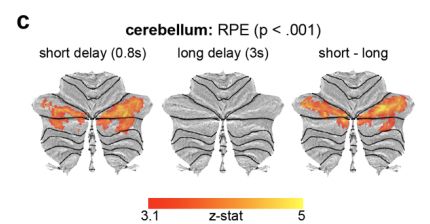
New preprint from the lab! 🧠
Led by Juliana Trach, w/ Sophia Ou
Using fMRI, we discovered evidence for time-sensitive reward prediction errors (RPEs) in the human cerebellum.
Builds on, and extends, recent work in both rodents and NHPs
Led by Juliana Trach, w/ Sophia Ou
Using fMRI, we discovered evidence for time-sensitive reward prediction errors (RPEs) in the human cerebellum.
Builds on, and extends, recent work in both rodents and NHPs
September 8, 2025 at 2:31 PM
New preprint from the lab! 🧠
Led by Juliana Trach, w/ Sophia Ou
Using fMRI, we discovered evidence for time-sensitive reward prediction errors (RPEs) in the human cerebellum.
Builds on, and extends, recent work in both rodents and NHPs
Led by Juliana Trach, w/ Sophia Ou
Using fMRI, we discovered evidence for time-sensitive reward prediction errors (RPEs) in the human cerebellum.
Builds on, and extends, recent work in both rodents and NHPs
Reposted by Jonathan Nicholas

I'm excited to share that my new postdoctoral position is going so well that I submitted a new paper at the end of my first week! www.biorxiv.org/content/10.1... A thread below

Sensory Compression as a Unifying Principle for Action Chunking and Time Coding in the Brain
The brain seamlessly transforms sensory information into precisely-timed movements, enabling us to type familiar words, play musical instruments, or perform complex motor routines with millisecond pre...
www.biorxiv.org
September 6, 2025 at 2:36 PM
I'm excited to share that my new postdoctoral position is going so well that I submitted a new paper at the end of my first week! www.biorxiv.org/content/10.1... A thread below
Reposted by Jonathan Nicholas

Successful prediction of the future enhances encoding of the present.
I am so delighted that this work found a wonderful home at Open Mind. The peer review journey was a rollercoaster but it *greatly* improved the paper.
direct.mit.edu/opmi/article...
I am so delighted that this work found a wonderful home at Open Mind. The peer review journey was a rollercoaster but it *greatly* improved the paper.
direct.mit.edu/opmi/article...
August 9, 2025 at 4:27 PM
Successful prediction of the future enhances encoding of the present.
I am so delighted that this work found a wonderful home at Open Mind. The peer review journey was a rollercoaster but it *greatly* improved the paper.
direct.mit.edu/opmi/article...
I am so delighted that this work found a wonderful home at Open Mind. The peer review journey was a rollercoaster but it *greatly* improved the paper.
direct.mit.edu/opmi/article...
Reposted by Jonathan Nicholas

Thrilled to announce that I'll be starting in January 2026 as an Assistant Professor of Psychology at Hunter College, City University of New York.
The lab will study the thought processes that underlie our decision-making.
The lab will study the thought processes that underlie our decision-making.

August 6, 2025 at 4:35 PM
Thrilled to announce that I'll be starting in January 2026 as an Assistant Professor of Psychology at Hunter College, City University of New York.
The lab will study the thought processes that underlie our decision-making.
The lab will study the thought processes that underlie our decision-making.
Reposted by Jonathan Nicholas
Very happy to see this work with Euan Prentis posted! If you’re going to CCN next week, go check out Euan’s poster on this work!

Overcoming distortion in multidimensional predictive representation https://www.biorxiv.org/content/10.1101/2025.07.29.667463v1
July 31, 2025 at 9:03 PM
Very happy to see this work with Euan Prentis posted! If you’re going to CCN next week, go check out Euan’s poster on this work!
Reposted by Jonathan Nicholas

My first, first author paper, comparing the properties of memory-augmented large language models and human episodic memory, out in @cp-trendscognsci.bsky.social!
authors.elsevier.com/a/1lV174sIRv...
Here’s a quick 🧵(1/n)
authors.elsevier.com/a/1lV174sIRv...
Here’s a quick 🧵(1/n)
authors.elsevier.com
July 26, 2025 at 3:05 PM
My first, first author paper, comparing the properties of memory-augmented large language models and human episodic memory, out in @cp-trendscognsci.bsky.social!
authors.elsevier.com/a/1lV174sIRv...
Here’s a quick 🧵(1/n)
authors.elsevier.com/a/1lV174sIRv...
Here’s a quick 🧵(1/n)
Reposted by Jonathan Nicholas

Super excited to share this one!! Meta-learning sparsity and learning rate gives rise to brain-like gradients of complementary learning systems. So complementary learning systems emerge organically through behavior optimization, and it's not just two of them!!

Excited to share a new preprint w/ @annaschapiro.bsky.social! Why are there gradients of plasticity and sparsity along the neocortex–hippocampus hierarchy? We show that brain-like organization of these properties emerges in ANNs that meta-learn layer-wise plasticity and sparsity. bit.ly/4kB1yg5

A gradient of complementary learning systems emerges through meta-learning
Long-term learning and memory in the primate brain rely on a series of hierarchically organized subsystems extending from early sensory neocortical areas to the hippocampus. The components differ in t...
bit.ly
July 16, 2025 at 4:18 PM
Super excited to share this one!! Meta-learning sparsity and learning rate gives rise to brain-like gradients of complementary learning systems. So complementary learning systems emerge organically through behavior optimization, and it's not just two of them!!
the paper looks cool, excited to dig in!
July 5, 2025 at 10:06 AM
the paper looks cool, excited to dig in!
Reposted by Jonathan Nicholas

Thrilled to see our TinyRNN paper in @nature! We show how tiny RNNs predict choices of individual subjects accurately while staying fully interpretable. This approach can transform how we model cognitive processes in both healthy and disordered decisions. doi.org/10.1038/s415...
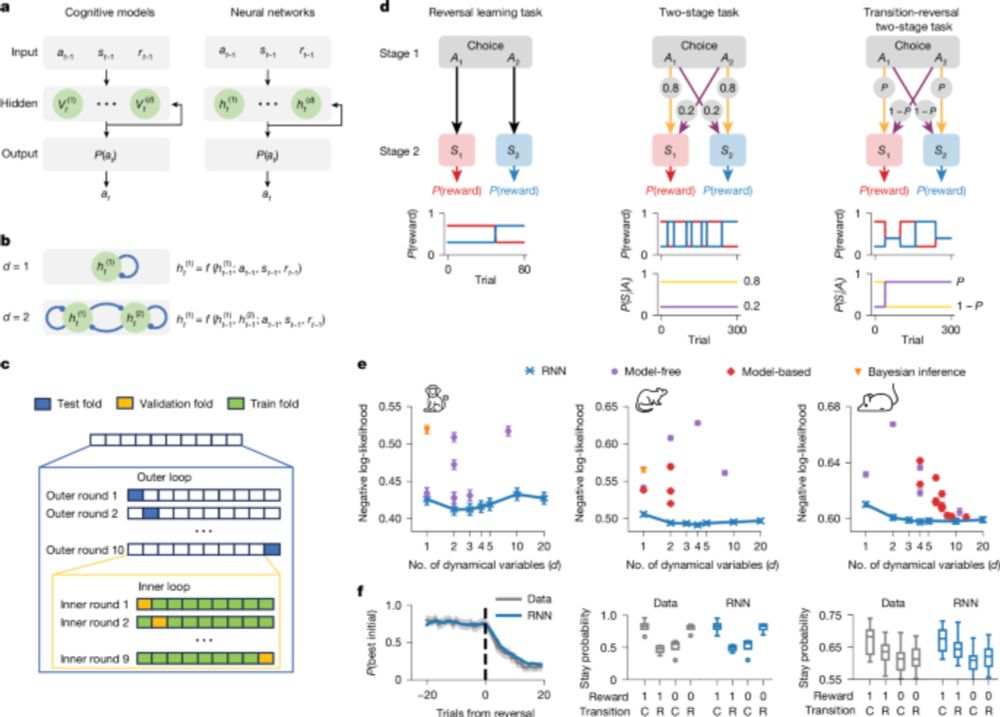
Discovering cognitive strategies with tiny recurrent neural networks - Nature
Modelling biological decision-making with tiny recurrent neural networks enables more accurate predictions of animal choices than classical cognitive models and offers insights into the underlying cog...
doi.org
July 2, 2025 at 7:03 PM
Thrilled to see our TinyRNN paper in @nature! We show how tiny RNNs predict choices of individual subjects accurately while staying fully interpretable. This approach can transform how we model cognitive processes in both healthy and disordered decisions. doi.org/10.1038/s415...