Jonathan Lenoir 🌳🌲🌴
banner
jonlen.bsky.social
Jonathan Lenoir 🌳🌲🌴
@jonlen.bsky.social

Senior researcher @CNRS (EDYSAN) @UPJV, Amiens, France #PhD in #forest #sciences 🌳🌲🌴 I study #biodiversity #plant #species #redistribution #microclimate #ecology #biostatistics #climatechange #BioShifts I don't wear 👨‍🔬 & never used a 🧪, yet I'm a scientist .. more

Environmental science 59%
Geography 16%

Entretien grand angle avec Aurélien Boutaud de M3 Métropole Grand Lyon sur l'adaptation des forêts françaises au changement climatique 🌳🌲🐿🦉🦎🐜🌡📈

🌍🌎🌏🌐🧪

@cnrsecologie.bsky.social
@cnrs-hautsdefrance.bsky.social
@upjv-univ.bsky.social
@cnrs.fr

shorturl.at/yDlig
Jonathan Lenoir, écologue (CNRS, Université de Picardie) : « En forêt, la diversité est une alliée face au changement climatique » | Millénaire 3
Dépérissement des arbres, incendies dévastateurs, perte de biodiversité… Ces véritables poumons verts de notre territoire subissent de plein fouet le réchauffement climatique.
shorturl.at
Climate change has already reshaped the bioclimatic space of extreme events in the Arctic 🌐❄️ Arctic biodiversity has entered a new era of bioclimatic extremes w/ more droughts, greater winter-warming 📈 & more rain-on-snow events 💧❄️

shorturl.at/pQsVP

Just published in Science Advances ⬇️
A new era of bioclimatic extremes in the terrestrial Arctic
Long-term climate data suggest that the Arctic is entering a new era of bioclimatic extremes threatening cold ecosystems.
shorturl.at

The CESABINAR #12 featuring the BIOSHIFTS group will start in about 2 hours (at 3 pm CET). Here are the info you need to join the webinar:

Zoom link:

us06web.zoom.us/j/8295073328...

Secret key:

486426

Reposted by Jonathan Lenoir

Our next #CESABINAR will take place on Dec 11th, 3 pm, Paris time

Lise Conte and Jonathan Lenoir will present the work of the #BIOSHIFT group:

👉 Global redistribution of biodiversity

Zoom : us06web.zoom.us/j/8295073328...
key : 486426

@jonlen.bsky.social @frbiodiv.bsky.social
🌐🧪🌍🦤🦑🪴🍁

Reposted by Billur Bektaş

On Thursday 11th December, at 3 PM CET, we will present results from our #CESAB working group #BIOSHIFTS on species range shifts in response to climate change 🌡📈🌳🦔🦉🐝🦎🐟🐚🦈

CESABINAR #12

Find the Zoom link on the webpage of #FRB below & attend 😊

shorturl.at/p7J2R

@frbiodiv.bsky.social

🧪🌐🌍🌎🌏🏔⛰️🗻

Offre de postdoc de 13 mois à pourvoir dans notre unité EDYSAN, à Amiens, sur l'analyse de données de séries temporelles de températures de l'air et de l'eau au sein des ripisylves de Thiérache (Picardie)

Microclimats des ripisylves 🌳💧🌳

shorturl.at/lYeJg
Post-Doctorat (2026-2027) en Analyse des Microclimats des Ripisylves
Contexte du poste Le poste s’inscrit dans le projet Contrat plant Etat-Région (CPER) intitulé « ECRIN – Environnement Climat – Recherche et Innovation » qui a pour objectif de mieux identifier et c…
shorturl.at

Thanks Brunno ☺️

Mince je viens de voir que c'est pour un stage de 2 mois 😅 Bon, du coup tu peux ignorer ma réponse 😅

Je t'ai fait suivre une candidature spontanée d'une étudiante de Montpellier qui à fait une candidature spontanée et sa lettre de motivation est bien rédigée. Je pense que l'offre de stage bryo pourrait l'intéresser

Reposted by Jonathan Lenoir

📢 Annonce offre de stage (2 mois)
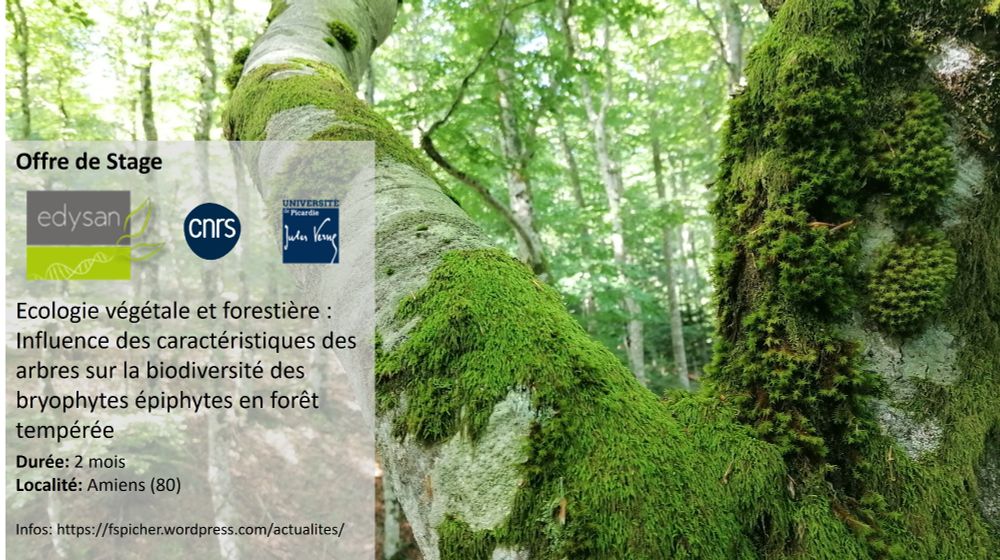
L'unité #EDYSAN propose un stage s’intéressant à l'influence des caractéristiques des arbres sur la biodiversité des bryophytes épiphytes en forêt tempérée.
#bryologie #mousses #forêt #écorce #microclimat

Plus d'information: tinyurl.com/m2sp4zfr

Thanks a lot Brian ☺️
#Prix&Distinctions 🏆
Toutes nos félicitations à Frédéric Thomas (UMR Mivegec), Sylvain Gandon (UMR Cefe) et Jonathan Lenoir (UMR Edysan) ! 🥳
www.inee.cnrs.fr/fr/cnrsinfo/...
Trois chercheurs d’unités CNRS Écologie & Environnement récompensés par l’Académie des sciences
Comme chaque année, l’Académie des sciences remet près de 80 prix couvrant l’ensemble des domaines scientifiques, aussi bien fondamentaux qu’appliqués
www.inee.cnrs.fr

Reposted by Jonathan Lenoir

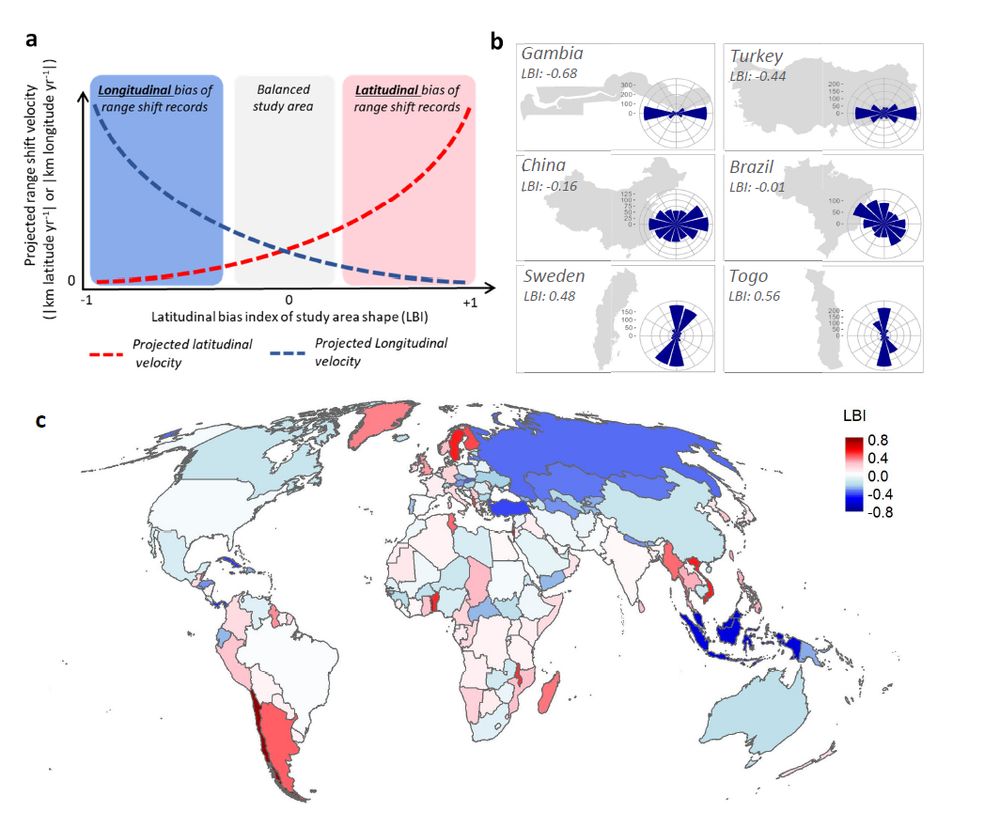
We revealed that species range shift studies globally tend to have a geographic set-up that facilitates the detection of poleward movements, as expected with warming. This leads to the perception that poleward, warming-driven range shifts predominate.

Thanks a lot Jono 😊

Thanks Stephane ☺️

Thanks a lot Tommaso 😊

Thanks Timo 😊

Merci Nicolas ☺️

You definitely are 🙏🫶

Thank you Daijiang 😊

Thanks a lot Robert 😊

Thank you Martin ❤️

Thanks a lot Fabricio 😊

I am so proud to receive the #Foulon price from the French Academy of Sciences 🤩 This is a huge recognition & it means a lot to me 🙏 I dedicate this price to all my close colleagues & collabortors in 🇨🇵, 🇪🇺 & 🌐🌏🌎🌍 without whom it would not have been possible

@academiesciences.bsky.social

*Erratum : il s'agit du prix Foulon 😉

Reposted by Jonathan Lenoir

@jonlen.bsky.social s’intéresse aux répercussions des changements globaux sur la redistribution du vivant et a démontré qu’en réponse au réchauffement global des températures, il existe une dynamique bien plus complexe qu’un simple déplacement des espèces vers les pôles et les sommets.
Study area shape matters when tracking species range shifts & we may underestimate longitudinal range shifts to the benefit of latitudinal range shifts, potentially undermining drivers other than T°C 🌡

🌐🌏🌎🌍🧪🐠🐍🦋🦉🦇🌳🌲

shorturl.at/prp63
Global bias towards recording latitudinal range shifts - Nature Climate Change
The authors consider studies reporting species range shifts and demonstrate a geometric bias in sampling along latitudinal, rather than longitudinal, gradients. This bias may favour the corroboration ...
shorturl.at

We have been very fortunate too to have you in the team 😉