Yue Kris Wu
kriswu.bsky.social
Yue Kris Wu
@kriswu.bsky.social

Postdoc at the Center for Theoretical Neuroscience at Columbia University
yuekriswu.github.io

Wu Yue may refer to the following:Wuyue, a 10th-century kingdom during the Five Dynasties and Ten Kingdoms period Sacred Mountains of China, also known as "Wu Yue" in Chinese

Source: Wikipedia
Environmental science 42%
Computer science 38%
Pinned
Excited to share our new work from @kenmiller.bsky.social lab!

How do different cell types, interacting via recurrent connections, give rise to context-dependent processing and circuit stability, and what dynamical signatures reveal their individual roles? (1/11)

doi.org/10.64898/2026.02.06.704473
doi.org

I will present a poster on this work at Cosyne and would be very happy to discuss it further with anyone interested.
Excited to share our new work from @kenmiller.bsky.social lab!

How do different cell types, interacting via recurrent connections, give rise to context-dependent processing and circuit stability, and what dynamical signatures reveal their individual roles? (1/11)

doi.org/10.64898/2026.02.06.704473
doi.org

Reposted by Yue Wu

Applications are now open for the summer school: 𝐌𝐚𝐭𝐡𝐞𝐦𝐚𝐭𝐢𝐜𝐚𝐥 𝐌𝐞𝐭𝐡𝐨𝐝𝐬 𝐢𝐧 𝐂𝐨𝐦𝐩𝐮𝐭𝐚𝐭𝐢𝐨𝐧𝐚𝐥 𝐍𝐞𝐮𝐫𝐨𝐬𝐜𝐢𝐞𝐧𝐜𝐞

🧠 Apply before March 15: www.compneuronrsn.org

📍 Located in beautiful Eresfjord 🇳🇴
🗓️ Between July 6-24

Supported by the @kavlifoundation.org
In collaboration with @kavlintnu.bsky.social
Mathematical Methods in Computational Neuroscience
Summer school in Eresfjord, Norway (July 8th - 26th, 2024)
www.compneuronrsn.org

Reposted by Yue Wu

🚨 preprint alert!

Check out our revised manuscript out on bioRxiv, where we strengthen the link between D1-dependent dopamine signaling in the anterior insular cortex and the control of anxiety.

@anna-beyeler.bsky.social

www.biorxiv.org/content/10.1...

Finally, we highlight the importance of ubiquitous biological features, such as recurrent connections and input-output nonlinearities, in shaping the integration of feedforward and feedback inputs during context-dependent processing. (11/11)

We show that assessing cell-type-specific circuit stabilization requires patterned perturbations, where paradoxical effects manifest along specific activity modes. We further characterize the spatial structure of the required patterned perturbations. (10/11)

As shown below, although SST is required for stabilization across the top optimized models under this stimulus condition, a uniform excitatory perturbation of SST does not always paradoxically decrease in its mean activity; in several models, the mean activity instead increases. (9/11)

Interestingly, we find that in high-dimensional spatially extended models, even when a specific inhibitory cell type is required for circuit stabilization, a uniform perturbation of it does not necessarily produce a paradoxical change in its mean activity. (8/11)

Most previous computational studies have focused on either population models or networks lacking explicit spatial structure. Perturbations used to probe paradoxical effects are typically applied uniformly to all inhibitory neurons, every inhibitory neuron receives the same perturbative input. (7/11)

As shown in Tsodyks et al. (1997), Sanzeni et al. (2020), and Sadeh & Clopath (2021), inhibition stabilization is commonly associated with paradoxical effects, whereby inhibitory activity paradoxically decreases in response to excitatory current injection into the inhibitory population. (6/11)

More specifically, while PV-mediated stabilization is indispensable across all models and stimulus conditions, SST-mediated stabilization is also required, and likely in a stimulus-dependent manner. (5/11)

This context-dependent shift in the dominance of cell-type-specific inhibition is accompanied by a corresponding change in cell-type-specific inhibition stabilization, that is, a change in the requirement of a particular inhibitory cell type for stabilization. (4/11)

Analysis of well-fitting models reveals that the dominant inhibitory cell type affecting excitatory neurons is not fixed but dynamically varies with stimulus and space. (3/11)

To answer these questions, we use data-driven approaches to construct spatially extended circuit models that capture the responses of diverse cell types in the mouse primary visual cortex during context-dependent processing. (2/11)
Our paper is out in @natneuro.nature.com!

www.nature.com/articles/s41...

We develop a geometric theory of how neural populations support generalization across many tasks.

@zuckermanbrain.bsky.social
@flatironinstitute.org
@kempnerinstitute.bsky.social

1/14

Reposted by Yue Wu
Thrilled to share that our work on neural circuits and economic decision-making is now published in @cp-neuron.bsky.social . Huge thanks to @camillopadoasch.bsky.social and @xjwanglab for this journey.

www.sciencedirect.com/science/arti...

Reposted by Yue Wu
Dear #Dendrites afficionados, due to popular demand we have extended the deadline for abstract submission by a few more days. Don’t miss the opportunity to join us for another amazing meeting on Dendrites in the beautiful Greek island of Crete!

Apply here: meetings.embo.org/event/26-den...

Reposted by Yue Wu
Early career researcher: Are you thinking about writing an ERC , Emmy Noether Proposal, or Lower Saxony AI Group application, and are you interested to work with us at @uni-goettingen.de and @goettingen-campus.de
Information Event on Funding Programs - Georg-August-University Göttingen
Website of the Georg-August-University Göttingen
www.uni-goettingen.de

Reposted by Yue Wu

Our new work is out in Science Advances. We show that neural activity in the striatum reflects not just cortical inputs, but also often-underappreciated thalamic inputs.

www.science.org/doi/10.1126/...
Complementary cortical and thalamic contributions to cell type–specific striatal activity dynamics during movement
Cell type–specific striatal activity during movement is shaped by cortical and thalamic inputs with complementary roles.
www.science.org

Reposted by Yue Wu

@braininspired.bsky.social talks with @michaelshadlen.bsky.social about his theory of how consciousness emerges and why only organisms with theory of mind possess consciousness.

#neuroskyence

www.thetransmitter.org/brain-inspir...
Michael Shadlen on how theory of mind ushers in consciousness
All our thoughts, mostly nonconscious, are interrogations of the world, he says. Reporting our answers to ourselves brings a thought into conscious awareness.
www.thetransmitter.org
The hippocampal map has its own attentional control signal!
Our new study reveals that theta #sweeps can be instantly biased towards behaviourally relevant locations. See 📹 in post 4/6 and preprint here 👉
www.biorxiv.org/content/10.6...
🧵(1/6)
Attention-like regulation of theta sweeps in the brain's spatial navigation circuit
Spatial attention supports navigation by prioritizing information from selected locations. A candidate neural mechanism is provided by theta-paced sweeps in grid- and place-cell population activity, which sample nearby space in a left-right-alternating pattern coordinated by parasubicular direction signals. During exploration, this alternation promotes uniform spatial coverage, but whether sweeps can be flexibly tuned to locations of particular interest remains unclear. Using large-scale Neuropixels recordings in freely-behaving rats, we show that sweeps and direction signals are rapidly and dynamically modulated: they track moving targets during pursuit, precede orienting responses during immobility, and reverse during backward locomotion — without prior spatial learning. Similar modulation occurs during REM sleep. Canonical head-direction signals remain head-aligned. These findings identify sweeps as a flexible, attention-like mechanism for selectively sampling allocentric cognitive maps. ### Competing Interest Statement The authors have declared no competing interest. European Research Council, Synergy Grant 951319 (EIM) The Research Council of Norway, Centre of Neural Computation 223262 (EIM, MBM), Centre for Algorithms in the Cortex 332640 (EIM, MBM), National Infrastructure grant (NORBRAIN, 295721 and 350201) The Kavli Foundation, https://ror.org/00kztt736 Ministry of Science and Education, Norway (EIM, MBM) Faculty of Medicine and Health Sciences; NTNU, Norway (AZV)
www.biorxiv.org

Reposted by Yue Wu

My perspective in @thetransmitter.bsky.social on why emotion research feels stuck and how we might move forward—by focusing on how the brain uses internal brain models to shape emotional processing across species. www.thetransmitter.org/emotion/why-...
Why emotion research is stuck—and how to move it forward
Studying how organisms infer indirect threats and understand changing contexts can establish a common framework that bridges species and levels of analysis.
www.thetransmitter.org

Very cool work on how distributed, recurrent neural circuits cooperate to implement evidence accumulation. www.cell.com/neuron/fullt...
A multi-region recurrent circuit for evidence accumulation in rats
Gupta et al. demonstrate that the rat prefrontal cortex and striatum jointly accumulate sensory evidence through recurrent, bidirectional communication rather than a feedforward hierarchy. Combining m...
www.cell.com

Reposted by Yue Wu, Dana Howard

Don’t let Russell Vought trick Congress into destroying science by removing multiyear funding limits from the NIH funding bill.

Reposted by Joanna Bryson, Yue Wu

Nature @nature.com · Jan 15
Nature research paper: Predictive coding of reward in the hippocampus

go.nature.com/49mB13V
Predictive coding of reward in the hippocampus - Nature
Calcium imaging of mouse hippocampal neurons while mice learn a reward-based task over several weeks provides insight into the evolution of the hippocampal reward representation during extended periods of experience.
go.nature.com

Reposted by Yue Wu

In 2026, Valentin Braitenberg would have celebrated his 100th birthday.

To commemorate this occasion, the Bernstein Network will present the next Valentin Braitenberg Award during the #BernsteinConference 2026.

Nominations are open until April 30 👉 bernstein-network.de/en/network/a...

It is gratifying to see the growing appreciation of theoretical and computational neuroscience over the years. A deep understanding of the brain undoubtedly requires close collaborations between experimentalists and theorists. magazine.columbia.edu/article/20-y...
20 Years of Modeling the Brain
At Columbia’s Center for Theoretical Neuroscience, scientists have spent the past two decades using computational models to predict neural behavior
magazine.columbia.edu

Reposted by Yue Wu

New preprint: visual attention may follow decisions more than it shapes them.
We identify behavioral signatures inconsistent with models in which attention affects value, instead pointing to a substantial post-decisional component.
www.biorxiv.org/content/10.6...
Behavioral Signatures of Post-Decisional Attention in Preferential Choice
Attention plays a key role in decision-making by directing limited cognitive resources to relevant information. It has been proposed that attention also biases the decision process, due to a multiplic...
www.biorxiv.org

Reposted by Yue Wu

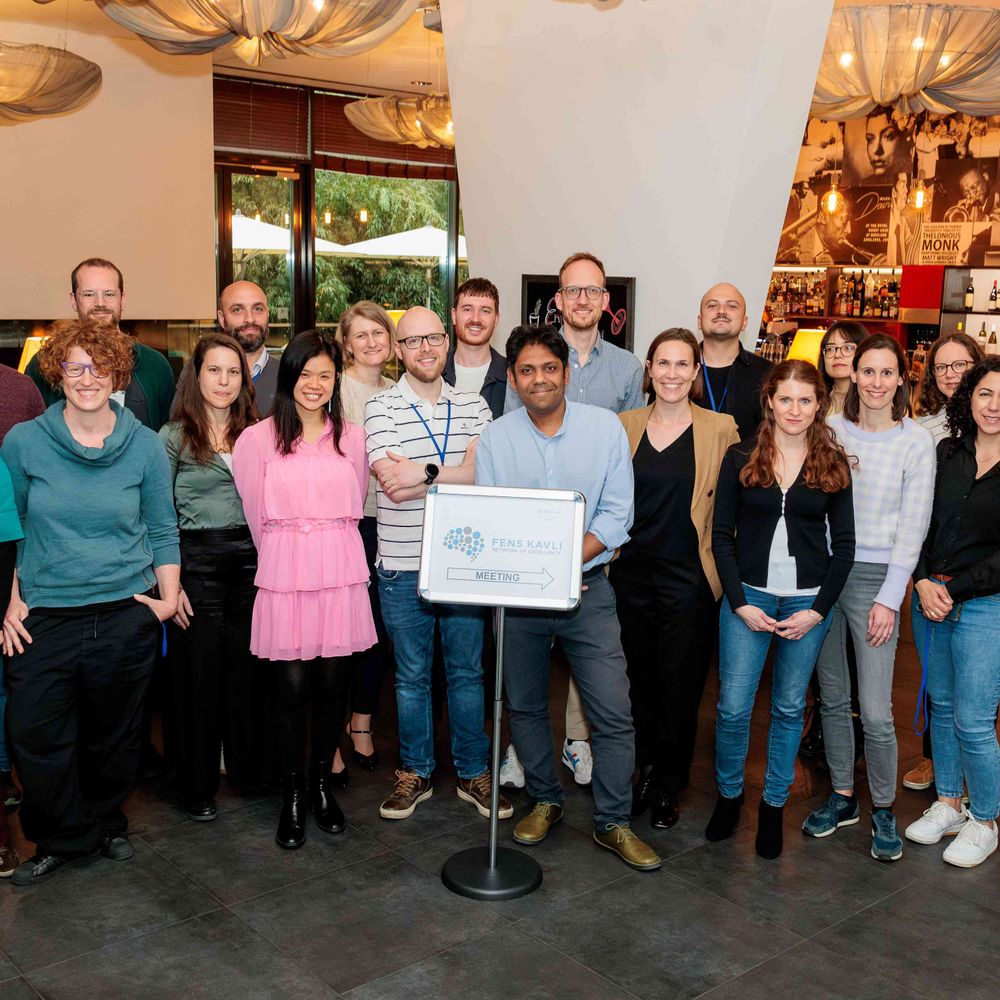
Step into a Europe-wide community of neuroscience leaders. Junior & mid-career group leaders: apply by 30 Jan to become a FENS-Kavli Network Scholar and connect, collaborate, and contribute to shaping neuroscience in Europe. rb.gy/havqur

Reposted by Yue Wu

Please spread the word🔊My lab is looking to hire two international postdocs. If you want to do comp neuro, combine machine learning and awesome math to understand neural circuit activity, then come work with us! Bonn is such a cool place for neuroscience now, you don't want to miss out.