




Lingonaut
@lingonaut.bsky.social
A volunteer made language learning platform built to teach and not to profit.
No ads, no subscriptions and no timers!
🔗 https://linktr.ee/Lingonaut
No ads, no subscriptions and no timers!
🔗 https://linktr.ee/Lingonaut
Pinned
Lingonaut
@lingonaut.bsky.social
· Sep 29
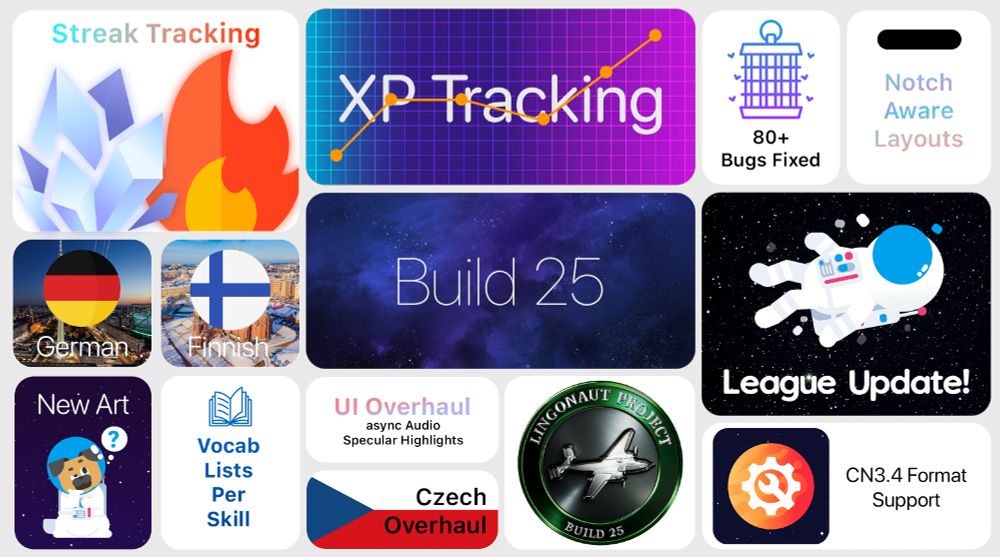
Lingonaut Build 25 is out and it's our biggest update yet!
Read more about it here!:
lingonaut.app/build-25-is-...
We've also added 1000 new spots to the beta so get in while you still can! lingonaut.app/beta
This mission relies on your patronage!
patreon.com/lingonaut
Read more about it here!:
lingonaut.app/build-25-is-...
We've also added 1000 new spots to the beta so get in while you still can! lingonaut.app/beta
This mission relies on your patronage!
patreon.com/lingonaut
TIL Zulu and Xhosa use clicks because of contact, not inheritance, their Bantu ancestors had none! They borrowed clicks from Khoisan neighbours and that spread into native words too. Both languages have three basic click types: written 'c' 'q' 'x' ! Xhosa is described as having 36 click consonants.
December 8, 2025 at 9:21 PM
TIL Zulu and Xhosa use clicks because of contact, not inheritance, their Bantu ancestors had none! They borrowed clicks from Khoisan neighbours and that spread into native words too. Both languages have three basic click types: written 'c' 'q' 'x' ! Xhosa is described as having 36 click consonants.
TIL Some languages have a 'mother-in-law register', in Dyirbal you switch to a special vocabulary whenever taboo in-laws are within earshot. The grammar stays the same but almost all content words change. E.g: ring-tail possum is usually called 'midin' - but 'jibuny' near MILs.
December 7, 2025 at 7:14 PM
TIL Some languages have a 'mother-in-law register', in Dyirbal you switch to a special vocabulary whenever taboo in-laws are within earshot. The grammar stays the same but almost all content words change. E.g: ring-tail possum is usually called 'midin' - but 'jibuny' near MILs.
You wanted a roadmap, we give you a roadmap!
we've un-retired the domain and now have a slick new way for you to catch up on what's what month-by month!
You can also see the timeline of the project from its inception in late 2023 all the way up to now!
roadmap.lingonaut.app
we've un-retired the domain and now have a slick new way for you to catch up on what's what month-by month!
You can also see the timeline of the project from its inception in late 2023 all the way up to now!
roadmap.lingonaut.app
Lingonaut Roadmap
See what the Lingonaut team is building next across the core web experience and Android app.
roadmap.lingonaut.app
December 6, 2025 at 7:04 PM
You wanted a roadmap, we give you a roadmap!
we've un-retired the domain and now have a slick new way for you to catch up on what's what month-by month!
You can also see the timeline of the project from its inception in late 2023 all the way up to now!
roadmap.lingonaut.app
we've un-retired the domain and now have a slick new way for you to catch up on what's what month-by month!
You can also see the timeline of the project from its inception in late 2023 all the way up to now!
roadmap.lingonaut.app
TIL Maltese is a Semitic language that developed from Arabic! It’s the only form of Arabic written in the Latin alphabet and has strong Sicilian influence. It’s also the only Semitic official language of the EU.
December 3, 2025 at 8:17 PM
TIL Maltese is a Semitic language that developed from Arabic! It’s the only form of Arabic written in the Latin alphabet and has strong Sicilian influence. It’s also the only Semitic official language of the EU.
TIL English 'they - them - their' are Scandinavian loans. Old English used 'hie - him - heora'.
After contact in the Danelaw, Norse 'þeir - þeim - þeirra' spread and displaced the native set - likely because it avoided clashes with 'he - him - her' as those forms converged!
After contact in the Danelaw, Norse 'þeir - þeim - þeirra' spread and displaced the native set - likely because it avoided clashes with 'he - him - her' as those forms converged!
December 1, 2025 at 11:48 AM
TIL English 'they - them - their' are Scandinavian loans. Old English used 'hie - him - heora'.
After contact in the Danelaw, Norse 'þeir - þeim - þeirra' spread and displaced the native set - likely because it avoided clashes with 'he - him - her' as those forms converged!
After contact in the Danelaw, Norse 'þeir - þeim - þeirra' spread and displaced the native set - likely because it avoided clashes with 'he - him - her' as those forms converged!
Lingonaut Build 36 Update is live!
More beta places are out as of right now! Sign up at lingonaut.app/beta
More beta places are out as of right now! Sign up at lingonaut.app/beta
Beta – Lingonaut
lingonaut.app
November 30, 2025 at 6:38 PM
Lingonaut Build 36 Update is live!
More beta places are out as of right now! Sign up at lingonaut.app/beta
More beta places are out as of right now! Sign up at lingonaut.app/beta
Welcome to November's What's new with Lingonaut!
-Translatonauts, Tablets and Thanksgiving!-
This month is a real great read and I tried shortening it for your reading pleasure, and you can find it here:
lingonaut.app/translatonau...
-Translatonauts, Tablets and Thanksgiving!-
This month is a real great read and I tried shortening it for your reading pleasure, and you can find it here:
lingonaut.app/translatonau...
Translatonauts, Tablets and Thanksgiving! #WNWL 7 – Lingonaut
lingonaut.app
November 29, 2025 at 8:15 PM
Welcome to November's What's new with Lingonaut!
-Translatonauts, Tablets and Thanksgiving!-
This month is a real great read and I tried shortening it for your reading pleasure, and you can find it here:
lingonaut.app/translatonau...
-Translatonauts, Tablets and Thanksgiving!-
This month is a real great read and I tried shortening it for your reading pleasure, and you can find it here:
lingonaut.app/translatonau...
Negative concord is normal in many languages! It’s only standard English (+ a few others) that ban it.
Spanish - ‘no vi a nadie’ and Italian ‘non ho vista nessuno’ both mean ‘I saw nobody’. and it’s not a double negative!
Even some English dialects allow it too :D
Spanish - ‘no vi a nadie’ and Italian ‘non ho vista nessuno’ both mean ‘I saw nobody’. and it’s not a double negative!
Even some English dialects allow it too :D
November 28, 2025 at 10:20 PM
Negative concord is normal in many languages! It’s only standard English (+ a few others) that ban it.
Spanish - ‘no vi a nadie’ and Italian ‘non ho vista nessuno’ both mean ‘I saw nobody’. and it’s not a double negative!
Even some English dialects allow it too :D
Spanish - ‘no vi a nadie’ and Italian ‘non ho vista nessuno’ both mean ‘I saw nobody’. and it’s not a double negative!
Even some English dialects allow it too :D
🇩🇪German course update 27/11/25🇩🇪
Added lots of new lessons
Added images to all the skills and their notes
Revised and reformatted guides
Added text to speech for all the questions (preparing for real speech soon!)
Tons of new content!
Credits: WrenMala08, Fuchsteufel, Adrian7 , ElMago, pilvi#2140
Added lots of new lessons
Added images to all the skills and their notes
Revised and reformatted guides
Added text to speech for all the questions (preparing for real speech soon!)
Tons of new content!
Credits: WrenMala08, Fuchsteufel, Adrian7 , ElMago, pilvi#2140
November 27, 2025 at 8:56 PM
🇩🇪German course update 27/11/25🇩🇪
Added lots of new lessons
Added images to all the skills and their notes
Revised and reformatted guides
Added text to speech for all the questions (preparing for real speech soon!)
Tons of new content!
Credits: WrenMala08, Fuchsteufel, Adrian7 , ElMago, pilvi#2140
Added lots of new lessons
Added images to all the skills and their notes
Revised and reformatted guides
Added text to speech for all the questions (preparing for real speech soon!)
Tons of new content!
Credits: WrenMala08, Fuchsteufel, Adrian7 , ElMago, pilvi#2140
Some languages build ‘two’ into grammar!
Slovene has dual pronouns and verb forms: ‘midva greva’ - we two vs ‘mi gremo’ - we go.
Arabic marks duality on nouns and agreement: ‘kitāb’ - book vs ‘kitābān’ - 2 books (gen/acc: kitābayn)
English used to have them too but I've ran out of space so byeee
Slovene has dual pronouns and verb forms: ‘midva greva’ - we two vs ‘mi gremo’ - we go.
Arabic marks duality on nouns and agreement: ‘kitāb’ - book vs ‘kitābān’ - 2 books (gen/acc: kitābayn)
English used to have them too but I've ran out of space so byeee
November 27, 2025 at 8:07 PM
Some languages build ‘two’ into grammar!
Slovene has dual pronouns and verb forms: ‘midva greva’ - we two vs ‘mi gremo’ - we go.
Arabic marks duality on nouns and agreement: ‘kitāb’ - book vs ‘kitābān’ - 2 books (gen/acc: kitābayn)
English used to have them too but I've ran out of space so byeee
Slovene has dual pronouns and verb forms: ‘midva greva’ - we two vs ‘mi gremo’ - we go.
Arabic marks duality on nouns and agreement: ‘kitāb’ - book vs ‘kitābān’ - 2 books (gen/acc: kitābayn)
English used to have them too but I've ran out of space so byeee
Our Creatonaut Course creator has had a massive update!
This change adds lots and fixes lots in preparation for the next language we're adding. We're basically at the point where Creatonaut is more is less complete!
It's free and anyone can use it at creatonaut.lingonaut.app
Changelog below \|/
This change adds lots and fixes lots in preparation for the next language we're adding. We're basically at the point where Creatonaut is more is less complete!
It's free and anyone can use it at creatonaut.lingonaut.app
Changelog below \|/

November 26, 2025 at 7:12 PM
Our Creatonaut Course creator has had a massive update!
This change adds lots and fixes lots in preparation for the next language we're adding. We're basically at the point where Creatonaut is more is less complete!
It's free and anyone can use it at creatonaut.lingonaut.app
Changelog below \|/
This change adds lots and fixes lots in preparation for the next language we're adding. We're basically at the point where Creatonaut is more is less complete!
It's free and anyone can use it at creatonaut.lingonaut.app
Changelog below \|/
Many languages split ‘we’ into two, inclusive and exclusive. Inclusive ‘we’ includes the listener while exclusive ‘we’ doesn’t!
Tagalog: tayo vs kami Tok Pisin: yumi vs mipela
Fijian: keda vs keimami
Quechua: ñuaanchik vs ñuggyku
English only has one we though! weeee
Tagalog: tayo vs kami Tok Pisin: yumi vs mipela
Fijian: keda vs keimami
Quechua: ñuaanchik vs ñuggyku
English only has one we though! weeee
November 22, 2025 at 5:07 PM
Many languages split ‘we’ into two, inclusive and exclusive. Inclusive ‘we’ includes the listener while exclusive ‘we’ doesn’t!
Tagalog: tayo vs kami Tok Pisin: yumi vs mipela
Fijian: keda vs keimami
Quechua: ñuaanchik vs ñuggyku
English only has one we though! weeee
Tagalog: tayo vs kami Tok Pisin: yumi vs mipela
Fijian: keda vs keimami
Quechua: ñuaanchik vs ñuggyku
English only has one we though! weeee

Just a reminder that if you like what we do repost and tell your friends :)
November 18, 2025 at 3:49 PM
Just a reminder that if you like what we do repost and tell your friends :)
TIL: Finnish has no separate future tense. The present covers future time. ‘Huomenna sataa’ - literally ‘tomorrow it rains’ which means it will rain tomorrow. Speakers add time words or modals when needed and the pattern is common cross-linguistically!
November 18, 2025 at 1:48 PM
TIL: Finnish has no separate future tense. The present covers future time. ‘Huomenna sataa’ - literally ‘tomorrow it rains’ which means it will rain tomorrow. Speakers add time words or modals when needed and the pattern is common cross-linguistically!
Lingonaut Build 31 'Tock' Update
This change is focused on fixing bugs, improving quality of life and compatibility as well as bringing the course engine in line with Creatonaut 3.4! We've also added additional places to the beta, join while there's space!
lingonaut.app/beta
This change is focused on fixing bugs, improving quality of life and compatibility as well as bringing the course engine in line with Creatonaut 3.4! We've also added additional places to the beta, join while there's space!
lingonaut.app/beta
lingonaut.app
November 17, 2025 at 12:04 PM
Lingonaut Build 31 'Tock' Update
This change is focused on fixing bugs, improving quality of life and compatibility as well as bringing the course engine in line with Creatonaut 3.4! We've also added additional places to the beta, join while there's space!
lingonaut.app/beta
This change is focused on fixing bugs, improving quality of life and compatibility as well as bringing the course engine in line with Creatonaut 3.4! We've also added additional places to the beta, join while there's space!
lingonaut.app/beta
TIL ‘Robot’ is Czech! Karel Capek’s R.U.R. (1920) introduced it, from ‘robota’ meaning ‘forced labour’. His brother Josef coined the word. In the play the robots are lab-made biological workers rather than metal machines, that idea came later.
November 14, 2025 at 9:16 PM
TIL ‘Robot’ is Czech! Karel Capek’s R.U.R. (1920) introduced it, from ‘robota’ meaning ‘forced labour’. His brother Josef coined the word. In the play the robots are lab-made biological workers rather than metal machines, that idea came later.
Some languages don’t have exact words for exact numbers. Piraha in the Amazon uses words roughly meaning ‘small quantity’ and ‘larger quantity’ instead of ‘1' and '2’, and experiments found that speakers approximate amounts but struggle with exact quantities once sets get bigger or go out of sight!
November 13, 2025 at 6:24 PM
Some languages don’t have exact words for exact numbers. Piraha in the Amazon uses words roughly meaning ‘small quantity’ and ‘larger quantity’ instead of ‘1' and '2’, and experiments found that speakers approximate amounts but struggle with exact quantities once sets get bigger or go out of sight!
TIL Spanish ‘ñ’ began as shorthand for ‘nn’, kinda like ß being ss in German! Medieval scribes wrote an ’n’ with a small wavy line above it (the tilde) and ‘anno’ became ‘año’. The shorthand later became a distinct letter in Spanish and spread to Galician and Basque too.
November 9, 2025 at 2:42 PM
TIL Spanish ‘ñ’ began as shorthand for ‘nn’, kinda like ß being ss in German! Medieval scribes wrote an ’n’ with a small wavy line above it (the tilde) and ‘anno’ became ‘año’. The shorthand later became a distinct letter in Spanish and spread to Galician and Basque too.
TIL Many languages don’t use the verb ‘have’! Instead of ‘I have a book’ they would say ‘at me is a book’.
Russian: u menya est’ king.
Irish: tá leabhar agam.
Hebrew: yesh li sefer.
They combine the verb for ‘to be’ with an adposition!
Russian: u menya est’ king.
Irish: tá leabhar agam.
Hebrew: yesh li sefer.
They combine the verb for ‘to be’ with an adposition!
November 5, 2025 at 9:35 PM
TIL Many languages don’t use the verb ‘have’! Instead of ‘I have a book’ they would say ‘at me is a book’.
Russian: u menya est’ king.
Irish: tá leabhar agam.
Hebrew: yesh li sefer.
They combine the verb for ‘to be’ with an adposition!
Russian: u menya est’ king.
Irish: tá leabhar agam.
Hebrew: yesh li sefer.
They combine the verb for ‘to be’ with an adposition!
Hindu and Urdu are one spoken language, Hindustani! They’re split apart by script and prestige vocabulary.
Hindi uses Devanagari and more Sanskrit loans while Urdu uses Nastaliq and more Persian/Arabic loans.
Colloquial speech is mostly mutually intelligible though!
Hindi uses Devanagari and more Sanskrit loans while Urdu uses Nastaliq and more Persian/Arabic loans.
Colloquial speech is mostly mutually intelligible though!
November 1, 2025 at 7:46 PM
Hindu and Urdu are one spoken language, Hindustani! They’re split apart by script and prestige vocabulary.
Hindi uses Devanagari and more Sanskrit loans while Urdu uses Nastaliq and more Persian/Arabic loans.
Colloquial speech is mostly mutually intelligible though!
Hindi uses Devanagari and more Sanskrit loans while Urdu uses Nastaliq and more Persian/Arabic loans.
Colloquial speech is mostly mutually intelligible though!
Now is the time to flex that pledge! (Or if you don't have one yet, to grab one!)
Should we go with the Android client next or the Web client? You decide!
www.patreon.com/posts/142398...
Thank you to our patrons for helping keep lingonaut free for everyone!
Should we go with the Android client next or the Web client? You decide!
www.patreon.com/posts/142398...
Thank you to our patrons for helping keep lingonaut free for everyone!

Poll: Web or Android, we can have one by the end of the year | Lingonaut
Get more from Lingonaut on Patreon
www.patreon.com
October 30, 2025 at 9:59 AM
Now is the time to flex that pledge! (Or if you don't have one yet, to grab one!)
Should we go with the Android client next or the Web client? You decide!
www.patreon.com/posts/142398...
Thank you to our patrons for helping keep lingonaut free for everyone!
Should we go with the Android client next or the Web client? You decide!
www.patreon.com/posts/142398...
Thank you to our patrons for helping keep lingonaut free for everyone!
Sick of the energy update? lingonaut.app, has infinite energy, infinite hearts and is made with infinite heart ❤️
Free for everyone, no paywalls, no mtx and no AI. Join the beta now! lingonaut.app/beta
Free for everyone, no paywalls, no mtx and no AI. Join the beta now! lingonaut.app/beta
Lingonaut – A language learning app to teach, not to profit.
Lingonaut.app
October 25, 2025 at 1:25 PM
Sick of the energy update? lingonaut.app, has infinite energy, infinite hearts and is made with infinite heart ❤️
Free for everyone, no paywalls, no mtx and no AI. Join the beta now! lingonaut.app/beta
Free for everyone, no paywalls, no mtx and no AI. Join the beta now! lingonaut.app/beta
Icelanders don't really use family surnames! Names are patronymic or matronymic, Jon Einarsson's daughter is Anna Jondottir and his son would be Olafur Jonnson!
People are listed and addressed by their first name, and a state Naming Committee approves new given names.
People are listed and addressed by their first name, and a state Naming Committee approves new given names.
October 22, 2025 at 3:37 PM
Icelanders don't really use family surnames! Names are patronymic or matronymic, Jon Einarsson's daughter is Anna Jondottir and his son would be Olafur Jonnson!
People are listed and addressed by their first name, and a state Naming Committee approves new given names.
People are listed and addressed by their first name, and a state Naming Committee approves new given names.