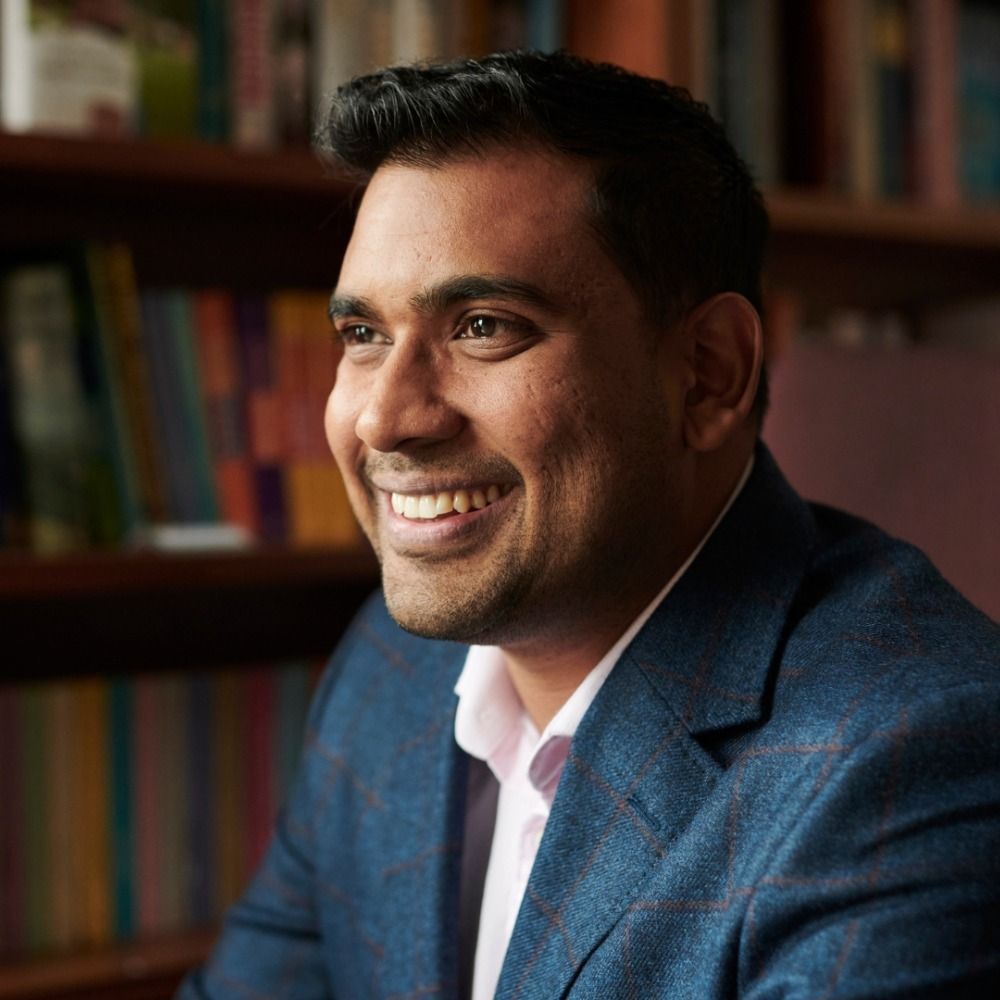
Michael Muthukrishna
michael.muthukrishna.com
Michael Muthukrishna
@michael.muthukrishna.com

Prof. #LSE. Author: A Theory of Everyone. Researching & spreading the word on how humans evolved & what that means for us today. www.atheoryofeveryone.com

Michael Muthukrishna is a professor of economic psychology at the London School of Economics and Political Science (LSE), in England. He is an affiliate of the Developmental Economics Group at the LSE's STICERD, technical director of UBC's Database of Religious History, and CIFAR's Azrieli Global Scholar in the Boundaries, Membership and Belonging programme. His main area of interest is the application of research in cultural evolution to public policy. .. more

Psychology 37%
Sociology 21%
In a recent @timeshighered.bsky.social article, Professor @michael.muthukrishna.com highlights the lack of opportunity for academics to take their research where it can inform decision-making. Our @academicsbureau.bsky.social initiative tackles this issue: academicspeakersbureau.com
📢CfP: The Cultural Evolution of Migration and Diversity conference @wzb.bsky.social

We want to bring together cultural evolution scholars & social
scientists to explore how evolutionary perspectives can contribute to empirical research on migration & diversity.

Keynote by @michael.muthukrishna.com
This is a fascinating bit of research diving into why some octopuses have larger brains than others. #science #intelligence #evolution
It was great talking to @michael.muthukrishna.com, @pkatz.bsky.social and Robin Dunbar about this for @newscientist.com
🧪 🦑 🧠

www.newscientist.com/article/2512...
Octopuses prompt rethink of why animals evolve big brains
A popular idea suggests a link between big brains and a rich social life, but octopuses don't fit the pattern, which suggests something else is going on
www.newscientist.com

One-size-policy-recommendations-do-not-fit-all.

Our North Star (or Southern Cross) is simple:
Leave no mind behind.

Grateful to colleagues at @UNDPasiapac and to the global group of scholars who contributed. A genuinely international effort at a critical moment.

www.undp.org/asia-pa...
13/15

But AI can drive development and narrow gaps - we offer differentiated policy roadmaps:

• By starting point
• With steps at time horizons: 0–12 months, 1–2 years, 3–5 years
• And by sector (health, education, finance, agriculture, biodiversity, governance)
12/15

As well as real and potential opportunities:

• AI tutors in remote or multilingual settings
• Diagnostics in clinics without specialists
• Climate and disaster modelling for Pacific Island countries
• SME credit access through alternative data
11/15

We discuss AI development traps, such as:

• Dependency on foreign cloud/models
• Automation without productivity
• Pilots that never scale or can't without dependence on ongoing foreign investment
• Limited ability to govern or adapt systems
10/15

The report discusses the risks and opportunities across 3 channels:

👨‍👩‍👦‍👦 People: Uneven access to health, education, security, and data visibility
💱 Economy: Divergent productivity gains and job exposure
🏛️ Governance: Big differences in state capability, trust, and readiness
9/15

Even within countries, the GDP per capita of Kuala Lumpur and Shanghai are similar (~$30,000) while the GDP of the poorest Malaysian state, Kelantan, would rank in the lower half of an Asia-Pacific countries list.
8/15

Meanwhile, Papua New Guinea and Myanmar are struggling with reliable electricity let alone internet.
7/15

Without deliberate policy choices, AI will drive another Great Divergence.

China is building foundation models and Singapore's Ministry of Education have begun training the next generation with the new competencies needed for the AI era.
6/15

As with the Great Divergence, some countries have the infrastructure, institutions, data, skills, and governance to race ahead on the back of this new intelligence, while others risk being left behind, at best renters rather than owners of the future.
5/15

Over the past year, I’ve been working with @UNDP on a report that we hope intervenes are a critical moment in history.

AI is reshaping the world at a much faster rate than the steam engine, electricity, shipping container, or internet.

www.undp.org/asia-pa...
4/15

It took till the 1980s/90s for the Great Convergence to begin in parts of East, Southeast, and South Asia. It's still ongoing. Again it was a combination of technology, culture and people, state capacity, and institutions.
3/15

Western Europe and its offshoots in North America and Australasia surged ahead on the back of industrial technologies, access to energy, and supporting culture and institutions. Asia, Africa, and Latin America fell behind leaving themselves vulnerable to exploitation.
2/15

Grateful to colleagues at UNDP in Asia and the Pacific and to the global group of scholars who contributed. A genuinely international effort at a critical moment.
13/15

• By starting point
• With steps at time horizons: 0–12 months, 1–2 years, 3–5 years
• And by sector (health, education, finance, agriculture, biodiversity, governance)

One-size-policy-recommendations-do-not-fit-all.

Our North Star (or Southern Cross) is simple:
Leave no mind behind.
12/15

• AI tutors in remote or multilingual settings
• Diagnostics in clinics without specialists
• Climate and disaster modelling for Pacific Island countries
• SME credit access through alternative data

But AI can drive development and narrow gaps - we offer differentiated policy roadmaps:
11/15

• Dependency on foreign cloud/models
• Automation without productivity
• Pilots that never scale or can't without dependence on ongoing foreign investment
• Limited ability to govern or adapt systems

As well as real and potential opportunities:
10/15

👨‍👩‍👦‍👦 People: Uneven access to health, education, security, and data visibility
💱 Economy: Divergent productivity gains and job exposure
🏛️ Governance: Big differences in state capability, trust, and readiness

We discuss AI development traps, such as:
9/15

Even within countries, the GDP per capita of Kuala Lumpur and Shanghai are similar (~$30,000) while the GDP of the poorest Malaysian state, Kelantan, would rank in the lower half of an Asia-Pacific countries list.

The report discusses the risks and opportunities across 3 channels:
8/15

Meanwhile, Papua New Guinea and Myanmar are struggling with reliable electricity let alone internet.
7/15

Without deliberate policy choices, AI will drive another Great Divergence.

China is building foundation models and Singapore's Ministry of Education have begun training the next generation with the new competencies needed for the AI era.
6/15

As with the Great Divergence, some countries have the infrastructure, institutions, data, skills, and governance to race ahead on the back of this new intelligence, while others risk being left behind, at best renters rather than owners of the future.
5/15

Over the past year, I’ve been working with UNDP on a report that we hope intervenes are a critical moment in history.

AI is reshaping the world at a much faster rate than the steam engine, electricity, shipping container, or internet.
4/15

It took till the 1980s/90s for the Great Convergence to begin in parts of East, Southeast, and South Asia. It's still ongoing. Again it was a combination of technology, culture and people, state capacity, and institutions.
3/15

Western Europe and its offshoots in North America and Australasia surged ahead on the back of industrial technologies, access to energy, and supporting culture and institutions. Asia, Africa, and Latin America fell behind leaving themselves vulnerable to exploitation.
2/15
Starting the countdown to Christmas with Besample's very own Advent Calendar of Insights from Beyond the West — 24 daily reminders that the world is bigger, more diverse, and far less WEIRD than many behavioral scientists assume.

This one was gifted to us by our advisor @michael.muthukrishna.com
In our latest free teaching resource, we explore #AI and #socialsciences with researchers from The London School of Economics and Political Science (LSE) in the UK.
futurumcareers.com/the-future-o...

@michael.muthukrishna.com @eugeniedugoua.bsky.social @lizstokoe.bsky.social