


Patricia Gerdes
@pgerdes.bsky.social
MSCA Fellow at Lund University 🇪🇺 🇸🇪 | Molecular Neurogenetics lab | retrotransposons, genetics, epigenetics, evolution 🧬 🧠 🐒
Pinned
Patricia Gerdes
@pgerdes.bsky.social
· Dec 14
New preprint from our lab: ‘Retroviral insertions contributed to the divergence of human and chimpanzee brains’. Very proud of this piece which took almost a decade to finish.
www.biorxiv.org/content/10.6...
www.biorxiv.org/content/10.6...

Retroviral insertions contributed to the divergence of human and chimpanzee brains
Over the past 5 to 7 million years, humans and chimpanzees have diverged in brain size, structural complexity, and cognitive abilities despite high conservation of protein-coding genes. Notably, the e...
www.biorxiv.org
Very happy that this part of my postdoc work is now out as a preprint!! Our findings reveal a new mechanism by which retroviral pandemics may have shaped primate brain evolution 🧬🐒🧠 This was a true team effort! w/ @ofeliakarlsson.bsky.social @raquelgarza.bsky.social @jakobssonlab.bsky.social #TEsky
Reposted by Patricia Gerdes
New preprint from the lab! We dig into the regulatory roles of TEs in the mouse placenta, with some surprising findings. Led by the awesome @smamante.bsky.social. Particular kudos to him for navigating the many twists and turns of the project.
www.biorxiv.org
February 2, 2026 at 10:25 AM
New preprint from the lab! We dig into the regulatory roles of TEs in the mouse placenta, with some surprising findings. Led by the awesome @smamante.bsky.social. Particular kudos to him for navigating the many twists and turns of the project.
Reposted by Patricia Gerdes

The speed at which Oxford Nanopore is cancelling support for their devices is just mind boggling 😳
P2 solo will be decommissioned soon!!! This is not sustainable!
@nanoporetech.com
P2 solo will be decommissioned soon!!! This is not sustainable!
@nanoporetech.com
January 19, 2026 at 3:54 PM
The speed at which Oxford Nanopore is cancelling support for their devices is just mind boggling 😳
P2 solo will be decommissioned soon!!! This is not sustainable!
@nanoporetech.com
P2 solo will be decommissioned soon!!! This is not sustainable!
@nanoporetech.com
Reposted by Patricia Gerdes

Sad to hear that Oxford Nanopore wants to discontinue the P2Solo later this year in favor of the P2i (the very pricey P2Solo that comes with a GPU to do the basecalling in it)
It feels like such a big step in the wrong direction. They are a great sequencing company, not a great GPU upseller...
It feels like such a big step in the wrong direction. They are a great sequencing company, not a great GPU upseller...
nanoporetech-customers - Sign In
community.nanoporetech.com
January 20, 2026 at 8:50 PM
Sad to hear that Oxford Nanopore wants to discontinue the P2Solo later this year in favor of the P2i (the very pricey P2Solo that comes with a GPU to do the basecalling in it)
It feels like such a big step in the wrong direction. They are a great sequencing company, not a great GPU upseller...
It feels like such a big step in the wrong direction. They are a great sequencing company, not a great GPU upseller...
Reposted by Patricia Gerdes

New Year, New Paper!🎊
Pervasive cis-regulatory co-option of a transposable element family reinforces cell identity across the mouse immune system
www.biorxiv.org/content/10.6...
Centerpiece of Jason Chobirko's PhD, talented PhD student co-mentored by Andrew Grimson & me. Really excited about it!🧵
Pervasive cis-regulatory co-option of a transposable element family reinforces cell identity across the mouse immune system
www.biorxiv.org/content/10.6...
Centerpiece of Jason Chobirko's PhD, talented PhD student co-mentored by Andrew Grimson & me. Really excited about it!🧵

Pervasive cis-regulatory co-option of a transposable element family reinforces cell identity across the mouse immune system
Transposable elements (TEs) make up about half of the human and mouse genomes and play important regulatory roles in immune responses. However, the cis -regulatory contribution of TEs to immune cell d...
www.biorxiv.org
January 7, 2026 at 7:45 PM
New Year, New Paper!🎊
Pervasive cis-regulatory co-option of a transposable element family reinforces cell identity across the mouse immune system
www.biorxiv.org/content/10.6...
Centerpiece of Jason Chobirko's PhD, talented PhD student co-mentored by Andrew Grimson & me. Really excited about it!🧵
Pervasive cis-regulatory co-option of a transposable element family reinforces cell identity across the mouse immune system
www.biorxiv.org/content/10.6...
Centerpiece of Jason Chobirko's PhD, talented PhD student co-mentored by Andrew Grimson & me. Really excited about it!🧵
Reposted by Patricia Gerdes
We are looking for a Postdoc at the Center for Gene Expression in Copenhagen. Deadline for applications is the 11th of January. If you are interested in 3D chromatin, SMC complexes, and super-resolution microscopy, join us. www.nature.com/naturecareer...

Postdocs at Center for Gene Expression in Department of Cellular and Molecular Medicine - Copenhagen, Hovedstaden (DK) job with University of Copenhagen | 12849488
We are looking for 2 or more highly motivated postdocs interested in ribosome biology, 3D chromatin organisation, or regulation of protein turnove...
www.nature.com
January 2, 2026 at 8:12 AM
We are looking for a Postdoc at the Center for Gene Expression in Copenhagen. Deadline for applications is the 11th of January. If you are interested in 3D chromatin, SMC complexes, and super-resolution microscopy, join us. www.nature.com/naturecareer...
Very happy that this part of my postdoc work is now out as a preprint!! Our findings reveal a new mechanism by which retroviral pandemics may have shaped primate brain evolution 🧬🐒🧠 This was a true team effort! w/ @ofeliakarlsson.bsky.social @raquelgarza.bsky.social @jakobssonlab.bsky.social #TEsky
New preprint from our lab: ‘Retroviral insertions contributed to the divergence of human and chimpanzee brains’. Very proud of this piece which took almost a decade to finish.
www.biorxiv.org/content/10.6...
www.biorxiv.org/content/10.6...
Retroviral insertions contributed to the divergence of human and chimpanzee brains
Over the past 5 to 7 million years, humans and chimpanzees have diverged in brain size, structural complexity, and cognitive abilities despite high conservation of protein-coding genes. Notably, the e...
www.biorxiv.org
December 14, 2025 at 10:10 PM
Very happy that this part of my postdoc work is now out as a preprint!! Our findings reveal a new mechanism by which retroviral pandemics may have shaped primate brain evolution 🧬🐒🧠 This was a true team effort! w/ @ofeliakarlsson.bsky.social @raquelgarza.bsky.social @jakobssonlab.bsky.social #TEsky
Reposted by Patricia Gerdes

How do pluripotent stem cells resist harmful interferon responses to safeguard development? Through total epigenetic lockdown of ligands, sensors and effectors of IFN-I. In our preprint, James Holt shares his PhD discoveries on the ground state of immune evasion 😊: www.biorxiv.org/cgi/content/...

Epigenetic lockdown of type I interferon sensing and signalling in human pluripotent cells.
The Human Silencing Hub (HUSH) complex safeguards genome integrity in human somatic cells by repressing transposable elements and regulating type I interferon (IFN-I) induction. In early development, ...
www.biorxiv.org
October 29, 2025 at 6:03 PM
How do pluripotent stem cells resist harmful interferon responses to safeguard development? Through total epigenetic lockdown of ligands, sensors and effectors of IFN-I. In our preprint, James Holt shares his PhD discoveries on the ground state of immune evasion 😊: www.biorxiv.org/cgi/content/...
Reposted by Patricia Gerdes

Wonderful highlight of our work! 🧬

Hominoid-specific retrotransposons fuel regulatory novelty in early brain development , by @retrogenomics.bsky.social.
➡️ www.cell.com/cell-genomic...
➡️ www.cell.com/cell-genomic...

October 13, 2025 at 6:15 PM
Wonderful highlight of our work! 🧬
Reposted by Patricia Gerdes
New paper from our lab! We found that LINE-1 transposons contribute to early human brain development.
Funded by @asapresearch.parkinsonsroadmap.org
www.cell.com/cell-genomic...
Funded by @asapresearch.parkinsonsroadmap.org
www.cell.com/cell-genomic...
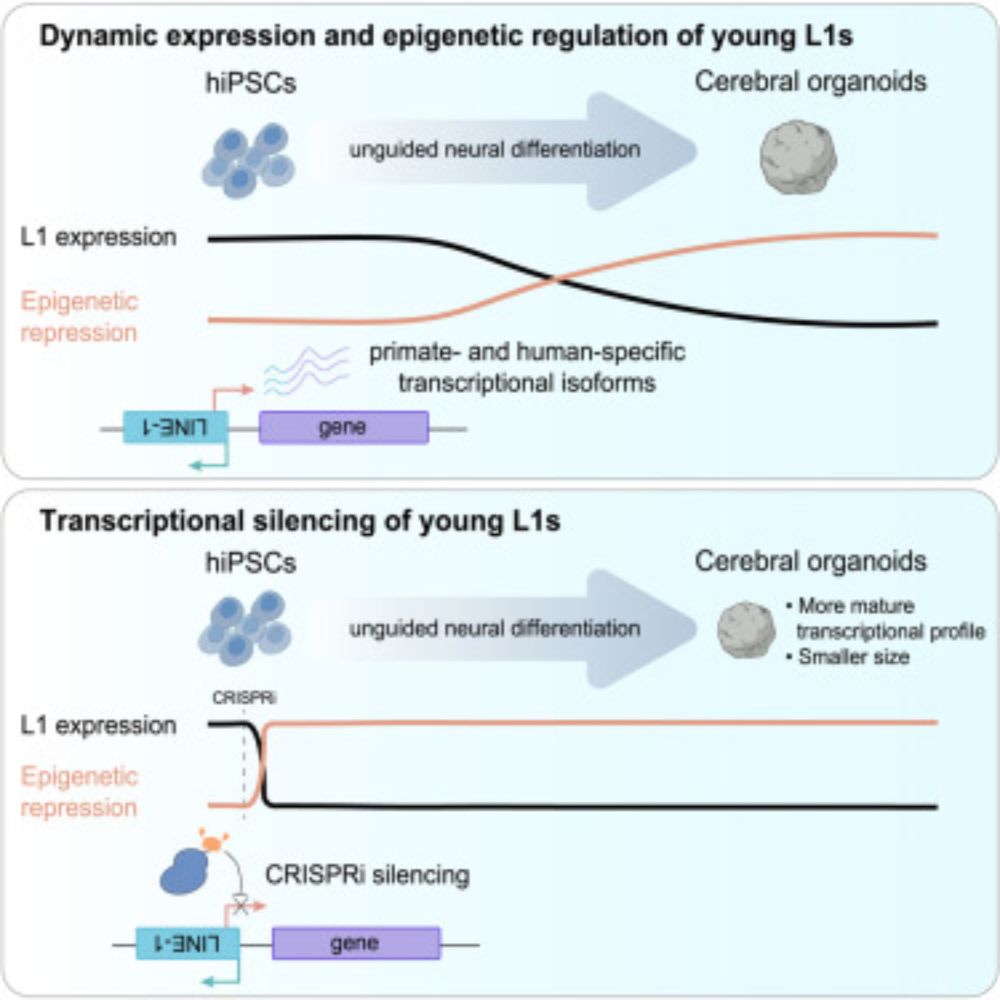
LINE-1 retrotransposons mediate cis-acting transcriptional control in human pluripotent stem cells and regulate early brain development
Adami et al. demonstrate that evolutionarily young L1s are expressed in human pluripotent
stem cells and are dynamically regulated throughout neural differentiation. The study
examines the role of L1s...
www.cell.com
August 23, 2025 at 9:47 AM
New paper from our lab! We found that LINE-1 transposons contribute to early human brain development.
Funded by @asapresearch.parkinsonsroadmap.org
www.cell.com/cell-genomic...
Funded by @asapresearch.parkinsonsroadmap.org
www.cell.com/cell-genomic...
Reposted by Patricia Gerdes
Very happy to share our protocols paper for CELLO-seq. This will make single cell long read RNA-seq more accessible and provides analysis guidelines. We hope this helps the #transposon #TEsky community and folks working on #singleCell isoform and allelic #gene expression. doi.org/10.1038/s415...
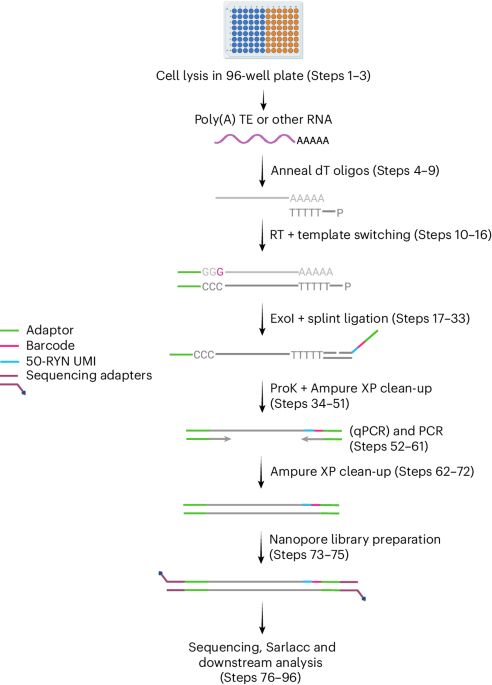
Long-read RNA sequencing of transposable elements from single cells using CELLO-seq - Nature Protocols
Single-cell long-read RNA sequencing enables the high-fidelity mapping of single-cell expression data from highly sequence-similar transposable elements to unique genomic loci by correcting errors fro...
doi.org
July 16, 2025 at 4:55 PM
Very happy to share our protocols paper for CELLO-seq. This will make single cell long read RNA-seq more accessible and provides analysis guidelines. We hope this helps the #transposon #TEsky community and folks working on #singleCell isoform and allelic #gene expression. doi.org/10.1038/s415...
Reposted by Patricia Gerdes

Is the annotation of viruses in the human genome accurate? We think not. Take a look at our new paper and let us know if you agree! www.science.org/doi/10.1126/...
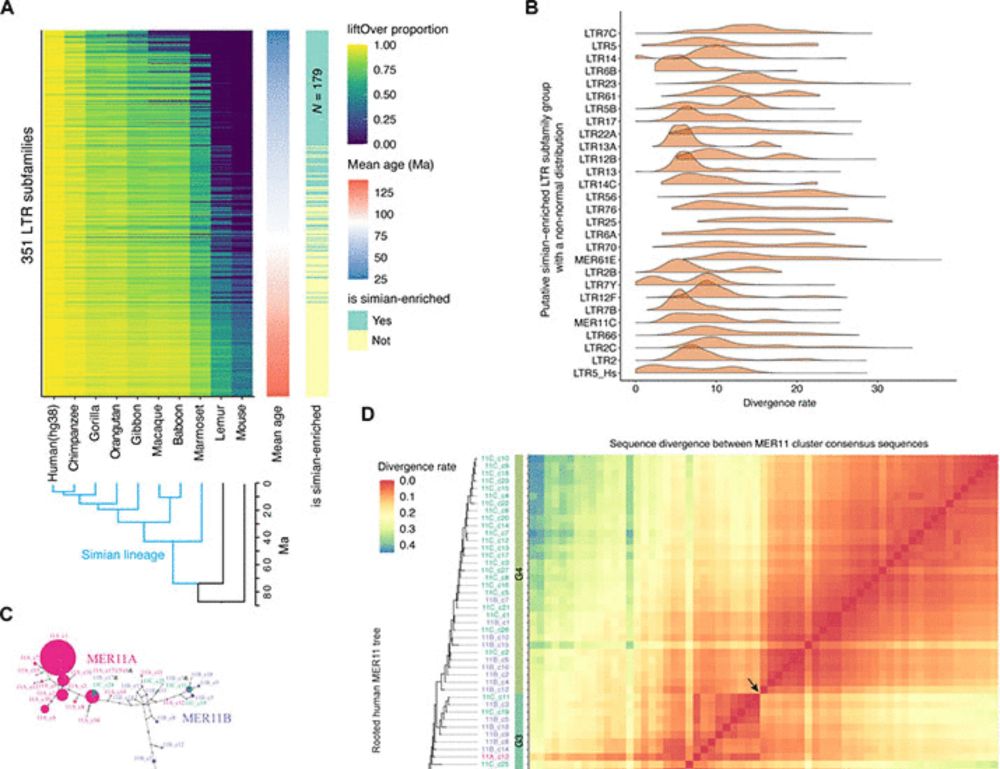
A phylogenetic approach uncovers cryptic endogenous retrovirus subfamilies in the primate lineage
A phylogenetic approach reveals cryptic LTR subfamilies and functional insights at nucleotide resolution in primates.
www.science.org
July 21, 2025 at 1:51 PM
Is the annotation of viruses in the human genome accurate? We think not. Take a look at our new paper and let us know if you agree! www.science.org/doi/10.1126/...
Reposted by Patricia Gerdes

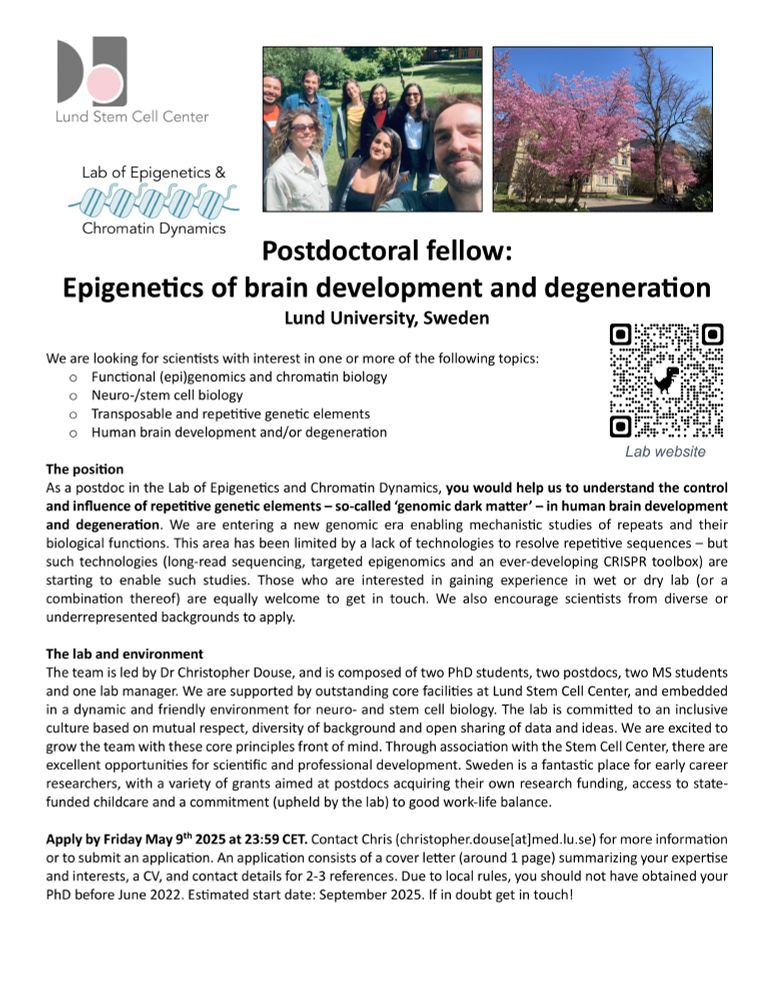
Come to Lund! We are looking for a postdoc to join the team. #transposons #epigenetics
April 17, 2025 at 12:29 PM
Come to Lund! We are looking for a postdoc to join the team. #transposons #epigenetics
Reposted by Patricia Gerdes
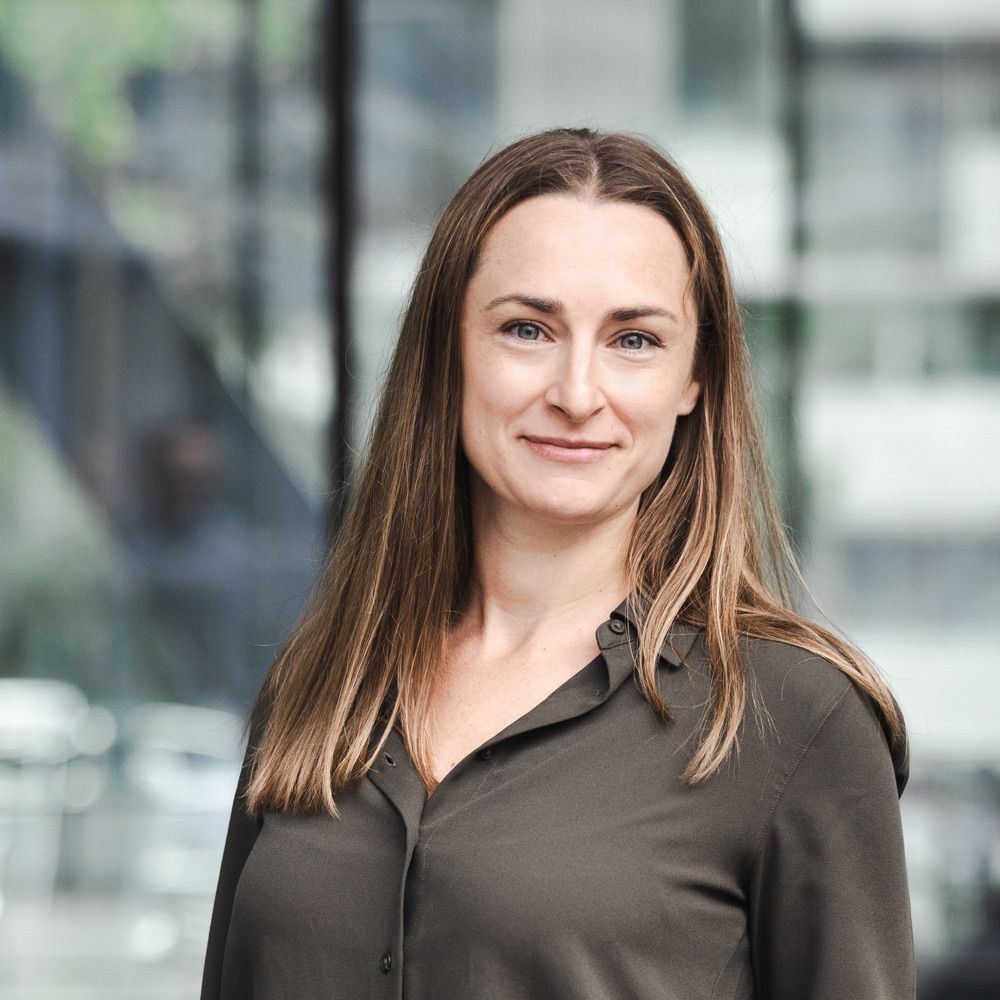
Join our team as a postdoc and explore the exciting world of transposable elements and developmental biology with us! @imbavienna.bsky.social @vbcscitraining.bsky.social
April 6, 2025 at 4:24 PM
Join our team as a postdoc and explore the exciting world of transposable elements and developmental biology with us! @imbavienna.bsky.social @vbcscitraining.bsky.social
Reposted by Patricia Gerdes
New preprint from our lab! Why is not everyone working on Transposons?
Loss of H3K9me3 maintenance in human neural progenitor cells leads to transcriptional activation of L1 retrotransposons
www.biorxiv.org/content/10.1...
Loss of H3K9me3 maintenance in human neural progenitor cells leads to transcriptional activation of L1 retrotransposons
www.biorxiv.org/content/10.1...
Loss of H3K9me3 maintenance in human neural progenitor cells leads to transcriptional activation of L1 retrotransposons
Heterochromatin is characterised by an inaccessibility to the transcriptional machinery and associated with the histone mark H3K9me3. Heterochromatin erosion is a hallmark of human ageing and H3K9me3 ...
www.biorxiv.org
March 29, 2025 at 10:05 AM
New preprint from our lab! Why is not everyone working on Transposons?
Loss of H3K9me3 maintenance in human neural progenitor cells leads to transcriptional activation of L1 retrotransposons
www.biorxiv.org/content/10.1...
Loss of H3K9me3 maintenance in human neural progenitor cells leads to transcriptional activation of L1 retrotransposons
www.biorxiv.org/content/10.1...
Another successful year with our workshop at #UniStemDay2025. We explained to high school students how we study human brain evolution using human and monkey brain organoids and looking at gene expression 🧠🐒🔬🧬 w/ @vivienhorvath.bsky.social @ofeliakarlsson.bsky.social @lundstem.bsky.social


March 14, 2025 at 2:17 PM
Another successful year with our workshop at #UniStemDay2025. We explained to high school students how we study human brain evolution using human and monkey brain organoids and looking at gene expression 🧠🐒🔬🧬 w/ @vivienhorvath.bsky.social @ofeliakarlsson.bsky.social @lundstem.bsky.social
Reposted by Patricia Gerdes
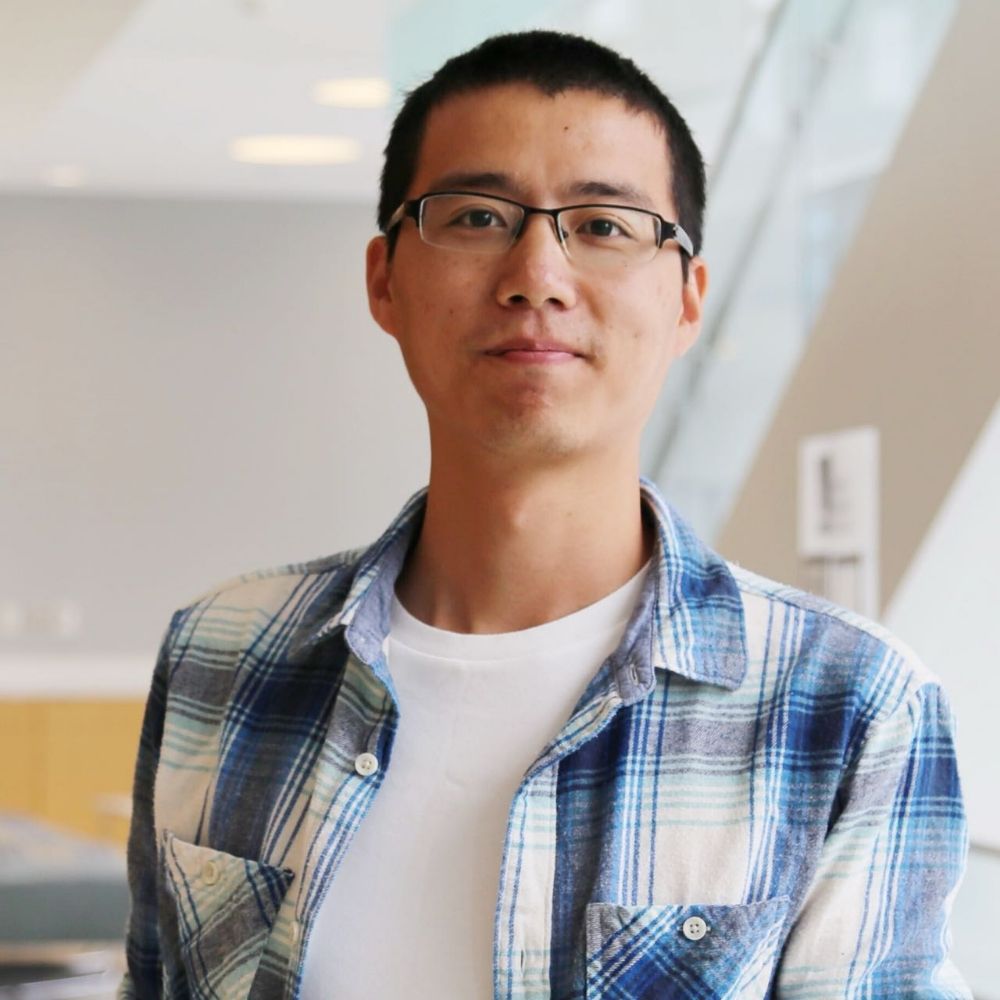
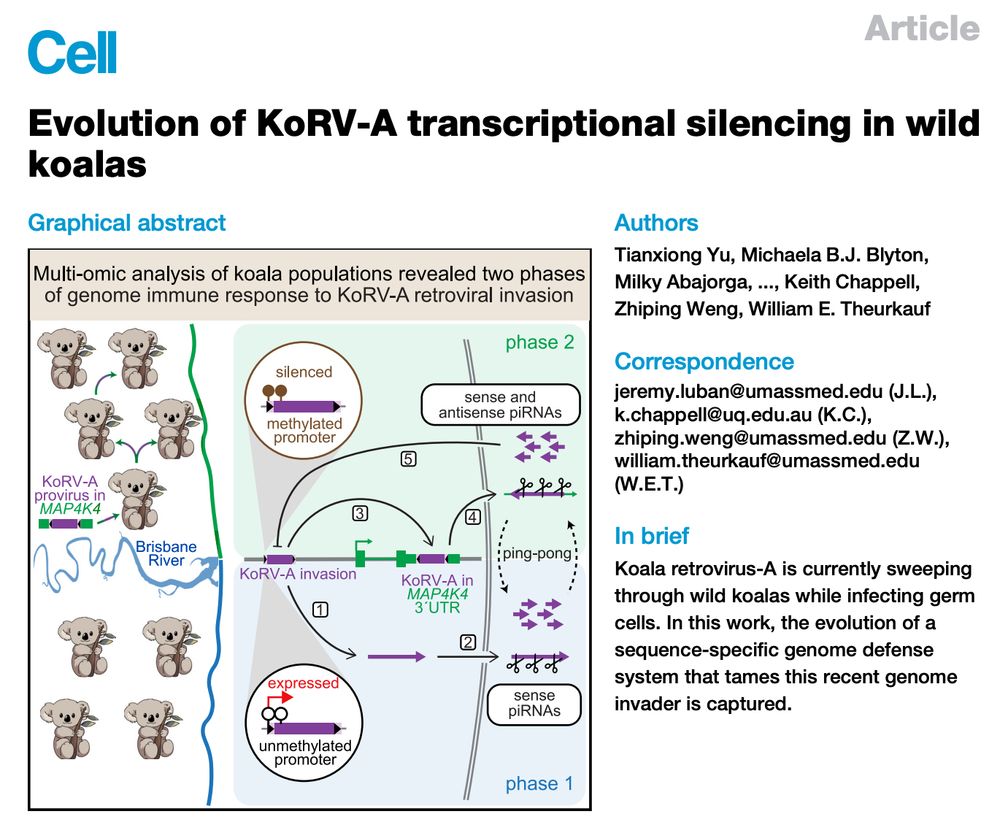
I am thrilled to share our story online at @cellpress.bsky.social . Big thanks to all authors: Zhiping, Bill, @lubanlab.bsky.social, Keith & bluesky-less!
authors.elsevier.com/c/1kjdaL7PXu...
How to tame a genome invader? It takes wild koalas 🐨🐨 to learn it.
#Retrovirus #koala #piRNA
More below 👇
authors.elsevier.com/c/1kjdaL7PXu...
How to tame a genome invader? It takes wild koalas 🐨🐨 to learn it.
#Retrovirus #koala #piRNA
More below 👇
March 9, 2025 at 2:35 AM
I am thrilled to share our story online at @cellpress.bsky.social . Big thanks to all authors: Zhiping, Bill, @lubanlab.bsky.social, Keith & bluesky-less!
authors.elsevier.com/c/1kjdaL7PXu...
How to tame a genome invader? It takes wild koalas 🐨🐨 to learn it.
#Retrovirus #koala #piRNA
More below 👇
authors.elsevier.com/c/1kjdaL7PXu...
How to tame a genome invader? It takes wild koalas 🐨🐨 to learn it.
#Retrovirus #koala #piRNA
More below 👇
Reposted by Patricia Gerdes
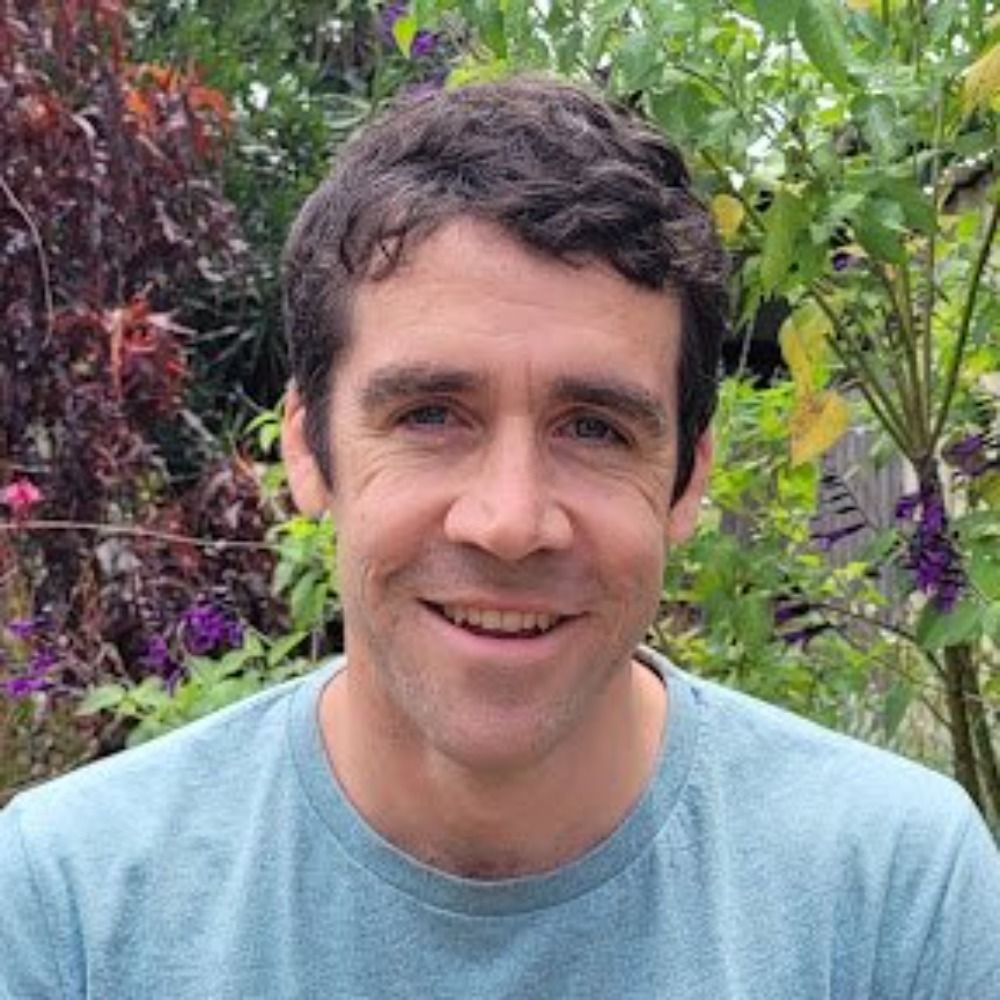
Read this preprint today from @jakobssonlab.bsky.social lab that profiles and CRISPRi perturbs L1 transcription in hiPSCs and cerebral organoids. It is extremely well done. The L1 CRISPRi phenotype in the organoids is subtle and variable but interesting. 1/n
www.biorxiv.org/content/10.1...
#TEsky
www.biorxiv.org/content/10.1...
#TEsky

LINE-1 retrotransposons regulate the exit of human pluripotency and early brain development
Long interspersed nuclear element 1 (L1) retrotransposons represent a vast source of divergent genetic information. However, mechanistic analysis of whether and how L1s contribute to human development...
www.biorxiv.org
February 13, 2025 at 2:18 AM
Read this preprint today from @jakobssonlab.bsky.social lab that profiles and CRISPRi perturbs L1 transcription in hiPSCs and cerebral organoids. It is extremely well done. The L1 CRISPRi phenotype in the organoids is subtle and variable but interesting. 1/n
www.biorxiv.org/content/10.1...
#TEsky
www.biorxiv.org/content/10.1...
#TEsky
Reposted by Patricia Gerdes
We are hiring! 3-year BBSRC-funded postdoc position available. TEs, epigenetics, pregnancy: if you love one or more of these keywords, apply through the link below.
Please spread the word.
Please spread the word.
Postdoctoral Research Associate - QMUL Jobs
ID: 4897. Title: Postdoctoral Research Associate . Application Deadline:
qmul-jobs.tal.net
January 21, 2025 at 9:33 AM
We are hiring! 3-year BBSRC-funded postdoc position available. TEs, epigenetics, pregnancy: if you love one or more of these keywords, apply through the link below.
Please spread the word.
Please spread the word.
Reposted by Patricia Gerdes
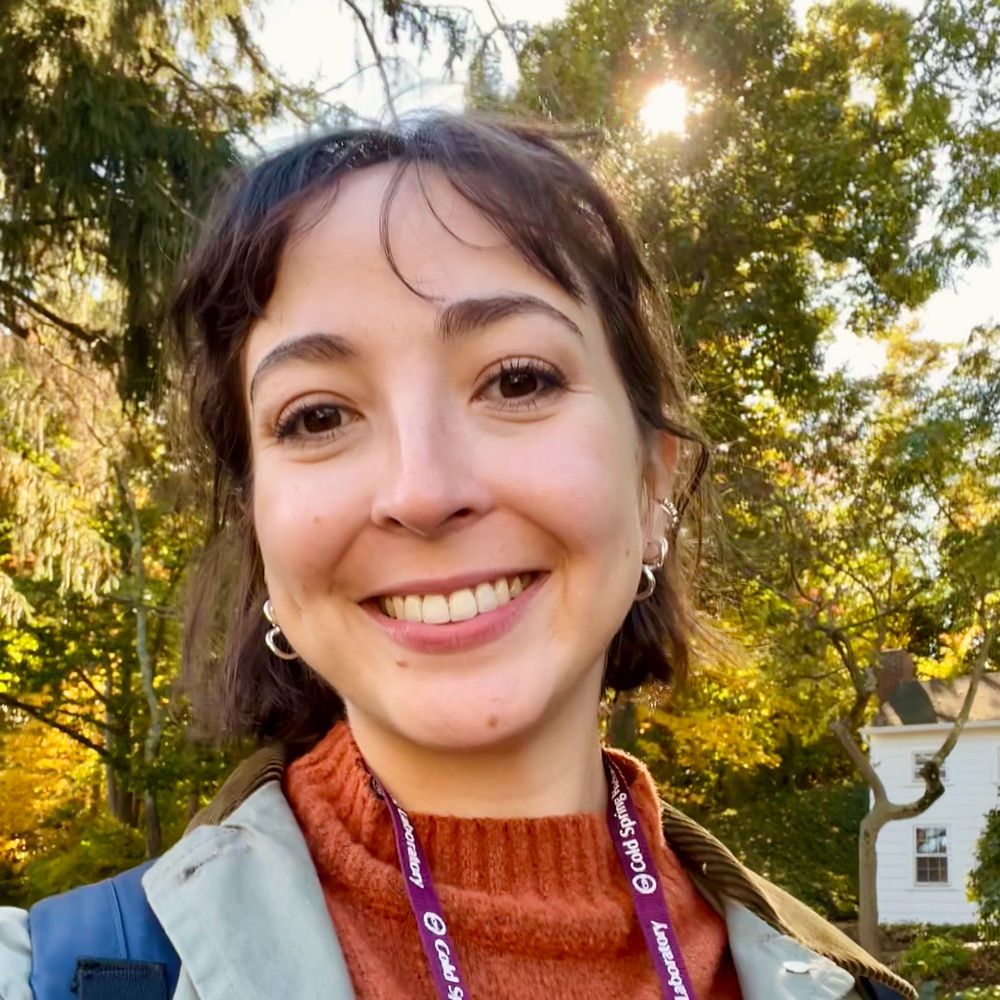
We profiled the effects of our CRISPRi system targeting young L1 elements in human pluripotency & brain development. These elements deeply impact our transcriptome, but also have very distinct effects on their nearby genome. Check it out!! 🧬👾
#TEsky #CRISPR #L1 #development #epigenetics
#TEsky #CRISPR #L1 #development #epigenetics
🚨 New pre-print from Team Jakobsson! LINE-1 retrotransposons regulate the exit of human pluripotency and early brain development.
This work was led by @anitaada.bsky.social, @raquelgarza.bsky.social and @jakobssonlab.bsky.social from the Jakobsson Lab.
www.biorxiv.org/content/10.1...
This work was led by @anitaada.bsky.social, @raquelgarza.bsky.social and @jakobssonlab.bsky.social from the Jakobsson Lab.
www.biorxiv.org/content/10.1...

LINE-1 retrotransposons regulate the exit of human pluripotency and early brain development
Long interspersed nuclear element 1 (L1) retrotransposons represent a vast source of divergent genetic information. However, mechanistic analysis of whether and how L1s contribute to human development...
www.biorxiv.org
January 18, 2025 at 11:30 AM
We profiled the effects of our CRISPRi system targeting young L1 elements in human pluripotency & brain development. These elements deeply impact our transcriptome, but also have very distinct effects on their nearby genome. Check it out!! 🧬👾
#TEsky #CRISPR #L1 #development #epigenetics
#TEsky #CRISPR #L1 #development #epigenetics
Reposted by Patricia Gerdes
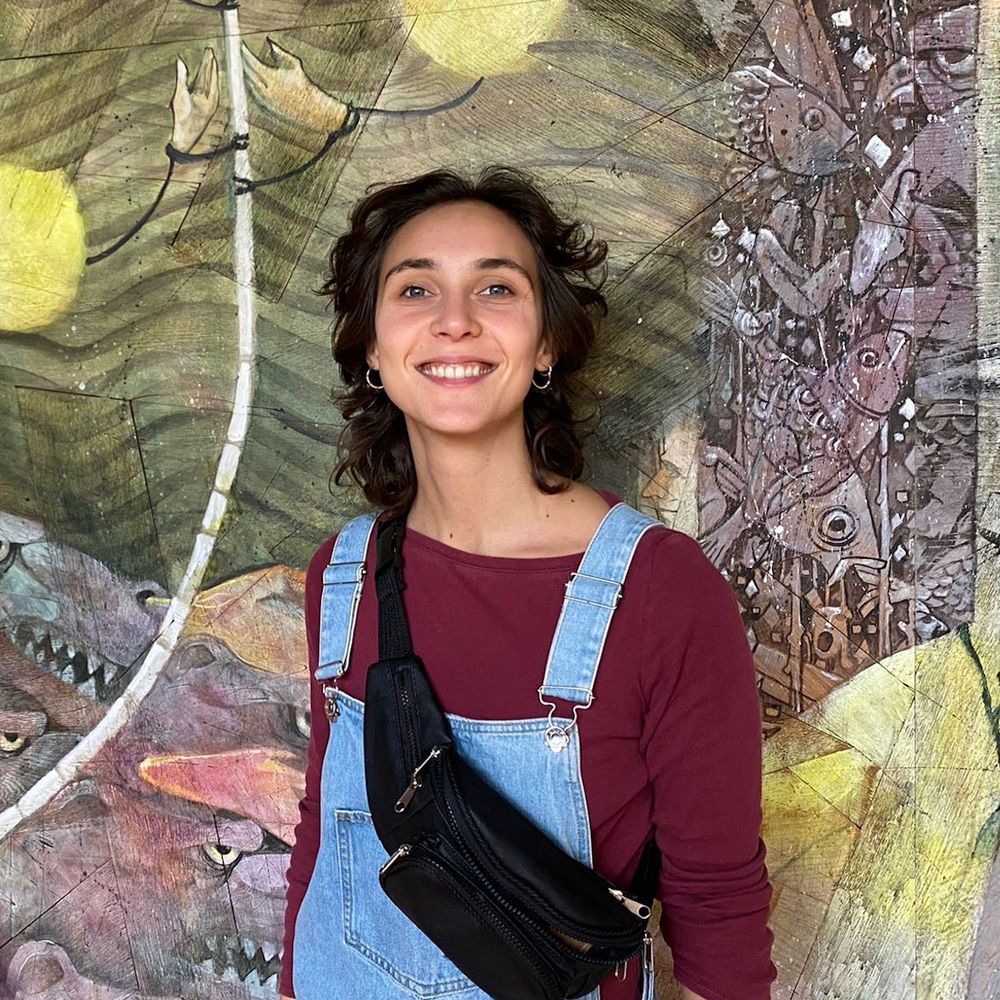
Profiling and targeting young L1s is no easy matter 🧐 check out our new preprint to see how we delve into transcriptional and epigenomic profiling of L1s, and investigate their involvement in pluripotency and early brain development 🧠
🚨 New pre-print from Team Jakobsson! LINE-1 retrotransposons regulate the exit of human pluripotency and early brain development.
This work was led by @anitaada.bsky.social, @raquelgarza.bsky.social and @jakobssonlab.bsky.social from the Jakobsson Lab.
www.biorxiv.org/content/10.1...
This work was led by @anitaada.bsky.social, @raquelgarza.bsky.social and @jakobssonlab.bsky.social from the Jakobsson Lab.
www.biorxiv.org/content/10.1...
LINE-1 retrotransposons regulate the exit of human pluripotency and early brain development
Long interspersed nuclear element 1 (L1) retrotransposons represent a vast source of divergent genetic information. However, mechanistic analysis of whether and how L1s contribute to human development...
www.biorxiv.org
January 18, 2025 at 2:53 PM
Profiling and targeting young L1s is no easy matter 🧐 check out our new preprint to see how we delve into transcriptional and epigenomic profiling of L1s, and investigate their involvement in pluripotency and early brain development 🧠
Reposted by Patricia Gerdes
🚨 New pre-print from Team Jakobsson! LINE-1 retrotransposons regulate the exit of human pluripotency and early brain development.
This work was led by @anitaada.bsky.social, @raquelgarza.bsky.social and @jakobssonlab.bsky.social from the Jakobsson Lab.
www.biorxiv.org/content/10.1...
This work was led by @anitaada.bsky.social, @raquelgarza.bsky.social and @jakobssonlab.bsky.social from the Jakobsson Lab.
www.biorxiv.org/content/10.1...
LINE-1 retrotransposons regulate the exit of human pluripotency and early brain development
Long interspersed nuclear element 1 (L1) retrotransposons represent a vast source of divergent genetic information. However, mechanistic analysis of whether and how L1s contribute to human development...
www.biorxiv.org
January 18, 2025 at 9:41 AM
🚨 New pre-print from Team Jakobsson! LINE-1 retrotransposons regulate the exit of human pluripotency and early brain development.
This work was led by @anitaada.bsky.social, @raquelgarza.bsky.social and @jakobssonlab.bsky.social from the Jakobsson Lab.
www.biorxiv.org/content/10.1...
This work was led by @anitaada.bsky.social, @raquelgarza.bsky.social and @jakobssonlab.bsky.social from the Jakobsson Lab.
www.biorxiv.org/content/10.1...
Reposted by Patricia Gerdes
New preprint from our lab. Led by the outstanding @anitaada.bsky.social and @raquelgarza.bsky.social. Funded by @asapresearch.bsky.social and @vetenskapsradet.bsky.social.
LINE-1 retrotransposons regulate the exit of human pluripotency and early brain development
www.biorxiv.org/content/10.1...
LINE-1 retrotransposons regulate the exit of human pluripotency and early brain development
www.biorxiv.org/content/10.1...
LINE-1 retrotransposons regulate the exit of human pluripotency and early brain development
Long interspersed nuclear element 1 (L1) retrotransposons represent a vast source of divergent genetic information. However, mechanistic analysis of whether and how L1s contribute to human development...
www.biorxiv.org
January 18, 2025 at 8:58 AM
New preprint from our lab. Led by the outstanding @anitaada.bsky.social and @raquelgarza.bsky.social. Funded by @asapresearch.bsky.social and @vetenskapsradet.bsky.social.
LINE-1 retrotransposons regulate the exit of human pluripotency and early brain development
www.biorxiv.org/content/10.1...
LINE-1 retrotransposons regulate the exit of human pluripotency and early brain development
www.biorxiv.org/content/10.1...
Reposted by Patricia Gerdes
Don't miss the first CSH Asia meeting on transposons in April in Suzhou, China. Truly fantastic line-up! Abstract deadline at the end of the month... (why is not everyone working on transposons?).

January 13, 2025 at 3:18 PM
Don't miss the first CSH Asia meeting on transposons in April in Suzhou, China. Truly fantastic line-up! Abstract deadline at the end of the month... (why is not everyone working on transposons?).
Reposted by Patricia Gerdes
We're thrilled to announce that our project has been funded by @asapresearch.bsky.social in partnership with the Michael J. Fox Foundation! 🚀 Excited to continue exploring the role of transposable elements in Parkinson’s disease. Learn more here:
www.lunduniversity.lu.se/article/52-m...
www.lunduniversity.lu.se/article/52-m...
52 Million SEK towards uncovering genetic drivers of Parkinson’s Disease
Lund University. Jumping genes, or transposable elements, make up nearly half of the human genome. These mobile sequences can shift within the genome and are known to influence various biological proc...
www.lunduniversity.lu.se
December 5, 2024 at 2:45 PM
We're thrilled to announce that our project has been funded by @asapresearch.bsky.social in partnership with the Michael J. Fox Foundation! 🚀 Excited to continue exploring the role of transposable elements in Parkinson’s disease. Learn more here:
www.lunduniversity.lu.se/article/52-m...
www.lunduniversity.lu.se/article/52-m...
Fantastic line up of speakers at the 7th Max Planck Freiburg Epigenetics Meeting! Looking forward to hear about all the interesting science done in the epigenetics field!! 🧬🤓 @mpi-ie.bsky.social

December 4, 2024 at 4:29 PM
Fantastic line up of speakers at the 7th Max Planck Freiburg Epigenetics Meeting! Looking forward to hear about all the interesting science done in the epigenetics field!! 🧬🤓 @mpi-ie.bsky.social