



Jonathan Cornford
@repromancer.bsky.social
Lecturer (Assistant Professor) in Computational Neuroscience at Leeds University School of Computer Science.
Combining insights from biological and artificial intelligence to develop resource-efficient AI.
Combining insights from biological and artificial intelligence to develop resource-efficient AI.
Reposted by Jonathan Cornford

🚨 I’m excited to say that my CIHR Project Grant was funded! My NHP lab is now full-speed-ahead, and I’m hiring experimentalists (postdoc, PhD student, and/or a tech/manager). We’ll do multi-region ephys during reaching/grasping in macaques, with behavioral and spinal perturbations.
August 13, 2025 at 4:23 PM
🚨 I’m excited to say that my CIHR Project Grant was funded! My NHP lab is now full-speed-ahead, and I’m hiring experimentalists (postdoc, PhD student, and/or a tech/manager). We’ll do multi-region ephys during reaching/grasping in macaques, with behavioral and spinal perturbations.
Reposted by Jonathan Cornford
Trying to train RNNs in a biol plausible (local) way? Well, try our new method using predictive alignment. Paper just out in Nat. Com. Toshitake Asabuki deserves all the credit!
www.nature.com/articles/s41...
www.nature.com/articles/s41...
www.nature.com
July 23, 2025 at 12:10 PM
Trying to train RNNs in a biol plausible (local) way? Well, try our new method using predictive alignment. Paper just out in Nat. Com. Toshitake Asabuki deserves all the credit!
www.nature.com/articles/s41...
www.nature.com/articles/s41...
I’ve just had a grant costed at 1.7x salary at Leeds. And I, clearly mistakenly, thought that must be pushing the limits..
July 17, 2025 at 9:22 AM
I’ve just had a grant costed at 1.7x salary at Leeds. And I, clearly mistakenly, thought that must be pushing the limits..
Reposted by Jonathan Cornford

Fabulous day at UK Neural Computation 2025!
Thanks to today’s invited speakers Jonathan Cornford, Jenny Bizley, Petr Znamenskiy and Flavia Mancini
Congratulations to ECR speakers Ian Hawes and Andrea Colins Rodriguez, selected from 80+ outstanding abstract submissions
Roll on Day 3!
#UKNC25
Thanks to today’s invited speakers Jonathan Cornford, Jenny Bizley, Petr Znamenskiy and Flavia Mancini
Congratulations to ECR speakers Ian Hawes and Andrea Colins Rodriguez, selected from 80+ outstanding abstract submissions
Roll on Day 3!
#UKNC25


July 11, 2025 at 8:01 AM
Fabulous day at UK Neural Computation 2025!
Thanks to today’s invited speakers Jonathan Cornford, Jenny Bizley, Petr Znamenskiy and Flavia Mancini
Congratulations to ECR speakers Ian Hawes and Andrea Colins Rodriguez, selected from 80+ outstanding abstract submissions
Roll on Day 3!
#UKNC25
Thanks to today’s invited speakers Jonathan Cornford, Jenny Bizley, Petr Znamenskiy and Flavia Mancini
Congratulations to ECR speakers Ian Hawes and Andrea Colins Rodriguez, selected from 80+ outstanding abstract submissions
Roll on Day 3!
#UKNC25
Reposted by Jonathan Cornford

Together with @repromancer.bsky.social, I have been musing for a while that the exponentiated gradient algorithm we've advocated for comp neuro would work well with low-precision ANNs.
This group got it working!
arxiv.org/abs/2506.17768
May be a great way to reduce AI energy use!!!
#MLSky 🧪
This group got it working!
arxiv.org/abs/2506.17768
May be a great way to reduce AI energy use!!!
#MLSky 🧪

Log-Normal Multiplicative Dynamics for Stable Low-Precision Training of Large Networks
Studies in neuroscience have shown that biological synapses follow a log-normal distribution whose transitioning can be explained by noisy multiplicative dynamics. Biological networks can function sta...
arxiv.org
July 9, 2025 at 2:34 PM
Together with @repromancer.bsky.social, I have been musing for a while that the exponentiated gradient algorithm we've advocated for comp neuro would work well with low-precision ANNs.
This group got it working!
arxiv.org/abs/2506.17768
May be a great way to reduce AI energy use!!!
#MLSky 🧪
This group got it working!
arxiv.org/abs/2506.17768
May be a great way to reduce AI energy use!!!
#MLSky 🧪
💯 Great to see!
July 10, 2025 at 12:48 PM
💯 Great to see!
Really like this work!

Pleased to say that our story of how a theory of self-supervised learning in cortical layers accounts for several experimental observations is now out 🎉
www.nature.com/articles/s41...
www.nature.com/articles/s41...
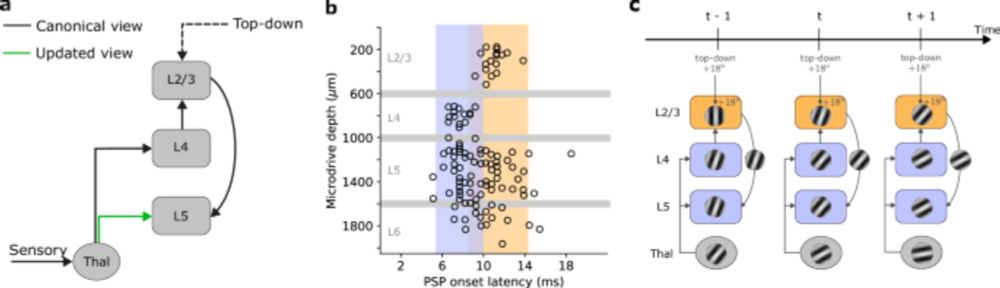
Self-supervised predictive learning accounts for cortical layer-specificity - Nature Communications
How the cortex learns an internal representation of the world and why the cortex relies on a layered structure remain poorly understood. Here, the authors propose a computational theory in which the n...
www.nature.com
July 4, 2025 at 5:21 PM
Really like this work!
Very much agree with you that they have these troubles, and are important to focus on. But I think the disagreement becomes about strength of evidence (not no evidence) which is largely an emotional call. Hence why we need a peer review jury! :)
June 30, 2025 at 9:00 PM
Very much agree with you that they have these troubles, and are important to focus on. But I think the disagreement becomes about strength of evidence (not no evidence) which is largely an emotional call. Hence why we need a peer review jury! :)
So, being provocative, I’d ask if any of the qualitatively different approaches you mention can learn non-trivial things (which has to be important for a model of the mind). I agree with you re explaining (see above). But the point is our best model of intelligence also v naturally shares redundancy
June 30, 2025 at 8:53 PM
So, being provocative, I’d ask if any of the qualitatively different approaches you mention can learn non-trivial things (which has to be important for a model of the mind). I agree with you re explaining (see above). But the point is our best model of intelligence also v naturally shares redundancy
The neuropsych observations are interesting and valid, but aren’t inconsistent with PDP models. They could (imo do) just point to learning dynamics & resource pressures shaping the circuitry. Combined with PDP they generate hypothesis that can be tested. And this is true of other model approaches.
June 30, 2025 at 8:31 PM
The neuropsych observations are interesting and valid, but aren’t inconsistent with PDP models. They could (imo do) just point to learning dynamics & resource pressures shaping the circuitry. Combined with PDP they generate hypothesis that can be tested. And this is true of other model approaches.
I’m a bit confused reading this. Redundancy e.g. to cell loss is not a smoking gun but it certainly is evidence *supporting* PDP models as being a good model of the brain. If the reverse was true we would v likely discard ANNs as models as redundancy is such a basic issue in experimental neuro.
June 30, 2025 at 8:21 PM
I’m a bit confused reading this. Redundancy e.g. to cell loss is not a smoking gun but it certainly is evidence *supporting* PDP models as being a good model of the brain. If the reverse was true we would v likely discard ANNs as models as redundancy is such a basic issue in experimental neuro.
Reposted by Jonathan Cornford
Closing soon! Register by July 1st for UK Neural Computation 2025
neuralcomputation.uk
ECR day: 9 July - careers, grants, starting a lab
Main meeting: 10-11 July - 13 speakers, 70+ posters, sandpit
Hosted by @imperialcollegeldn.bsky.social
Sponsors @aria-research.bsky.social @crick.ac.uk
neuralcomputation.uk
ECR day: 9 July - careers, grants, starting a lab
Main meeting: 10-11 July - 13 speakers, 70+ posters, sandpit
Hosted by @imperialcollegeldn.bsky.social
Sponsors @aria-research.bsky.social @crick.ac.uk
UKNC25 |
neuralcomputation.uk
June 25, 2025 at 2:04 PM
Closing soon! Register by July 1st for UK Neural Computation 2025
neuralcomputation.uk
ECR day: 9 July - careers, grants, starting a lab
Main meeting: 10-11 July - 13 speakers, 70+ posters, sandpit
Hosted by @imperialcollegeldn.bsky.social
Sponsors @aria-research.bsky.social @crick.ac.uk
neuralcomputation.uk
ECR day: 9 July - careers, grants, starting a lab
Main meeting: 10-11 July - 13 speakers, 70+ posters, sandpit
Hosted by @imperialcollegeldn.bsky.social
Sponsors @aria-research.bsky.social @crick.ac.uk
Reposted by Jonathan Cornford

Excited for the UK Neural Computation Conference 2025 @ Imperial, 9th - 11th July! 🚀
World leading scientists working in brain computation - from experimental to modelling, mathematics & ML (+ all combinations thereof).
Registration closes 1st July! Plz share:
neuralcomputation.uk
World leading scientists working in brain computation - from experimental to modelling, mathematics & ML (+ all combinations thereof).
Registration closes 1st July! Plz share:
neuralcomputation.uk


June 18, 2025 at 7:56 AM
Excited for the UK Neural Computation Conference 2025 @ Imperial, 9th - 11th July! 🚀
World leading scientists working in brain computation - from experimental to modelling, mathematics & ML (+ all combinations thereof).
Registration closes 1st July! Plz share:
neuralcomputation.uk
World leading scientists working in brain computation - from experimental to modelling, mathematics & ML (+ all combinations thereof).
Registration closes 1st July! Plz share:
neuralcomputation.uk
Reposted by Jonathan Cornford

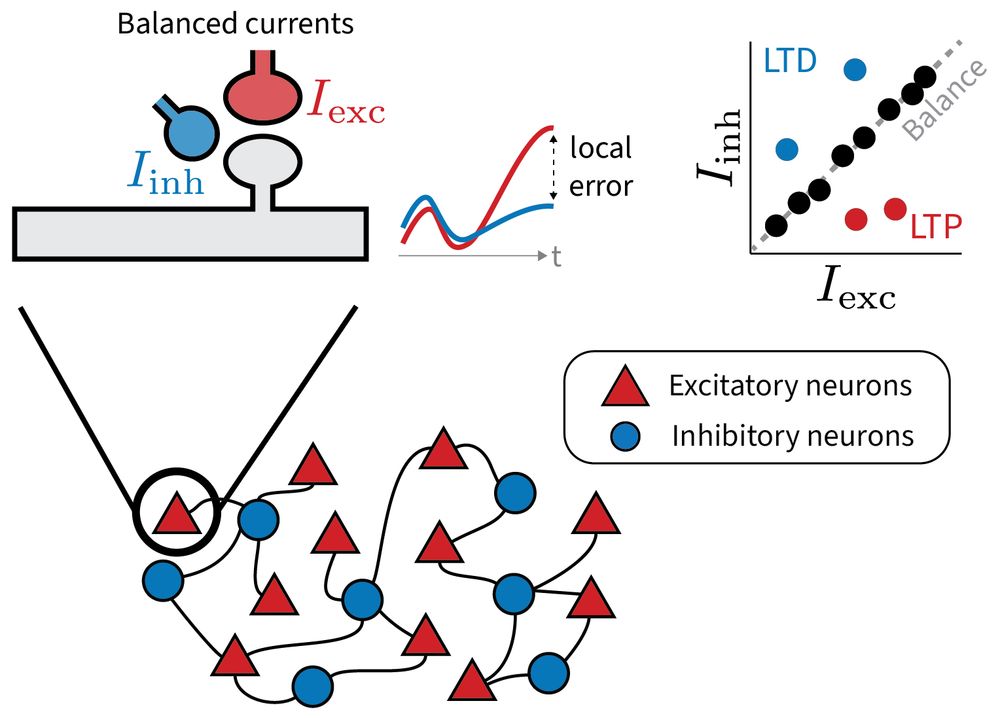
1/6 Why does the brain maintain such precise excitatory-inhibitory balance?
Our new preprint explores a provocative idea: Small, targeted deviations from this balance may serve a purpose: to encode local error signals for learning.
www.biorxiv.org/content/10.1...
led by @jrbch.bsky.social
Our new preprint explores a provocative idea: Small, targeted deviations from this balance may serve a purpose: to encode local error signals for learning.
www.biorxiv.org/content/10.1...
led by @jrbch.bsky.social
May 27, 2025 at 7:49 AM
1/6 Why does the brain maintain such precise excitatory-inhibitory balance?
Our new preprint explores a provocative idea: Small, targeted deviations from this balance may serve a purpose: to encode local error signals for learning.
www.biorxiv.org/content/10.1...
led by @jrbch.bsky.social
Our new preprint explores a provocative idea: Small, targeted deviations from this balance may serve a purpose: to encode local error signals for learning.
www.biorxiv.org/content/10.1...
led by @jrbch.bsky.social
Reposted by Jonathan Cornford

New #NeuroAI #compneurosky preprint! To better understand how target-directed learning works in the brain, we sought to engineer an artificial neural network capable of solving complex image classification tasks that comprises only experimentally-supported biological building blocks. (1/15)

May 27, 2025 at 6:40 PM
New #NeuroAI #compneurosky preprint! To better understand how target-directed learning works in the brain, we sought to engineer an artificial neural network capable of solving complex image classification tasks that comprises only experimentally-supported biological building blocks. (1/15)
Can I register without booking a room? I’m based in Leeds!
April 25, 2025 at 4:13 PM
Can I register without booking a room? I’m based in Leeds!
Reposted by Jonathan Cornford

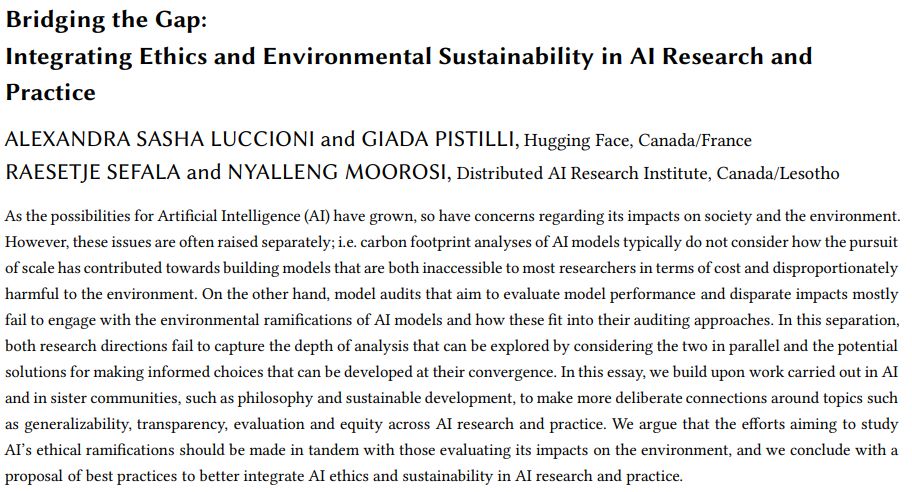
Discussions around AI ethics and sustainability tend to happen in different circles, with different people and from different perspectives... but what if we had these important conversations together? 🤝
April 2, 2025 at 1:52 PM
Discussions around AI ethics and sustainability tend to happen in different circles, with different people and from different perspectives... but what if we had these important conversations together? 🤝
Reposted by Jonathan Cornford
Really enjoyed TAing for this tutorial, had great discussions with several attendees. Do check out `torch_brain` and the other packages here:
github.com/neuro-galaxy
github.com/neuro-galaxy
April 5, 2025 at 12:50 PM
Really enjoyed TAing for this tutorial, had great discussions with several attendees. Do check out `torch_brain` and the other packages here:
github.com/neuro-galaxy
github.com/neuro-galaxy
Reposted by Jonathan Cornford

Are you training self-supervised/foundation models, and worried if they are learning good representations? We got you covered! 💪
🦖Introducing Reptrix, a #Python library to evaluate representation quality metrics for neural nets: github.com/BARL-SSL/rep...
🧵👇[1/6]
#DeepLearning
🦖Introducing Reptrix, a #Python library to evaluate representation quality metrics for neural nets: github.com/BARL-SSL/rep...
🧵👇[1/6]
#DeepLearning

April 1, 2025 at 6:24 PM
Are you training self-supervised/foundation models, and worried if they are learning good representations? We got you covered! 💪
🦖Introducing Reptrix, a #Python library to evaluate representation quality metrics for neural nets: github.com/BARL-SSL/rep...
🧵👇[1/6]
#DeepLearning
🦖Introducing Reptrix, a #Python library to evaluate representation quality metrics for neural nets: github.com/BARL-SSL/rep...
🧵👇[1/6]
#DeepLearning
Come by Poster 068 to learn about why comp neuro studies should use exponentiated gradient descent!

March 29, 2025 at 5:22 PM
Come by Poster 068 to learn about why comp neuro studies should use exponentiated gradient descent!
Yes exactly! Not sure how it would play out in implementation. But I can see a role in providing an enriched learning objective for a mech model as the foundation model has extracted and compressed into a representation what is meaningful in the neural data.
March 27, 2025 at 7:52 PM
Yes exactly! Not sure how it would play out in implementation. But I can see a role in providing an enriched learning objective for a mech model as the foundation model has extracted and compressed into a representation what is meaningful in the neural data.
Do you see a usecase in distilling the neural-structure understanding of foundational models into a mechanistic model?
March 27, 2025 at 7:02 PM
Do you see a usecase in distilling the neural-structure understanding of foundational models into a mechanistic model?
Congratulations Guillaume!
March 25, 2025 at 11:36 AM
Congratulations Guillaume!
Can you point me to one or two? I don’t see anywhere where you say why language isn’t one?
My take is that language is compressing information about the world. Eg take a newspaper article. How is that not an encoding of reality?
My take is that language is compressing information about the world. Eg take a newspaper article. How is that not an encoding of reality?
March 21, 2025 at 5:51 PM
Can you point me to one or two? I don’t see anywhere where you say why language isn’t one?
My take is that language is compressing information about the world. Eg take a newspaper article. How is that not an encoding of reality?
My take is that language is compressing information about the world. Eg take a newspaper article. How is that not an encoding of reality?